

Stop the Trip! Understanding Why Your AC Breaker Keeps Flipping


.avif)

What It Really Means When Your AC Breaker Keeps Tripping
AC circuit breaker keeps tripping what it means is straightforward at its core: your electrical system is detecting more current than the circuit can safely handle, and it's shutting things down to protect your home from overheating wires, damaged equipment, or worse — an electrical fire.
Here are the most common reasons this happens:
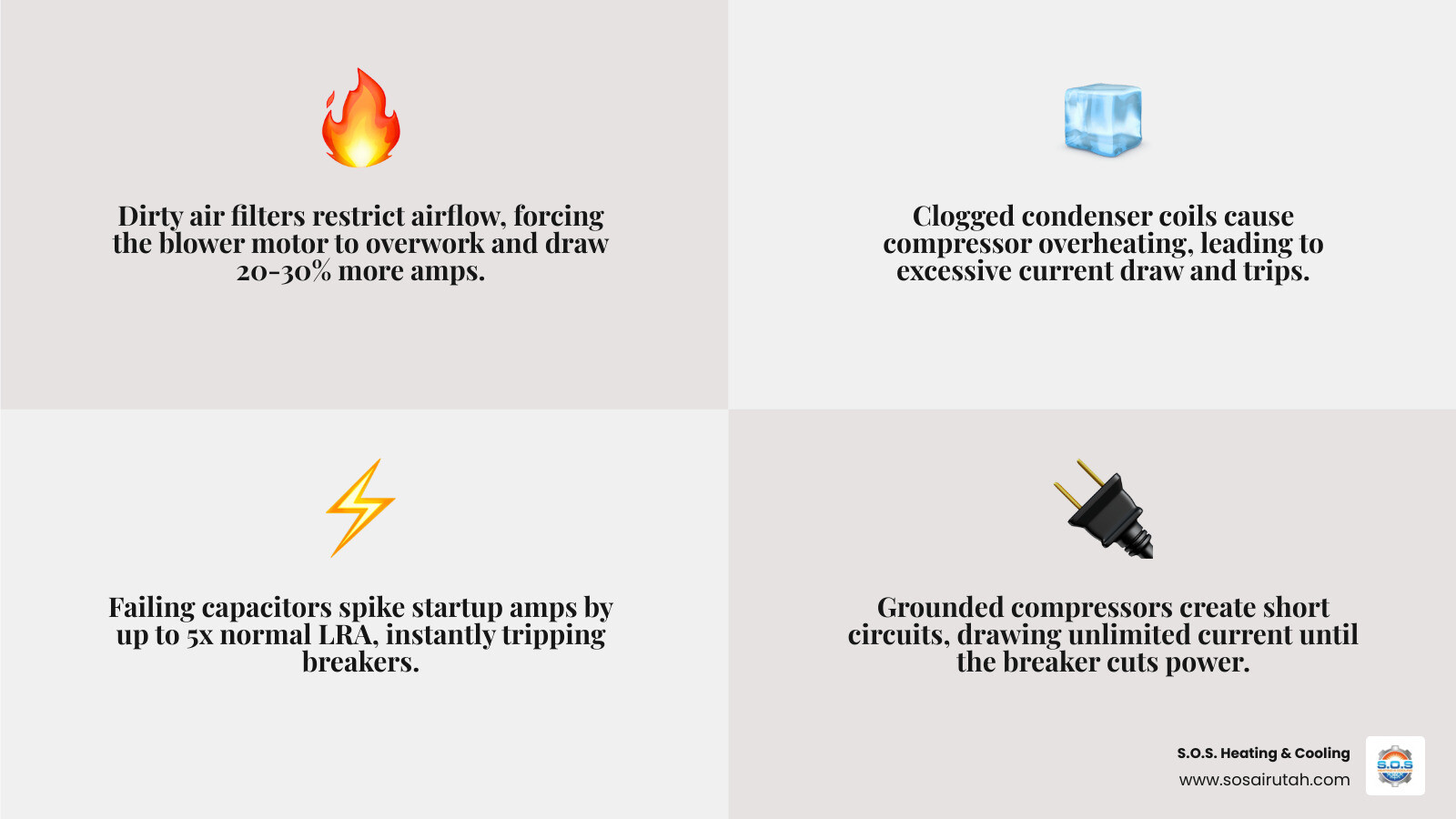
- Dirty air filter — restricts airflow, forcing the blower motor to work harder and draw more power
- Clogged condenser coils — trap heat inside the system, causing the compressor to overheat
- Failing capacitor — causes the motor to struggle at startup, spiking the amperage draw instantly
- Grounded or shorted compressor — creates a direct electrical fault that trips the breaker immediately
- Loose wiring or a worn-out breaker — the breaker itself may be triggering prematurely
If your breaker tripped once and hasn't again, a simple reset may be all you need. But if it keeps happening, that's your system telling you something is wrong — and ignoring it can lead to compressor burnout or a fire hazard.
One homeowner shared exactly this kind of frustration online: "My AC unit seems to be tripping when I turn my heat on and it pops my breaker" — a reminder that this problem can catch people off guard in ways they don't expect, whether it's peak summer heat or a cool evening with the heat running.
I'm Bryson Ninow, an HVAC professional with NATE, EPA, and DOPL certifications, and I've helped countless Salt Lake City homeowners figure out exactly what ac circuit breaker keeps tripping what it means for their specific system. In this guide, I'll walk you through everything you need to know — from simple DIY checks to when it's time to call a pro.
Understanding the Safety Switch: Why Your AC Breaker Trips
To understand why your breaker is flipping, we first have to look at what that little switch in your gray metal panel actually does. Think of your circuit breaker as a vigilant security guard. Its only job is to monitor the flow of electricity. If the current (measured in amps) exceeds the breaker’s rated limit, the guard "slams the door" by flipping the switch to the OFF position.
In most homes across the Salt Lake Meridian, from Bountiful down to Draper, air conditioners use a double-pole breaker. Unlike a single-pole breaker that handles 120 volts for your lights or outlets, a double-pole breaker handles 240 volts to provide the heavy-duty power your AC’s compressor and fan motors require.
When this breaker trips, it is usually responding to one of three things:
- Overload: The system is working too hard and pulling slightly more power than it should for an extended period.
- Short Circuit: An "unintended path" has been created—usually when two wires touch—causing a massive, instant spike in current.
- Ground Fault: This is a specific type of short circuit where electricity escapes the wiring and hits the metal casing of the unit or the ground wire. Interestingly, ground faults make up about 98% of all electrical faults.
If you suspect your system has electrical gremlins, it's worth learning the Signs of Faulty Wiring in Your HVAC Unit. Catching a loose wire early can save you from a complete system shutdown.
Common Causes: ac circuit breaker keeps tripping what it means
When we talk about ac circuit breaker keeps tripping what it means, we are usually looking at a mechanical problem that has turned into an electrical one. Your AC doesn't just "decide" to use more power; it is forced to because of heat or friction.
Airflow Restrictions and ac circuit breaker keeps tripping what it means
It might seem hard to believe that a simple piece of pleated paper could shut down your whole cooling system, but it happens every day in Utah. A dirty air filter acts like a wall. When air can't pass through easily, the blower motor has to strain to pull air in.
Imagine trying to breathe through a thick pillow—you'd have to work much harder, right? That’s exactly what your blower motor does. This extra mechanical strain increases the amperage draw. Furthermore, restricted airflow can cause your evaporator coils to freeze over. Once they turn into a block of ice, the system runs longer and harder, eventually pulling enough power to trip the breaker. Regular filter changes are the cheapest "repair" you'll ever perform.
Electrical Faults and ac circuit breaker keeps tripping what it means
If the airflow is fine but the breaker still flips, we likely have an internal component failure. Here are the most common electrical culprits:
- Failing Start Capacitor: This is a small cylindrical part that gives your compressor a "kickstart" of energy. If it’s weak, the compressor struggles to turn over, drawing a massive amount of power known as Locked Rotor Amps (LRA). This usually causes the breaker to trip the moment the AC tries to start.
- Compressor Short to Ground: This is a serious issue. Over time, the insulation on the motor windings inside the compressor can break down due to heat or acid in the refrigerant. If the wire touches the metal side of the compressor, it creates a ground fault.
- Worn-Out Fan Motor: If the outdoor fan motor is seizing up, it will run hot and pull excessive current before finally tripping the safety switch.
- Loose Connections: Utah's temperature swings and even minor seismic vibrations can loosen electrical terminals. If you're dealing with these types of gremlins, Resolving HVAC Electrical Connection Issues is a top priority to prevent arcing and fire risks.
If you are in need of professional help, reaching out for AC Repair Salt Lake City UT is the safest way to diagnose these high-voltage components.
Troubleshooting and Safety: What to Check Before Calling a Pro
Before you pick up the phone, there are a few things you can safely check. However, always remember: never touch internal wiring or open the electrical panel's dead front if you aren't trained.
| Symptom | Likely Cause | Urgency |
|---|---|---|
| Trips after 20-30 minutes | Overload (Dirty filter/coils) | Moderate - Clean components |
| Trips immediately on startup | Short circuit or bad capacitor | High - Do not reset again |
| Burning smell near unit | Melted insulation or seized motor | Emergency - Shut off power |
| Clicking or humming then trip | Failed capacitor or compressor | High - Requires professional repair |
Start by checking your thermostat. Ensure it isn't set to an impossibly low temperature that forces the unit to run 24/7 during a July heatwave. Also, do a quick visual inspection of the outdoor unit. Are there weeds or debris choking the side of the condenser? If so, the heat can't escape, causing the compressor to overheat and trip.
In some cases, the issue might be related to AC Thermostat Wiring Issues in Kaysville or other local areas, where a frayed wire sends the wrong signal to your system.
How to Safely Reset a Tripped Breaker
If your breaker trips, don't just run to the panel and flip it back. Follow this safety protocol:
- Turn off the AC at the thermostat. This ensures the unit doesn't try to "slam" back on the moment the breaker is reset.
- Go to your electrical panel. Find the breaker marked "AC" or "HVAC." It will likely be in a middle position between ON and OFF.
- Flip it all the way to OFF, then back to ON.
- Wait 30 minutes. This allows the internal components and the compressor to cool down and the pressures in the refrigerant lines to equalize.
- Turn the thermostat back to COOL.
The One-Reset Rule: If the breaker trips again immediately or even later that day, stop. Repeatedly resetting a tripping breaker can lead to compressor burnout—a repair that often costs as much as a new outdoor unit.
Identifying the Source: AC Unit vs. Electrical Panel
Sometimes, the AC isn't the problem—the breaker is. Circuit breakers have internal springs that can weaken over time (especially in older homes in the Avenues or Sugar House). A "soft" breaker may trip even if the AC is drawing a normal amount of current.
Additionally, Salt Lake City's location near the Wasatch Fault means we deal with minor seismic activity. Over decades, this can cause panels to shift slightly, leading to loose wiring connections. If you notice flickering lights in other parts of the house when the AC kicks on, the issue might be your main panel's ability to handle the load. For a full system check, consider HVAC Repair Salt Lake City UT to ensure both the cooling and electrical components are in sync.
Preventive Maintenance to Stop Future Breaker Trips
As we move through April 2026, it's the perfect time to think about prevention. Most breaker trips are entirely avoidable with a little bit of annual TLC.
- Monthly Filter Changes: This is the #1 way to prevent blower motor overload.
- Clean the Condenser Coils: Use a garden hose (with the power OFF) to gently rinse away the dust and cottonwood fuzz that accumulates on your outdoor unit. Dirty coils act like a blanket, trapping heat and forcing the compressor to draw more amps.
- Clear the Perimeter: Keep at least two feet of clear space around your outdoor unit. No bushes, no tall grass, and no stored firewood.
- Inversion Protection: In Salt Lake City, our winter inversions can lead to corrosive buildup on outdoor electrical components. A spring tune-up ensures that these connections are cleaned and tightened before the summer heat hits.
Frequently Asked Questions about AC Breaker Issues
Why does my AC trip the breaker only when the heat is turned on?
This often happens with heat pump systems. When you switch to heat, the unit uses a reversing valve to change the flow of refrigerant. If there is an electrical short in the reversing valve solenoid or if the outdoor unit is struggling to extract heat from the cold air, it can pull excessive current. It could also be related to "emergency heat" strips (electric heat) drawing more power than the circuit can handle.
Is it dangerous to keep resetting my AC circuit breaker?
Yes, it can be very dangerous. A breaker is a safety device. If it trips, it’s because it detected a hazard. By forcing it back on repeatedly, you are bypassing that safety. This can lead to the wiring inside your walls melting, which is a leading cause of house fires. If it trips more than once, call a professional.
Can a dirty outdoor unit cause my breaker to flip?
Absolutely. The outdoor unit’s job is to release the heat collected from inside your home. If the coils are covered in dirt, the heat stays trapped. This makes the compressor work much harder and run much hotter. Eventually, the compressor will "thermal overload" and pull a spike of electricity that flips the breaker.
Conclusion
Understanding ac circuit breaker keeps tripping what it means is the first step toward keeping your home safe and cool. Whether it’s a simple matter of a $20 air filter or a more complex issue like a grounded compressor, that tripping breaker is a signal you shouldn't ignore.
At S.O.S. Heating & Cooling, we specialize in the deep diagnostics required to solve these problems for good. From Salt Lake City to Sandy and Kaysville to Herriman, our team uses advanced tools like megohmmeters to test compressor insulation and multimeters to check for precise amp draws. We focus on your convenience with 24/7 emergency repairs and a commitment to getting the job done right the first time.
Don't let a flipping switch leave you in the heat. Schedule Expert Air Conditioning Services Today and let us ensure your system is safe, efficient, and ready for whatever the Utah weather throws your way.
Explore Our Latest Insights and Updates in Plumbing Services
Mini Split vs Central AC Cost Comparison for Savvy Homeowners

A Step-by-Step Guide: How to Apply for Energy Rebates in Utah
The Wasatch Front Guide to Choosing Standard or Premium AC