

Don't Sweat the Math: Calculating Your Long-Term AC Savings


.avif)

The Financial Crossroads: AC Repair vs New Unit Long Term Savings
When your air conditioner begins to falter, you are standing at a financial crossroads. On one hand, a repair seems like the path of least resistance—it addresses the immediate heat and keeps your current system chugging along. On the other hand, the ac repair vs new unit long term savings debate is rooted in the reality that every mechanical system has a finite lifespan.
Most central air conditioning units are designed to last between 10 and 15 years. As a unit approaches the end of this window, the internal components undergo significant degradation. Motors lose efficiency, coils may develop microscopic leaks, and the compressor—the heart of the system—works harder to achieve the same cooling results.
Choosing between AC Repair or Replacement involves looking at more than just the immediate invoice. We often see homeowners fall into the trap of "nickel and diming" an old system. You might pay for a capacitor this year, a fan motor next year, and a refrigerant top-off the year after. Individually, these are manageable. Collectively, they represent a "repair spiral" where you are essentially buying a new unit one expensive piece at a time, without ever receiving the energy-saving benefits of a modern system.
Furthermore, an aging unit is an energy glutton. Systems manufactured over a decade ago were built to much lower efficiency standards. Even if the unit is running "perfectly" by 2010 standards, it is likely consuming 20% to 40% more electricity than a modern ENERGY STAR-certified model. If you notice signs your AC needs immediate repair, such as unusual noises or frequent cycling, it is time to look at the cumulative impact on your wallet.
Identifying the "Late-Life" Stage
In the HVAC world, we consider the 10-to-12-year mark the "late-life" stage for an air conditioner. In our Salt Lake City climate, where systems face intense summer heat and long periods of dormancy in the winter, mechanical stress is high.
When you consider AC replacement, age is the primary predictor of future costs. A unit in its late-life stage is significantly more likely to experience a terminal failure—usually the compressor or the evaporator coil—during the hottest week of July. Proactive replacement allows you to shop for the best technology and incentives at your own pace, rather than making a panicked decision in a 90-degree house.
The Cost of Inefficiency
Inefficiency is a hidden tax on your household budget. Older units often struggle with humidity control and airflow consistency, leading to "hot spots" in your home. This often prompts homeowners to lower the thermostat even further, forcing an already struggling unit to run constantly.
By investing in an efficient AC system, you bridge the technology gap. Modern units feature variable-speed compressors that don't just turn "on" or "off"; they adjust their output to the exact cooling needs of your home, maintaining a steady temperature and significantly better humidity control. This precision is where the real long-term savings live.
Decision Frameworks: The 50% and $5,000 Rules
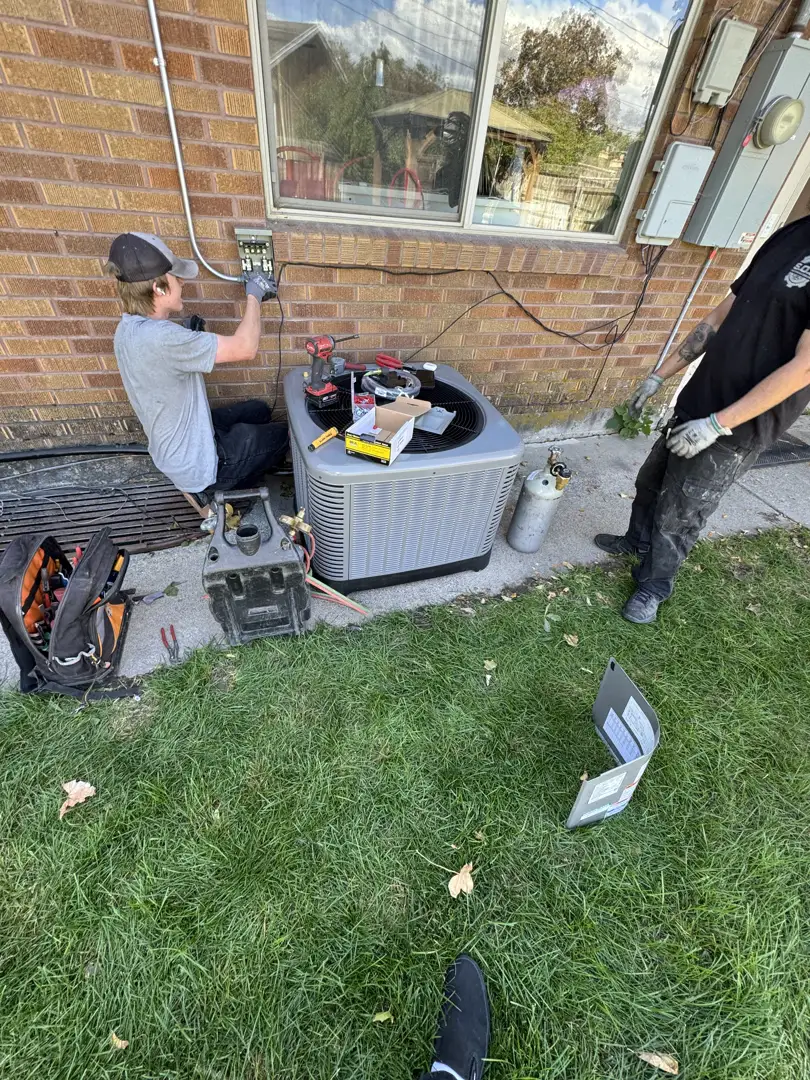
To take the emotion out of the decision, we use two industry-standard mathematical benchmarks. These rules help homeowners objectively determine when a repair is a sound investment and when it is simply "throwing good money after bad." Knowing should you repair or replace your AC becomes much easier when you apply these formulas.
| Rule | Definition | Action |
|---|---|---|
| The 50% Rule | Repair cost vs. New unit cost | If repair is >50% of replacement, replace. |
| The $5,000 Rule | Age of unit × Repair cost | If result is >$5,000, replace. |
Applying the 50% Rule
The 50% Rule is straightforward: if a single repair estimate exceeds 50% of the cost of a brand-new, installed system, you should almost always opt for replacement. Major component failures, such as a burnt-out compressor or a leaking evaporator coil, often fall into this category.
There is more what you need to know before you replace your AC unit, but the core logic here is about ROI. Spending half the price of a new unit on a system that is already halfway through its life expectancy is rarely a winning financial move. You are essentially paying for a partial fix while still keeping an old, inefficient motor and an out-of-warranty cabinet.
Calculating the $5,000 Rule
The $5,000 Rule is a favorite among financial-minded homeowners because it accounts for the age of the equipment. To use it, multiply the age of your unit (in years) by the repair estimate.
For example:
- A 12-year-old unit needs a $450 repair. (12 x 450 = 5,400). Result: Replace.
- An 8-year-old unit needs a $300 repair. (8 x 300 = 2,400). Result: Repair.
This rule helps highlight the "sunk cost fallacy." Just because you spent $500 on a repair last year doesn't mean you should spend another $500 this year. Much like knowing when to replace your furnace, calculating the total value of your HVAC assets helps you see when the machine has simply reached the end of its economic usefulness.
Long-Term Value: Efficiency, Technology, and Regulatory Factors
The ac repair vs new unit long term savings equation has shifted significantly in 2026 due to new regulations and technological leaps. Today’s entry-level units are often more efficient than the "premium" models of a decade ago. Keeping your system in peak shape through AC maintenance in Sandy, UT is vital, but even the best maintenance cannot overcome obsolete technology.
How SEER2 ratings impact ac repair vs new unit long term savings
In 2023, the industry moved to SEER2 (Seasonal Energy Efficiency Ratio 2) standards, which provide a more accurate measure of how a unit performs under real-world conditions. Upgrading from an old 10 SEER system to a modern SEER2 18 unit can reduce your cooling bills by 25% to 35%.
For a typical 2,000-square-foot home along the Wasatch Front, this can translate to savings of $40 to $60 every single month during the summer. Over a 10-year period, those monthly savings can offset a massive portion of the initial installation cost. When you look at an AC repair guide for Centerville, UT, you'll see that while we can fix almost anything, we can't "repair" a low SEER rating into a high one.
Maximizing ac repair vs new unit long term savings through tax credits
One of the biggest arguments for replacement in 2026 is the availability of federal and local incentives. Under the Inflation Reduction Act, homeowners can access the 25C tax credit, which can provide up to $2,000 annually for qualifying heat pumps or up to $600 for high-efficiency central AC units.
When you combine these federal credits with local utility rebates available in areas like Bountiful, the "net cost" of a new unit drops significantly. If you are following an AC repair guide for Bountiful, UT, always ask your technician if your current repair needs could be better solved by leveraging these credits toward a new, warrantied system.
The Refrigerant Factor: R-22 vs. Modern Alternatives
If your AC was installed before 2010, there is a high probability it uses R-22 refrigerant (often called Freon). As of 2020, R-22 is no longer produced or imported in the U.S. due to environmental regulations.
This has made R-22 incredibly scarce and expensive. A simple refrigerant "top-off" for an old unit can now cost hundreds or even thousands of dollars. Furthermore, newer systems manufactured after 2025 use R-454B or R-32, which are more environmentally friendly and much cheaper to service. If your unit has a refrigerant leak and uses R-22, the ac repair vs new unit long term savings math almost always dictates a replacement. You are essentially paying a premium for a chemical that is being phased out of existence.
Frequently Asked Questions about AC Repair vs New Unit Long Term Savings
What is the average lifespan of a central AC unit in Utah?
In our specific Utah climate, a central AC unit typically lasts between 12 and 15 years. While the dry air is actually easier on some components compared to humid coastal regions, our extreme temperature swings and high-altitude UV exposure can accelerate the wear on outdoor electrical components and fan motors. Regular maintenance is the single biggest factor in reaching (or exceeding) that 15-year mark.
When does an AC repair become a "sunk cost"?
A repair becomes a sunk cost when you are spending money on a system that will likely require another major repair within 12 to 24 months. If you find yourself calling for service more than once a season, or if you are paying for refrigerant recharges on a system with a known leak, you are in the "repair spiral." At this point, your money is better spent as a down payment on a new unit that comes with a 10-year parts and labor warranty.
How much can I save on energy bills by upgrading to a high-efficiency model?
Most homeowners see a reduction of 20% to 40% on their monthly cooling costs when moving from a 10-12 year old unit to a modern ENERGY STAR-certified system. If you choose a high-efficiency SEER2 18+ model with a variable-speed compressor, the savings can be even higher. Many of our customers find that the system "pays for itself" through energy savings and avoided repairs within 5 to 7 years.
Conclusion
Deciding between ac repair vs new unit long term savings doesn't have to be a guessing game. By using the 50% and $5,000 rules, considering the rising costs of phased-out refrigerants, and factoring in the massive energy savings of SEER2 technology, the right path usually becomes clear.
In Salt Lake City, our homes are our sanctuaries. Whether you are in Draper, Layton, or Murray, you deserve a cooling system that is reliable, efficient, and cost-effective. While a repair might get you through today, a new unit is often the smartest investment for your future.
At S.O.S. Heating & Cooling, we pride ourselves on providing honest, transparent assessments. We won't push a replacement if a simple repair will give you years of reliable service, but we will always show you the math so you can make the best choice for your budget.
Consult with a professional for a long-term savings analysis today and let us help you keep your home—and your finances—cool all summer long.
Explore Our Latest Insights and Updates in Plumbing Services
The Wasatch Front Guide to Choosing Standard or Premium AC
The Early Bird Gets the Coolest Air This Summer
The Fantastic Four Components That Keep You Cool