

The Ultimate Guide to DIY AC Troubleshooting Before Calling a Professional


.avif)

AC Troubleshooting Tips Before Calling a Pro: What to Check First
AC troubleshooting tips before calling a pro can save you time, money, and a lot of frustration — especially when Salt Lake City temperatures are climbing and your system picks the worst possible moment to act up. Before you schedule a service call, there are several quick checks you can do yourself that resolve the issue more often than you'd think. In fact, HVAC professionals report that nine out of ten calls about central AC systems not working properly come down to a single, easy fix: a dirty air filter.
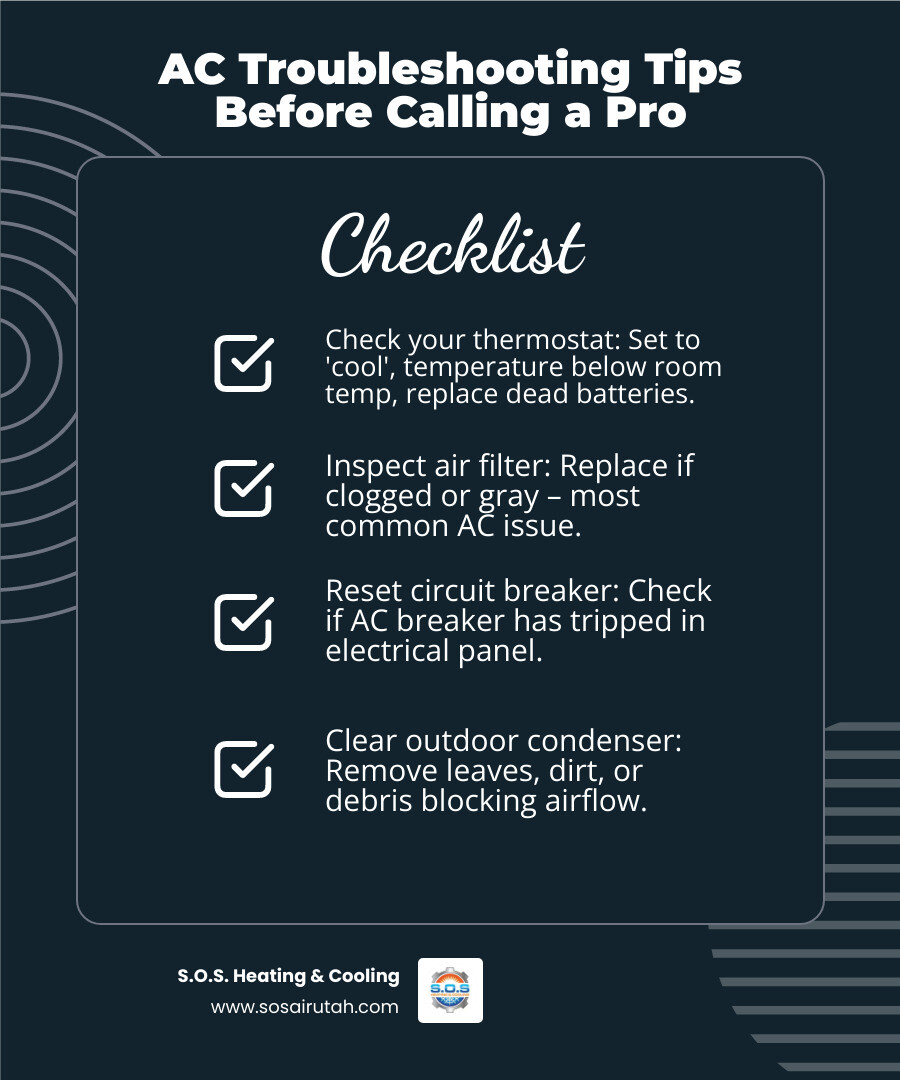
Here are the essential steps to check before calling a technician:
- Check your thermostat — Make sure it's set to "cool," the temperature is set below the current room temp, and the batteries aren't dead.
- Inspect your air filter — A clogged filter is the most common cause of AC problems. Replace it if it looks gray or blocked.
- Reset the circuit breaker — Locate your electrical panel and check if the breaker for your AC has tripped.
- Check the outdoor condenser unit — Clear away any leaves, dirt, or debris that may be blocking airflow.
- Look at your vents and registers — Make sure none are blocked by furniture, rugs, or closed dampers.
- Inspect the condensate drain line — A clogged drain can cause your system to shut off automatically.
- Check for a frozen evaporator coil — If ice is visible on your indoor unit, turn the system off and let it thaw before restarting.
These checks take less than an hour and cost nothing, yet they resolve a surprising number of common AC complaints.
As someone who has worked in the HVAC industry and holds certifications including NATE, EPA, and RMGA, I'm Bryson Ninow — and I've seen how often a few simple ac troubleshooting tips before calling a pro are all a homeowner needs to restore their comfort. In this guide, I'll walk you through every check step by step so you know exactly what to look at, what to fix yourself, and when it's time to call in a professional.
Essential AC Troubleshooting Tips Before Calling a Pro
When your home starts feeling more like a sauna than a sanctuary, it’s easy to panic. However, many common cooling issues don’t actually require a toolkit or a degree in mechanical engineering. By following a systematic approach to ac troubleshooting tips before calling a pro, you can often identify the culprit in minutes.
It is important to understand that your AC is a delicate balance of airflow, electrical signals, and refrigerant cycles. If one piece of the puzzle is missing—like a clean filter or a closed circuit—the whole system may shut down to protect itself. If you find your unit isn't responding at all, you might want to explore Why Your AC Won't Turn On in Holladay for specific local insights. Recognizing the Signs That Your AC Needs Immediate Repair is also vital to prevent a minor hiccup from turning into a total system replacement.
Thermostat and Power: AC Troubleshooting Tips Before Calling a Pro
The thermostat is the "brain" of your HVAC system. If the brain isn't sending the right signals, the "body" (your AC unit) won't move.
- Check the Mode: It sounds silly, but we’ve seen many service calls resolved just by switching the thermostat from "Heat" or "Fan" back to "Cool." Ensure it hasn't been accidentally bumped.
- Battery Replacement: If your thermostat screen is blank or flashing, the batteries are likely dead. Most digital thermostats require AA or AAA batteries. Replace them even if the screen looks okay, as weak batteries can cause erratic signals.
- Circuit Breakers: Your AC uses a lot of power, especially on those 100-degree Salt Lake City afternoons. Check your home’s main electrical panel. If the breaker for the "AC" or "HVAC" is in the middle position, flip it all the way to "Off" and then back to "On."
- The Outdoor Disconnect: There is often a secondary power switch located in a small box near your outdoor condenser unit. Ensure this hasn't been toggled off during yard work.
If your system turns on but seems to be struggling with its timing, you should investigate Why Your AC Cycles On and Off Rapidly, as this "short cycling" can lead to premature motor failure.
Airflow and Filters: AC Troubleshooting Tips Before Calling a Pro
Airflow is the lifeblood of your cooling system. Without proper airflow, the heat exchange process fails, often leading to a frozen system or a burnt-out compressor.
- The Filter Test: A dirty filter is the #1 cause of AC failure. It restricts airflow, forcing the system to work harder and longer. Hold your filter up to a light; if you can’t see light through it, it’s time for a change. In our April 2026 season, with local pollen and dust, you should be checking these monthly.
- Clear the Vents: Walk through your home and ensure that furniture, curtains, or rugs aren't blocking the return or supply vents. We recommend keeping at least 2 feet of space around all vents to maintain proper pressure.
- Open the Dampers: Ensure the registers in each room are actually open. Closing too many vents in unused rooms can actually cause Why Your HVAC System Has Poor Airflow and damage your ductwork.
If you notice that some rooms are freezing while others are sweltering, check out our Solutions for Uneven Home Cooling or see why your AC Has Weak Airflow in Salt Lake City.
Inspecting the Condenser and Drainage System
The outdoor portion of your AC, known as the condenser, is responsible for releasing the heat collected from inside your home. If it’s crowded or dirty, it can't breathe.
- Debris Removal: Keep at least two feet of clearance around your outdoor unit. Trim back bushes, remove tall weeds, and clear away any stray leaves or grass clippings.
- Cleaning the Fins: Over time, the metal fins on the condenser can get clogged with dirt. With the power off, you can gently hose down the unit with a garden hose (never use a pressure washer, as it will flatten the delicate fins). For more complex issues, you may need to Troubleshoot AC Condenser Coil Damage professionally.
- The Condensate Drain: As your AC cools the air, it also removes moisture. This water travels through a plastic PVC pipe called the condensate drain. If this line clogs with algae or debris, a safety "float switch" will trigger and shut down your entire system to prevent a flood.
- The Vinegar Flush: To keep the line clear, you can pour a cup of white vinegar down the drain line access point near your indoor unit. If it's already clogged, a wet/dry vacuum can often suck the blockage out from the exterior end of the pipe. Understanding What Causes AC Drain Line Clogs can help you prevent the mess that occurs Why Your AC Leaks Water Inside Your Home.
When to Stop DIY and Call an HVAC Expert
While DIY troubleshooting is great for your wallet, safety must come first. High-voltage electricity and pressurized refrigerants are dangerous. If you've checked the batteries, the filter, and the breakers and the system still isn't cooling, it's time to call the pros at S.O.S. Heating & Cooling.
| Task | DIY or Pro? | Why? |
|---|---|---|
| Changing Air Filter | DIY | Simple, safe, and essential maintenance. |
| Resetting Breaker (Once) | DIY | Common after power surges or high-heat days. |
| Clearing Debris from Unit | DIY | Improves efficiency safely. |
| Resetting Breaker (Repeatedly) | Pro | Indicates a dangerous electrical short. |
| Refrigerant Leaks/Recharge | Pro | Requires EPA certification and specialized tools. |
| Strange Noises (Grinding/Squealing) | Pro | Signals mechanical failure or loose parts. |
Attempting to handle refrigerant yourself is not only illegal without certification but can lead to Solve AC Refrigerant Floodback Issues which can destroy your compressor. Knowing How to Prevent AC Refrigerant Leaks through professional maintenance is always better than a midnight emergency repair. If your system is older, you might be facing the big question: AC Repair or Replacement?
Identifying Mechanical Failures and Unusual Noises
Your AC is usually a quiet companion, but when it starts making "complaints," you should listen.
- Blowing Warm Air: If the air coming from your vents feels like a hair dryer, check your thermostat and filter first. If those are fine, you may have a failed capacitor or a refrigerant leak. See What to Do When Your AC Stops Cooling for a deeper dive.
- Frozen Coils: If you see ice on the copper lines or the indoor unit, turn the system off immediately. Let it thaw for 2-4 hours. This is often caused by a dirty filter, but if it happens again after changing the filter, you need to Fix AC That Freezes Up in Salt Lake City.
- Scary Sounds:
- Grinding/Squealing: Usually a motor bearing or belt issue. AC Makes Grinding and Squealing Sounds should never be ignored.
- Clicking: Why Your AC Makes Clicking Sounds can range from a failing relay to a simple pebble stuck in the fan.
- Rattling: In Murray homes, this often means something has come loose in the cabinet or debris has fallen into the outdoor unit.
- Short Cycling: If the outdoor unit keeps clicking on and off every few minutes, you might be dealing with AC Compressor Short Cycling in Draper.
Frequently Asked Questions about AC Troubleshooting
What should I do if my AC is blowing warm air?
First, verify your thermostat is set to "Cool" and "Auto" (not "On," which blows air even when the compressor is off). Check your air filter; if it’s clogged, the system can’t cool effectively. If the outdoor unit isn't running, check your circuit breaker. If the unit is running but the air is warm, you likely have a refrigerant issue or a dirty condenser coil.
How often should I change my AC air filter in 2026?
Standard 1-inch filters should be changed every 30 to 90 days. However, if you live in high-dust areas of the Salt Lake Valley or have pets, we recommend checking them every 30 days. High-efficiency pleated filters can last up to 6 months, but always check the manufacturer's recommendation.
Is it safe to reset my HVAC circuit breaker?
It is safe to reset a tripped breaker once. Sometimes a power surge or a particularly hot day can cause a nuisance trip. However, if the breaker trips again immediately or frequently, do not reset it. This is a clear sign of an electrical fault, such as a failing compressor or a short circuit, and requires a professional inspection to prevent a fire.
What if I see water pooling around my indoor unit?
This is usually a sign of a clogged condensate drain or a frozen evaporator coil that is melting. Use a wet/dry vac to clear the drain line. If you need more specific help for our area, read about How to Fix AC Leaks in Salt Lake City. Sometimes, the issue is more technical, such as What Causes AC Expansion Valve Failure, which prevents proper moisture removal.
Conclusion
Taking the time to run through these ac troubleshooting tips before calling a pro can save you from a "false alarm" service call and get your home back to a comfortable temperature faster. The majority of AC issues stem from simple maintenance oversights like dirty filters or blocked vents.
However, even the best DIY efforts have their limits. To truly protect your investment and ensure your system lasts its full 15-20 year lifespan, seasonal professional checks are essential. Whether you are in Bountiful, Draper, or right here in Salt Lake City, S.O.S. Heating & Cooling is ready to help with 24/7 emergency service and expert tune-ups.
If your troubleshooting has hit a dead end, don't sweat it. Contact us today for reliable Air Conditioning service you can trust.
Explore Our Latest Insights and Updates in Plumbing Services
Signs You Need Help with Pipe Repair in Sandy UT
South Jordan Same Day Pipe Repair to Save Your Basement
Stop the Leak Fast with Same Day Pipe Repair in Sandy