

A Quick Start Guide to Heat Pump Winter Performance in the Salt Lake Valley


.avif)

Can a Heat Pump Handle the Cold Winters of the Salt Lake Valley? Here's What You Need to Know
Can a heat pump handle the cold winters of the salt lake valley? Yes — and modern cold-climate heat pumps do it better than most homeowners expect. Here is a quick overview:
Quick Answer:
- Modern cold-climate heat pumps maintain 100% of their rated heating capacity at 5°F
- They continue operating down to -13°F
- The NOAA 99th-percentile design temperature for Salt Lake City is just 4°F — well within that range
- The Salt Lake Valley floor typically bottoms out between 5°F and 10°F on the coldest nights
- Davis County benchlands see roughly 3 to 5 nights per year at 0°F to -5°F
- For higher-elevation areas or extreme cold snaps, a dual-fuel (hybrid) system adds a gas furnace as backup
- With the right equipment and proper sizing, a heat pump can serve as your primary heating and cooling system year-round
That said, not every heat pump is built the same, and the wrong equipment choice — or a poorly sized installation — can leave you cold when temperatures drop hard in January. The good news is that with the right guidance, this is a completely solvable problem.
I'm Bryson Ninow, an NATE-certified HVAC professional with hands-on experience helping Salt Lake Valley homeowners navigate exactly this question of whether a heat pump can handle the cold winters of the salt lake valley — including sizing, rebate programs, and choosing the right system for your specific elevation and microclimate. In this guide, I'll walk you through everything you need to make a confident decision.
How Heat Pumps Work in Cold Weather
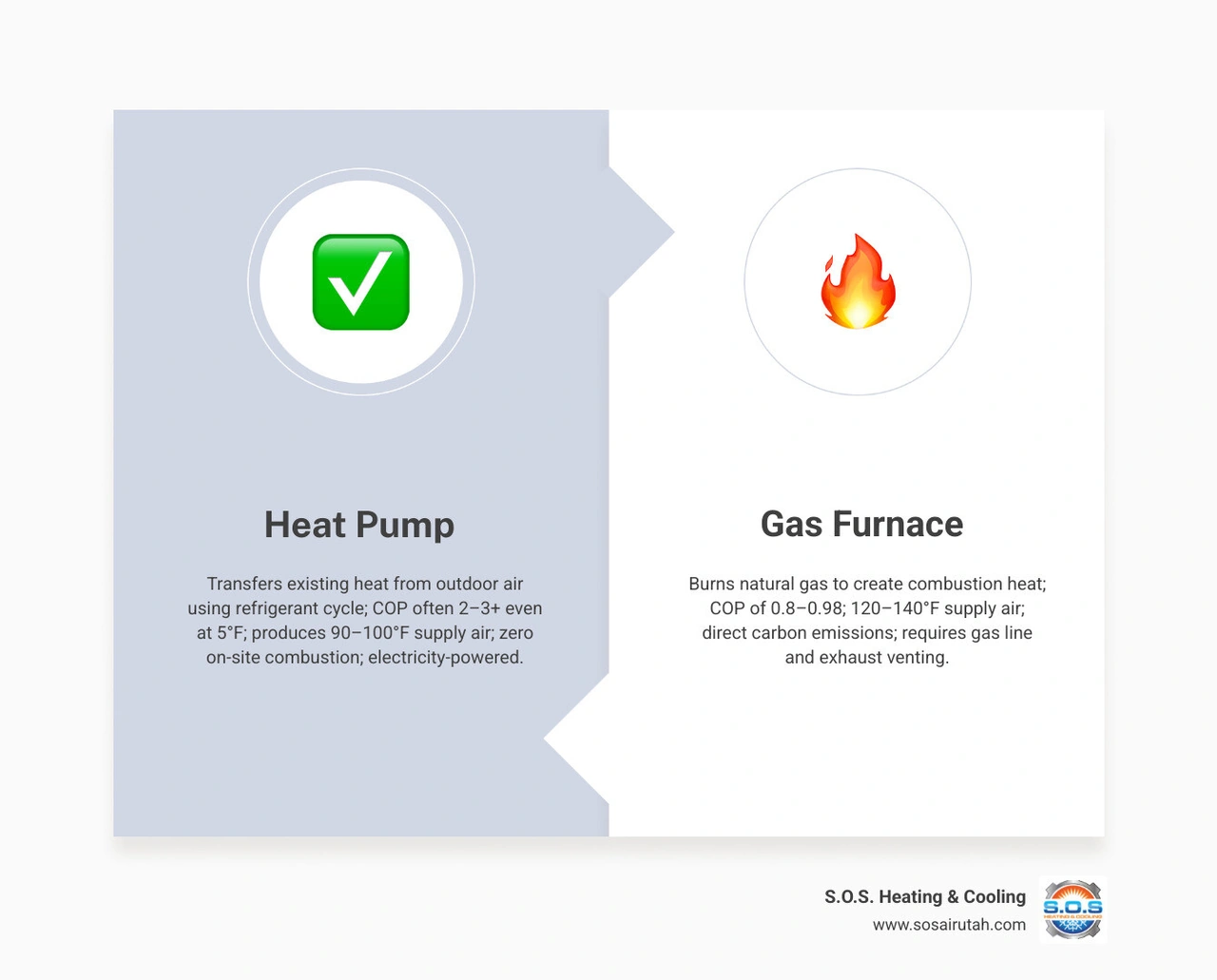
To understand how a modern heat pump keeps your home warm when the Great Salt Lake is freezing over, we have to throw out the old idea of "making" heat. Traditional gas furnaces burn natural gas to generate heat. Heat pumps, on the other hand, act as thermal transporters. They are essentially two-way air conditioners.
In the summer, a heat pump absorbs heat from inside your home and dumps it outside. In the winter, the system reverses this cycle. Using a specialized reversing valve, the refrigerant flow is flipped. The outdoor unit becomes the evaporator, absorbing ambient heat from the freezing outdoor air, while the indoor unit becomes the condenser, releasing that heat into your living spaces.
Even when it feels freezing to us, outdoor air down to absolute zero (-459.67°F) contains heat energy. The liquid refrigerant inside the outdoor coils is kept at an extremely low temperature—far lower than the outdoor air. Because heat naturally flows from a warmer area to a colder one, the refrigerant absorbs the ambient heat from the Utah winter air. The compressor then squeezes this low-pressure gas, raising its temperature and pressure significantly, and sends it indoors to warm your home.
This process is measured by the Coefficient of Performance (COP). A COP of 3.0 means the system delivers three units of heating energy for every single unit of electricity it consumes. By comparison, even a brand-new, top-tier high-efficiency gas furnace only has a COP of 0.95 (95% efficiency).
To dive deeper into how these components interact, you can read our guide on Understanding Heat Pump Systems.
Modern systems achieve these high COPs in freezing weather thanks to variable-speed inverter compressors. Unlike older systems that were either 100% "on" or completely "off," variable-speed compressors operate like a dimmer switch. They scale their output anywhere from 25% to 100% capacity to match your home’s exact heating load. This constant, low-speed operation keeps your indoor climate incredibly stable and prevents the drafty, "all-or-nothing" cycles of older HVAC setups.
Can a Heat Pump Handle the Cold Winters of the Salt Lake Valley?
The short answer is a resounding yes, but the long answer requires looking at our local climate data.
When professional HVAC engineers design a heating system, they don't look at the absolute coldest temperature ever recorded in Utah history. Instead, they use the NOAA 99th-percentile design temperature. For the Salt Lake City International Airport, this design temperature is 4°F. This means that for 99% of the winter hours in our region, the temperature remains above 4°F.
Modern cold-climate heat pumps are specifically engineered to handle these conditions. High-performance models maintain 100% of their rated heating capacity at 5°F and continue to operate effectively down to -13°F. This means that during a standard winter in the Salt Lake Valley, a properly sized cold-climate heat pump has more than enough muscle to heat your home without needing any assistance.
However, our unique geography means that weather patterns can vary wildly depending on whether you live on the valley floor or up along the benches. To see how these geographic elements interact with your home's mechanical systems, check out our article on How the Wasatch Front Climate Affects Your HVAC and Plumbing.
Why Older Systems Struggled and How Modern Tech Answers: Can a Heat Pump Handle the Cold Winters of the Salt Lake Valley?
If you talk to long-time Utah residents, many will warn you that heat pumps are terrible in the cold. They aren't lying; they are just remembering 1990s technology.
Older, traditional heat pumps relied on single-stage, fixed-speed compressors. These systems were sized primarily for summer cooling. When winter temperatures dropped below 30°F, their heating capacity plummeted. To keep up, they had to turn on auxiliary electric resistance heat strips inside the air handler. These heat strips are essentially giant hair dryers. While they kept the house warm, they consumed massive amounts of electricity, causing utility bills to skyrocket.
Modern cold-climate heat pumps have completely solved this issue through two key technological advancements:
- Vapor Injection Technology: This process injects a portion of refrigerant vapor back into the compressor at an intermediate stage. This boosts the mass flow rate of the refrigerant, allowing the compressor to work much harder and extract heat from extremely cold air without overheating or failing.
- Advanced Low-Temperature Refrigerants: The transition to modern, high-pressure refrigerants allows for better heat transfer rates even when outdoor temperatures are well below freezing.
These innovations mean that modern systems rarely need to rely on expensive backup heat strips, keeping your home warm and your electric bills manageable.
Microclimates and Elevation: Can a Heat Pump Handle the Cold Winters of the Salt Lake Valley?
The Salt Lake Valley is not a flat, uniform plain. It is a complex basin surrounded by massive mountain ranges, creating distinct microclimates that impact how we design HVAC systems.
- The Valley Floor (Salt Lake City, Murray, Sandy, West Jordan, Draper, South Jordan): The valley floor experiences relatively moderate winter temperatures compared to the surrounding canyons. Winter lows typically hover in the 20s, with only occasional drops into the single digits. Standalone cold-climate heat pumps are highly effective here and can easily serve as the sole source of heat.
- The Benchlands (Centerville, Bountiful, Farmington, Kaysville, Layton, Mt. Olympus): If your home sits higher up on the East Bench or in the northern parts of Davis County, you know that winters can be harsher. These areas see stronger winds, more snow, and temperatures that routinely drop 5 to 10 degrees colder than the valley floor. While a cold-climate heat pump can still perform exceptionally well here, many homeowners in these areas choose a hybrid system for peace of mind.
Another major factor on the valley floor is our notorious winter inversions. Cold, dense air becomes trapped under a warm layer of air, sealing in vehicle and residential emissions. Residential wood-burning and gas combustion are major contributors to PM 2.5 pollution during these inversions.
By switching to an electric heat pump, you produce zero direct emissions at your home. This helps keep our local air cleaner during those stagnant winter weeks. If you want to explore how ductless and ducted heat pumps fit into our local neighborhoods, take a look at our services for Heat Pumps Salt Lake City.
Heat Pumps vs. Gas Furnaces: Efficiency, Comfort, and Savings
When deciding between a traditional gas furnace and a heat pump, it helps to look at the numbers and comfort factors side-by-side.
| Feature | Modern Cold-Climate Heat Pump | High-Efficiency Gas Furnace (95%+ AFUE) | Standard Gas Furnace (80% AFUE) |
|---|---|---|---|
| Primary Energy Source | Electricity | Natural Gas | Natural Gas |
| Operating Efficiency | 150% to 400% (COP 1.5 - 4.0) | 95% to 98% | 80% |
| Carbon Footprint | Low (Zero direct emissions) | Moderate to High | High |
| Supply Air Temp | 90°F to 100°F (Continuous, gentle) | 120°F to 130°F (Hot, intermittent blasts) | 120°F to 130°F |
| Summer Cooling | Included (Reversible system) | Requires separate AC unit | Requires separate AC unit |
| Performance in Inversions | Excellent (Helps reduce valley PM 2.5) | Contributes to local emissions | Contributes to local emissions |
Because a heat pump moves heat rather than creating it, its efficiency is unmatched. At current Utah utility rates (with Rocky Mountain Power at roughly $0.10/kWh and Dominion Energy at $1.10/therm), a heat pump operating at a COP of 3.0 delivers heat at a rate of $0.977 per 100,000 BTU. In comparison, an 80% AFUE gas furnace costs $1.375 per 100,000 BTU to run.
This means that during the shoulder seasons (October, November, March, and April) when outdoor temperatures range from 35°F to 55°F, a heat pump is significantly cheaper to run than a standard gas furnace. Even as the temperature drops and the heat pump's COP dips toward 2.0, it remains highly competitive.
Beyond the energy math, there is a noticeable comfort difference. Traditional furnaces blast hot air (around 120°F to 130°F) in short, intense bursts. This can create hot and cold spots throughout your home. A variable-speed heat pump delivers a steady stream of warm air (around 90°F to 100°F) over longer cycles. This keeps the air circulating constantly, eliminating cold corners and keeping the temperature incredibly consistent.
To learn more about the environmental and financial perks of making the switch, check out our guide on Heat Pump Benefits for Utah Homeowners.
The Dual-Fuel (Hybrid) Solution for Utah Homes
While standalone cold-climate heat pumps are fantastic, many Salt Lake Valley homeowners choose the "sweet spot" of home comfort: a dual-fuel (hybrid) system.
A dual-fuel system pairs an electric heat pump with a high-efficiency gas furnace. Think of it like a hybrid car. When the weather is mild or moderately cold (above 30°F), the heat pump handles 100% of the heating. It runs quietly and at peak efficiency, saving you money on your heating bills.
When a severe winter storm rolls in and temperatures plummet into the single digits or below zero, the system automatically switches over to the gas furnace. This switch-over point is called the "economic crossover" or "balance point."
For most homes in Bountiful, Layton, or Draper, we set the balance point between -5°F and -10°F. This means the heat pump still handles roughly 90% to 95% of your annual heating hours. The gas furnace is simply there as an insurance policy, ensuring your home stays warm during those rare, extreme cold snaps without relying on backup electric heat strips.
If you want to read more about how these hybrid systems are designed and installed, explore our detailed breakdown of the Hybrid Heat Pump System.
Lifespan, Maintenance, and Incentives in Utah
Investing in a heat pump is a long-term decision. With professional installation and routine care, a modern heat pump typically lasts 15 to 20 years. Because these systems work year-round—heating in the winter and cooling in the summer—they do experience more runtime than a standalone furnace. This makes regular maintenance essential to keep them running efficiently.
Fortunately, the financial transition to a heat pump is easier than ever thanks to state, federal, and utility incentives available in 2026:
- Federal Tax Credits (Energy Efficient Home Improvement Credit - Section 25C): Homeowners can claim a federal tax credit of up to $2,000 for installing qualified cold-climate heat pumps.
- Utility Rebates: Local programs like Rocky Mountain Power’s Wattsmart and Dominion Energy’s ThermWise offer substantial rebates for qualifying high-efficiency heat pump installations and dual-fuel upgrades.
To ensure your system qualifies for these local incentives and is installed to meet strict energy standards, visit our pages on Heat Pump Service Salt Lake City UT and Heat Pump Installation Salt Lake City UT.
Essential Winter Maintenance Steps
To maximize your heat pump's efficiency and lifespan during a harsh Utah winter, keep these simple maintenance steps in mind:
- Change Your Filters Regularly: Check your indoor air filters every 1 to 3 months. A clogged filter restricts airflow, forcing the compressor to work harder and use more electricity.
- Keep the Outdoor Unit Clear: After a heavy Wasatch snowstorm, check your outdoor unit. Ensure there is no heavy snow buildup on top of or around the sides of the cabinet. Keep a 2-foot clearance zone around the unit free of snow, ice, and fallen leaves.
- Elevate the Outdoor Unit: During installation, we always place heat pumps on snow stands (elevated risers). This keeps the coil clear of accumulating snow and allows meltwater to drain away safely during defrost cycles.
- Schedule Bi-Annual Tune-Ups: Because a heat pump runs year-round, it should be serviced twice a year—once in the spring before the cooling season, and once in the fall before the winter cold hits.
Frequently Asked Questions about Heat Pumps in Utah
We hear a lot of questions from our customers in Murray, Sandy, and Centerville about how these systems handle our unique climate. Here are the facts behind the most common myths.
Do heat pumps blow cold air?
No, but the air they produce feels different than a gas furnace. A gas furnace blasts air at roughly 120°F to 130°F. Since our body temperature is 98.6°F, that air feels hot to the touch.
A heat pump delivers air at a steady 90°F to 100°F. While this is warmer than your thermostat setting, it is close to your body temperature, so it can feel lukewarm if you stand directly in front of a register. However, because the variable-speed system runs continuously and gently, it heats your rooms much more evenly without the drafty "hot blast, cold draft" cycle of older furnaces.
Can a heat pump completely replace both my furnace and AC?
Yes, absolutely. A heat pump is an all-in-one heating and cooling system. In the summer, it acts as a high-efficiency air conditioner, pulling heat from inside your home and releasing it outdoors. In the winter, it reverses the process.
If your home has ductwork in good condition and you are looking to replace both an aging furnace and AC, a single heat pump can replace both units, simplifying your mechanical systems and reducing your overall maintenance footprint.
To see if your home's layout and electrical system are ready for this transition, read our detailed guide: Is a Heat Pump Right for Your Home.
What happens to a heat pump during a Salt Lake Valley inversion?
During our winter inversions, high humidity levels and cold temperatures can cause frost to build up on the outdoor unit's coils. This is completely normal.
When this happens, the heat pump automatically enters a defrost cycle. It temporarily reverses into cooling mode for 3 to 5 minutes to send warm refrigerant through the outdoor coils, melting the ice. During this brief cycle, the system uses its indoor backup heat strips or gas furnace to ensure you don't feel a chill inside. You might see steam rising from the outdoor unit during this process—don't worry, it's just the system doing its job!
Additionally, because heat pumps run entirely on electricity, they produce zero direct emissions. This helps reduce the PM 2.5 emissions that contribute to our valley's winter smog.
Conclusion
So, can a heat pump handle the cold winters of the salt lake valley? With modern cold-climate technology, the answer is a clear yes. Whether you live on the valley floor in Sandy or high up on the benchlands of Bountiful, there is a heat pump or hybrid configuration designed to keep your home comfortable, clean, and energy-efficient year-round.
At S.O.S. Heating & Cooling, we specialize in helping Utah homeowners find the perfect HVAC setup for their specific microclimate. We perform detailed Manual J load calculations to ensure your new system is sized perfectly for your home's insulation, layout, and altitude.
Ready to see how a modern heat pump can transform your home's comfort and lower your energy bills? Contact our team today to schedule a professional home assessment and explore our Heat Pump Systems Sandy UT.
Explore Our Latest Insights and Updates in Plumbing Services

How to Fix Constant AC Running from Poor Insulation
How to Calculate Energy Savings From a New AC Replacement in the Wasatch Front

How a Dirty Filter Raises Your Energy Bill in Dry Utah Climate