

How to Fix AC Tripping the Breaker in Your Salt Lake Home


.avif)

What to Do When Your AC Trips the Breaker in a Salt Lake City Home
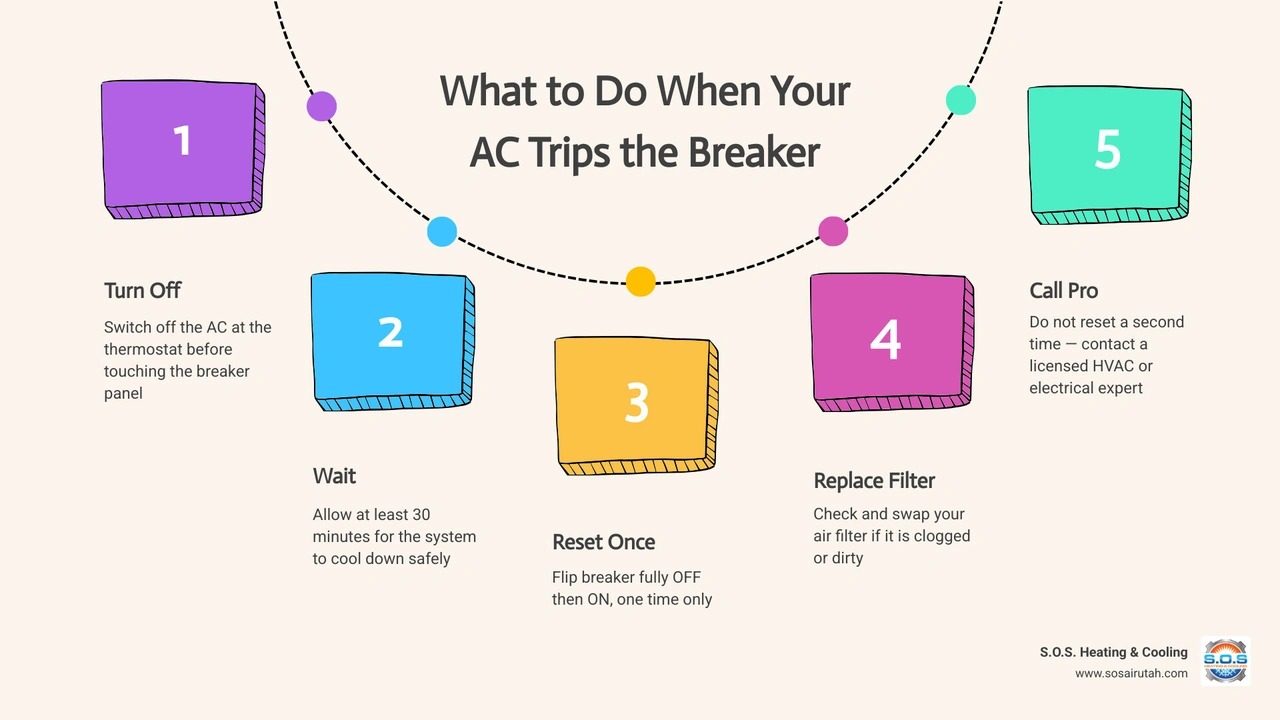
If you're dealing with a circuit breaker tripping when AC turns on, what to do in a Salt Lake home comes down to a few key steps:
- Turn off your AC at the thermostat before touching the breaker panel.
- Wait at least 30 minutes to let the system cool down.
- Reset the breaker once — flip it fully to OFF, then back to ON.
- Check and replace your air filter if it looks clogged or dirty.
- Do not reset the breaker a second time if it trips again immediately — call a licensed HVAC or electrical professional.
It happens without warning. You turn on your AC on a hot Salt Lake City afternoon, and within seconds the power cuts out. You head to the electrical panel and find a tripped breaker. You reset it, the AC kicks back on, and then — it trips again.
That cycle is frustrating, but it's also your home's electrical system doing exactly what it's designed to do: protect your wiring and your family from a potentially dangerous overload. A tripped breaker isn't just an inconvenience. It's a warning sign. According to FEMA, approximately 24,000 residential electrical fires are reported in the United States every year, and many are linked to overloaded circuits from high-draw appliances like air conditioners.
Salt Lake City homeowners face a unique combination of challenges — scorching summer heat, seismic activity that can loosen electrical connections over time, and a large stock of older homes that weren't built to handle modern AC loads. All of that makes understanding this problem especially important.
I'm Bryson Ninow, an NATE-certified HVAC professional with years of hands-on experience helping Salt Lake area homeowners navigate issues like a circuit breaker tripping when AC turns on and what to do in a Salt Lake home. Whether the culprit is a dirty filter, a failing capacitor, or an outdated electrical panel, I'll walk you through exactly what's happening and how to handle it safely.
What It Means When Your AC Trips the Breaker
When your air conditioner kicks on, it requires a significant amount of electrical current to get the compressor and fan motors running. If the electrical current flowing through the circuit exceeds the safe limit that the circuit is designed to handle, the circuit breaker acts as a built-in safety mechanism.
The breaker is engineered to detect this excess current and instantly shut off the power. If it didn't, the electrical wires inside your walls would quickly overheat, melting their protective insulation and creating a severe fire hazard.
Understanding Your Circuit Breaker Tripping When AC Turns On: What to Do in a Salt Lake Home
If you want to understand what is happening behind the drywall, you have to look at the relationship between your electrical panel and your cooling system. To get a detailed breakdown of this dynamic, you can read our guide on AC Circuit Breaker Keeps Tripping What It Means.
At its core, a breaker trips for one of three primary reasons:
- Circuit Overload: The total demand of the appliances running on the circuit exceeds the breaker’s amp capacity.
- Short Circuit: A "hot" wire comes into direct contact with a "neutral" wire, creating an immediate, massive spike in electricity that forces the safety switch to flip.
- Ground Fault: A "hot" wire touches a grounded portion of the system, such as the metal cabinet of your outdoor condenser. Ground faults are incredibly common, accounting for approximately 98% of all electrical faults in residential systems.
The Danger of Repeatedly Resetting a Tripped Breaker
It is incredibly tempting to walk over to your electrical panel, flip the switch back to "ON," and hope for the best. However, doing this repeatedly is one of the most dangerous things a homeowner can do.
We advise all our customers in Salt Lake City, Sandy, and Draper to practice the "One-Reset Rule." You may reset a tripped breaker exactly once after letting the system cool down. If the breaker trips again immediately or shortly after, stop resetting it.
Repeatedly forcing electricity through a faulty circuit bypasses the system's safety mechanisms. This can lead to:
- Melted Wiring: The extreme heat can destroy the wiring inside your walls, turning a minor repair into an incredibly expensive whole-home rewiring project.
- Compressor Burnout: Forcing a struggling compressor to start up under high electrical stress can destroy the motor entirely, often requiring a complete outdoor unit replacement.
- Electrical Fires: The persistent arcing and heat generation are leading causes of residential house fires.
Common Causes of AC Breaker Trips in Utah Homes
An air conditioner is a complex system of moving parts, refrigerant lines, and high-voltage electrical connections. When something goes wrong with any of these components, the electrical draw spikes, causing your breaker to trip.
Airflow Restrictions and Dirty Filters
One of the most common — and easily avoidable — reasons for a tripped breaker is restricted airflow. If you notice other issues alongside the electrical trips, you should read about the Signs Your AC Needs Repair.
When your air filter is packed with dust, pet hair, and dander, your AC’s blower motor has to work significantly harder to pull air through the system. This extra effort causes the motor to draw more electrical current.
Furthermore, restricted airflow can cause the indoor evaporator coils to freeze over. When the coils freeze, the entire system struggles, and the compressor runs hotter and longer. Dirty air filters can increase your system's energy consumption by up to 15%, pushing an already stressed electrical circuit over its limit during hot Salt Lake summer afternoons.
Electrical Component Failures and Ground Faults
Inside your outdoor AC unit, several electrical components work together to start and run the system. If you live in Farmington or Kaysville and suspect wiring issues, you can learn more about AC Electrical Connection Problems Farmington.
- Failing Start Capacitor: The capacitor acts like a temporary battery, providing the extra electrical boost your compressor needs to start up. If the capacitor weakens or fails, the compressor will struggle to start, drawing massive amounts of electricity (known as Locked Rotor Amps) until the breaker trips.
- Fan Motor Malfunctions: If the fan motor in either the indoor blower or the outdoor condenser has failing bearings or a short circuit, it will draw excess power and trip the circuit.
- Grounded Compressor: This is a severe issue where the electrical windings inside the compressor motor break down and make contact with the metal casing of the compressor. This creates a direct ground fault, instantly tripping the breaker the second the unit tries to turn on.
How Utah’s Climate and Seismic Activity Impact Your Electrical System
Utah’s climate and geography play a surprisingly large role in how your home's electrical and HVAC systems behave:
- Extreme Summer Heat: During July and August, outdoor temperatures in the Salt Lake Valley regularly climb past 100°F. This extreme heat raises the temperature inside your electrical panel, increasing electrical resistance and making breakers more sensitive to tripping.
- Winter Inversions and Temperature Swings: The dramatic shift from freezing winter temperatures to blistering summer heat causes metal wires and terminals to expand and contract. Over time, this natural movement can loosen electrical connections.
- Seismic Activity: The Wasatch Front is a seismically active zone. While we don't feel minor tremors every day, constant microscopic vibrations and minor seismic shifts can gradually loosen screw terminals inside your electrical panel and your outdoor AC disconnect box, creating loose connections that cause electrical arcing and tripped breakers.
Circuit Breaker Tripping When AC Turns On: What to Do in a Salt Lake Home
If you find yourself sitting in a warm house with a tripped breaker, don't panic. There is a safe, systematic way to troubleshoot the issue before calling in the professionals.
Safe Troubleshooting for a Circuit Breaker Tripping When AC Turns On: What to Do in a Salt Lake Home
If your air conditioner isn't blowing cold air or keeps shutting down, you can start by reading our guide on AC Not Cooling Properly What to Check.
Here is the exact step-by-step troubleshooting process you should follow:
- Turn Off the Thermostat: Go to your thermostat and switch the system from "COOL" to "OFF." This prevents the AC from trying to start up the moment you reset the breaker, which can cause dangerous electrical arcing.
- Wait 30 Minutes: Give your AC system at least 30 minutes to cool down. If the compressor tripped due to thermal overload, it needs time to cool off and reset its internal safety switches.
- Inspect the Air Filter: Locate your indoor air filter. If it is covered in a thick layer of dust or debris, replace it immediately with a fresh, clean filter.
- Locate Your Electrical Panel: Go to your electrical panel. Ensure your hands are completely dry, and you are not standing in any water.
- Identify and Reset the Breaker: Look for the double-pole breaker labeled "AC" or "Air Conditioner." A tripped breaker will usually be sitting in the middle position, or showing a red indicator. To reset it, push the switch firmly to the OFF position until you hear a distinct click, then flip it back to the ON position.
- Turn the Thermostat Back On: Return to your thermostat and set it back to "COOL."
- Monitor the System: If the AC starts up and runs normally, keep a close eye on it. If it trips the breaker again immediately or within a few hours, turn the thermostat back to OFF and do not try to reset the breaker again.
Isolating the Issue: AC Unit vs. Electrical Panel
Sometimes, the problem isn't your air conditioner at all — it could be your electrical panel or the circuit breaker itself. To help you distinguish between these two systems, you can check out our resource on AC Repair Recognizing Common Issues.
Here is how you can tell if the issue lies with the AC unit or your home's electrical infrastructure:
- The "Weak" Breaker: Circuit breakers are mechanical devices that typically last between 30 and 40 years. Over time, the internal spring mechanism can weaken, especially if the breaker has tripped frequently. A weak breaker will trip under normal electrical loads. If your breaker feels "mushy" or loose when you flip it, or if it feels warm to the touch, the breaker itself likely needs to be replaced by a licensed electrician.
- Dedicated Circuit Interference: Your air conditioner must run on a dedicated 240-volt circuit. If another high-draw appliance (like a power tool in the garage or a backup freezer) has been incorrectly wired into the same circuit, running them simultaneously will overload the breaker.
- Signs of Electrical Panel Damage: Open your panel door (but do not remove the safety cover) and look for visible signs of damage. If you notice a burning smell, buzzing or crackling sounds, or black scorch marks on the breakers, shut off your main power disconnect immediately and call an electrician.
Electrical Panel and Wiring Challenges in Older Salt Lake Homes
Salt Lake City is famous for its beautiful, historic neighborhoods like The Avenues, Sugar House, and Harvard-Yale. While these older homes are full of character, their electrical systems were never designed to support the heavy power demands of modern central air conditioning systems.
Outdated Panels and 100-Amp Service Limits
If you are planning to add central air to an older home or upgrade an existing system, you should read about our AC Installation Salt Lake City services.
Many homes built before the 1980s in Salt Lake City, Bountiful, and Murray were installed with 100-amp (or even 60-amp) electrical panels. In those days, homes didn't have computers, electric vehicle chargers, hot tubs, or large central air conditioners.
When your AC starts up, it can draw a massive temporary spike of electricity. On a 100-amp panel, running your AC at the same time as your dryer, oven, or microwave can easily push your entire home past its electrical capacity, causing the main breaker or the AC breaker to trip.
Furthermore, some older homes still contain outdated wiring types like knob-and-tube or lack proper grounding. If your home still has an active Federal Pacific or Zinsco electrical panel, these are known fire hazards that often fail to trip during an overload, and they should be replaced immediately.
| Feature | 100-Amp Electrical Panel | 200-Amp Electrical Panel |
|---|---|---|
| Average Age | Common in homes built before 1990 | Standard in modern homes (post-1990) |
| Power Capacity | ~24,000 watts | ~48,000 watts |
| AC Compatibility | Struggles with modern high-efficiency ACs | Easily supports multiple HVAC zones |
| Future Expansion | Very limited (cannot support EV chargers, etc.) | High (supports hot tubs, chargers, workshops) |
| Safety Profile | Higher risk of overload in modern households | Highly safe with modern safety standards |
The Benefits of Panel Upgrades and Surge Protection
Upgrading from a 100-amp panel to a modern 200-amp panel is one of the best investments you can make for your Salt Lake home. Not only does it eliminate frequent breaker trips, but it also increases your home's value by 5% to 10% and ensures your electrical system meets current National Electrical Code (NEC) standards.
Additionally, we highly recommend installing whole-home surge protection. Summer thunderstorms along the Wasatch Front are common, and lightning strikes can send massive power surges through the local utility grid.
In fact, power surges affect approximately 1 in 200 homes in our region annually. A whole-home surge protector, which typically costs between $300 and $800 to install, protects your expensive AC compressor, control boards, and other household appliances from being fried by a sudden voltage spike.
Frequently Asked Questions About Tripping AC Breakers
Why does my AC trip the breaker only when the heat is turned on?
If you have a heat pump system, it provides both heating and cooling. If your system trips the breaker only when you switch to heat mode, it is usually caused by one of two issues. First, there could be an electrical short in the reversing valve solenoid, which is the component that physically switches the system from cooling to heating. Second, your system's emergency auxiliary heat strips (which kick in during freezing Salt Lake winter days) draw an immense amount of power. If these heat strips are damaged or drawing too many amps, they will instantly trip the breaker. For more information on system behaviors during seasonal transitions, see our post on Why AC Produces Strange Odors Riverton.
Can a dirty outdoor condenser unit cause my breaker to flip?
Yes, absolutely. Your outdoor condenser unit is responsible for releasing the heat collected from inside your home. If the condenser coils are caked with dirt, cottonwood seeds, or lawn clippings, they cannot release that heat efficiently. This traps heat inside the unit, forcing the compressor to work much harder and run much hotter. Eventually, the compressor will hit its thermal overload limit and pull a sudden spike of electricity, tripping your circuit breaker. If you need professional coil cleaning, check out our AC Repair Salt Lake City services.
Is it normal for an AC breaker to trip occasionally during a Salt Lake summer?
No, it is not normal. While a rare utility grid surge during peak summer demand can occasionally cause a nuisance trip, a healthy, properly installed air conditioner running on a correctly sized circuit should never trip your breaker. If your breaker trips more than once a month, it indicates an underlying electrical or mechanical issue that requires immediate professional inspection to prevent damage to your system.
Conclusion
A circuit breaker tripping when AC turns on, what to do in a Salt Lake home is a situation that requires a careful balance of basic troubleshooting and professional expertise. While changing your air filter and resetting the breaker once are safe steps you can take today, persistent tripping is a clear warning sign of a deeper electrical or mechanical problem.
At S.O.S. Heating & Cooling, we are dedicated to keeping your home safe, comfortable, and efficient. We proudly serve homeowners across the Salt Lake Valley, including Bountiful, Centerville, Cottonwood Heights, Draper, Farmington, Herriman, Holladay, Kaysville, Layton, Millcreek, Mt. Olympus, Murray, Riverton, Salt Lake City, Sandy, South Jordan, South Salt Lake, and Woods Cross.
Our team offers 24/7 emergency repairs, priority service for our maintenance partners, and flexible financing options to make your repairs as stress-free as possible. Plus, we never charge evaluation fees during normal business hours!
If you are trying to decide on the best team for your home's needs, read our guide on How to Choose the Right HVAC Contractor for the Job.
Don't risk your family's safety or damage your expensive cooling system by repeatedly resetting a tripping breaker. If you've tried basic troubleshooting and the issue persists, check out our AC Troubleshooting Tips Before Calling a Pro or contact us today to schedule a professional inspection with one of our licensed experts!
Explore Our Latest Insights and Updates in Plumbing Services
The Definitive Guide to Trenchless Sewer Repair Lifespan
How to Extend Water Heater Life in Hard Water Areas
Cheat Sheet to How Hard Water Scale Buildup Leads to Pipe Failure in the Wasatch Front