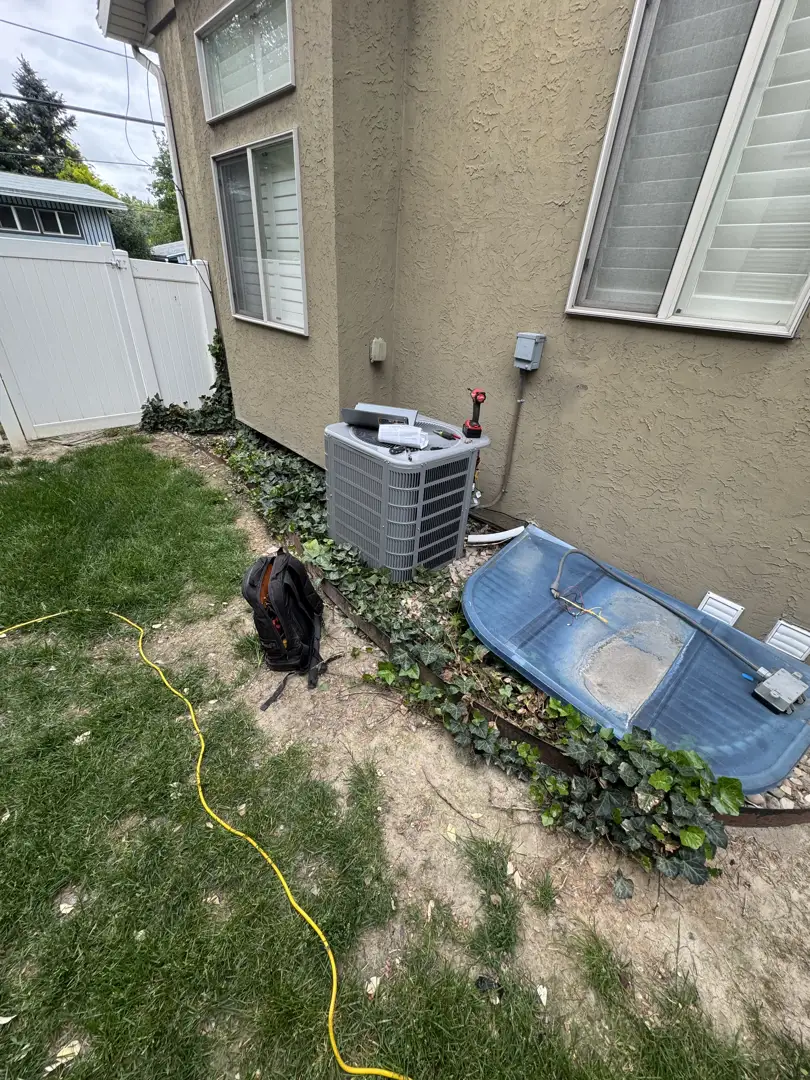

Should You Fix or Flee Your Old AC Unit?


.avif)

When to Fix and When to Walk Away: Understanding the Cost of Repairing Old AC vs Buying a New System
The cost of repairing old AC vs buying a new system is one of the most common — and stressful — decisions homeowners face, especially when a breakdown hits on the hottest day of the year. Here's a quick answer to help you decide:
| Situation | Likely Best Choice |
|---|---|
| Unit is under 10 years old, minor repair | Repair |
| Unit is 10-15+ years old, major repair needed | Replace |
| Repair cost x unit age exceeds $5,000 | Replace |
| Repair cost exceeds 50% of new system price | Replace |
| Unit uses R-22 (Freon) refrigerant | Replace |
| Small repair on a well-maintained unit | Repair |
For most Salt Lake City homeowners, the tipping point comes down to three things: how old the unit is, what the repair costs, and how much you're already spending on energy bills every month. If your system is pushing 12 to 15 years old and needs a major fix, the math often favors a new system — even if the upfront cost feels painful.
I'm Bryson Ninow, an HVAC professional with certifications in EPA, NATE, and energy efficiency, and I've helped hundreds of homeowners in the Salt Lake City area work through the cost of repairing old AC vs buying a new system to find the option that actually saves them money long-term. Let's break down exactly how to make that call with confidence.
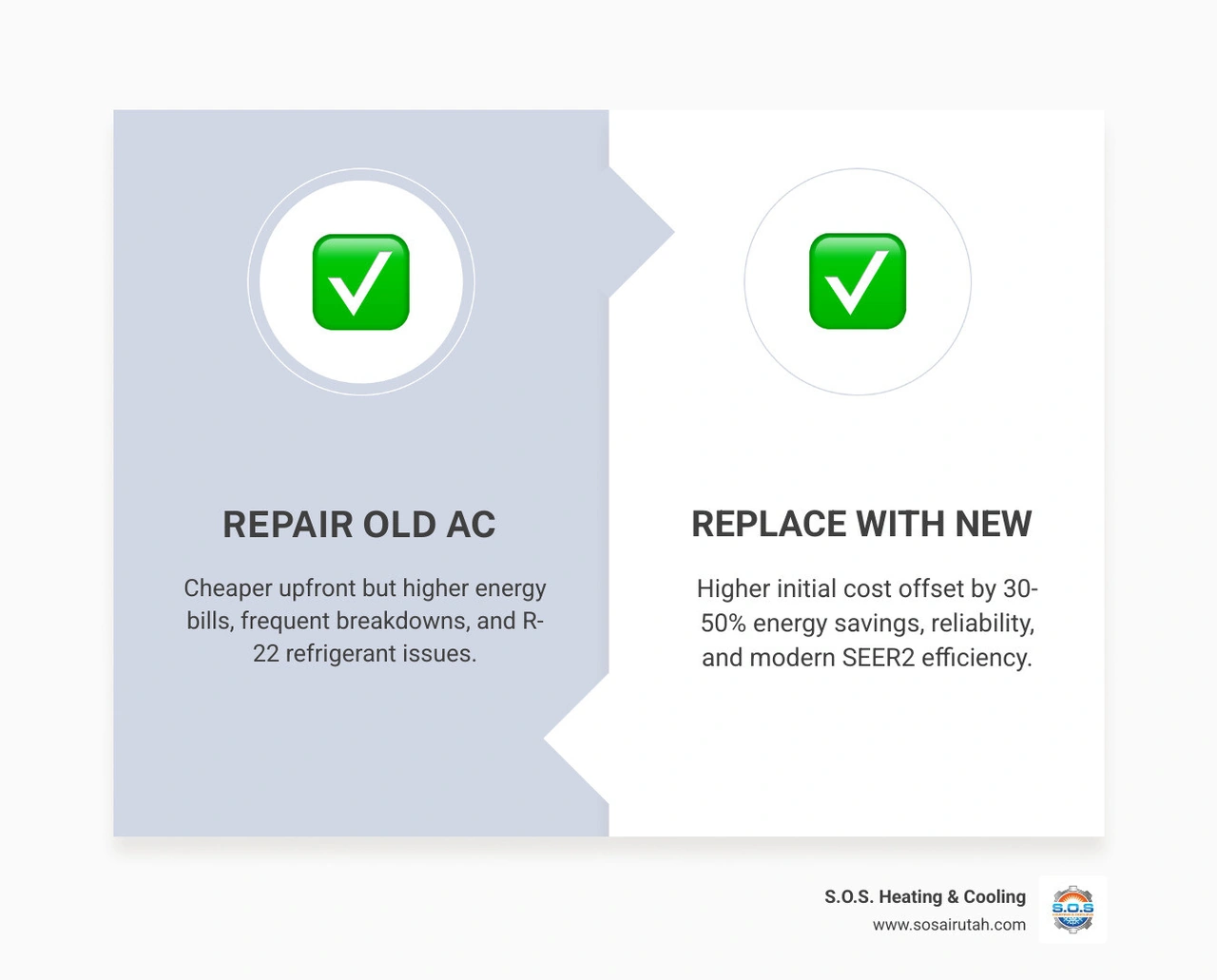
The Financial Math: Cost of Repairing Old AC vs Buying a New System
When your air conditioner stops blowing cold air in the middle of a July heatwave in Sandy or Draper, it is easy to make an emotional decision. You just want the house to be cool again. However, looking at the cost of repairing old ac vs buying a new system requires a bit of cold, hard logic.
We often see homeowners fall into the "sunk cost fallacy." This is the idea that because you spent money on a new capacitor last year and a fan motor the year before, you must keep repairing the unit to "get your money's worth." In reality, you might just be throwing good money after bad. To help our neighbors in Salt Lake City make a smart choice, we look at several industry-standard benchmarks.
| Factor | Repair Advantage | Replacement Advantage |
|---|---|---|
| System Age | 0–8 Years | 12+ Years |
| Repair Frequency | First repair in years | Two or more repairs in 12 months |
| Efficiency | High SEER/SEER2 | Low SEER (10–13) |
| Refrigerant | R-410A or R-454B | R-22 (Freon) |
| Warranty | Parts still covered | Warranty expired |
Applying the $5,000 Rule to Your Unit
One of the most reliable ways to remove the guesswork is the $5,000 Rule. This is a simple mathematical formula used by HVAC professionals to determine if a repair is a sound investment or a financial trap.
Here is how it works: Multiply the age of your AC unit (in years) by the repair estimate (in dollars).
- If the result is under $5,000, the repair is likely worth it.
- If the result is over $5,000, you should strongly consider AC repair or replacement options.
For example, if you have a 12-year-old unit in Riverton that needs a $600 blower motor, the math is $7,200. Since that is well over the $5,000 threshold, you are in the "replacement zone." However, if that same unit only needed a $150 capacitor, the result is $1,800, making the repair a reasonable "bridge strategy" to get you through the season.
Evaluating the 50% Rule for Major Repairs
Another perspective we use is the 50% Rule. This rule states that if the cost of a single repair exceeds 50% of the value of a brand-new system, you should flee the old unit and invest in a new one.
Major components like the compressor or the evaporator coil are the "engine" and "transmission" of your AC. If a compressor fails on a 10-year-old unit, the repair can be incredibly expensive. When you factor in the labor, the cost of the part, and the necessary refrigerant, you are often looking at nearly half the cost of a modern, high-efficiency installation. In these cases, spending that money on a machine with a 10-year warranty is much wiser than putting it into a machine that is already in its "late-life" stage. As we often say when discussing knowing when to replace your furnace, there comes a point where "enough is enough."
Hidden Factors Influencing the Cost of Repairing Old AC vs Buying a New System
Beyond the immediate repair invoice, there are "invisible" costs associated with keeping an aging system running. In May 2026, the landscape of HVAC technology has shifted significantly, making older units even more expensive to maintain than they were just a few years ago.
The R-22 Refrigerant Problem
If your AC was installed before 2010, there is a high probability it uses R-22 refrigerant, commonly known as Freon. The EPA fully phased out the production and import of R-22 in 2020 because of its impact on the ozone layer.
By 2026, the supply of reclaimed R-22 has become incredibly scarce and expensive. If your old unit has a refrigerant leak, "topping it off" is no longer a cheap fix. We have seen cases where a full recharge of an R-22 system can cost as much as a significant down payment on a new unit. Repairing an R-22 system is often a losing proposition; you are paying a premium for obsolete chemistry in a machine that is likely to leak again. This is a major factor in the AC repair or replacement debate.
Long-Term Savings and SEER2 Efficiency
Efficiency standards have come a long way. In 2023, the industry moved to SEER2 ratings, which are more stringent and accurate than the old SEER standards.
If you are currently running a 10 or 12 SEER unit, you are essentially paying a "clunkiness tax" every month to Rocky Mountain Power. Upgrading to a modern 16 or 18 SEER2 system can slash your cooling costs by 30% to 50%. Over a five-year period, those monthly savings add up to thousands of dollars, effectively subsidizing the cost of the new system. When you look at what you need to know before you replace your AC unit, energy ROI is usually at the top of the list.
Signs Your AC is in Terminal Decline
Sometimes the signs of a failing AC aren't just found in the math; they are found in your daily comfort. If you notice any of the following, your system is likely signaling that it’s time to retire:
- Frequent Breakdowns: If we’ve been to your house in Holladay or South Jordan twice in the last year for different issues, your unit is in a "repair spiral."
- Strange Noises: Grinding, squealing, or "jet engine" sounds usually indicate that major internal components like the motor bearings or the compressor are failing.
- Humidity Issues: An AC doesn't just cool; it dehumidifies. If your home feels "sticky" or "heavy" despite the air blowing, the system is no longer performing its primary functions effectively.
- Uneven Cooling: If the living room is a refrigerator but the bedrooms are a sauna, your blower or ductwork may be failing to distribute air properly.
When these symptoms appear in a unit over 10 years old, it is usually time to consider AC replacement rather than another temporary patch.
When to Consider a Full System Upgrade
One thing many homeowners overlook is the "matched system" concept. Your outdoor AC and your indoor furnace (or air handler) are designed to work together. If you replace the outdoor unit but leave a 20-year-old furnace in place, you likely won't achieve the advertised SEER2 efficiency, and you could even void the warranty on your new AC.
If your furnace is also aging, we often recommend replacing both at the same time. This ensures the components are perfectly matched for maximum airflow and efficiency. Plus, it saves you money on labor and avoids the stress of a furnace failure six months after you just fixed the AC. It’s worth checking out our guide on when to consider furnace replacement to see if your heating system is also on its last legs.
Maximizing Value: Incentives and Financing for New Systems
The upfront cost of a new system is often the biggest hurdle, but 2026 is a great time to buy thanks to various incentives. Under the Inflation Reduction Act, federal tax credits of up to $2,000 are available for high-efficiency heat pumps, and up to $600 for high-efficiency central AC units.
When you combine these federal credits with local utility rebates and our flexible financing options at S.O.S. Heating & Cooling, the "sticker shock" becomes much more manageable. Financing allows you to spread the cost over several years, often with monthly payments that are partially offset by your lower energy bills.
Calculating the 5-Year Cost of Repairing Old AC vs Buying a New System
To truly understand the cost of repairing old AC vs buying a new system, you have to look at a five-year horizon.
- The Repair Path: You pay for the current repair, plus the likely 2-3 more repairs that will happen as the unit continues to age. You also continue to pay high utility bills because of the low efficiency.
- The Replacement Path: You pay for the new system (minus rebates and tax credits). You pay significantly less in utilities every month. You pay $0 in repairs because the unit is under a 10-year parts and labor warranty.
Most importantly, you gain "peace of mind." There is a quantifiable value in knowing your AC won't quit on a 100-degree Sunday afternoon when you have family visiting.
Frequently Asked Questions about AC Repair and Replacement
At what age should I replace my AC instead of repairing it?
Most central AC systems last between 12 and 15 years. Once a unit passes the 10-year mark, it enters the "late-life" stage. If your unit is over 12 years old and requires a repair that costs more than a few hundred dollars, replacement is usually the smarter financial move.
Is it worth fixing an AC that uses R-22 refrigerant in 2026?
Almost never. Because R-22 is no longer produced, the cost to recharge a system is astronomical. Furthermore, an R-22 unit is likely at least 16 years old, meaning other major components are also at high risk of failure. Investing money into an R-22 system is generally considered "throwing good money after bad."
Should I replace my furnace and AC at the same time?
Yes, in most cases. HVAC systems are designed as matched sets. Replacing both at once ensures that the indoor and outdoor components communicate perfectly, maximizes energy efficiency, and typically comes with a unified warranty. It also saves on labor costs compared to doing them separately.
Conclusion
Deciding between the cost of repairing old AC vs buying a new system doesn't have to be a gamble. By using the $5,000 Rule, checking your refrigerant type, and looking at your monthly energy waste, the right choice usually becomes clear.
In the Salt Lake City area—from Bountiful down to Herriman—we experience extreme temperature swings that put a lot of stress on our HVAC systems. At S.O.S. Heating & Cooling, we are here to provide a professional, honest assessment of your unit’s health. Whether you need a quick, reliable repair to get through the week or a full system upgrade to protect your home for the next decade, we’ve got your back.
If you’re tired of the "repair spiral" and want to see what a modern, efficient system can do for your comfort and your wallet, contact us today for a professional AC repair or replacement consultation. We’ll help you keep your cool, no matter what the Utah summer throws at you.

Plumbing
Expert plumbing services offering reliable repairs, installations, maintenance, and emergency support.

Air Conditioning
Comprehensive air conditioning services include installation, repairs, maintenance, and energy-efficient solutions.
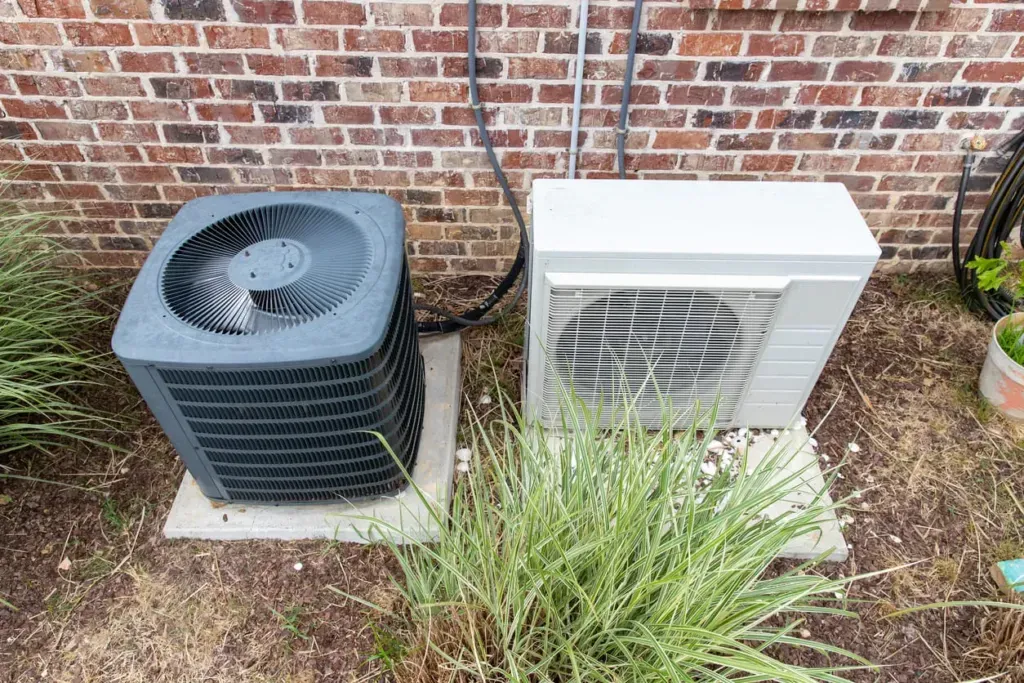
Heat Pumps
Enjoy year-round comfort with our energy-efficient and professional heat pump solutions.

Indoor Air Quality
Enhance your home’s air with our cutting-edge indoor air quality solutions you can trust.

Fireplaces
Transform your space into a warm and cozy atmosphere with our professional fireplace services.

Heating
Specialized heating services provide reliable installation, repair, system maintenance, and energy-optimization solutions.
Explore Our Latest Insights and Updates in Plumbing Services
How to Prevent Drain Backups Year Round

How Often to Change Air Filters in Dry Dusty Utah Home