

Everything You Need to Know About Installing a New Garbage Disposal


.avif)

What You Need to Know Before Installing a Garbage Disposal
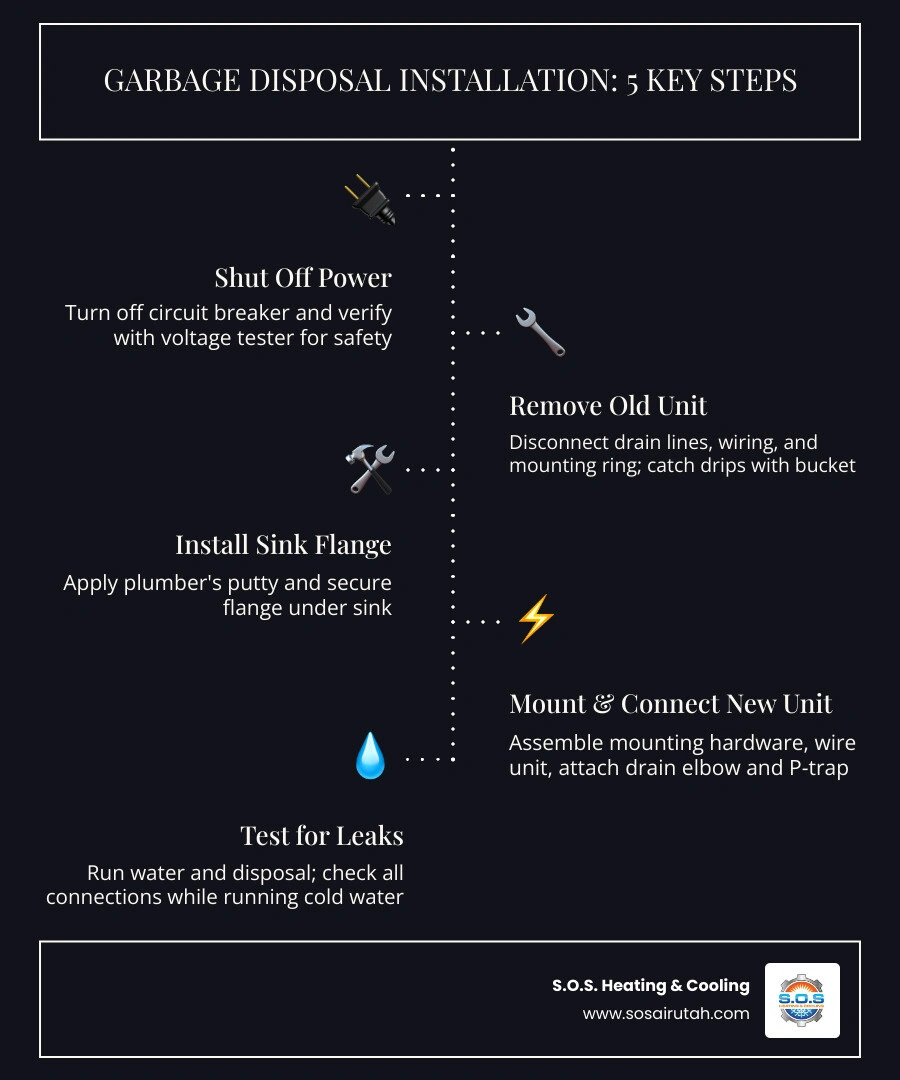
Garbage disposal installation what to know comes down to a handful of key steps and decisions that can make or break the job before you even pick up a wrench.
Here is a quick overview to get you oriented:
- Choose the right unit - Match horsepower (1/3 to 1 HP+), feed type, and septic compatibility to your household's needs
- Gather your tools - You'll need a screwdriver, channel lock pliers, plumber's putty, a voltage tester, and a bucket
- Shut off power first - Turn off the circuit breaker and verify with a voltage tester before touching any wiring
- Remove the old unit - Disconnect the drain lines, electrical connections, and mounting ring before pulling the unit free
- Install the new unit - Mount the sink flange, assemble the mounting hardware, connect the wiring, and attach the drain lines
- Test for leaks - Fill the sink with water, release it while the disposal runs, and check every connection point
Most homeowners can complete this project in one to three hours. But knowing what to expect before you start saves time, prevents leaks, and keeps you safe.
Garbage disposals are a staple of the modern kitchen. They grind food waste directly into the drain line, reducing trash and keeping your sink clear. The average unit lasts about a decade before it starts to wear out — and when that time comes, knowing how to replace it (or when to call in help) makes all the difference.
I'm Bryson Ninow, and while my background is rooted in the HVAC trades, I've spent years working alongside plumbing professionals and helping homeowners navigate home system upgrades — including everything that falls under garbage disposal installation what to know. Whether you're a confident DIYer or trying to decide if this is a job for a pro, this guide will walk you through every step clearly and honestly.
Choosing the Right Unit: Garbage Disposal Installation What to Know
Before you ever crawl under the sink, you need to make sure the unit you’ve bought is actually the right fit for your home. It’s May 2026, and the options on the market are more diverse than ever. Choosing the wrong horsepower or feed type can lead to frequent jams, excessive noise, or even plumbing backups.
Horsepower (HP) Ratings
Horsepower is essentially the "muscle" of your disposal.
- 1/3 HP: This is the entry-level motor. It is suitable for small households with one or two people who only use the disposal for light, soft scraps.
- 1/2 HP: The most common choice for average households. It provides enough power for typical food waste but can still struggle with tougher, fibrous items.
- 3/4 HP to 1 HP+: These are the "heavy hitters." If you have a large family or cook frequently, a 3/4 HP unit is the sweet spot. They tend to have more stainless steel components, run quieter, and can handle things like small bones or harder vegetable scraps without breaking a sweat.
Feed Types: Continuous vs. Batch
When looking at garbage disposal installation what to know, you’ll notice two main styles:
- Continuous Feed: These are the ones we all know. You flip a wall switch, and the unit runs while you push food into it. They are convenient but require a bit more caution to ensure nothing non-food related (like a spoon!) falls in while it’s spinning.
- Batch Feed: These only run when you put the drain cover in place and turn it. They are arguably safer for homes with curious children and don't require a wall switch, making them a popular choice for kitchen islands where wiring a switch is difficult.
Septic Compatibility and Materials
If your home in Draper or Riverton runs on a septic system, you can’t just buy any disposal. You need a model specifically labeled as "septic-safe." These units often feature an enzyme-injection system that helps break down food waste so it doesn't overwhelm your septic tank. Also, look for units with stainless steel grinding components; they resist corrosion far better than galvanized steel, especially with the hard water we often see in the Salt Lake Valley. For more details on picking a model, check out our Garbage Disposal Complete Guide Salt Lake City.

Essential Tools and Safety Preparations
Preparation is the difference between a 90-minute project and an all-day ordeal. You don't want to be halfway through a removal only to realize you’re missing a specific tool while your sink is out of commission.
Your Tool Checklist
To handle a garbage disposal installation what to know, gather these essentials:
- Screwdrivers: Both flathead and Phillips.
- Channel Lock Pliers: Essential for tightening or loosening large plumbing nuts.
- Voltage Tester: Never trust a switch alone; use a non-contact voltage tester to ensure the wires are truly dead.
- Plumber’s Putty: This is what creates the watertight seal between the sink and the flange.
- Bucket and Towels: There is always a little "soupy" water left in the P-trap. Be ready for it.
- Hammer and Blunt Dowel: You’ll need these if you are connecting a dishwasher (to knock out the drain plug).
Safety First: Electricity and Water
We cannot stress this enough: Turn off the power at the circuit breaker. Simply turning off the wall switch isn't enough because the outlet under the sink may still be energized. Once the breaker is flipped, use your voltage tester to verify.
Also, clear out everything from under the sink. You need enough room to work comfortably, and having a cramped workspace is how mistakes (and leaks) happen. If you’re in Murray and feeling a bit overwhelmed by the electrical side of things, our team at S.O.S. Heating & Cooling is always available to help. You can learn more about local services here: Garbage Disposals Murray UT.
Step-by-Step Removal and Installation Guide
Now for the "how-to" part. If you’re replacing an old unit, the removal process is actually a great way to learn how the new one goes in.
Removing the Old Unit
- Disconnect the Drain: Place your bucket under the P-trap and loosen the nuts connecting the disposal to the waste line.
- Disconnect the Dishwasher: If you have a dishwasher, unscrew the hose clamp and pull the hose off the disposal's inlet.
- Release the Disposal: Most disposals are held by a mounting ring with three tabs. Use a screwdriver as a lever in one of the tabs and turn it counter-clockwise. Warning: Disposals are heavy! Support the unit with your other hand or a box so it doesn't crash down on your fingers.
- Remove the Old Flange: Unscrew the mounting assembly from the sink and push the old sink flange up through the hole. Use a putty knife to scrape away the old, crusty plumber's putty until the sink surface is clean and smooth.
Garbage Disposal Installation What to Know: The Mounting Assembly
The mounting assembly is the "sandwich" of parts that holds the disposal to your sink. Getting the order right is vital for a leak-free seal.
- Apply the Putty: Roll a piece of plumber's putty into a rope about 3/8-inch thick (roughly the thickness of a pencil). Wrap it around the underside of the new sink flange.
- Seat the Flange: Press the flange firmly into the sink drain hole. A little putty should ooze out—this is a good sign!
- The "Sandwich": From under the sink, slide on the fiber gasket, the backup flange, and the mounting ring.
- The Snap Ring: This is often the trickiest part. Slide the snap ring up the flange until it "snaps" into the groove. This holds the whole assembly in place while you tighten the three mounting screws. Tighten these screws evenly until the assembly is tight against the sink. Wipe away the excess putty from inside the sink.
For a deeper dive into these mechanical steps, see our Garbage Disposal Murray UT Complete Guide.
Garbage Disposal Installation What to Know: Final Plumbing Connections
With the mounting hardware in place, it’s time to hang the unit and hook up the "plumbing."
- The Dishwasher Knockout: If you have a dishwasher, look at the small inlet pipe on the side of the disposal. There is a plastic plug inside. Use a hammer and a screwdriver to "knock it out" into the disposal chamber. Important: Reach inside the disposal and pull that plastic plug out! If you leave it, it will jam your new motor or damage the blades.
- Mount the Unit: Lift the disposal and align the three mounting tabs with the ramps on the mounting ring. Turn the lower ring clockwise until the unit is locked into place. You should feel it "click" or lock firmly.
- Connect the Discharge Elbow: Attach the plastic discharge elbow to the side of the disposal using the provided gasket and flange.
- Align the P-trap: Connect the discharge elbow to your house’s waste lines. You may need to rotate the disposal slightly to get everything to line up. Tighten all the PVC nuts by hand, then give them a small quarter-turn with your pliers.
If you’re working in the Sandy area, you might find that older plumbing doesn't always line up perfectly with modern units. We have more tips for local Sandy residents here: Garbage Disposals Sandy UT.
Testing, Maintenance, and Troubleshooting
Once everything is tightened, it’s time for the moment of truth.
The Leak Test
Don't just turn the water on and hope for the best. Plug the sink, fill it with about two or three inches of water, and then pull the plug. This creates a "pressure test" as a large volume of water rushes through the system. Watch the sink flange, the dishwasher connection, and the discharge elbow. If it’s bone dry, you’re good to go!
Maintenance Tips for Longevity
A disposal should last 10–12 years if you treat it right.
- Use Cold Water: Always run cold water before, during, and for 20 seconds after you finish grinding. Cold water keeps fats solid so they can be ground up and flushed away. Hot water melts fats, which then coat your pipes and cause clogs.
- The "No" List: Never put "FOG" (fats, oils, grease) down the drain. Also, avoid fibrous materials like corn husks, celery, and onion skins, as well as expanding foods like pasta and rice.
- Cleaning: Every few weeks, toss in some ice cubes and a handful of kosher salt. This "scrubs" the internal components. For a fresh scent, grind up a few citrus peels.
Troubleshooting Common Issues
- Humming but not spinning: This usually means a jam. Turn off the power, and use the hex wrench (usually included with the unit) in the hole at the very bottom of the disposal to manually rotate the motor and break the jam.
- No power at all: Check the red "reset" button on the bottom of the unit. If the motor gets overworked, it trips this internal breaker. Push it back in and try again.
Frequently Asked Questions about Garbage Disposal Installation
How long does a typical garbage disposal installation take?
For a handy homeowner, a standard replacement takes about 1 to 2 hours. If you are installing one for the first time where there wasn't one before—meaning you have to add an electrical outlet and modify the plumbing—it can take 3 hours or more. A professional plumber can usually swap a unit in under an hour if the plumbing is already in good shape.
What should I do if I have a dishwasher connected to the disposal?
The most critical step is removing that knockout plug mentioned earlier. If you forget, your dishwasher won't drain, and you’ll end up with a mess. Additionally, ensure your dishwasher drain hose has a "high loop"—meaning it is fastened to the underside of the countertop before it connects to the disposal. This prevents dirty sink water from siphoning back into your clean dishwasher.
When is it best to hire a professional instead of doing a DIY installation?
While many enjoy the DIY route, there are times when it’s safer and more cost-effective to call us at S.O.S. Heating & Cooling. You should consider a professional if:
- You need a new electrical circuit or outlet installed.
- The new disposal’s discharge doesn't line up with your existing wall drain (this requires repositioning the pipes).
- You have a specialized sink material (like soapstone or thin-gauge stainless) that requires specific sealing techniques.
- You want the peace of mind that comes with a professional warranty and guaranteed leak-free performance.
Conclusion
Installing a new garbage disposal is one of those projects that provides immediate satisfaction. No more soggy food scraps in the trash and a much cleaner kitchen workflow. By following this guide on garbage disposal installation what to know, you’re well on your way to a successful setup.
The key to a long-lasting disposal isn't just a good installation—it's consistent maintenance. Use plenty of cold water, avoid the "forbidden" foods, and give it a good cleaning once a month.
If you run into trouble or simply want the job done right the first time, S.O.S. Heating & Cooling is here for all our neighbors in Salt Lake City, South Salt Lake, and the surrounding areas. We offer 24/7 emergency repairs and flexible financing to make sure your home stays comfortable and functional.
Ready for expert help? Check out our services in South Salt Lake here: Garbage Disposals South Salt Lake UT, or browse our full range of Professional Plumbing Services.
Explore Our Latest Insights and Updates in Plumbing Services
Tankless vs Tank Water Heater: Utah Homeowner Guide
How to Detect Hidden Pipe Leak in Salt Lake Valley

How Freeze-Thaw Cycles Stress Utah Sewer Lines (and How to Avoid Damage)