

Ultimate Guide to How a Whole Home Humidifier Makes Your Heating System Feel Warmer in a Dry Utah Winter


.avif)

Why a Whole Home Humidifier Makes Your Heating System Feel Warmer in a Dry Utah Winter
Understanding how a whole home humidifier makes your heating system feel warmer in a dry Utah winter comes down to one simple idea: moist air holds heat better than dry air, and it slows the rate at which your body loses warmth through evaporation. Here's a quick summary:
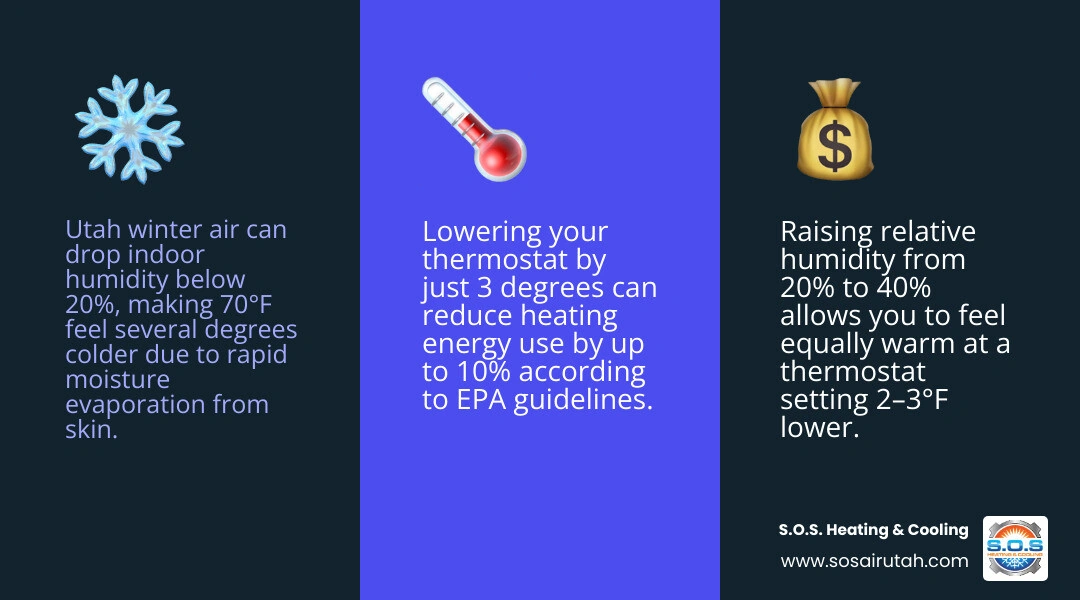
- Dry air pulls heat away from your body faster, making you feel colder even when the thermostat reads 70°F
- A whole-home humidifier adds moisture to the air circulating through your HVAC system, raising indoor relative humidity to a comfortable 30–50%
- Humid air feels warmer at the same temperature, so you can lower your thermostat by 2–3 degrees without feeling any less comfortable
- That thermostat reduction translates to real savings — according to the EPA, you can save up to 4% on your heating bill for every degree you lower your thermostat
- Utah winters are especially harsh because the state's arid, high-elevation climate can push indoor humidity below 20% — lower than the Sahara Desert on some days
If you've ever cranked up the heat in January and still felt cold, dry air is likely the reason. Utah's desert climate and high elevation already strip moisture from the air before winter even begins. Then your furnace kicks on, heats that already-dry air even further, and the result is an indoor environment that can feel raw and chilly no matter how hard your heating system works. It's a comfort problem that a higher thermostat setting alone simply cannot fix.
My name is Bryson Ninow, and as an HVAC professional with certifications in indoor air quality and energy efficiency, I've helped countless Salt Lake City homeowners discover how a whole home humidifier makes their heating system feel warmer in a dry Utah winter — often while lowering their monthly utility bills at the same time. Read on for a complete, practical guide to how it all works.
The Science of Dry Air and Perceived Temperature in Utah

To understand how moisture levels dictate your comfort, you have to look at the physics of how human beings experience temperature. Your skin is incredibly sensitive to moisture levels in the surrounding air. When the air is dry, it acts like a giant sponge, constantly pulling moisture away from any source it can find—including your body.
Why Utah Winters Are Exceptionally Dry
Utah is famous for its "Greatest Snow on Earth," but that legendary powder is only possible because our atmosphere is naturally arid. The state lies in a high-elevation desert, heavily influenced by the rain shadow effect of the Sierra Nevada and Cascade mountain ranges. When Pacific storm systems travel eastward, they dump most of their moisture on the western slopes of those coastal ranges long before reaching the Great Basin.
As a result, northern Utah locations like Bountiful, Layton, and Salt Lake City experience incredibly dry outdoor air.
Furthermore, cold air inherently lacks the capacity to hold water vapor. When outdoor temperatures drop to 20°F or 30°F along the Wasatch Front, the air can hold only a fraction of the moisture that warm summer air carries.
When you draw that cold, dry outdoor air into your home and run it through a standard forced-air furnace, the heating process expands the air but adds zero moisture. The relative humidity (RH) inside a typical unhumidified Utah home in January can easily plummet to 10% or 15%. To put that into perspective, the Sahara Desert averages about 25% relative humidity.
The Science Behind How a Whole Home Humidifier Makes Your Heating System Feel Warmer in a Dry Utah Winter
Why does dry air make you feel like you are freezing inside your own living room? The answer lies in evaporative cooling.
Your body naturally regulates its temperature by evaporating microscopic amounts of moisture from your skin. In a highly humid environment, this evaporation process slows down because the surrounding air is already saturated with water vapor. In a dry environment, the air aggressively evaporates moisture from your skin at an accelerated rate.
Because evaporation is a cooling process, this rapid loss of moisture acts like a personal air conditioner running directly on your skin. It strips away your body's natural thermal boundary layer, making 72°F feel more like 68°F.
By utilizing a whole-home system to add controlled water vapor back into the air, you slow down this rate of sweat evaporation. The moisture remains on your skin slightly longer, preserving your body's natural heat.
Additionally, moist air has a higher thermal conductivity and heat retention capacity than bone-dry air. It holds onto the heat generated by your furnace far more effectively, creating a more stable, comfortable "heat index" inside your home.
This is the core reason How Humidifiers Improve Winter Comfort in Dry Climates is such an important topic for Wasatch Front residents. When you balance the humidity, you change how your body interacts with the ambient air temperature, solving the root cause of winter chilliness described in our guide on How Low Humidity Affects Your Comfort and Your AC.
How a Whole Home Humidifier Makes Your Heating System Feel Warmer in a Dry Utah Winter
Now that we understand the science of human comfort and evaporative cooling, let's look at how adding a whole-home humidification system alters the actual operation of your heating system and thermostat.
Step-by-Step: How a Whole Home Humidifier Makes Your Heating System Feel Warmer in a Dry Utah Winter
When a whole-home humidifier is installed, it doesn't just sit in a corner blowing mist into a single room. Instead, it integrates directly with your central HVAC ductwork and water supply line. Here is exactly how it transforms your indoor climate:
- The Humidistat Detects Dryness: Just as your thermostat monitors temperature, a digital humidistat monitors the relative humidity of the air inside your home. If the humidity falls below your target setting (usually between 30% and 40% for a cold Utah winter), the humidistat signals the humidifier to activate.
- Water Meets the Heating Cycle: As your furnace turns on to heat your home, a solenoid valve opens on the humidifier, allowing a controlled stream of water to flow across an evaporative pad (or vaporize via a steam canister).
- Moisture Integrates into the Airflow: Dry, warm air from your furnace passes directly through this water panel. The heat from the furnace evaporates the water, instantly turning it into invisible, clean water vapor.
- Whole-Home Distribution: Your HVAC blower fan pushes this warm, perfectly humidified air through your supply ducts, distributing it evenly to every single room in your home—from Sandy to Centerville.
- A Consistent Comfort Level is Maintained: Because the system is integrated with your central heating, you don't experience the dramatic humidity spikes and drops common with portable units. The entire house maintains a stable, balanced relative humidity level.
To learn more about finding the perfect balance for your specific home, check out our resources on Ideal Indoor Humidity Levels for the Wasatch Front and Perfect Home Humidity Levels.
Lowering the Thermostat Without Losing Comfort
The most exciting benefit of this process is the direct impact on your energy consumption. When your indoor relative humidity is sitting at a healthy 35% to 45%, the air feels significantly warmer than it actually is.
This allows you to turn your thermostat down by 2 or 3 degrees without experiencing any loss of comfort. In fact, most homeowners report that 68°F with proper humidity feels warmer and vastly more comfortable than 71°F in a bone-dry house.
This simple adjustment yields substantial financial rewards:
- Reduced Furnace Strain: Your furnace doesn't have to cycle as frequently or run as long to keep you feeling cozy, which extends the lifespan of your expensive heating equipment.
- Direct Bill Savings: Utah households spend an average of $877 annually on heating. However, using a whole-home humidifier can reduce those heating costs by up to 10%.
- Proven Efficiency: Lowering your thermostat by just 3 degrees can save up to 5% on your heating bill when using a whole-home humidifier. According to the EPA, you can save up to 4% on your heating bill for every single degree you lower your thermostat.
Integrating a Humidifier with Your Existing HVAC System
A whole-home humidifier is not a one-size-fits-all appliance. To get the best performance, it must be carefully matched to your existing heating system, duct layout, and the square footage of your home. If you live in areas like Salt Lake City, Draper, or Sandy, we can help you select and install the ideal unit for your space. Check out our services for Whole Home Humidifiers Salt Lake City UT to explore your options.
Bypass vs. Flow-Through vs. Steam Humidifiers
There are three primary types of whole-home humidifiers that integrate with residential HVAC systems. Each has its own distinct advantages depending on your home's size and heating configuration:
- Bypass Humidifiers: These units are installed on either the supply or return plenum of your furnace. A dedicated bypass duct channels a portion of the warm air from the furnace through the humidifier's water panel and back into the system. Bypass systems are highly reliable, cost-effective, and have very few moving parts. They are perfect for small to mid-sized homes.
- Flow-Through (Fan-Powered) Humidifiers: Unlike bypass units, fan-powered humidifiers have their own built-in electric fan that actively pulls air across the water panel. This allows them to produce more moisture daily, making them an excellent choice for larger homes or systems where duct space is limited.
- Steam Humidifiers: Often considered the "gold standard" of humidification, steam systems generate their own steam by boiling water electrically. This steam is then injected directly into your ductwork. Steam humidifiers operate independently of whether your furnace is actively heating, providing incredibly precise control. They are highly recommended for large homes, homes with high-end hardwood floors, or households with expensive musical instruments like pianos.
To help you visualize the difference between these whole-home systems and the common portable retail units, we've put together this quick comparison table:
| Feature | Whole-Home Humidifiers (Bypass / Steam) | Portable Room Humidifiers |
|---|---|---|
| Coverage Area | Entire home (up to 5,000+ sq. ft.) | Single room or small zone (under 400 sq. ft.) |
| Maintenance | Once-a-year pad replacement and cleaning | Daily water refills, cleaning every 2–3 days |
| Water Source | Connected directly to home's water line | Manual filling of heavy water tanks |
| Aesthetics | Completely hidden out of sight in the utility closet | Visible plastic unit taking up floor/table space |
| Noise Level | Whisper quiet (integrated with central HVAC) | Can be noisy with buzzing fans near your bed |
| Risk of Mold | Negligible (monitored by smart humidistat) | High if water sits or humidity is over-concentrated |
How Humidification Protects Your Furnace and Reduces Wear
When your indoor air is balanced and comfortable, your furnace operates under much lighter conditions. In a dry home, residents often experience "temperature chasing"—constantly walking to the thermostat to raise the temperature because they feel cold, only to turn it down later when the house gets stuffy.
This constant adjusting causes your heating system to short-cycle (turn on and off rapidly). Short-cycling is incredibly hard on a furnace, leading to premature component failure, cracked heat exchangers, and wasted energy.
A whole-home humidifier helps maintain a stable, consistent indoor climate. By eliminating the need to constantly adjust the thermostat, your furnace runs in longer, more efficient, and balanced cycles. This drastically reduces wear and tear, helping your heating system last years longer.
Health and Home Protection Benefits of Proper Humidity
While feeling warmer and saving money on heating are incredible benefits, adding moisture to your indoor air also provides critical protection for your physical health and your home's physical structure. In dry high-desert climates like northern Utah, maintaining balanced humidity is a necessity, as outlined in our Humidity Control Benefits for High Desert Homes.
Preventing Wood Damage, Static, and Structural Cracking
Wood is a hygroscopic material, meaning it acts like a sponge—it naturally absorbs and releases moisture to stay in equilibrium with the surrounding air. When Utah's winter air dries out your home, it strips moisture directly out of your wooden structures.
This leads to several common household issues:
- Gaps in Hardwood Floors: You may notice wide, unsightly gaps forming between your floorboards during the winter.
- Structural and Trim Cracking: Wooden crown molding, door frames, and cabinets can shrink, pull away from walls, or develop cracks.
- Squeaky Stairs and Subfloors: As wood shrinks and rubs against fasteners, irritating squeaks develop.
- Damage to Musical Instruments: Pianos, acoustic guitars, and violins are highly sensitive to low humidity and can easily warp, crack, or go out of tune.
Additionally, dry air is a primary contributor to static electricity. If you are tired of getting zapped every time you touch a doorknob or pet your cat, a humidifier is the solution.
Homes with balanced humidity experience 20% fewer repairs related to wood damage or static electricity each year. For a deeper look at identifying these dry-air warning signs, read our guide on the Signs Your Home Is Too Dry or Too Humid.
Reducing Airborne Viruses and Improving Sleep Quality
Your body’s first line of defense against illness is your mucous membranes in your nose and throat. When you breathe dry air all night, these membranes dry out and crack, making it much easier for cold and flu viruses to bypass your immune system.
Furthermore, research shows that influenza and other airborne viruses survive and spread far more easily in dry air. In dry conditions, viral droplets break down into smaller, lighter particles that can float in the air for hours.
Maintaining indoor humidity levels between 40–60% can reduce the transmission of airborne viruses by up to 30%. This is why keeping your home properly humidified is one of the best preventative health measures you can take for your family, as discussed in our Humidity Health Home Guide 2026.
Proper humidity also does wonders for your sleep. If you wake up with a scratchy throat, dry nasal passages, or a persistent morning cough, dry air is likely the culprit. Adding moisture to the air lubricates your airways, which can significantly reduce snoring and congestion.
To learn more about optimizing your bedroom environment for a restful night, check out our articles on how to Enhance Sleep Quality with Better Indoor Air and The Connection Between Room Temperature and Sleep Quality.
Frequently Asked Questions about Utah Home Humidification
What is the ideal indoor relative humidity range for Utah winters?
For most homes along the Wasatch Front, the ideal indoor relative humidity range during the winter is 30% to 40% (and up to 45% on milder winter days).
While 40% to 60% is ideal for health, keeping your home at 50% humidity when it is 10°F outside can cause issues. When warm, humid indoor air hits a freezing window pane, it condenses into water droplets. Over time, this condensation can rot wooden window frames, ruin drywall, and encourage mold growth.
Modern whole-home humidifiers use outdoor temperature sensors to automatically adjust your indoor humidity target. On extremely cold nights, the system will temporarily drop the humidity level to prevent window condensation, then raise it back up as outdoor temperatures rise.
Can a whole-home humidifier help lower my heating bills?
Yes, absolutely! Because humid air slows down the rate of evaporative cooling on your skin, you will naturally feel warmer at lower temperatures.
Instead of setting your thermostat to 71°F, you can set it to 68°F and feel just as cozy. Since you save up to 4% to 5% on your heating bills for every degree you lower your thermostat, this small shift can easily reduce your monthly gas and electricity bills by up to 10% over the course of a long Utah winter.
What maintenance is required for a whole-home humidifier?
Whole-home humidifiers are incredibly low-maintenance compared to portable units, but they do require some basic annual attention:
- Replace the Water Panel (Evaporative Pad): For bypass and flow-through systems, the water panel should be replaced once or twice per heating season, depending on the hardness of your local water supply.
- Inspect the Drain Line: Ensure the condensate and drain lines are clear of debris or mineral scale.
- Clean the Water Distribution Tray: Wipe away any mineral deposits that have accumulated from your tap water.
- Seasonal Shutoff: At the end of the spring heating season, you should turn off the water supply to the humidifier and set your humidistat to "Off" for the summer.
We highly recommend scheduling this quick inspection as part of your annual professional HVAC maintenance.
Conclusion
A dry Utah winter doesn't have to mean living with dry skin, static shocks, and an overworked heating system that never quite makes you feel warm. By understanding how a whole home humidifier makes your heating system feel warmer in a dry Utah winter, you can take control of your indoor climate, protect your health, save money on your utility bills, and extend the lifespan of your furnace.
At S.O.S. Heating & Cooling, we are dedicated to helping homeowners across Salt Lake City, Sandy, South Jordan, Draper, Riverton, Millcreek, and the surrounding communities enjoy pristine indoor air quality and ultimate winter comfort. Whether you need a quick system inspection, a furnace tune-up, or a professional whole-home humidifier installation, our expert technicians are ready to help.
Don't spend another winter shivering in dry air. Contact S.O.S. Heating & Cooling today to schedule a consultation and bring true, cozy comfort back to your Utah home!
Explore Our Latest Insights and Updates in Plumbing Services
Summer AC Maintenance Checklist for Salt Lake Valley Homeowners
How to Fix AC Tripping the Breaker in Your Salt Lake Home

How to Fix Constant AC Running from Poor Insulation