
The Homeowner Guide to Surviving the R-410A Phase Down


.avif)

Why How AC Refrigerant Changes Affect Homeowners Matters More Than Ever in 2026
How AC refrigerant changes affect homeowners comes down to a few key realities you should know right now:
- Your current system is not illegal. If you have an R-410A or R-22 system, you can keep using and repairing it.
- New AC installations changed as of January 1, 2026. Any new system installed after that date must use a low-GWP refrigerant like R-454B or R-32.
- Retrofitting is not an option. New refrigerants are not compatible with older systems due to differences in pressure, chemistry, and safety requirements.
- Repair costs on older systems will rise. As R-410A is phased down, the refrigerant becomes harder to source and more expensive.
- New equipment costs more upfront. Systems built for the new refrigerants include advanced safety technology, which drives up the price.
- You are not alone. Every homeowner with a central AC system in Salt Lake City is navigating this same transition.
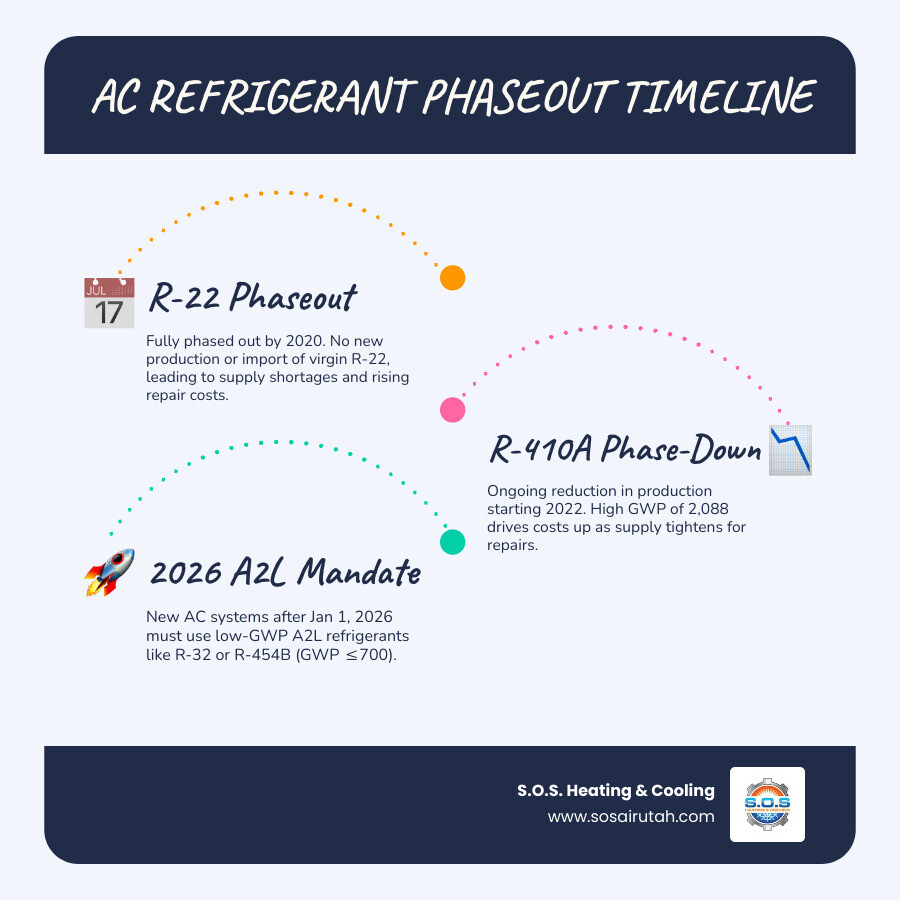
The HVAC industry is in the middle of one of its biggest shifts in decades. Driven by the EPA's authority under the AIM Act and aligned with the global Kigali Amendment to the Montreal Protocol, the phase-down of high-GWP refrigerants like R-410A is well underway. R-410A carries a Global Warming Potential more than 2,000 times that of carbon dioxide — and the new replacements cut that impact by roughly 65%. This is not just a regulatory checkbox. The broader effort to phase out ozone-depleting and climate-damaging refrigerants is projected to prevent more than 280 million cases of skin cancer and 45 million cases of cataracts among Americans born between 1890 and 2100.
For homeowners in Salt Lake City and along the Wasatch Front, where summers push your AC hard and the stakes of a breakdown are real, understanding what these changes mean for your system — and your wallet — is essential.
I'm Bryson Ninow, an HVAC professional with certifications including EPA, NATE, DOPL, and RMGA, and I've spent years helping homeowners navigate exactly these kinds of shifts — including how AC refrigerant changes affect homeowners who are trying to make smart, budget-conscious decisions about their equipment. In the sections ahead, I'll walk you through everything you need to know to make confident, informed choices about your system.
Understanding How AC Refrigerant Changes Affect Homeowners in 2026
The core reason we are seeing these shifts is the Global Warming Potential (GWP) of the chemicals we use to keep our homes cool. For years, R-410A (often known by brand names like Puron) was the gold standard because it didn't deplete the ozone layer. However, it was discovered that R-410A is a potent greenhouse gas, with a GWP of 2,088. This means it is over 2,000 times more effective at trapping heat in the atmosphere than CO2.
To address this, the EPA has mandated a transition to refrigerants with a GWP of 700 or less. This shift is part of the American Innovation and Manufacturing (AIM) Act, which aligns the U.S. with international agreements like the Kigali Amendment. By reducing our reliance on these high-GWP substances, we are significantly lowering the climate impact of our cooling systems.
| Refrigerant Type | Global Warming Potential (GWP) | Status in 2026 |
|---|---|---|
| R-22 (Freon) | 1,810 | Phased out; reclaimed only |
| R-410A (Puron) | 2,088 | Phased down; no new installs |
| R-32 | 675 | Approved (Low GWP) |
| R-454B | 466 | Approved (Low GWP) |
Beyond the climate, the health benefits are staggering. Phasing out ozone-depleting substances is expected to avoid approximately 1.6 million skin cancer deaths in the United States. When you look at the big picture, how ac refrigerant changes affect homeowners is a story of trading old, high-impact chemicals for modern, safer alternatives.
The Shift to A2L Refrigerants: R-32 and R-454B
As we move into 2026, you will start hearing the term "A2L." This is a new safety classification for refrigerants like R-32 and R-454B. These are considered "mildly flammable." While that sounds a bit intimidating, it simply means they are very difficult to ignite and burn slowly if they do. To put it in perspective, many household items you already use, like hairspray or certain cleaners, are more flammable than A2L refrigerants.
Because of this classification, manufacturers have redesigned HVAC equipment with advanced safety features. New systems now include built-in Refrigerant Detection Systems (RDS). If these sensors detect a leak, they automatically trigger the indoor blower motor to dissipate the gas, preventing it from reaching a concentration that could pose a risk.
However, even with these safety features, it is still vital to understand how to prevent AC refrigerant leaks. Leaks don't just affect safety; they also reduce the energy efficiency of your unit. Interestingly, while R-454B is a blend that contains some PFAS (often called "forever chemicals"), R-32 does not, leading to ongoing industry debates about the long-term environmental trade-offs.
Managing Your Existing R-410A or R-22 System
If your air conditioner was installed before 2025, it likely uses R-410A. If it's a real veteran (pre-2010), it might even use R-22. One of the most common questions we get is whether you can simply "drop in" the new refrigerants into your old unit.
The short answer is: No.
New A2L refrigerants operate at different pressures and require specific oils and components that older systems simply don't have. Retrofitting is generally considered impractical and cost-prohibitive. If your system is struggling, you might be resolving AC refrigerant pressure issues in Murray, but eventually, the cost of specialized repairs may outweigh the value of the unit.
You can find out what your system uses by looking at the nameplate on your outdoor condenser. If you notice your AC makes grinding and squealing sounds, it could be a sign of mechanical stress caused by low refrigerant or aging components.
How AC refrigerant changes affect homeowners with older units
For those with older units along the Wasatch Front, the biggest impact will be on your maintenance budget. While R-410A is not banned for use in repairs, the EPA is strictly limiting its production. This creates a supply-and-demand squeeze. Just as we saw with the R-22 phase-out, the price of reclaimed R-410A is expected to climb significantly.
If you experience AC suction line freeze problems in Murray, it often indicates a leak. In the past, a simple "top-off" might have been a cheap fix. Moving forward, that "top-off" will become increasingly expensive, making a full system replacement a more logical financial move for units nearing the end of their 15-to-20-year lifespan.
Identifying and Addressing Refrigerant Leaks
Refrigerant is the lifeblood of your AC. It doesn't get "used up" like gasoline; it circulates in a closed loop. If your system is low, you have a leak. One of the most obvious signs of a leak is a frozen evaporator coil. If you need to fix an AC that freezes up in Salt Lake City, it’s often because the low refrigerant pressure caused the coil temperature to drop below freezing, turning condensation into ice.
Other symptoms include:
- Hissing or bubbling sounds near the refrigerant lines.
- Oily residue on the copper lines or near the coils (refrigerant carries oil for the compressor).
- Warm air blowing from your vents despite the thermostat being set to "cool."
- Unexplained spikes in your utility bills.
If you see ice forming on your AC unit, understanding the causes and what to do is critical to saving your compressor, which is the most expensive part of the system. We specialize in how to fix AC leaks in Salt Lake City to ensure your home stays comfortable without breaking the bank.
Why how AC refrigerant changes affect homeowners with leaks
Leaking refrigerant isn't just a mechanical problem; it's a legal and safety issue. Under Section 608 of the Clean Air Act, it is illegal to knowingly vent refrigerants into the atmosphere. This is why you should only hire EPA-certified technicians who use proper recovery equipment.
From a safety perspective, refrigerants are heavier than air. If a large leak occurs in an enclosed space, the gas can pool at floor level, displacing oxygen. This can lead to dizziness or respiratory irritation, especially for pets and small children who are closer to the ground.
Preparing for the future: how AC refrigerant changes affect homeowners
The best way to stay ahead of these changes is through proactive planning. Here in Utah, our rapid seasonal swings put immense stress on HVAC systems. We recommend:
- Professional Inspections: Have a certified technician check your refrigerant levels and coil health every spring.
- Energy Star Upgrades: If your system is over 12 years old, look into ENERGY STAR certified units. These can cut your annual energy bills by more than $160.
- Utility Rebates: Check with local utility providers for incentives that offset the cost of upgrading to high-efficiency, low-GWP systems.
- Smart Thermostats: These can reduce the workload on your system, extending its life during those sweltering July afternoons.
Frequently Asked Questions About the 2026 Refrigerant Transition
Do I need to replace my AC immediately because of the new laws?
No. There is no law requiring you to rip out a working R-410A system. You can continue to use and repair your existing unit for as long as parts and reclaimed refrigerant are available. However, you should prepare for repair costs to rise as the chemical supply diminishes.
Can I use the new R-454B or R-32 refrigerant in my old R-410A system?
No. These refrigerants are not "drop-in" replacements. The new gases require different pressures and specialized safety sensors that are only found in systems designed specifically for them. Attempting to mix refrigerants can destroy your compressor and create safety hazards.
Are the new mildly flammable A2L refrigerants safe for my home?
Yes. While they are classified as "mildly flammable," they are very difficult to ignite. The new systems are required to have leak detection technology that automatically vents the system if a leak is detected, making them incredibly safe for residential use.
Conclusion
Navigating how ac refrigerant changes affect homeowners doesn't have to be a headache. Whether you are looking to squeeze a few more years out of your current R-410A unit or you're ready to upgrade to a modern, eco-friendly A2L system, we are here to help. At S.O.S. Heating & Cooling, we serve families from Bountiful to Draper and everywhere in between, providing the expert guidance you need to keep your home comfortable and compliant.
Don't wait for a mid-summer breakdown to think about your refrigerant. Schedule your expert air conditioning service today and let us help you prepare for the future of home cooling.
Explore Our Latest Insights and Updates in Plumbing Services
What Should Your Wasatch Front Home Humidity Actually Be
High Altitude HVAC: What Every Utah Homeowner Should Know
Upgrade Your Comfort with the Science of Advanced Air Conditioning