

Don't Let Your Humidifier and AC Fight Like Siblings


.avif)

Why Understanding How Adding a Humidifier Works With Your AC in Dry Weather Can Transform Your Home Comfort
How adding a humidifier works with your AC in dry weather comes down to one simple idea: your AC cools the air by pulling moisture out of it, and in an already-dry climate like Salt Lake City, that can leave your indoor air uncomfortably parched. A humidifier steps in to put controlled moisture back in, so you get cool air and a humidity level that actually feels good to breathe.
Here is a quick breakdown of how the two systems interact:
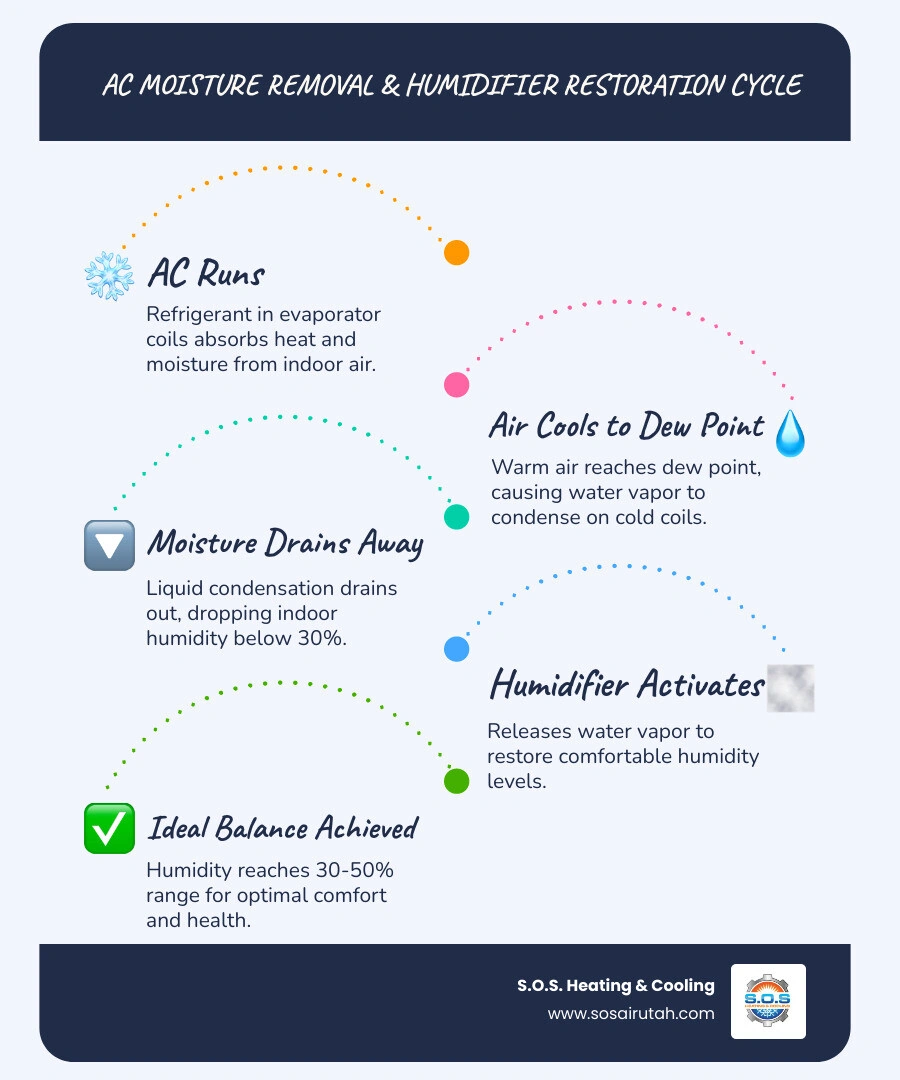
- Your AC runs - refrigerant in the evaporator coils absorbs heat and moisture from the air, draining it away.
- Indoor humidity drops - in dry climates, this can push levels well below 30%, causing dry skin, irritated sinuses, and static shocks.
- Your humidifier adds moisture back - releasing water vapor to restore levels to the comfortable 30-50% range.
- The two systems find balance - with the right settings, they work together rather than against each other.
If your home's humidity is already low before you even flip on the AC, running your cooling system without a humidifier can make things noticeably worse fast.
I'm Bryson Ninow, an HVAC professional with certifications including NATE, EPA, and RMGA, and a deep focus on indoor air quality and energy efficiency — the exact areas that matter most when figuring out how adding a humidifier works with your AC in dry weather. In the sections below, I'll walk you through everything you need to know to get both systems working in harmony rather than fighting each other.
The Science of Cooling: How Your AC Dries Out the Air
To understand why your home feels like a desert in May 2026, we have to look at the mechanics of Air Conditioning. Most people think their AC only "creates cold," but it is actually a heat and moisture removal machine.
Inside your AC unit, there are evaporator coils filled with cold refrigerant. As the warm air from your home is pulled over these coils, the refrigerant absorbs the heat. However, there is a secondary effect: as the air cools, it reaches its "dew point." This is the temperature at which air can no longer hold its water vapor. That vapor turns into liquid water (condensation) on the cold coils—much like the droplets that form on a cold glass of lemonade on a patio in Layton, UT.
This moisture drips into a drain pan and is piped out of your home. While this is a blessing in humid places like Florida, in our arid Utah climate, it’s often an accidental "over-drying" process. The AC doesn't know the air is already dry; it just removes moisture as a byproduct of cooling. This can drop your indoor humidity levels to 20% or lower, which is where the discomfort begins.
How Adding a Humidifier Works With Your AC in Dry Weather
In arid climates like ours, we face a unique challenge. We need the cooling power of the AC to handle those 90-degree Utah summers, but we don't necessarily need the dehumidification that comes with it. This creates a "competition" between your appliances. Your AC is working to pull moisture out, while your humidifier is working to put it back in.
It might seem counterintuitive to run both, but Perfect Home Humidity Levels are essential for true comfort. When the air is too dry, your body’s natural cooling process—sweating—happens too quickly. This can actually make you feel "chilled" or clammy rather than comfortably cool. By adding a humidifier to the mix, you’re creating a balanced environment where the air has enough "body" to feel pleasant against your skin.
Why You Need a Humidifier With Your AC in Dry Weather
Living in places like Salt Lake City or Sandy means dealing with naturally low outdoor humidity. When you add AC to that equation, your Indoor Air Quality can suffer significantly. Here is why that balance matters for your health and home:
- Respiratory Health: Dry air dries out the mucous membranes in your nose and throat. This can lead to a scratchy throat, dry cough, and even increased snoring. Maintaining humidity between 30% and 50% helps keep these passages moist, reducing irritation.
- Skin Hydration: Have you noticed your skin feels itchy or that your lips are constantly chapped even in the summer? That’s the AC stealing moisture from your body. A humidifier helps your skin retain its natural oils.
- Static Electricity: Low humidity is the primary cause of static shocks. If you’re getting zapped every time you touch a light switch in your Murray home, your humidity is likely below 30%.
- Virus Protection: Research shows that many airborne viruses thrive in dry air. Raising indoor humidity to around 43% can actually make a large percentage of airborne virus particles ineffective by making them "heavy" so they drop to the ground.
Maintaining Balance: How Adding a Humidifier Works With Your AC in Dry Weather
You might worry that adding moisture will make your AC work harder, and technically, you're right. Moist air holds more heat energy than dry air, which means the AC has to process that extra energy. However, there is a major "comfort trade-off."
When your humidity is balanced, you can often set your thermostat a degree or two higher and feel just as comfortable. This is because properly humidified air slows down the evaporation of moisture from your skin, helping you feel "warmer" at a higher temperature.
To keep things efficient, consider Whole House Air Filtration Salt Lake City UT alongside your humidity control. Clean filters ensure that your AC doesn't have to struggle with airflow while it manages the moisture levels. The goal is to avoid "over-humidifying," which can lead to mold. Keeping the range between 30-50% is the "Goldilocks" zone for Utah homeowners.
Choosing the Right Moisture Solution for Your Home
When deciding how to add moisture back into your cooled air, you have two main paths: portable units or whole-home systems. For most families in the Salt Lake Valley, a whole-home solution is the most effective way to ensure consistent comfort in every room.
| Feature | Portable Humidifier | Whole-Home Humidifier |
|---|---|---|
| Coverage | Single Room | Entire House |
| Maintenance | Daily refills & weekly cleaning | Annual or semi-annual service |
| Noise | Can be loud (fan/gurgling) | Silent (integrated into HVAC) |
| Control | Manual settings | Automatic via humidistat |
| Aesthetics | Visible unit & cords | Hidden in ductwork |
For those looking at Whole Home Humidifiers Sandy UT, there are a few specific types to consider:
- Steam Humidifiers: These are the "heavy hitters." They boil water to create pure steam, which is then injected into your airflow. They work independently of your furnace or AC blower, making them incredibly reliable in very dry climates.
- Bypass Humidifiers: These use the pressure of your HVAC blower to move air through a moistened water panel. They are cost-effective but generally work best when the heat is running.
- Fan-Powered Humidifiers: These have their own internal fan to push air through the water panel, providing a bit more "oomph" than bypass models when the AC is in cooling mode.
Best Practices for Running Both Systems Efficiently
To ensure your humidifier and AC don't start "fighting like siblings," follow these expert tips for Enhancing Indoor Air Quality:
- Use a Hygrometer: You can’t manage what you can’t measure. A hygrometer is an inexpensive device that tells you exactly what your indoor relative humidity is. Aim for that 30-50% sweet spot.
- Distilled Water is King: If you use a portable unit, always use distilled water. Tap water contains minerals that can create a "white dust" on your furniture and clog the internal components of your humidifier.
- Weekly Cleaning: For portable units, a weekly scrub with vinegar is essential to prevent mold and bacteria growth. For whole-home units, ensure you’re changing the water panel (filter) at least once a year—usually at the start of the cooling or heating season.
- Positioning Matters: If using a portable unit, keep it away from the AC return vent. You don't want the AC to immediately suck up the moisture you just put into the room!
Signs Your Home is Too Dry Despite the AC Running

How do you know if you're losing the battle against dry air? Your home and your body will start sending signals. If you notice these symptoms in your Draper or Riverton home, it’s time to look into Whole Home Humidifiers Draper UT.
- The "Lotion Test": If you apply lotion and your skin drinks it up in seconds, your air is likely parched.
- Physical Irritation: Itchy eyes, frequent nosebleeds, and waking up with a "sandpaper" throat are classic signs of AC-induced dryness.
- Home Damage: Wood is a natural sponge. When the air gets too dry, wood furniture, flooring, and musical instruments (like pianos) can shrink, leading to visible cracks or gaps.
- Static Shocks: If your cat runs away because every pet results in a spark, your humidity has dropped way too low.
Frequently Asked Questions about AC and Humidifiers
What is the ideal indoor humidity level when running both AC and a humidifier?
The general consensus among HVAC professionals is to keep your home between 30% and 50% relative humidity. If you go below 30%, you’ll start feeling the physical symptoms of dryness. If you go above 50% during the summer, you risk creating an environment where mold, mildew, and dust mites can thrive. In Utah, staying closer to 35-40% often feels "just right."
Does using a humidifier with AC increase energy costs?
Yes, but usually only slightly. Because the AC has to remove the moisture that the humidifier is adding, the compressor may run a bit longer. However, because humid air feels warmer, many homeowners find they can raise their AC temperature by 2 or 3 degrees and feel just as cool. This often offsets the extra energy used by the humidifier, leading to a wash in utility costs while significantly increasing comfort.
Can I use tap water in my humidifier when the AC is on?
It is highly discouraged for portable units. Tap water contains minerals like calcium and magnesium. When the water evaporates, these minerals are left behind as a fine white dust that can settle on your electronics and furniture. In whole-home systems, tap water is standard, but it will eventually cause "scale" buildup on the humidifier pad, which is why those pads must be replaced annually to maintain efficiency.
Conclusion
At S.O.S. Heating & Cooling, we’ve spent years helping Salt Lake City residents find the perfect balance between "cool" and "comfortable." We know that how adding a humidifier works with your AC in dry weather is a top concern for homeowners who are tired of the "summer itch" and static shocks. Whether you are in Bountiful, South Jordan, or anywhere in between, our team is ready to help you integrate a moisture solution that works seamlessly with your existing cooling system.
Don't settle for air that is cold but uncomfortable. Let us help you find the harmony your home deserves. From professional installation to 24/7 emergency repairs, we are your local experts in total home climate control. Ready to breathe easier? Check out our latest options for Air Conditioning and whole-home humidification today!
Explore Our Latest Insights and Updates in Plumbing Services
The Truth Behind Your Pipes and What Camera Inspections Reveal

Why Utah Sewer Lines Break and How to Fix Them
The Ultimate Guide to Preventing Costly Drain Backups