

Beating the Wasatch Front Heat Without Losing Your Cool


.avif)

Why How Air Conditioning Works Differently in Arid Climates Matters for Wasatch Front Homeowners
Understanding how air conditioning works differently in arid climates is the key to staying comfortable — and keeping your energy bills under control — in the Salt Lake City area. Here is the short answer:
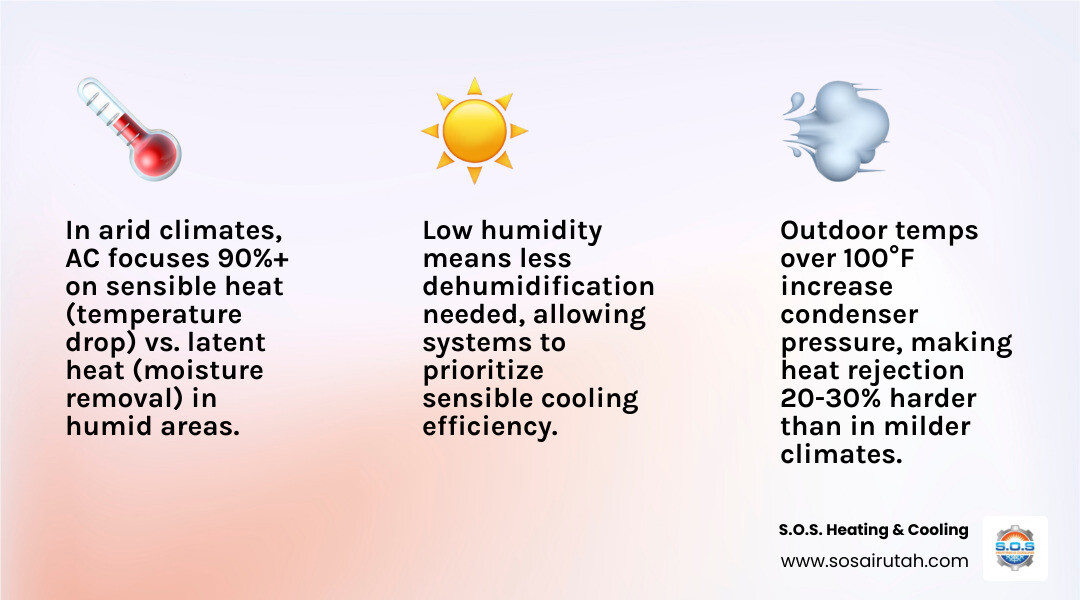
- Sensible heat is the main load. Desert AC systems focus almost entirely on dropping air temperature, not removing moisture like systems in humid climates do.
- Heat rejection is harder. When outdoor air is already 100°F+, your system must work against higher internal pressures to push heat outside.
- Dust is a bigger threat than humidity. Fine desert particles coat coils and clog filters faster than moisture ever could.
- Low humidity needs to be managed. Even in a dry climate, indoor air can get too dry, causing discomfort, static, and even damage to your home.
- Efficiency ratings matter more here. Because your system runs longer and harder, a higher SEER2 or EER2 rating delivers real, measurable savings.
- Cooling technology choices are broader. Evaporative (swamp) coolers, two-stage systems, and hybrid setups all perform differently in dry heat than they would in a humid region.
If you have ever stepped into your home after a July afternoon and felt like you walked into an oven, you already know what arid climate AC challenges feel like firsthand. The mechanics behind why that happens — and what to do about it — are what this guide is all about.
I am Bryson Ninow, an NATE-certified HVAC professional with hands-on experience helping Wasatch Front homeowners navigate exactly the question of how air conditioning works differently in arid climates, from Salt Lake City's dry winters to its triple-digit summer afternoons. In the sections ahead, I will walk you through the science, the technology, and the practical steps that make the biggest difference for homes in our high-desert environment.
The Science of Sensible Heat: How Air Conditioning Works Differently in Arid Climates

When we talk about cooling a home, we generally look at two types of "heat load": sensible heat and latent heat. In a humid place like Florida, an air conditioner spends a massive amount of energy just pulling water out of the air (latent heat). However, along the Wasatch Front, our cooling is almost entirely about sensible heat—the actual temperature you read on a thermometer.
In our high-desert environment, the air is "lightweight" because it lacks moisture. This sounds like a good thing, but it changes the physics of heat transfer. Air conditioners don't actually "create" cold; they move heat from inside your house to the outside. This process relies on a temperature differential. When it is 105°F in Draper or Riverton, the outdoor air is already so saturated with heat that it becomes physically harder for your AC unit to "dump" the heat it gathered from your living room.
Furthermore, extreme heat reduces refrigerant density. This means your compressor has to work much harder to move the same amount of cooling power through your lines. If your system isn't optimized for these conditions, you might notice that some rooms stay sweltering while others are chilly. This is often Why Your AC Has Poor Cooling Distribution, a common frustration in larger desert homes where sun-baked south-facing walls absorb heat all day long.
Why Standard AC Units Struggle with How Air Conditioning Works Differently in Arid Climates
Standard, single-stage air conditioners are designed to be "all or nothing." They turn on at 100% power, blast cold air until the thermostat is satisfied, and then shut off. In the triple-digit heat of a Salt Lake summer, this leads to a "sprint and stop" cycle that puts immense strain on the compressor.
When outdoor temperatures soar, the internal pressures within your AC system spike. The compressor—the "heart" of your AC—must work against these high pressures to condense the refrigerant. This constant high-pressure operation generates its own heat, which can lead to mechanical failure or "hard starting."
Ironically, even in a desert, you can run into a situation where you see Ice Forming on Your AC Unit: Causes and What to Do. In arid climates, this is often caused by restricted airflow. Because there is so little moisture to help "wash" the indoor evaporator coils, fine desert dust can cake onto the metal, insulating the coil and causing the refrigerant inside to drop below freezing, turning any trace of humidity into a block of ice.
Comparing Cooling Technologies for the High Desert
Living in an arid climate gives us access to a technology that homeowners in the South can only dream of: evaporative cooling, commonly known as "swamp coolers." But how do they stack up against traditional refrigerant-based central AC?
| Feature | Evaporative (Swamp) Cooler | Central Refrigerant AC |
|---|---|---|
| Operating Cost | 60–80% less electricity | Higher energy consumption |
| Installation Cost | $40 (portable) to $3,500 (roof) | $3,000 to $7,000+ |
| Humidity Impact | Adds moisture to the air | Removes moisture from the air |
| Effectiveness | Best below 15% humidity | Works in any humidity level |
| Maintenance | Monthly pad/water checks | Annual professional tune-up |
In places like South Jordan or Kaysville, choosing between these depends on your comfort preference. Evaporative cooling uses the "wet bulb" effect—the same reason you feel cold when stepping out of a pool. By blowing hot, dry air through wet pads, the water evaporates, absorbing heat and dropping the air temperature significantly. In fact, on a typical 108°F day with low humidity, an efficient swamp cooler can deliver 72°F air into your home.
However, many residents still prefer Air Conditioning Salt Lake City UT because refrigerant-based systems offer more precise control. Swamp coolers require you to leave windows cracked to let air escape, which can invite dust and allergens inside—a major downside during Utah's windy seasons.
The Role of Evaporative Cooling in How Air Conditioning Works Differently in Arid Climates
The science of evaporative cooling is ancient—even the Egyptians used wet blankets over doorways to catch desert breezes. Today, it remains a powerhouse for energy efficiency. Because it only uses a fan and a small water pump, it avoids the massive power draw of a compressor.
The global market for these units is expected to reach nearly $20 billion by 2026, driven largely by the demand in arid regions. For a homeowner in Woods Cross or Bountiful, a swamp cooler can be a fantastic way to keep a garage or a small home cool for pennies on the dollar. However, when the "monsoon" moisture creeps into Utah in late summer, swamp coolers lose their effectiveness because the air is too "full" of water to allow for further evaporation. This is why many desert homeowners are moving toward high-efficiency refrigerant systems that can handle any weather.
Maximizing Efficiency with Two-Stage and Variable-Speed Systems
If you are sticking with traditional AC, the best way to handle how air conditioning works differently in arid climates is to move away from single-stage units.
Two-stage air conditioners are a game-changer for the Wasatch Front. These units have a "high" setting for those 100-degree afternoons in Herriman and a "low" setting for the milder 80-degree mornings. Because they can run at 60-70% capacity most of the time, they use significantly less electricity—often 60-80% less than older models.
Even better is variable-speed (inverter) technology. Think of a single-stage AC like a light switch (on or off) and an inverter system like a dimmer switch. It can adjust its speed in tiny increments to match the exact cooling needs of your home. This eliminates the "blast" of cold air followed by a warm period, maintaining a steady, comfortable temperature.
When shopping for these systems, look at the SEER2 and EER2 ratings. While SEER2 measures efficiency over an entire season, EER2 (Energy Efficiency Ratio) is actually more important for us in the desert. EER2 measures how the unit performs at a specific, high temperature (usually 95°F). In a desert climate, you want a high EER2 to ensure the unit doesn't lose its efficiency the moment the sun hits its peak. To Optimize Your AC's Performance, we often recommend a SEER2 of 16 or higher for our local climate.
The Impact of Dust and Low Humidity on System Longevity
In Utah, dust is the silent killer of HVAC systems. Our arid soil and frequent wind storms mean that your outdoor condenser and your indoor filters are under constant assault.
Dust acts as an insulator. When it coats your outdoor coils, it prevents heat from escaping. When it clogs your indoor filter, it restricts airflow, forcing your blower motor to work harder and potentially causing the system to overheat or short-cycle. This is why AC Maintenance Salt Lake City UT is so critical here. In a dusty environment, we recommend checking your filters every month, especially during the windy spring and fall seasons.
Low humidity also presents a unique mechanical challenge: static electricity. Dry air is a poor conductor, allowing static charges to build up. This can actually damage the sensitive electronic control boards in modern, high-efficiency AC units if they aren't properly grounded. Furthermore, dry air can cause rubber seals and gaskets in your ductwork to dry out and crack, leading to expensive air leaks.
Optimizing Your Home for How Air Conditioning Works Differently in Arid Climates
One of the biggest myths about desert cooling is that you don't need to worry about humidity. In reality, maintaining an indoor relative humidity of 30-50% is vital for your health and your home. Extremely dry air can warp wood flooring, cause itchy skin, and make you more susceptible to respiratory issues.
In some cases, you might wonder Why AC Produces Excessive Moisture in Layton or Millcreek, which is usually a sign of a drainage issue or an oversized unit that isn't running long enough to properly regulate the air. For most of us, however, the problem is the opposite.
We often recommend steam humidifiers for Wasatch Front homes. Unlike older "bypass" humidifiers that waste a lot of water, steam humidifiers provide a one-to-one ratio—every gallon of water becomes a gallon of moisture in your air. This works in tandem with your AC to ensure the air is cool but not "parched." Properly sealed ductwork is also essential; using mastic sealant instead of tape ensures that your cool, humidified air actually reaches your bedrooms instead of leaking into a 130-degree attic.
Future-Proofing Your Home: R-32 Refrigerant and Smart Strategies
As we move through 2026, the HVAC industry is shifting toward more environmentally friendly and efficient refrigerants. R-32 refrigerant is becoming the new standard. It has a Global Warming Potential (GWP) that is 68% lower than the old R-410A, and it is more efficient at transferring heat in high-ambient temperatures. For a homeowner in Salt Lake City, an R-32 system is a smart way to future-proof your investment.
Beyond the equipment itself, how you use your AC matters. Here are three smart strategies for desert living:
- Zoning: Using motorized dampers to send more cooling to the upstairs during the day and the bedrooms at night.
- Smart Thermostats: These can learn your schedule and account for the "thermal soak" of your home—the way your walls hold onto heat long after the sun goes down.
- Pre-Cooling: This involves "charging" your home with cool air in the early morning hours when electricity is often cheaper and the outdoor air is cool. By dropping your thermostat a few degrees at 6:00 AM, you can reduce the workload on your AC during the expensive 4:00 PM peak.
Frequently Asked Questions about Desert AC
Can I run a swamp cooler and central AC at the same time?
Technically you can, but you shouldn't. They work against each other. A central AC is trying to dehumidify the air to make it feel cooler, while a swamp cooler is pumping moisture into the air. Running both will result in a humid, "sticky" house and a very high energy bill.
Why does my AC leak water in such a dry climate?
It might seem strange to see a puddle in the desert, but your AC still pulls some moisture out of the air. If the drain line is clogged with dust or "sludge," that water has nowhere to go. If you notice a leak, it’s important to understand Why Your AC Leaks Water Inside Your Home to prevent water damage to your furnace or floors.
What is the best SEER rating for Utah's desert heat?
While the federal minimum in the Southwest is now 14.3 SEER2, we generally recommend a SEER2 of 16 or higher for the Wasatch Front. Because our summers are long and the temperature "gradient" (the difference between inside and outside) is so large, the energy savings from a higher-efficiency unit usually pay for themselves much faster than they would in a milder climate.
Conclusion
Navigating how air conditioning works differently in arid climates is a full-time job for those of us living along the Wasatch Front. From the massive "diurnal swings" (where temperatures can drop 40 degrees once the sun sets) to the relentless desert dust, our homes require a specialized approach to HVAC.
At S.O.S. Heating & Cooling, we’ve spent years perfecting "climate-responsive design" for our neighbors from Bountiful to South Jordan. Whether you are looking to upgrade to a two-stage system, need a steam humidifier to combat the dry Utah winter, or just want to ensure your current Air Conditioning unit is ready for the next heatwave, we are here to help. We offer 24/7 emergency repairs and flexible financing because we know that in Salt Lake City, a working AC isn't just a luxury—it's a necessity for your family's comfort and safety. Stay cool out there!
Explore Our Latest Insights and Updates in Plumbing Services
Everything You Need to Know About Repair or Replace Air Conditioner in Salt Lake Valley
How to Save Money on Cooling with These 5 Quick Changes
The Science of Sip: How Reverse Osmosis Levels Up Your Tap Water