

Why Your AC Needs to Breathe to Keep You Cool


.avif)

Why Airflow Is the Foundation of Your AC's Performance
How airflow affects your air conditioners performance is one of the most important things to understand as a homeowner — and one of the most overlooked. In short, without steady, unrestricted airflow, your AC cannot do its job, no matter how new or powerful it is.
Here is a quick breakdown of how airflow directly impacts your system:
- Cooling efficiency — Air must move across the evaporator coil for heat exchange to occur. Less airflow means less heat removed from your home.
- Energy bills — Restricted airflow forces your system to run longer and work harder, driving up your monthly utility costs.
- Humidity control — Poor airflow prevents your system from pulling enough moisture out of the air, leaving your home feeling damp and sticky.
- Hot and cold spots — Uneven airflow means some rooms never reach a comfortable temperature while others overcool.
- System lifespan — Components like the blower motor and compressor wear out faster when they are constantly fighting restricted air movement.
- Frozen coils — Without enough warm air passing over the evaporator coil, temperatures drop below freezing and ice begins to form, blocking airflow even further.
- Strange noises and pressure imbalances — Whistling vents, slamming doors, and rattling sounds are often signs of airflow that is out of balance.
Think of airflow as the lifeblood of your air conditioning system. Just like blood needs to circulate freely through the body to keep it functioning, air needs to move freely through your system to keep your home cool and comfortable. When that flow is disrupted — by a clogged filter, a blocked vent, a leaky duct, or a struggling blower motor — the entire system pays the price.
My name is Bryson Ninow, and with years of hands-on HVAC experience and certifications including NATE, EPA, and DOPL, I have seen how understanding how airflow affects your air conditioners performance can mean the difference between a system that runs smoothly for 20 years and one that breaks down prematurely. In the sections ahead, we will walk through everything you need to know to keep air moving freely through your home.
Understanding How Airflow Affects Your Air Conditioners Performance

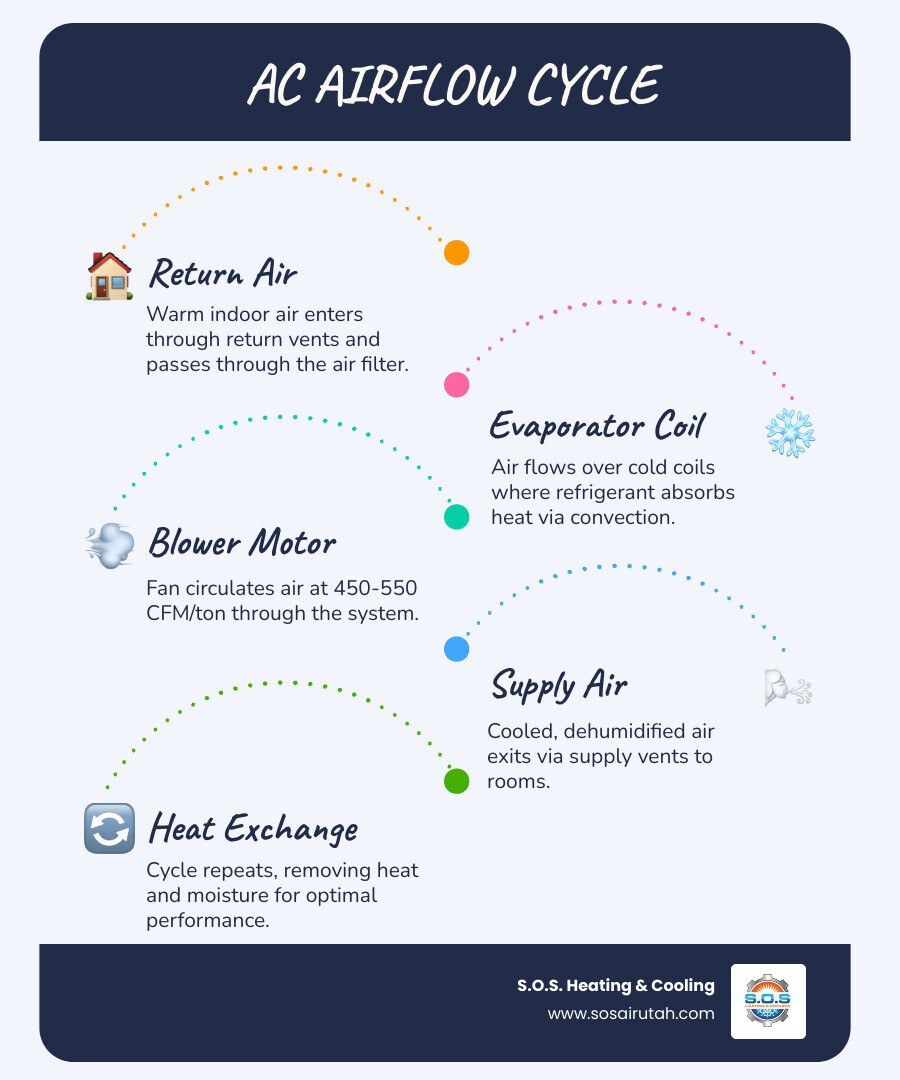
To truly grasp how airflow affects your air conditioners performance, we have to look at the physics of heat transfer. Your air conditioner doesn't actually "create" cold; it removes heat. This process relies on convection—moving air over a cold surface (the evaporator coil) so the refrigerant inside can soak up the heat.
The blower motor is the "heart" of this movement. It pulls warm, unconditioned air from your home through the return vents, pushes it through a filter, and forces it across the indoor coils. If the air moves too slowly, the heat exchange is inefficient. If it moves too fast, the air doesn't spend enough time in contact with the coils to lose its heat or moisture. This delicate balance is why we often have to Solve AC Airflow Restriction in Salt Lake City to restore a home's comfort.
The Science of CFM: How Airflow Affects Your Air Conditioners Performance in Dry Climates
In the HVAC world, we measure airflow in CFM, or Cubic Feet per Minute. For every "ton" of cooling capacity your AC has, it needs a specific amount of air to function correctly. While humid climates might target 350-400 CFM per ton to prioritize dehumidification, things change when we talk about the Wasatch Front.
In Salt Lake City and surrounding areas like Draper and Sandy, we live in a high-altitude, dry climate. Because the air is thinner and less dense here in May 2026, your system actually needs more volume to move the same amount of "cooling power." For our region, the optimal range is often 450-550 CFM per ton. This higher airflow helps maximize "sensible cooling"—the actual lowering of the air temperature you feel on your skin.
Technical Diagnostics: Superheat and Subcooling
When our technicians at S.O.S. Heating & Cooling arrive for a service call, we don't just feel the vents; we look at the numbers. Airflow directly impacts refrigerant measurements.
- Low Airflow: Causes a drop in suction line temperature (often below 50°F). Because there isn't enough warm air to "boil" the refrigerant in the coils, the compressor doesn't have to work as hard, which might sound good, but it leads to "slugging" or liquid refrigerant returning to the compressor—a recipe for total system failure.
- Static Pressure: We measure Total External Static Pressure (TESP) to see how much resistance the air faces. High static pressure is like trying to breathe through a straw; it strains the blower motor and kills efficiency.
Common Symptoms and Causes of Restricted Airflow
Identifying how airflow affects your air conditioners performance starts with recognizing the red flags. If you notice a "trickle" of air from your registers instead of a strong breeze, or if the air coming out feels lukewarm, you likely have a restriction.
One of the most dramatic symptoms is a frozen evaporator coil. When airflow is blocked, the coil gets so cold that the condensation on the fins turns to ice. This creates a physical wall of ice that stops air entirely. You might also hear whistling or rattling noises, which indicate the system is struggling to pull air through a gap that is too small. If you're noticing these signs, it's worth exploring Why Your HVAC System Has Poor Airflow before the problem leads to a breakdown. For residents in the valley, AC Has Weak Airflow in Salt Lake City is a common complaint that often has a simple, albeit hidden, cause.
Identifying the Silent Saboteurs of System Performance
What is actually stopping the air? Usually, it's one of these "silent saboteurs":
- Dirty Filters: This is the #1 cause of airflow issues. A filter caked in dust and pet hair acts like a brick wall.
- Blocked Vents: We often find furniture, thick rugs, or heavy drapes covering return or supply grilles.
- The Wrong Filter: Choosing the Right HVAC Filter is crucial. A MERV rating that is too high (like a HEPA filter in a system not designed for it) can actually restrict air as much as a dirty filter would.
External Factors and Maintenance Neglect
The "breathing" doesn't just happen inside. Your outdoor condenser unit needs to exhaust heat. If it’s crowded by overgrown sagebrush, weeds, or debris, the heat has nowhere to go. This causes the system to "recycle" heat, skyrocketing your energy use. Furthermore, internal issues like What Causes AC Drain Line Clogs can sometimes lead to water backing up into the emergency pan, triggering a system shut-off that looks like a mechanical failure but is actually an airflow/drainage safety response.
The High Cost of Poor Circulation: Efficiency and Lifespan
Poor airflow is a "silent killer" of HVAC equipment. When the system can't move air easily, it stays on longer to reach the temperature set on your thermostat. This "short cycling" or extended runtime translates directly to your wallet.
| Airflow State | Energy Efficiency | Estimated Lifespan | Comfort Level |
|---|---|---|---|
| Optimal (450-550 CFM/ton) | High (Peak SEER2) | 15–20 Years | Consistent & Even |
| Restricted (300 CFM/ton) | Medium-Low | 10–12 Years | Hot/Cold Spots |
| Critically Low (<250 CFM/ton) | Very Low | <7 Years | System Freezes/Failure |
Reliability is the top priority for 83% of homeowners, and maintaining airflow is the best way to ensure it. Neglecting issues like Fixing AC Drain Line Blockages in Draper or ignoring weak air from vents can cut your system's life expectancy in half.
Humidity Control and How Airflow Affects Your Air Conditioners Performance
Even in Utah's dry climate, humidity matters. Your AC removes "latent heat" (moisture) by condensing it on the cold coils. If airflow is too fast, the air doesn't stay on the coil long enough to drop its moisture. If it's too slow, the coil saturates and can't absorb any more. This leads to a "muggy" feeling indoors, even if the thermometer says it's 72 degrees. Finding Solutions for Uneven Home Cooling often involves balancing this moisture removal.
Comfort Disparities and Pressure Imbalances
Have you ever noticed a door in your house that seems to slam shut on its own when the AC kicks on? That is a sign of a pressure imbalance caused by poor airflow. When a room has a supply vent but no way for the air to "return" to the system (like a closed door or a blocked return vent), the room becomes pressurized. This leads to Why Your AC Has Poor Cooling Distribution, leaving you with a bedroom that feels like an oven while the hallway is a walk-in freezer.
Optimizing Your Ductwork and Ventilation
The "highways" of your air—your ducts—are often where the most significant airflow gains are made. Many homes in areas like Layton or Riverton have undersized ductwork that was never designed for modern high-efficiency AC units.
Using industry standards like Manual D, we can calculate exactly how large your ducts should be to maintain the right air velocity. If your ducts are too small, the air whistles and the motor strains. If they are leaky, you could be losing up to 30% of your cooled air to your attic or crawlspace. Professional mastic sealing of joints and ensuring your return grilles are large enough are the most effective ways to lower static pressure and let your system "breathe" again.
Frequently Asked Questions about AC Airflow
What is the ideal CFM per ton for a Salt Lake City home?
Because of our high altitude and dry air, the nominal 400 CFM/ton used in other states isn't enough. For Salt Lake City, we aim for 450 to 550 CFM per ton. This ensures enough air volume to compensate for the lower air density, providing the sensible cooling needed for those 100-degree July days.
Can a dirty filter cause my AC coils to freeze?
Absolutely. A dirty filter is the most common reason for a frozen evaporator coil. The restriction prevents warm air from reaching the coil. Without that heat, the refrigerant temperature drops below 32°F, causing the moisture in the air to freeze instantly upon contact.
How often should I check my vents for blockages?
We recommend a quick walk-through once a month. Check that kids haven't dropped toys into floor registers, ensure that new furniture hasn't been placed over a return vent, and vacuum away any pet hair or dust buildup on the grilles.
Conclusion
At S.O.S. Heating & Cooling, we believe that a comfortable home in the Wasatch Front starts with a system that can breathe. Understanding how airflow affects your air conditioners performance is the first step toward lower energy bills and a longer-lasting AC. Whether you are in Bountiful, South Jordan, or anywhere in between, our team is here to ensure your system is perfectly balanced for our unique Utah climate.
Don't let a "silent saboteur" ruin your summer comfort. From annual 15-point tune-ups to complex duct redesigns, we provide the expertise needed to keep your air moving and your family cool. Schedule your professional air conditioning service today and experience the difference that proper airflow makes.
Explore Our Latest Insights and Updates in Plumbing Services
How to Save Money on Cooling with These 5 Quick Changes

The Science of Sip: How Reverse Osmosis Levels Up Your Tap Water

Step-by-Step Guide to How Bryson Ninow Built SOS on Fair and Honest Service