

Cheat Sheet to How Hard Water Scale Buildup Leads to Pipe Failure in the Wasatch Front


.avif)

Why Hard Water Scale Buildup Leads to Pipe Failure in the Wasatch Front — and What It Means for Your Home
How hard water scale buildup leads to pipe failure in the Wasatch Front is one of the most common — and most overlooked — causes of plumbing damage in Salt Lake City area homes. Here's the short answer:
How Hard Water Destroys Pipes in the Wasatch Front:
- Minerals dissolve into your water as it flows through limestone canyons and ancient Lake Bonneville deposits across Northern Utah
- Calcium and magnesium precipitate out when water is heated or slows down inside pipes, forming hard crystalline scale on interior pipe walls
- Scale narrows the pipe diameter — just 1/8 inch of buildup can reduce effective flow by 25–30%, forcing pressure spikes that stress pipe walls and joints
- Corrosion accelerates underneath scale in copper and galvanized steel pipes, creating pinhole leaks and structural weakening that worsen invisibly over years
- Failure occurs when restricted flow, pressure imbalances, or corrosion finally breach the pipe — often suddenly, and almost always expensively
The Wasatch Front is one of the hardest water regions in the country. Most communities along the corridor measure between 15 and 25 grains per gallon (GPG), far above the 10.5 GPG threshold that classifies water as "very hard." Some areas like Herriman and Eagle Mountain regularly exceed 25 GPG, especially during summer months when snowmelt gives way to mineral-rich groundwater. For context, the national average sits around 5 GPG. Utah's water is not just hard — it's in a category of its own.
That gap matters because scale doesn't build up gradually and then stop. It compounds. Think of it the way cholesterol narrows an artery: slowly at first, then faster as the restriction worsens, until something gives. The same process happens inside your pipes, your water heater, and every appliance connected to your plumbing — quietly, invisibly, and at a pace that catches most homeowners off guard.
I'm Bryson Ninow, and while my background is in HVAC, I've spent years working with Utah homeowners navigating the real-world damage that hard water scale buildup leads to in pipe failure across the Wasatch Front — particularly where water quality stress intersects with heating system breakdowns. In this guide, I'll walk you through exactly what's happening inside your plumbing, what to watch for, and what actually works to stop it.

The Science of How Hard Water Scale Buildup Leads to Pipe Failure in the Wasatch Front
To understand why your plumbing system is under constant threat along the Wasatch Front, we have to look at the chemistry of what is flowing through your municipal lines.
The water supplying homes in Salt Lake City, Sandy, Draper, and Bountiful begins as pristine snowpack high in the Wasatch Range. However, as that snow melts and runs down our rocky canyons, it passes over massive deposits of limestone, dolomite, and gypsum. These geological formations are rich in calcium carbonate ($CaCO3$) and magnesium carbonate ($MgCO3$). By the time this water reaches our local reservoirs and underground aquifers, it is heavily saturated with these dissolved minerals.
Inside your home, these dissolved minerals are highly sensitive to changes in temperature and pressure. When hard water is subjected to heat — such as inside your water heater or the hot water lines running to your washing machine — a chemical reaction occurs. Soluble calcium bicarbonate undergoes thermal decomposition, converting into insoluble calcium carbonate.
This is where the physical damage begins. Because of a chemical property known as inverse solubility, calcium carbonate becomes less soluble as water temperature increases. Instead of staying dissolved in the water, the minerals precipitate out as solid, rock-hard crystals. These crystals bond to the inner surfaces of your pipes, creating a rough, chalky layer known as limescale.
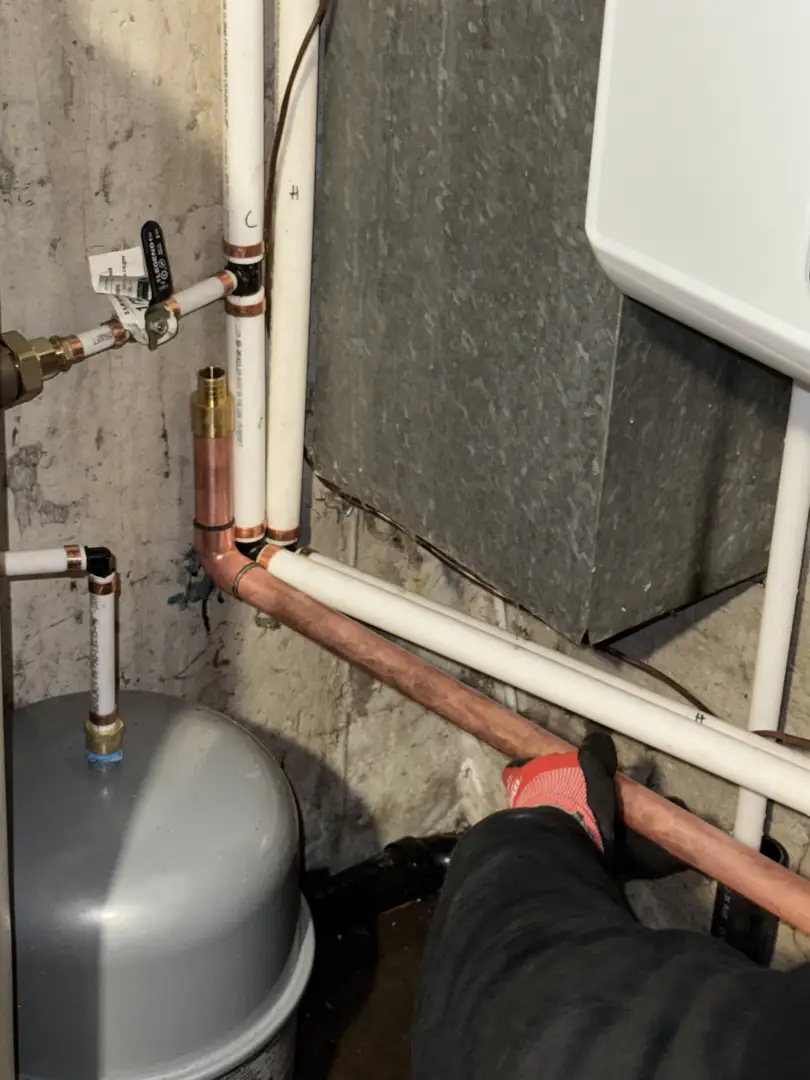
Once a microscopic layer of scale attaches to the pipe wall, it acts as a magnet for more minerals. This progressive accumulation narrows the interior diameter of your pipes. As the pipe restricts, several compounding plumbing issues occur:
- Flow Restriction: A pipe choked with scale cannot deliver the volume of water your household needs. Just 1/8 inch of scale buildup can reduce your pipe's effective carrying capacity by up to 30%.
- Velocity and Turbulence Spikes: As the opening narrows, water must flow faster through the remaining space to maintain volume. This high-velocity, turbulent flow physically erodes the interior walls of your pipes.
- Pressure Fluctuations: When water flow is restricted in one area, it creates localized pressure spikes elsewhere in the system. These spikes place immense stress on joints, elbows, and valves.
- Water Hammer: The combination of restricted pathways and high-velocity water increases the impact of water hammer — the shockwave that occurs when a faucet or valve is shut off. Over time, these repeated shockwaves weaken joints until a catastrophic burst occurs.
To learn more about how this geological reality impacts your home's infrastructure, you can read our deep dive on How Utah Hard Water Affects Your Plumbing.
How Hard Water Affects Different Pipe Materials
Not all plumbing systems are built from the same materials, and different pipes react to Utah's mineral-heavy water in unique ways. Whether your home is a historic bungalow in Salt Lake City or a brand-new build in Herriman, understanding your pipe material is critical to predicting when and how failure might occur.
| Pipe Material | Vulnerability Level | Primary Damage Mechanism | Estimated Lifespan (Hard Water) | Estimated Lifespan (Soft Water) |
|---|---|---|---|---|
| Copper | Moderate to High | Pitting corrosion under scale; pinhole leaks | 30–40 Years | 50+ Years |
| Galvanized Steel | Extremely High | Rust, scale clogging, complete blockage | 20–30 Years | 40–50 Years |
| PEX Tubing | Low (Fittings are High) | Scale at brass connections; joint stress | 40–50 Years | 50+ Years |
Copper Pipes and Pinhole Leaks
Copper has long been the gold standard for residential plumbing because of its durability and natural resistance to corrosion. However, copper is highly susceptible to a specific type of damage called under-deposit corrosion.
When hard water scale forms unevenly along the interior of a copper pipe, it creates tiny microscopic pockets beneath the mineral crust. Oxygen-rich water cannot circulate freely into these pockets. This creates an oxygen concentration cell, which initiates a localized electrochemical reaction.
To make matters worse, municipal water treatment facilities along the Wasatch Front use chlorine to disinfect drinking water. When residual chlorine gets trapped in these low-oxygen pockets beneath the scale, it reacts with the copper to form copper chloride. This highly acidic compound eats directly into the pipe wall, leading to deep structural pits. Eventually, these pits break through the exterior of the pipe, resulting in tiny, weeping "pinhole" leaks.
Because these leaks are so small, they often go unnoticed behind drywall or under floorboards for months, causing extensive rot, mold, and structural damage before they are discovered. For a closer look at this process, check out How Utah Hard Water Affects Your Plumbing.
Galvanized Steel and Accelerated Corrosion
If your home was built before the mid-1980s in older neighborhoods like Sugar House, South Salt Lake, or parts of Murray, there is a high probability you have galvanized steel pipes. These pipes are made of steel coated with a protective layer of zinc.
Hard water is incredibly destructive to galvanized plumbing. Over time, the high mineral content strips away the protective zinc coating. Once the raw steel beneath is exposed, it reacts with both the oxygen in the water and the minerals in the scale to form a thick, crusty mixture of rust and calcium deposits.
This combination of rust and scale builds up rapidly, eventually closing off the pipe entirely. Homeowners with galvanized pipes often experience a severe drop in water pressure, rust-colored water, and frequent clogs. Because galvanized steel becomes highly brittle as it corrodes from the inside out, these pipes are prone to sudden, major splits and joint failures.
PEX Tubing and Scale at Connection Fittings
Cross-linked polyethylene (PEX) is the most common pipe material used in modern Wasatch Front homes. PEX is highly flexible, resists freezing, and has incredibly smooth interior walls that make it difficult for mineral scale to attach to the tubing itself.
However, PEX systems are not immune to hard water damage. The vulnerability lies in the brass and copper connection fittings used to join PEX lines together.
As water passes through these fittings, the sudden change in direction and diameter creates localized turbulence. This turbulence, combined with the metallic surface of the fittings, makes them prime targets for scale precipitation. Over several years, scale builds up heavily inside these brass elbows and tees, restricting water flow just as severely as it would in a metal pipe.
Furthermore, the physical stress of thermal expansion and contraction, combined with heavy scale buildup at these connection points, can weaken the crimp rings, leading to sudden joint separation and major flooding.
Warning Signs and Appliance Damage from Hard Water
Because your plumbing is hidden behind walls and under floors, hard water damage is usually invisible until a pipe actually fails. However, your home will drop clues if you know where to look.
When minerals are actively destroying your pipes, they also leave their mark on your visible fixtures and appliances. Recognizing these warning signs early can save you from a major plumbing emergency. You can find more detail on this in our guide on How Hard Water Affects Your Fixtures and Appliances.
How Hard Water Scale Buildup Leads to Pipe Failure in the Wasatch Front: Early Warning Signs
If you notice any of the following symptoms in your home, it is a clear sign that scale is actively building up inside your plumbing system:
- White, Crusty Buildup: Chalky, green-white mineral deposits on your faucet aerators, showerheads, and around the base of fixtures.
- Gradually Declining Water Pressure: If your shower feels less powerful than it did a few years ago, or if it takes twice as long to fill the bathtub, scale is likely narrowing your main water lines.
- Spotted Dishes and Cloudy Glassware: Minerals left behind after the wash cycle in your dishwasher leave a stubborn, cloudy film.
- Stiff, Scratchy Laundry: Hard water prevents detergents from dissolving properly, leaving mineral residue trapped in fabric fibers.
- Whistling or Screaming Pipes: As water is forced through narrow, scale-choked openings, it can create high-pitched vibrations or whistling sounds behind your walls.
- Rising Utility Bills: When scale coats the heating elements in your water heater, the system has to run significantly longer to heat your water, driving up your gas or electric bills.
To understand the long-term financial impact of ignoring these warning signs, read about How Much Does Hard Water Cost You Over Time.
How Hard Water Scale Buildup Leads to Pipe Failure in the Wasatch Front: Water Heater Degradation
Your water heater is the ground zero for hard water damage. Because minerals precipitate rapidly when heated, your water heater acts as a massive scale collector.
In a conventional tank water heater, calcium and magnesium settle to the bottom of the tank, forming a thick, concrete-like layer of sediment. This sediment acts as a powerful thermal barrier between the burner or heating elements and the water.
Because limescale has a thermal conductivity that is 20 to 100 times lower than steel, the heat cannot transfer efficiently into the water. As a result, the bottom of the tank overheats, causing the steel to fatigue, crack, and eventually leak.
This sediment buildup also causes a phenomenon known as "kettling." When water gets trapped beneath the heavy layer of scale, it boils and flashes into steam, creating loud popping, rumbling, or gravel-rolling sounds.
For tankless water heaters, the situation is even more critical. Tankless units rely on incredibly narrow copper heat exchanger channels to heat water instantly. If scale builds up inside these narrow pathways, it restricts water flow and causes the heat exchanger to overheat rapidly. Without regular treatment, a tankless water heater in a high-hardness area like Herriman or Eagle Mountain can suffer complete heat exchanger failure in as little as two to three years.
To protect your system, it is vital to understand these dynamics. Read our articles on How Hard Water Damages Your Water Heater Faster and Tankless vs Tank Water Heater for Utah Hard Water. Additionally, when repairing or replacing these systems, ensuring Water Heater Code Compliance is critical for safety and system longevity.
Proven Solutions to Prevent and Remediate Scale Buildup
The good news is that you do not have to sit back and let Utah's minerals destroy your home's plumbing. There are several highly effective water treatment and maintenance strategies available to protect your pipes and appliances.
Ion Exchange Water Softeners
An ion exchange water softener is the single most effective solution for preventing scale buildup in Wasatch Front homes. These systems work by physically removing calcium and magnesium ions from your water supply and replacing them with non-scaling sodium or potassium ions.
Inside the water softener tank are thousands of microscopic, negatively charged resin beads. As hard water enters the tank, the positively charged calcium and magnesium ions stick to the resin beads. At the same time, a mild sodium charge is released into the water.
During the system's regeneration cycle, a saltwater brine solution from the salt tank flushes the resin beads, washing the trapped minerals down the drain and replenishing the sodium on the beads.
By removing the minerals before they ever enter your home's plumbing, a water softener completely halts the formation of new scale. To determine if this is the right choice for your home, explore our guides on Is a Water Softener Worth the Investment in Utah and the Water Softener Worth It Utah Guide 2026.
Alternative Water Treatment Options
While ion exchange softeners are the industry standard, there are other water treatment technologies available depending on your household's specific needs:
- Reverse Osmosis (RO) Systems: RO systems force water through a semi-permeable membrane, removing up to 99% of all dissolved solids, including calcium, magnesium, heavy metals, and chlorine. Because RO systems produce water slowly, they are typically installed as point-of-use systems under the kitchen sink to provide ultra-pure drinking and cooking water.
- Template-Assisted Crystallization (TAC): Often marketed as "salt-free conditioners," TAC systems do not remove minerals from the water. Instead, they use specialized ceramic media to convert dissolved calcium and magnesium into harmless, microscopic crystals that cannot bind to metal surfaces. While they do not soften the water (you will still experience soap scum and dry skin), they are highly effective at preventing scale inside pipes and water heaters.
- Electronic Water Conditioners: These devices wrap around your main water line and use electromagnetic waves to temporarily alter the behavior of mineral ions, reducing their ability to stick to surfaces. While easy to install, they are generally less effective in areas with extremely high GPG levels, such as Herriman or Eagle Mountain.
To compare these options in detail, read our Water Treatment Guide for Plumbing Appliances.
Preventive Maintenance and Descaling
If your home already has some scale buildup, proactive maintenance can help mitigate the damage and extend the life of your plumbing fixtures:
- Annual Water Heater Flushing: Flushing your water heater once or twice a year removes loose sediment before it can harden into a solid thermal barrier. If you live in a high-hardness zone, a mini-flush every four to six months is highly recommended.
- Vinegar Soaks: You can remove scale from showerheads and faucet aerators by unscrewing them and soaking them in warm white vinegar for a few hours. The mild acid in vinegar breaks down the calcium carbonate deposits safely.
- Professional Descaling: For tankless water heaters and heavily scaled copper lines, professional plumbers can pump a food-grade descaling acid through the system to safely dissolve and flush away stubborn mineral buildup.
To learn more about keeping your appliances running efficiently under harsh conditions, check out the Best Water Heater Options Hard Water 2026.
Frequently Asked Questions about Hard Water Pipe Damage
Can a water softener remove existing scale buildup from my pipes?
A water softener is primarily a preventive tool. Once installed, it immediately stops new scale from forming. However, it cannot quickly dissolve thick, rock-hard mineral deposits that have accumulated over decades.
Over a very long period, soft water (which is hungry for minerals) may slowly wear down and dissolve mild surface scale, but this process is incredibly slow. If your pipes are already heavily restricted or suffering from under-deposit corrosion, installing a softener will protect them from further damage, but it will not reverse existing structural weakening or severe blockages.
How long does it take for hard water to cause pipe failure in Utah?
The timeline for hard water damage depends heavily on your local water quality and the pipe materials in your home.
In areas with extreme hardness like Herriman or Eagle Mountain (where water regularly measures 22 to 35 grains per gallon), visible scale can form on fixtures within weeks, and significant flow restriction can occur inside hot water lines within 5 to 7 years. In older copper or galvanized systems, pinhole leaks and structural failure typically begin manifesting after 10 to 15 years of exposure to untreated hard water.
Does hard water affect PEX piping differently than copper?
Yes, significantly. PEX is a highly smooth, flexible polymer material, which makes it incredibly difficult for mineral scale to chemically bond to the interior walls of the tubing. Copper, on the other hand, is a metal that is highly susceptible to under-deposit corrosion and pitting when scale forms on its surface.
However, PEX systems still rely on brass and copper connection fittings. While the PEX tubing itself will remain clear, scale will still precipitate heavily inside these metal fittings, restricting water flow and stressing the joints.
Conclusion
How hard water scale buildup leads to pipe failure in the Wasatch Front is a quiet, ongoing battle for every homeowner in Northern Utah. From the geology of our mountain runoff to the chemistry of inverse solubility inside our water heaters, our plumbing systems are under constant mineral stress. Over time, this invisible accumulation narrows our pipes, destroys our appliances, and leads to costly structural leaks.
At S.O.S. Heating & Cooling, we are dedicated to helping our neighbors protect their homes. Serving Salt Lake City and surrounding communities — including Bountiful, Draper, Herriman, Layton, Murray, and Sandy — we provide comprehensive plumbing diagnostics, water heater maintenance, and professional water softener installations. Whether you are dealing with dropping water pressure, a noisy water heater, or want to test your water quality before damage occurs, our expert team is here to help 24/7.
Do not let invisible mineral scale destroy your home's plumbing from the inside out. Contact us today to schedule your water quality assessment, and let us help you keep your plumbing flowing smoothly for years to come. For professional pipe repair and assessment services in your area, visit S.O.S. Plumbing Pipe Repair Murray UT.
Explore Our Latest Insights and Updates in Plumbing Services
In Depth Guide to Utah Winter Inversion & Indoor Air Quality
How to Choose the Right Furnace for a Salt Lake Valley Home
Average Lifespan of a Central Air Conditioner in Hot Dry Utah Climate