

Why Your Skin and Furniture Crave a Winter Humidifier


.avif)

Why Dry Winter Air Is Hard on Your Body and Home
Understanding how humidifiers improve winter comfort in dry climates can make a real difference for Salt Lake City homeowners dealing with dry skin, scratchy throats, static shocks, and cracking wood every winter. Here is a quick summary:
- Dry skin and irritation - Low indoor humidity pulls moisture from your skin, lips, and nasal passages
- Static electricity - Dry air allows static charges to build up, causing shocks and risking damage to electronics
- Worse sleep - Dry airways cause snoring, dry mouth, and nighttime congestion
- Higher virus risk - Influenza survives and spreads more easily when indoor humidity drops below 40-50%
- Wood damage - Hardwood floors, furniture, and trim shrink, gap, and crack when humidity falls too low
- Feels colder - Humid air holds heat better, so dry air makes your home feel colder than it actually is
When winter arrives in Utah, temperatures are not the only thing that drops. The air inside your home can dry out dramatically — often falling below 30% relative humidity — thanks to a combination of cold outdoor air, desert climate conditions, and the constant cycle of your furnace pushing heated air through your home. That dryness does not just feel uncomfortable. It affects your health, your sleep, your skin, and even the structure of your home.
You might notice it as a dry, scratchy throat when you wake up, a static shock every time you touch a doorknob, or gaps slowly forming between your hardwood floorboards. These are not random winter annoyances. They are signs that your indoor air has lost too much moisture — and your home is telling you it needs help.
I'm Bryson Ninow, an HVAC professional with hands-on experience helping Utah homeowners solve exactly these kinds of dry-air problems, and I've seen how humidifiers improve winter comfort in dry climates like ours — from better sleep and healthier skin to protected floors and a home that simply feels warmer. In this guide, we'll walk through everything you need to know to bring your indoor humidity back into a healthy, comfortable range.
Why Indoor Air Gets So Dry in Winter
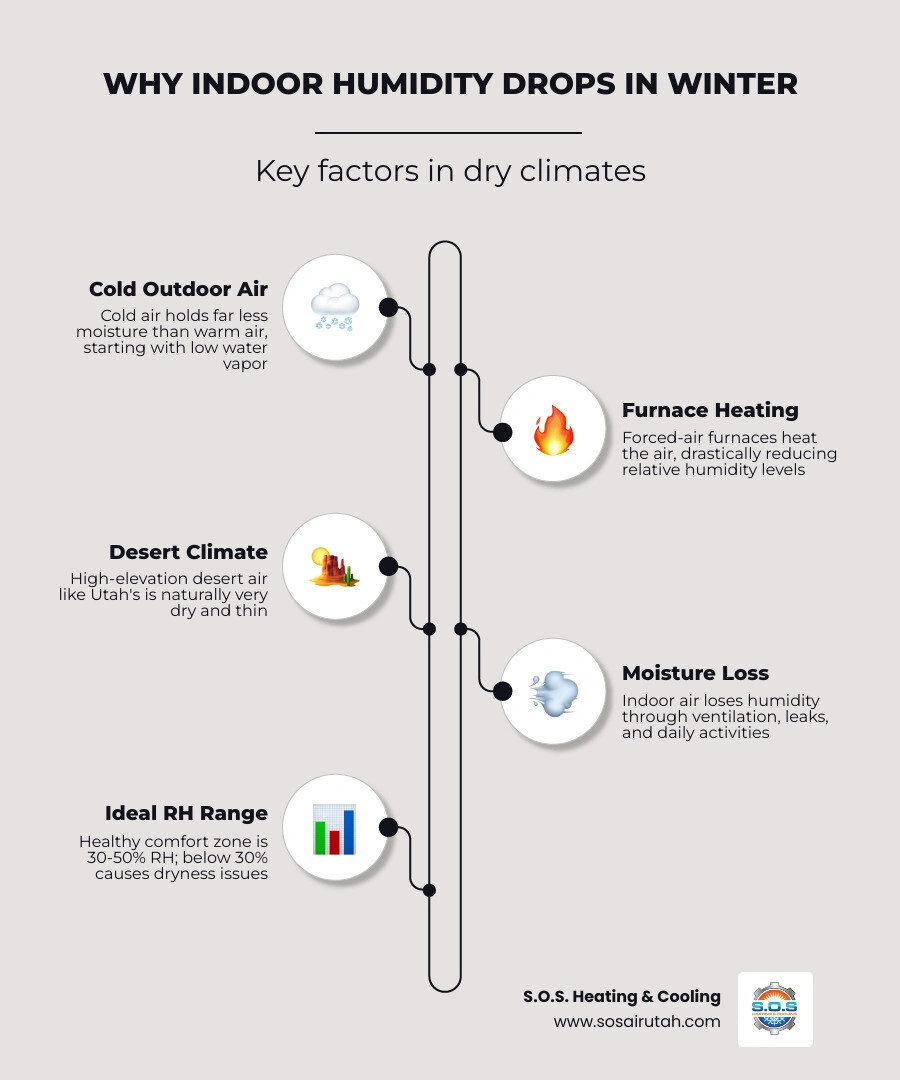
In places like Bountiful, Draper, and Salt Lake City, we are already living in a high-elevation desert. This means the air is naturally "thin" and holds less moisture than air at sea level. When May 2026 rolls around and we look back at the winter season, the physics remain the same: cold air simply cannot hold as much water vapor as warm air.
Why do indoor humidity levels drop significantly during winter in dry climates?
When that cold outdoor air leaks into your home through windows, doors, and vents, you turn on your furnace to warm it up. As the furnace heats that air, the relative humidity plummets. While the actual amount of water in the air stays the same, the air’s capacity to hold water increases as it gets hotter. This creates a "thirsty" environment where the air begins to aggressively pull moisture from everything it touches—including your skin, your plants, and your wooden furniture.
Why dry-climate homes often fall below healthy humidity levels
In the middle of a Utah January, it is common for indoor relative humidity (RH) to drop below 20% or even 15%. To put that in perspective, the Sahara Desert often has a higher humidity level than the average heated home in Layton or Sandy during the winter.
Organizations like ASHRAE and the EPA recommend keeping your indoor humidity between 30% and 50%. When you fall below this range, your home becomes a breeding ground for static electricity and respiratory irritation. Using a simple tool called a hygrometer (which you can pick up at most hardware stores) is the best way to see just how dry your air has become.
How Humidifiers Improve Winter Comfort in Dry Climates
If you have ever woken up with a "pesky tickle" in your throat or found yourself reaching for the lotion three times a day, you have experienced the effects of winter dryness. This is where how humidifiers improve winter comfort in dry climates becomes a game-changer for your daily life.

How humidifiers improve winter comfort in dry climates for your health
Your body relies on moisture to function correctly. Your nasal passages are lined with mucus that traps viruses and bacteria; when that lining dries out, your first line of defense is gone. By adding moisture back into the air, humidifiers help:
- Soothe Respiratory Passages: Reduce that dry, hacking cough and the feeling of "stuffy" but dry sinuses.
- Hydrate Your Skin: Prevent the itching, cracking, and "flaking" associated with winter eczema and psoriasis.
- Protect Your Eyes: Low humidity accelerates tear evaporation, which is a major cause of dry, scratchy eyes for those of us working on screens all day.
How humidifiers improve winter comfort in dry climates throughout your home
Beyond your physical health, a humidifier changes the "vibe" of your home. Have you noticed that 70°F feels much warmer on a humid summer day than it does in the dead of winter? That is because moisture in the air slows down the evaporation of sweat from your skin, which is how your body stays warm.
When you maintain a healthy humidity level, your home feels warmer at a lower thermostat setting. This means you can stay cozy without cranking the heat. Additionally, proper moisture levels virtually eliminate those annoying static shocks that zap you every time you touch a doorknob or pet the cat.
Do humidifiers help reduce viruses or improve sleep?
The short answer is yes. Research from the Mount Sinai School of Medicine has shown that flu virus transmission is significantly less likely when relative humidity is kept at 50% or higher. Viruses actually stay airborne longer and travel further in dry air.
As for sleep, many of our neighbors in South Jordan and Riverton find that a humidifier reduces snoring. When your throat and nasal passages are hydrated, they are less likely to vibrate or become obstructed by inflammation. You’ll wake up feeling refreshed rather than "parched."
Protecting Floors, Furniture, and Materials From Winter Dryness
Your home is likely your biggest investment, and much of it is made of wood. Wood is "hygroscopic," meaning it acts like a sponge—it absorbs and releases moisture based on the environment.
Why wood and building materials react to low humidity
When the air gets dry, wood contracts. This is why you might notice:
- Gaps in Hardwood Floors: Planks that were tight in July suddenly have visible spaces between them in December.
- Cracking Furniture: Expensive tables or musical instruments like pianos and guitars can develop structural cracks.
- Squeaky Stairs: As wood shrinks, joints loosen, leading to more creaks and groans when you walk through the house.
The best humidity range for protecting your home
To keep your hardwood floors and cabinets in top shape, aim for a range of 35% to 45% during the winter. Hardwood floors specifically perform best when kept between 30% and 50% RH. If you go above 50%, you risk window condensation and mold growth, so balance is key.
Choosing the Right Humidifier for a Dry-Climate Home
When deciding how to add moisture back into your life, you generally have two paths: portable units or whole-home systems.
Whole-home vs. portable humidifiers: which is better for dry climates?
| Feature | Portable Humidifier | Whole-Home Humidifier |
|---|---|---|
| Coverage | Single room (bedroom/office) | Entire house (every room) |
| Maintenance | Daily refills, frequent cleaning | Annual or semi-annual service |
| Noise | Fan/ultrasonic hum in the room | Silent (integrated into HVAC) |
| Appearance | Sits on a table/floor | Hidden in ductwork |
| Control | Manual settings | Automatic via thermostat/humidistat |
For most families in the Salt Lake Valley, a whole-home system is the most efficient choice. It connects directly to your water line and your furnace, so you never have to carry heavy water tanks across the house or worry about "white dust" on your furniture.
Humidifier types and how they differ
- Evaporative Humidifiers: These use a fan to blow air through a moistened wick or pad. They are very common in Utah because they are self-regulating—the drier the air, the more moisture it absorbs.
- Steam Humidifiers: These boil water to create pure, hygienic steam. They are incredibly powerful and are often the "gold standard" for large homes or those with high-end wood finishes. For every gallon of water used, you get exactly one gallon of moisture in the air.
- Ultrasonic Humidifiers: Usually portable, these use high-frequency vibrations to create a fine mist. While quiet, they require distilled water to avoid spreading mineral dust.
Signs your home needs a humidifier
Not sure if you need one? Watch for these "dry-air warning signs":
- Static sparks when touching doorknobs or family members.
- Waking up with a dry mouth or a "crusty" nose.
- Visible gaps in your floorboards or trim.
- Houseplants with brown, crispy edges despite regular watering.
- Wallpaper peeling at the corners or seams.
Where to learn about whole-home humidifier options in Utah
If you are tired of the winter "desert" inside your home, we can help you evaluate your space and find the right fit. We provide expert installation and service across the region:
- Whole Home Humidifiers Salt Lake City UT
- Whole Home Humidifiers Murray UT
- Whole Home Humidifiers Sandy UT
- Whole Home Humidifiers Draper UT
- Whole Home Humidifiers Layton UT
- Whole Home Humidifiers South Jordan UT
Humidifier Maintenance Tips for Healthy Winter Air
A humidifier is a fantastic tool, but it does require some TLC to keep it from becoming a "science project."
Essential cleaning habits to prevent mold and bacteria
If you use a portable unit, you should change the water daily. Standing water is a magnet for bacteria. Every 2-3 days, give the tank a quick rinse with a diluted vinegar solution to break up mineral scale.
For whole-home systems, maintenance is much simpler. Usually, you only need to replace the "water panel" or humidifier pad once or twice a season. This prevents mineral buildup and ensures the air can flow freely through the system.
How to avoid over-humidifying your home
More is not always better. If you see condensation forming on your windows (the "foggy window" effect), your humidity is too high. This can lead to mold growth inside your walls or in your attic. Always aim for that 30-50% sweet spot. In extremely cold weather (below zero), you may actually need to drop your humidity to 25% to prevent frost from forming on your windows.
Humidifiers and air filtration: what each one does
It is important to remember that while humidifiers improve comfort, they don’t "clean" the air. They add moisture, but they don't remove dust, pollen, or smoke. For the best indoor air quality, we recommend pairing a humidifier with a high-quality filtration system.
Frequently Asked Questions About Winter Humidity
What is the ideal indoor relative humidity range in winter?
For most Utah homes, the target should be 35% to 45%. This is high enough to protect your skin and your wood floors, but low enough to prevent mold growth and window condensation.
Can a humidifier make your house feel warmer?
Yes! Moist air feels warmer than dry air at the same temperature. By maintaining proper humidity, you can often turn your thermostat down by 2 or 3 degrees and feel just as comfortable, which can lead to modest savings on your heating bills.
How can you tell if your home needs a humidifier?
The most accurate way is to use a hygrometer. If your reading is consistently below 30%, your home is too dry. Other signs include frequent nosebleeds, static electricity, and "shrinking" wood furniture.
Conclusion
Winter in Utah is beautiful, but the dry air that comes with it can be a real burden on your comfort and your home's integrity. By understanding how humidifiers improve winter comfort in dry climates, you can take control of your indoor environment. From stopping the "zap" of static electricity to waking up without a sore throat, the benefits of balanced humidity are felt every single day.
Whether you are in Bountiful, Herriman, or anywhere in between, S.O.S. Heating & Cooling is here to help you achieve the perfect balance of warmth and moisture. If you’re ready to stop the winter itch and protect your home, reach out to us today.
Explore Our Latest Insights and Updates in Plumbing Services

Federal Tax Credits: Maximizing the Inflation Reduction Act for Utah Homes
The Secret to Making Your Dishwasher and Pipes Last Forever
How to Tell if Hard Water is Trashing Your Fixtures