

The Definitive Guide to Trenchless Sewer Repair Lifespan


.avif)

How Long Trenchless Sewer Repair Lasts in a Salt Lake Valley Home
How long does trenchless sewer repair last in a salt lake valley home is one of the first questions homeowners ask when facing a damaged sewer line — and for good reason. A sewer repair is a significant investment, and you want to know it will hold up for the long haul.
Quick Answer:
| Repair Method | Expected Lifespan |
|---|---|
| CIPP (Cured-in-Place Pipe) Lining | 40-60+ years |
| Pipe Bursting (HDPE pipe) | 50-100 years |
| Epoxy Pipe Coating | 30-50+ years |
| Traditional PVC (excavation) | 75-100 years |
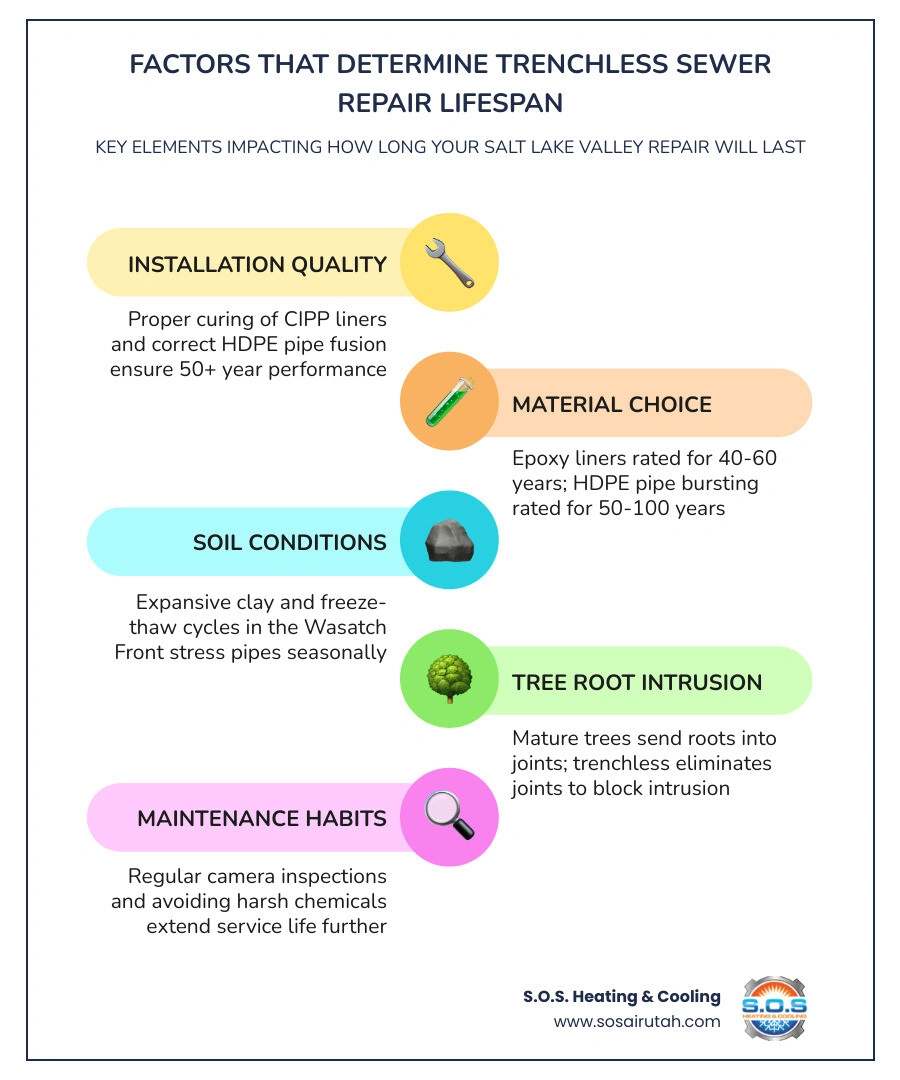
- Trenchless repairs are independently tested to a minimum 50-year service life when installed correctly.
- Some products carry a design life rating of up to 100 years for gravity sewer systems.
- Real-world performance depends on installation quality, materials used, soil conditions, and maintenance habits.
Most Salt Lake Valley homeowners can expect a properly installed trenchless repair to last 50 years or more — often outlasting the original pipe it replaced.
That said, Salt Lake Valley has some unique conditions worth knowing about. The Wasatch Front sits in an active seismic zone. Local soils include expansive clay that swells and contracts with moisture changes. Mature trees are common in older neighborhoods, and the region experiences real freeze-thaw cycles every winter. All of these factors play a role in how long any sewer repair — trenchless or otherwise — holds up over time.
This guide walks you through everything you need to know: how each trenchless method performs, what local conditions mean for your pipes, when trenchless repair is the right call, and when it is not.
My name is Bryson Ninow, and while my background is rooted in home comfort systems, I have spent years helping Salt Lake Valley homeowners understand how to protect their homes from the ground up — including the underground plumbing that most people never think about until something goes wrong. I am here to give you a straight, honest answer to how long trenchless sewer repair lasts in a salt lake valley home so you can make a confident, informed decision.
What is Trenchless Sewer Repair and How Does It Work?
Before we look at durability, it helps to understand what we mean by "trenchless" sewer repair. In the past, fixing a broken sewer line meant bringing in heavy machinery, digging a massive trench across your manicured lawn, tearing up driveways, and leaving your property looking like an active construction site for weeks.
Trenchless sewer rehabilitation is a modern, "no-dig" or "low-dig" alternative. Instead of excavating the entire length of the pipe, we access the sewer line through existing entry points or by digging just one or two small access pits.
To determine if a pipe is a good candidate for this technology, we always begin with a high-definition video camera inspection. This allows us to see exactly what is happening inside your sewer line without guessing. If you want to dive deeper into how we diagnose these issues, check out our Slugfix Sewer Line Salt Lake City Complete Guide and our Fix Sewer Line Murray UT Complete Guide.
There are two primary methods of trenchless repair used in the Salt Lake Valley: Cured-in-Place Pipe (CIPP) lining and Pipe Bursting.
Cured-in-Place Pipe (CIPP) Lining
CIPP lining is essentially creating a brand-new, structural "pipe within a pipe."
- Preparation: We thoroughly clean and descale the existing host pipe using high-pressure hydro-jetting or mechanical cleaning tools to ensure the interior walls are smooth and free of debris.
- Saturation: A flexible, felt-like liner is saturated with a high-quality, liquid epoxy resin.
- Insertion: The resin-soaked liner is pulled or inverted into the damaged pipe using air or water pressure.
- Curing: Once in place, the liner is inflated so it presses tightly against the inner walls of the old pipe. It is then left to cure (harden) at ambient temperatures, or the process is sped up using steam or blue light.
- The Result: The epoxy cures into a rock-hard, seamless, jointless sleeve that is structurally independent.
This process meets strict ASTM F1216 engineering standards, meaning the new liner does not rely on the old, failing pipe for its structural integrity. Because it has no joints, it completely eliminates the entry points that tree roots typically use to invade sewer lines.
Pipe Bursting Technology
While CIPP lining creates a new pipe inside the old one, pipe bursting is a complete replacement method.
- Access Pits: We excavate two small access pits—one at the launch point and one at the exit point.
- The Bursting Head: A heavy-duty steel bursting head is pulled through the old sewer line by a hydraulic pulling machine.
- Fracturing and Replacing: As the bursting head is pulled through, its conical shape fractures and breaks apart the old brittle pipe (whether it is clay, cast iron, concrete, or Orangeburg) and pushes the fragments into the surrounding soil.
- New Pipe Installation: Simultaneously, the bursting head pulls a brand-new, seamless High-Density Polyethylene (HDPE) pipe directly behind it into the same alignment.
Pipe bursting is incredibly effective because it allows us to replace the pipe entirely and, in some cases, even upsize the diameter of the line to improve flow capacity.
How Long Does Trenchless Sewer Repair Last in a Salt Lake Valley Home?
Now to the core question: how long does trenchless sewer repair last in a salt lake valley home?
In short, you can expect a quality trenchless sewer repair to last 50 to 100 years when installed correctly by certified professionals.
To give you an idea of how this compares to other options, we have compiled a quick comparison of the overall durability, disruption, and long-term performance of these methods:
| Feature | Trenchless (CIPP / Pipe Bursting) | Traditional Excavation (PVC Pipe) |
|---|---|---|
| Average Lifespan | 50 to 100 years | 75 to 100 years |
| Project Duration | 1 to 2 days | 3 to 7 days (or longer) |
| Property Disruption | Minimal (1-2 small access pits) | High (trenching through lawns/patios) |
| Root Resistance | Excellent (seamless, joint-free) | Moderate (joints can fail over time) |
| Year-Round Installation | Yes (can be done even in winter) | Difficult (frozen ground slows digging) |
| Post-Project Restoration | Low to none | High (re-paving, re-sodding, landscaping) |
While traditional PVC installed via excavation can technically last up to a century, the total cost of ownership often makes trenchless the smarter choice. When you factor in the expense of rebuilding porches, replacing driveways, and replanting mature trees destroyed by a trenching machine, the long-term value of trenchless becomes clear.
For more tips on keeping your system running smoothly, read our guide on Preventing Sewer Line Backups in Murray or learn about our diagnostic process in Sewer Line Inspection in Murray UT.
Comparing CIPP and Pipe Bursting: How Long Does Trenchless Sewer Repair Last in a Salt Lake Valley Home?
Both CIPP lining and pipe bursting offer incredible longevity, but they achieve it in different ways based on their materials:
- Epoxy Liners (CIPP): High-quality epoxy resins are engineered to have a structural design life of 50 years or more. Independent laboratory testing, which simulates decades of continuous water flow and pressure, shows that these liners resist chemical corrosion, cracking, and wear just as well as—and sometimes better than—brand-new PVC.
- HDPE Pipes (Pipe Bursting): High-Density Polyethylene is one of the toughest materials on earth. It is highly flexible, completely chemically inert, and boasts a design service life of 50 to 100 years. Because the pipe segments are heat-fused together into a single, continuous piece, there are no joints to leak or pull apart.
How Soil and Weather Affect How Long Does Trenchless Sewer Repair Last in a Salt Lake Valley Home
The Salt Lake Valley presents some distinct environmental challenges that can impact underground infrastructure:
- Expansive Clay Soils: From Bountiful down to Draper, our local soils contain high concentrations of clay. These soils swell when wet and shrink when dry. This constant shifting can put immense stress on rigid, jointed pipes like clay or cast iron, causing them to crack or offset. The flexible nature of HDPE pipes and CIPP liners allows them to bend slightly and absorb this ground movement without cracking.
- Freeze-Thaw Cycles: Utah winters are no joke. While sewer lines are buried below the frost line, the shallow sections of your plumbing and the ground above them undergo freeze-thaw cycles. Trenchless materials are highly resilient to these temperature swings.
- Root Intrusion: Traditional pipes have joints every few feet. Over time, trees seek out the moisture inside those joints, pushing their way in and eventually collapsing the line. Because trenchless repairs create a seamless, joint-free conduit, tree roots simply cannot find a way inside.
Environmental Factors Affecting Sewer Pipes in Northern Utah
The unique geography of the Wasatch Front makes sewer line durability a top priority. If you want to understand the geological forces at play, our article on How Shifting Soils Along the Wasatch Front Damage Sewer Pipes is a great resource. You can also learn more about local repairs in our guide to Fix Sewer Line Sandy UT.
Tree Root Intrusion and Soil Shifting
In older, established neighborhoods like Millcreek, Holladay, and parts of Salt Lake City, beautiful, mature trees line the streets. While they provide wonderful shade, their expansive root systems are a constant threat to clay and cast-iron sewer lines.
When a traditional pipe joint fails or cracks due to soil shifting, roots enter the pipe, catch debris, and cause frequent backups. Expansive clay soils accelerate this joint failure by physically pulling pipe sections away from each other. Trenchless repairs solve both issues at once: they remove the joints that roots exploit and provide the flexibility needed to withstand shifting ground.
When Trenchless Repair is Not Suitable
As much as we love trenchless technology, it is not a magic wand for every single sewer problem. There are situations where a trenchless repair might have a significantly shorter lifespan or might not even be possible.
To spot issues early, read our article on the Signs of Hidden Sewer Line Damage and our overview of Drain and Sewer Line Problems Signs and Solutions. If you are in the southern part of the valley, you can also check out our guide on how to Fix Sewer Line South Salt Lake UT.
Severely Collapsed or Misaligned Pipes
For trenchless methods to work, there must be a viable pathway for the liner or the bursting head:
- Complete Structural Collapse: If a section of the original sewer pipe has completely caved in or collapsed, we cannot run a CIPP liner through it because the liner requires a hollow host pipe to hold its shape while curing.
- Severe Offsets or Bellies: If shifting soil has caused a pipe to drop significantly (creating a "belly" or a low spot where water pools), or if the pipe segments are severely misaligned, lining the pipe will not fix the slope. A lined pipe with a bad belly will still suffer from chronic standing water and clogs.
- Orangeburg Pipes in Poor Condition: Some older homes in the valley still have Orangeburg pipes (made of wood fiber and coal tar). These pipes often flatten or disintegrate over time, making traditional excavation or highly targeted spot repairs necessary.
In these cases, we may recommend a hybrid approach: excavating and replacing the collapsed section, and then lining the rest of the pipe to protect it for the next 50+ years.
Frequently Asked Questions about Trenchless Sewer Lifespans
Does trenchless pipelining really last 50 years?
Yes. Quality CIPP liners are manufactured and tested to meet strict ASTM F1216 standards. These standards require the cured materials to undergo long-term creep testing, simulating 50 years of continuous structural load. The results show that the high-quality epoxy resins we use maintain their structural integrity, shape, and smooth flow characteristics for at least five decades, and often much longer under normal residential use.
Can tree roots still penetrate a lined sewer pipe?
No. Tree roots cannot chew through cured epoxy resin or solid HDPE pipe. Roots enter sewer lines by finding tiny cracks or gaps in pipe joints. Because both CIPP lining and pipe bursting create a continuous, seamless, joint-free pipe from your home to the municipal main, there are no entry points left for roots to exploit.
How do I maximize the lifespan of my trenchless sewer repair?
While trenchless pipes are incredibly tough, your daily habits still play a major role in their longevity:
- Watch What Goes Down: Never flush wet wipes (even if they say "flushable"), feminine hygiene products, paper towels, or dental floss.
- Keep Grease Out: Avoid pouring cooking oils, fats, or grease down your kitchen sink. Grease solidifies as it cools, catching other debris and creating stubborn blockages.
- Skip the Chemicals: Avoid using harsh, corrosive chemical drain cleaners. These products generate heat and chemical reactions that can degrade your plumbing over time. Instead, opt for professional hydro-jetting or enzyme-based cleaners.
- Schedule Inspections: Have a professional sewer camera inspection performed every 3 to 5 years to ensure the line remains clean and clear.
Conclusion
When you ask how long does trenchless sewer repair last in a salt lake valley home, you can rest easy knowing that modern trenchless technology is designed to provide a reliable, worry-free solution for 50 to 100 years. By choosing trenchless, you protect your home’s landscaping, save time, and invest in a durable, seamless pipe that resists roots, corrosion, and shifting soils.
At S.O.S. Heating & Cooling, we are dedicated to keeping your home running smoothly. We proudly serve homeowners across the Salt Lake Valley—including Bountiful, Centerville, Cottonwood Heights, Draper, Farmington, Herriman, Holladay, Kaysville, Layton, Millcreek, Mt. Olympus, Murray, Riverton, Salt Lake City, Sandy, South Jordan, South Salt Lake, and Woods Cross.
Whether you need a routine diagnostic camera inspection or a 24/7 emergency repair, our experienced plumbing team is here to help. We offer priority service, no evaluation fees during business hours, and flexible financing options to make your repair as stress-free as possible.
If you suspect your sewer line needs attention, do not wait for a small leak to turn into a major emergency. Contact the professionals at S.O.S. Heating & Cooling today to schedule a comprehensive sewer camera inspection and find the perfect, long-lasting solution for your home.
Explore Our Latest Insights and Updates in Plumbing Services
How to Extend Water Heater Life in Hard Water Areas
Cheat Sheet to How Hard Water Scale Buildup Leads to Pipe Failure in the Wasatch Front
How Often to Inspect a Sewer Line in Salt Lake Valley