

How Often to Inspect a Sewer Line in Salt Lake Valley


.avif)

Why Salt Lake Valley Homeowners Should Know How Often to Inspect Their Sewer Line
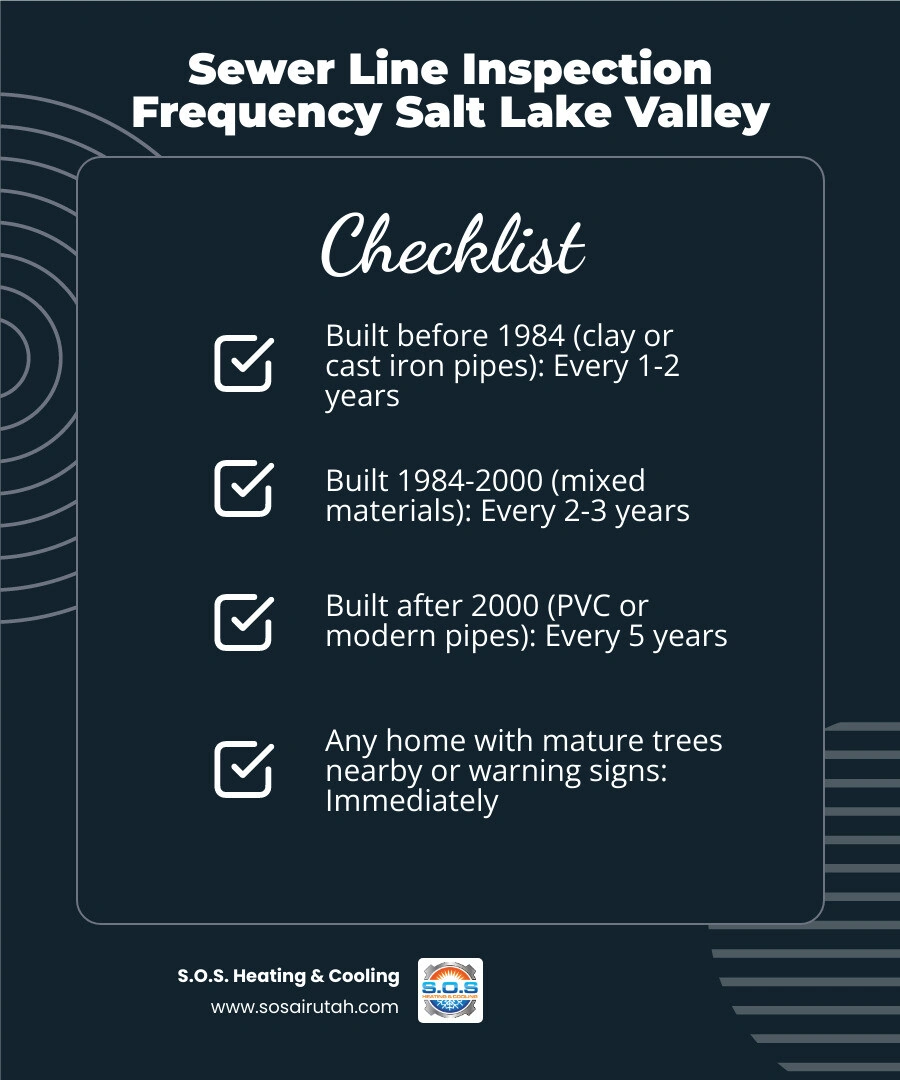
How often should a sewer line be inspected in a Salt Lake Valley home depends mainly on your home's age and pipe material — but here's a quick answer most homeowners can use right now:
Sewer Line Inspection Frequency by Home Type
| Home Type | Recommended Inspection Frequency |
|---|---|
| Built before 1984 (clay or cast iron pipes) | Every 1-2 years |
| Built 1984-2000 (mixed materials) | Every 2-3 years |
| Built after 2000 (PVC or modern pipes) | Every 5 years |
| Any home with mature trees nearby | Every 1-2 years |
| Any home showing warning signs | Immediately |
Your sewer line is one of the hardest-working systems in your home — and one of the easiest to forget about. It quietly carries wastewater away from every sink, toilet, and drain, day after day. Most Salt Lake Valley homeowners never think about it until something goes wrong. But by then, the damage is often already serious.
Salt Lake City maintains over 650 miles of sewer lines, and much of the residential infrastructure dates back to the mid-20th century. Neighborhoods like The Avenues, Sugar House, and Federal Heights are full of homes with original clay or cast iron pipes that were never designed to last this long. Add in the Wasatch Front's clay-rich soil, freeze-thaw cycles, hard mountain water, and mature tree-lined streets — and you have a recipe for sewer problems that can sneak up on you fast.
The good news is that a simple sewer scope inspection can catch small issues before they become expensive emergencies. Sewer line repairs can run into the thousands of dollars, but a routine inspection is a fraction of that cost.
My name is Bryson Ninow, and through years of hands-on home services work across the Salt Lake Valley, I've seen how often sewer problems go undetected until they cause real damage — which is exactly why understanding how often a sewer line should be inspected in a Salt Lake Valley home can save you significant stress and money. Read on for a complete breakdown of what every local homeowner needs to know.
How Often Should a Sewer Line Be Inspected in a Salt Lake Valley Home?
When we talk about preventative plumbing, the main sewer lateral is often the most neglected pipe in the entire house. Because it is buried deep underground, it is completely out of sight. However, knowing exactly how often to schedule a sewer scope can prevent catastrophic backups that ruin finished basements, damage flooring, and create major health hazards.
At S.O.S. Heating & Cooling, we recommend tailored inspection schedules because a "one-size-fits-all" timeline simply doesn't work for the unique geologic and historical landscape of the Salt Lake Valley. If you live in an area with older infrastructure, your timeline will look vastly different from someone living in a brand-new subdivision.
For a comprehensive overview of how local systems operate, you can read our guide on Salt Lake City Drains and Sewers. Additionally, if you are located in the Murray area, you can learn more about local-specific services in our overview of Sewer Line Inspection in Murray UT.
How Often Should a Sewer Line Be Inspected in a Salt Lake Valley Home Built Before 1984?
If your home was constructed before 1984, you should have your sewer line inspected every 1 to 2 years.
Prior to 1984, residential sewer lines in Utah were commonly constructed using clay tile, cast iron, or, in some unfortunate cases, Orangeburg pipe. These materials are highly susceptible to structural failure over time. Clay pipes, while durable against chemical corrosion, are incredibly brittle. They were installed in short, interlocking sections. Over the decades, the joints between these sections stretch, sag, and separate.
Once a joint separates even a fraction of an inch, moisture leaks into the surrounding soil. This acts as a beacon for hungry tree roots. Cast iron pipes from this era suffer from a different issue: tuberculation. This is an internal corrosion process where rust scales build up inside the line, catching debris, snagging toilet paper, and eventually causing complete blockages.
Because of these compounding risks, an annual or biennial checkup is essential. To understand the full scope of repairing these older lines, check out our Sewer Line Repair Salt Lake Guide 2025.
How Often Should a Sewer Line Be Inspected in a Salt Lake Valley Home with Modern PVC Pipes?
For newer homes built after 2000 that utilize modern polyvinyl chloride (PVC) or acrylonitrile butadiene styrene (ABS) plastic piping, we recommend a sewer scope inspection every 5 years.
Modern plastic pipes are incredibly durable. They feature smooth interior walls that resist mineral scale and grease buildup, and they are joined using solvent weld cement, which creates seamless, root-proof connections when installed correctly. However, "root-proof" does not mean "indestructible."
Even in a brand-new home, a sewer line can experience structural failure due to ground settling. When a new home is built, the soil around the foundation and utility trenches is excavated and backfilled. Over the first decade, this backfilled soil settles significantly. If the soil was not compacted correctly, the weight of the shifting earth can cause the PVC pipe to bow downward, creating a low spot known as a "belly."
A pipe belly acts like a trap, pooling water and catching solid waste, which eventually leads to a nasty backup. A quick camera inspection every five years ensures that soil settling hasn't compromised your modern line. For more on managing newer or mixed-material systems, refer to our Fix Sewer Line Murray UT Complete Guide.
Key Factors Affecting Sewer Line Health in the Wasatch Front
The Salt Lake Valley is beautiful, but our unique geography and climate place incredible stress on buried infrastructure. The Wasatch Front presents a trifecta of sewer line challenges: heavy clay soils, extreme temperature swings, and aggressive mature trees. For an in-depth look at how our local geology impacts your home's pipes, read about How Shifting Soils Along the Wasatch Front Damage Sewer Pipes.
Shifting Soils and Geological Strain
The soil beneath our feet along the Wasatch Front is rich in clay. Clay soil is highly expansive, meaning it acts like a sponge. During our wet springs and active winter snowmelts, the clay absorbs massive amounts of water and expands. During our hot, dry summers, the clay dries out, shrinks, and cracks.
This constant swelling and shrinking cycle exerts immense external pressure on buried sewer lines. As the earth moves, it forces pipes to shift. This movement easily shears brittle clay pipes, cracks old cast iron, and pulls apart pipe joints. When joints offset, solid waste gets caught on the exposed edges, leading to recurring clogs.
If you are dealing with shifting soil issues in the southern parts of the valley, you can learn more about localized solutions through our service page on how to Fix Sewer Line South Salt Lake UT.
Tree Root Intrusion in Historic Neighborhoods
If you live in a beautifully shaded neighborhood like Sugar House, Holladay, or Millcreek, you are surrounded by gorgeous, mature trees. Unfortunately, those trees have massive root systems that are constantly searching for water, oxygen, and nutrients.
A sewer pipe buried six feet underground is essentially a luxury buffet for a tree root. Warm water flowing through the pipe creates condensation on the outside of the cool pipe. Tree roots sense this moisture and grow directly toward it.
If there is even a microscopic hairline crack or a slightly loose joint in your sewer line, the root will wiggle its way inside. Once inside, the root thrives in the nutrient-rich wastewater, growing from a tiny hair-like fiber into a massive, thick root ball that completely fills the pipe.
To prevent these root systems from completely taking over your plumbing, we recommend proactive monitoring. You can find excellent prevention advice in our article on Preventing Sewer Line Backups in Murray.
Hard Water and Mineral Scale Accumulation
Salt Lake Valley's water supply originates high in the surrounding mountains. As snowpack melts and runs down through limestone and canyon rock, it picks up high concentrations of calcium and magnesium minerals. By the time this water reaches your home, it is classified as "hard water."
Over time, these minerals precipitate out of the water and cling to the inside of your sewer pipes. This mineral scale builds up slowly, creating a rough, sandpaper-like texture inside the pipe. This rough surface catches hair, kitchen grease, and food waste, accelerating the formation of stubborn clogs.
While hard water scale is slow-moving, combining it with grease or old cast iron corrosion can completely choke off your home's main drain line within a few years.
Warning Signs and Common Sewer Line Problems Found During Inspections
Many homeowners assume that if their toilets are flushing, their sewer line is perfectly healthy. Unfortunately, major structural damage, root blockages, and pipe collapses can develop slowly over months or years without causing a complete backup right away.
Knowing the warning signs can help you schedule an inspection before sewage starts bubbling up into your shower drain. For a detailed breakdown of these indicators, read our guide on Drain and Sewer Line Problems Signs and Solutions.
Red Flags That Require Immediate Sewer Scopes
If you notice any of the following warning signs, do not wait for your next scheduled inspection interval. Call us for a sewer scope immediately:
- Slow Drains Throughout the House: If a single sink is draining slowly, it's likely a localized clog. But if your kitchen sink, bathroom tub, and laundry drain are all draining slowly at the same time, the blockage is deep inside your main sewer line.
- Gurgling Toilets: When you run the washing machine or empty the bathtub, do your toilets make a bubbling or gurgling sound? This happens because air is trapped in the line by a partial blockage and is forcing its way back up through the toilet trap.
- Foul Sewage Odors: A properly functioning sewer system keeps sewer gases sealed underground. If you smell rotten eggs or sewer gas in your basement, yard, or near your drains, you likely have a cracked or broken sewer line.
- Soggy, Extra-Green Patches in the Yard: If a section of your lawn is constantly wet, spongy, or significantly greener and faster-growing than the rest of your yard, your buried sewer pipe is likely leaking nutrient-rich wastewater directly into the soil.
- An Influx of Sewer Flies: These tiny, moth-like flies breed in decomposing organic matter. If they suddenly appear in your basement or around your drains, it’s a strong sign of a break in the sewer line.
Common Pipe Materials and Their Vulnerabilities
During a professional sewer camera inspection, we identify the exact material of your sewer lateral to assess its overall structural integrity. Here is what we commonly find in Salt Lake Valley homes:
- Clay Pipe: Common in pre-1980 homes. Extremely brittle, highly prone to joint offsets, and very welcoming to tree roots.
- Cast Iron: Popular in mid-century homes. Over time, cast iron corrodes from the inside out. It develops a rough interior scale and can eventually rust thin along the bottom of the pipe, leading to structural collapse.
- Orangeburg Pipe: Made of wood pulp fibers bound with coal tar, Orangeburg was used between the 1950s and 1970s as a cheap alternative to metal. It is highly unstable and notoriously prone to flattening, bubbling, and completely collapsing under the weight of the soil. If you have Orangeburg, it needs to be inspected immediately and replaced as soon as possible.
- PVC and ABS: Modern plastic pipes. Highly durable and smooth, but vulnerable to poor installation, joint leaks, and soil-settling "bellies."
If your inspection reveals that your pipe material has reached the end of its lifespan, you can explore repair and replacement options in our comprehensive guide to Sewer Line Repair Salt Lake City UT.
Sewer Scope Inspections for Salt Lake Valley Homebuyers
If you are in the process of purchasing a home along the Wasatch Front, scheduling a sewer scope inspection is one of the smartest financial decisions you can make. While a standard home inspection covers a wide range of visible home components, it stops at the drains.
| Feature | Standard Home Inspection | Sewer Scope Inspection |
|---|---|---|
| What it covers | Visible plumbing fixtures, water pressure, functional drainage in sinks/tubs. | The entire interior of the buried sewer lateral from the home to the city main. |
| Equipment used | Visual assessment, basic testing tools. | High-definition, self-leveling fiber-optic video camera. |
| What it can detect | Leaking faucets, slow-draining sinks, worn-out water heaters. | Tree roots, pipe cracks, joint separations, pipe bellies, collapsed sections. |
| Is it included? | Yes, standard in real estate transactions. | No, must be ordered as a separate, specialized add-on service. |
Is a Sewer Scope Included in a Standard Home Inspection?
No, a sewer scope is almost never included in a standard home inspection. A general home inspector will turn on the faucets, flush the toilets, and run the dishwasher to ensure water drains out of the house.
However, they cannot see what is happening six feet underground. A sewer line can be completely filled with tree roots or on the verge of collapsing, yet still allow water to drain successfully for the short duration of a home inspection.
Without a specialized camera scope, you could easily purchase a home and inherit a massive, expensive sewer failure just weeks after moving in.
When to Schedule a Sewer Scope During the Buying Process
You should schedule your sewer scope inspection early within your contract's due diligence window (typically a 10-to-14-day period after your offer is accepted).
If the sewer scope reveals structural damage, major root intrusion, or a collapsed line, you have immense negotiation leverage. You can use the recorded video evidence and our professional written report to:
- Request that the seller completely repair or replace the damaged sewer line before closing.
- Negotiate a significant price reduction or a cash credit at closing so you can handle the repairs yourself after moving in.
- Walk away from the transaction entirely if the damage is severe and the seller refuses to cooperate.
Frequently Asked Questions About Salt Lake Valley Sewer Inspections
How long does a sewer scope inspection take?
A standard residential sewer scope inspection typically takes between 30 minutes and one hour to complete on-site.
Our technician will locate an accessible cleanout point (usually in the basement, utility closet, or outside near the foundation). We insert a flexible, high-resolution camera attached to a fiber-optic cable into the line. As we push the camera through to the municipal main line, we record the entire journey. You will receive a copy of the video along with a detailed written report outlining our findings.
Can a camera inspection find leaks under a concrete foundation?
Yes! Our advanced 360-degree sewer cameras can easily identify cracks, pinholes, and completely separated pipe joints directly beneath concrete slab foundations.
Because the camera head is equipped with a radio transmitter, we can locate the exact depth and physical spot of the leak from above ground, allowing us to perform highly targeted, non-invasive repairs without needlessly tearing up your entire basement floor.
Does homeowners insurance cover sewer line inspections?
Standard homeowners insurance policies do not cover routine sewer line inspections or damage caused by normal wear and tear, age, or tree root intrusion.
However, some insurance providers offer an optional add-on coverage called "Service Line Utility Coverage" or "Sewer Lateral Insurance." This affordable endorsement can cover the cost of repairing or replacing a failed sewer line. To qualify for this coverage or to file a successful claim, insurance companies often require documented proof of regular professional maintenance and inspections.
Conclusion
Understanding how often a sewer line should be inspected in a Salt Lake Valley home is one of the most effective ways to protect your property and your wallet. Whether you live in a charming historic bungalow in the East Bench or a modern home in Herriman, proactive inspections prevent minor pipe issues from escalating into major basement disasters.
At S.O.S. Heating & Cooling, we are dedicated to keeping your home safe, comfortable, and dry. We proudly serve homeowners across the entire Salt Lake Valley, including Bountiful, Draper, Sandy, Millcreek, and South Salt Lake. Don't wait for a slow drain to turn into an emergency backup. Schedule a professional sewer line inspection today and gain total peace of mind about what's happening beneath your home.
Explore Our Latest Insights and Updates in Plumbing Services

How to Save Money on Cooling with These 5 Quick Changes

The Science of Sip: How Reverse Osmosis Levels Up Your Tap Water
Step-by-Step Guide to How Bryson Ninow Built SOS on Fair and Honest Service