

Don't Wait for the Heatwave to Schedule Your AC Maintenance


.avif)

Don't Wait for the Heatwave: How Often Should You Schedule an AC Tune-Up?
How often should you schedule an AC tune-up is one of the most common questions Salt Lake City homeowners ask before summer hits — and the short answer is:
- Most homes: Once per year, ideally in spring (March–May) before the cooling season begins
- Heat pumps: Twice per year — spring and fall — due to year-round operation
- Older systems (10+ years): Twice per year or more, based on component condition
- Homes with pets, allergies, or high usage: Consider additional filter checks and potentially a mid-season visit
The goal is simple: catch small problems before they turn into expensive emergencies — especially in a Utah summer when your AC is working its hardest and technicians are at their busiest.
Here's the reality most homeowners learn the hard way. An air conditioner doesn't usually fail all at once. It degrades gradually — dirty coils, a weakening capacitor, low refrigerant — until one sweltering afternoon it just stops. Annual maintenance exists specifically to find those issues before they find you.
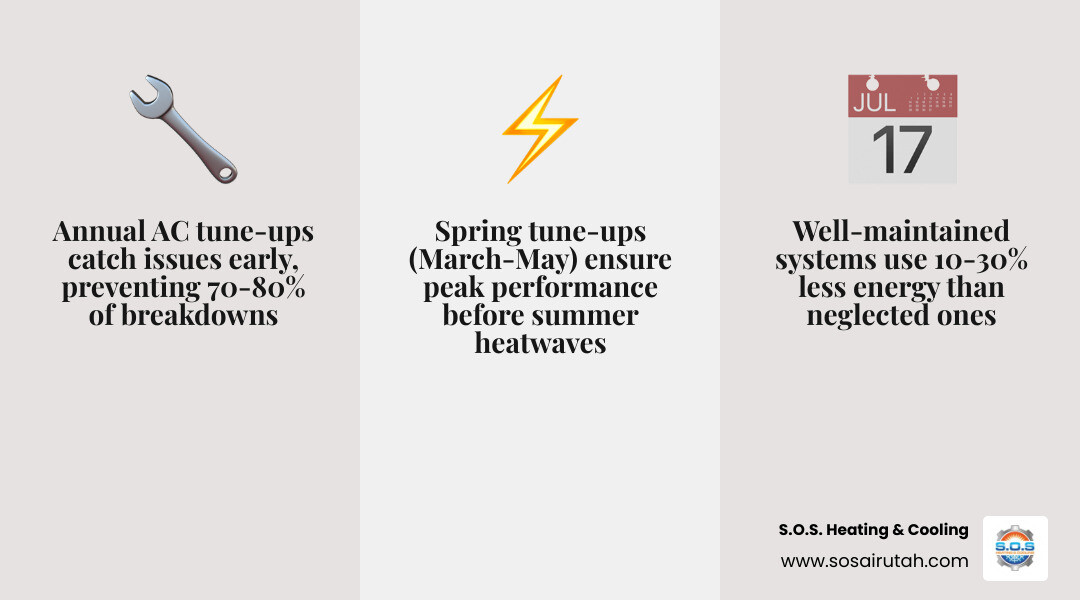
Well-maintained systems use 10–30% less energy than neglected ones, and regular service can prevent an estimated 70–80% of HVAC breakdowns. That's not a small margin. That's the difference between a comfortable summer and a week of emergency calls and repair bills.
I'm Bryson Ninow, an NATE-certified HVAC professional with years of hands-on experience helping Salt Lake City homeowners figure out exactly how often should you schedule an AC tune-up based on their specific system, usage, and home environment. Read on for a complete breakdown of maintenance schedules, what a tune-up actually includes, and what warning signs you should never ignore.
How Often Should You Schedule an AC Tune-Up for Peak Performance?

When we talk about Annual AC Tune-Ups, we are essentially talking about the "oil change" for your home. You wouldn't drive your car 20,000 miles without a check-up, and your air conditioner shouldn't run for 2,000 hours a season without one either. For the majority of residents in the Salt Lake Valley, the "gold standard" is once per year.
The timing is just as important as the frequency. We always recommend scheduling your service in the early spring—typically between March and May. Why? Because you want to ensure the system is capable of reaching its peak SEER2 efficiency rating before the first 90-degree day hits. Furthermore, most manufacturer warranties explicitly require proof of annual professional maintenance to remain valid. If a major component like your compressor fails in year five, but you haven't had a pro look at it since year one, you might find yourself footing the bill for a part that should have been covered.
Beyond the warranty, there is the matter of physics. An unserviced AC can lose roughly 5% of its efficiency every single year. Over five years, that is a 25% increase in the energy required to keep your living room at 72 degrees. By sticking to a strict annual schedule, you keep the mechanical components lubricated and the coils clean, ensuring your system doesn't have to work overtime.
| System Type | Recommended Frequency | Best Time to Schedule |
|---|---|---|
| Standard Central AC | Once Per Year | Spring (March-May) |
| Heat Pump | Twice Per Year | Spring and Fall |
| Older Units (10+ Years) | Twice Per Year | Spring and Mid-Summer |
| New Installations | Once Per Year | Spring (to maintain warranty) |
How Often Should You Schedule an AC Tune-Up for Heat Pumps vs. Central Air?
If you have a heat pump, the rules of the game change. Unlike a standard central air conditioner that gets a "vacation" during the Utah winter, a heat pump works year-round. It provides cooling in July and heating in January. Because it is essentially doing double duty, it experiences twice the wear and tear.
For these systems, we recommend a Seasonal AC Maintenance Guide approach: one visit in the spring to check the cooling side and one in the fall to inspect the heating components. During these visits, we pay special attention to the reversing valve—the part that allows the unit to switch between heating and cooling—and the defrost cycle, which is critical for preventing ice buildup on the outdoor coils during our cold Bountiful or Layton winters.
How Often Should You Schedule an AC Tune-Up for Older Systems?
Once an air conditioner passes the 10-year mark, it enters its "senior years." In the dry, dusty climate of the Wasatch Front, outdoor units can take a beating. For systems that are 10 to 15 years old, we often suggest more frequent check-ins. Component fatigue is real; capacitors (the "batteries" that start your motor) can begin to drift out of their intended electrical range.
A technician following our AC Maintenance Guide Salt Lake City will measure these electrical values. If a capacitor is running low, we can replace it proactively for a small cost. If you wait for it to fail, it usually happens on a Sunday afternoon, and the resulting strain can damage the much more expensive blower motor or compressor.
Why Regular Maintenance is Vital for Your Home
We often see maintenance as an "optional" expense, but the data suggests it is actually one of the best investments you can make in your home. There are four primary pillars to The Importance of AC Tune-Ups:
- Energy Savings: A well-tuned AC can save you up to 15% on your monthly energy bills. When coils are clean and motors are lubricated, the system draws less amperage to move the same amount of air.
- System Lifespan: While a neglected unit might only last 8 to 10 years, a well-cared-for AC unit can easily last 15 to 20 years. Regular service essentially adds a decade to the life of your equipment.
- Breakdown Prevention: Industry statistics show that annual service prevents an estimated 70–80% of all HVAC breakdowns. Most "surprises" are actually issues that have been brewing for months.
- Indoor Air Quality: Your AC is the lungs of your home. During a tune-up, we ensure that the evaporator coil isn't a breeding ground for biological growth and that the filtration system is working to remove dust, pollen, and pet dander.
Understanding Why Regular AC Tune-Ups Are Vital helps homeowners move from a "reactive" mindset to a "proactive" one. It’s the difference between choosing when to have a technician at your house and being forced to wait for one when your home is 85 degrees inside.
What a Professional AC Tune-Up Includes
When you book an AC Tune-Up with a professional team, you aren't just paying for someone to change a filter. A comprehensive Pre-Season AC System Inspection Guide involves a deep dive into the mechanical and electrical heart of the machine. Here is what a typical professional visit includes:
- Condenser Coil Cleaning: We wash away the cottonwood seeds, dirt, and Salt Lake City dust that acts as a thermal blanket, trapping heat inside your system.
- Refrigerant Level Check: We check for proper "charge." If refrigerant is low, it means there is a leak. Systems do not "use up" refrigerant like a car uses gas; it is a sealed loop.
- Electrical Inspection: We tighten loose wiring connections and measure the "draw" of your motors. High amperage is a red flag for a motor that is about to fail.
- Lubrication: We oil moving parts to reduce friction, which lowers energy use and prevents heat-related wear.
- Thermostat Calibration: We ensure your thermostat is actually communicating correctly with the unit so you aren't overcooling or short-cycling.
- Condensate Drain Clearing: We ensure the moisture pulled from your air has a clear path to the drain. A clogged drain line can lead to water damage in your attic or basement.
Signs Your System Needs Attention Before Your Next Visit
Even if you follow the "once a year" rule, your system might occasionally scream for help between visits. It is important to know when it's Time to Schedule an AC Tune-Up early. If you notice any of the following, don't wait for your spring appointment:
- Unusual Noises: Squealing, grinding, or loud "thumping" sounds usually indicate a belt or motor issue.
- Frequent Cycling: If your AC turns on and off every few minutes (short-cycling), it could be overheating or have a faulty sensor.
- Weak Airflow: If you feel "lukewarm" air or very little air coming from the vents, your evaporator coil might be frozen or your blower motor could be struggling.
- Musty Odors: This often points to biological growth on the coils or a clog in the condensate drain line.
- Ice on the Lines: If you see white frost or ice on the copper lines leading to your outdoor unit, shut it off immediately. This is usually caused by a severe airflow restriction or low refrigerant.
Common AC Warning Signs Checklist:
- [ ] Energy bills are significantly higher than April 2025.
- [ ] Humidity levels inside the home feel high.
- [ ] Certain rooms are much warmer than others.
- [ ] The outdoor unit is making a loud buzzing sound.
- [ ] There is standing water around the indoor furnace/air handler.
DIY Maintenance vs. Professional Service
We are big fans of homeowners taking an active role in their home's health. There are several things you can and should do yourself to keep things running smoothly. Our AC Maintenance Tips Cottonwood Heights UT guide highlights these key DIY tasks:
- Change the Filter: This is the #1 thing you can do. Check it every 30 days. If you have pets in a place like South Jordan or Riverton, you might need to change it more often.
- Clear the Perimeter: Ensure there is at least a 2-foot clearance around your outdoor condenser. Trim back bushes, remove tall weeds, and make sure no "treasures" are leaning against the unit.
- Visual Inspection: Look for frayed wires or signs of pests (like mice) nesting in the unit.
However, a Spring HVAC Tune-Up Essentials list also includes things that require specialized tools and training. You should never attempt to check refrigerant levels yourself (which requires EPA certification) or handle high-voltage electrical components. A professional has the meters to catch a failing capacitor or a refrigerant leak that a visual check would miss.
Frequently Asked Questions About AC Maintenance
When is the best time of year to schedule a tune-up?
The best time is early spring, specifically March through May. By scheduling early, you beat the "summer rush." Once the first heatwave hits Salt Lake City, HVAC companies are flooded with emergency repair calls. If you schedule in April, you get better technician availability and the peace of mind that your system is ready for the 100-degree days of July. It also gives you plenty of time to order parts if a potential problem is discovered.
Does skipping a tune-up void my warranty?
In many cases, yes. Most major HVAC manufacturers (and extended warranty providers) include a clause stating that the system must be maintained annually by a licensed professional. If you experience a major part failure—like a cracked heat exchanger or a seized compressor—the manufacturer may ask for "proof of service" documentation before they honor the warranty. Keeping your receipts from S.O.S. Heating & Cooling is your insurance policy against a denied warranty claim.
How long does a typical AC tune-up take?
A thorough, professional tune-up typically takes between 60 and 90 minutes. This provides enough time for a technician to perform a comprehensive 20-point inspection, clean the coils, test all electrical components, and run the system through a full cooling cycle to verify performance. If you are in a hurry, we can often coordinate an AC Tune-Up Draper visit that fits perfectly into your morning or afternoon window.
Conclusion
At S.O.S. Heating & Cooling, we’ve spent years serving our neighbors from Bountiful to South Jordan. We know that Utah weather is unpredictable, but your home comfort shouldn't be. By following a consistent maintenance schedule, you aren't just avoiding a breakdown—you're ensuring your family has a safe, efficient, and cool sanctuary all summer long.
Whether you have a brand-new system in Herriman or a 15-year-old unit in Millcreek, our team of experts is ready to help. We offer 24/7 emergency support for those times when things go wrong, but we’d much rather see you for a scheduled visit in the spring!
Don't wait for the mercury to rise. Contact us today to schedule your AC Tune-Up Salt Lake City UT and breathe easy knowing your cooling system is in top shape for 2026.
Explore Our Latest Insights and Updates in Plumbing Services
Why Your HVAC Needs a Humidity Sidekick to Keep You Comfortable

Signs Your Home Is Too Dry or Too Humid
Are Tankless Water Heater Benefits Real in Hard Water Areas?