

How Often to Service Your AC in Dry Utah Climate


.avif)

Why Utah Homeowners Need to Think Differently About AC Service
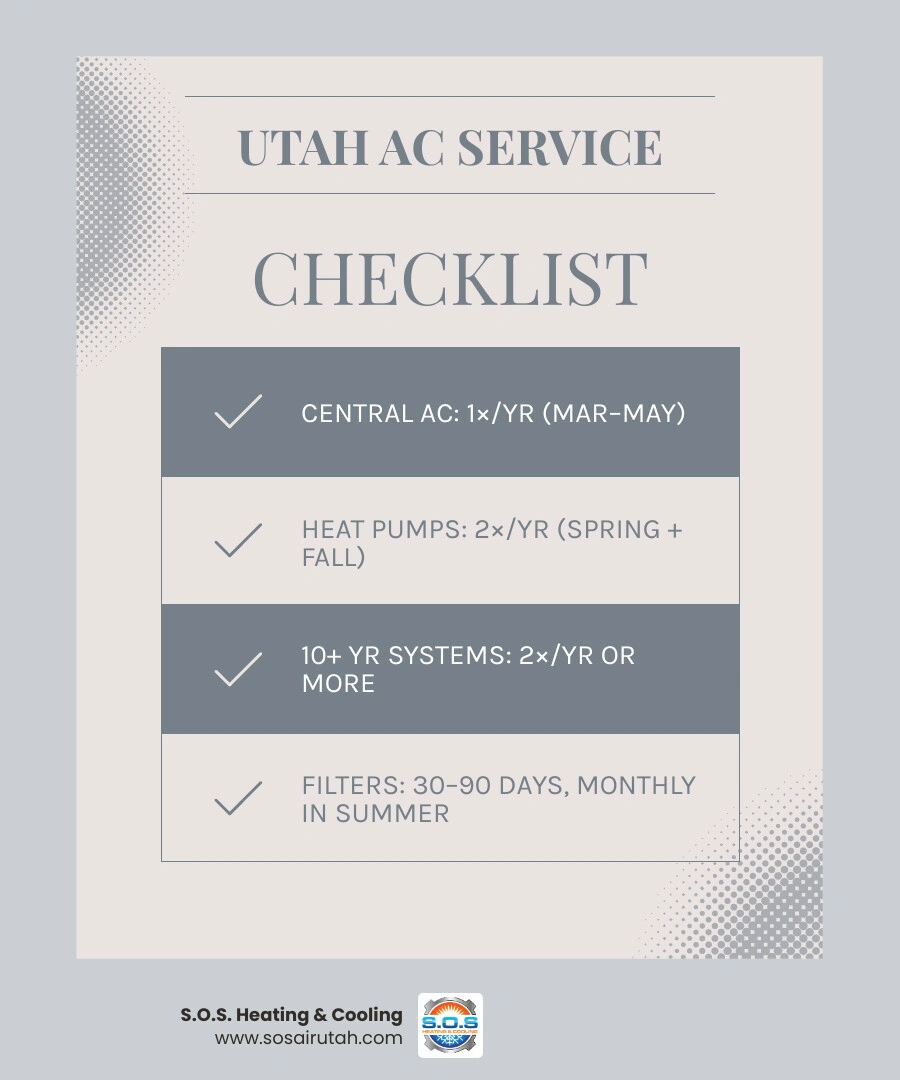
If you've ever wondered how often should you service your air conditioner in a hot dry Utah climate, here's the short answer:
- Standard central AC: Once per year, ideally in early spring (March–May)
- Heat pumps: Twice per year — spring and fall — due to year-round operation
- Systems 10+ years old: Twice per year or more, given accelerated wear in Utah's desert conditions
- Air filters: Every 30–90 days, with monthly changes during peak summer or heavy dust periods
Utah is not a typical climate for air conditioners. Summers push past 100°F with relative humidity dropping below 15 percent. Winters bring inversion season, trapping fine particulate matter that settles deep inside dormant equipment. Sitting at roughly 4,300 feet above sea level, the Salt Lake Valley adds UV intensity and thinner air to the mix — a combination that shortens AC lifespans and demands more from every component inside your system. While a well-maintained central AC can last 15 to 20 years nationally, Utah homeowners realistically see 12 to 16 years — and systems that miss regular service often show significant decline well before that.
Skipping even one year of maintenance can cost you. An unserviced AC can lose roughly 5 percent of its efficiency every single year, and regular service is estimated to prevent 70 to 80 percent of HVAC breakdowns. In a climate where your system runs hard for months without a break, that math matters.
I'm Bryson Ninow, a NATE-certified HVAC professional with hands-on experience helping Wasatch Front homeowners keep their cooling systems running through Utah's punishing summers — and answering the exact question of how often should you service your air conditioner in a hot dry Utah climate is something I help families with every season. In the sections below, I'll walk you through everything you need to know to protect your system, lower your energy bills, and avoid a breakdown on the hottest day of the year.
How Often Should You Service Your Air Conditioner in a Hot Dry Utah Climate?
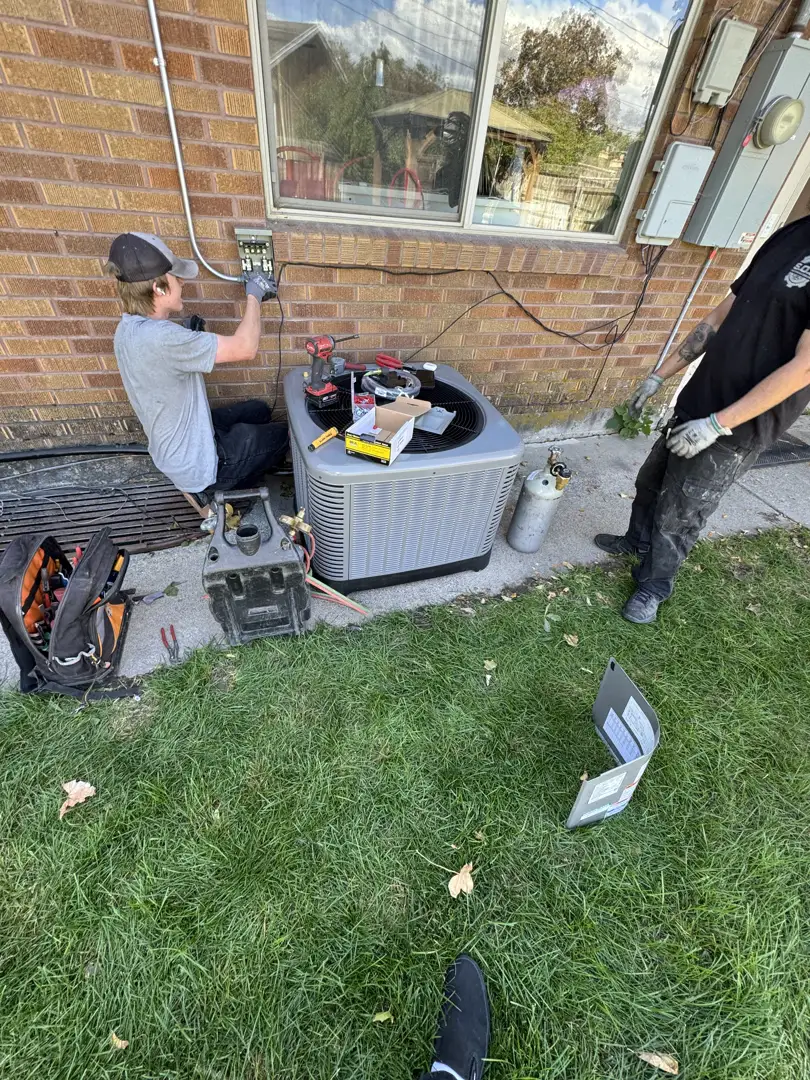
When we talk about scheduling a professional service, timing is just as important as frequency. Along the Wasatch Front, we recommend a baseline of one professional tune-up per year for standard cooling systems. However, our high-desert environment is incredibly demanding. The sheer volume of airborne dust, pollen, and winter inversion soot means your system works significantly harder than it would in a milder, more humid climate.
To understand why a set schedule is so important, it helps to look at How Often Should You Schedule an AC Tune-Up? to see how skipping even a single season can leave your system vulnerable.
For quick reference, here is our recommended professional service schedule based on your specific equipment type:
- Standard Central AC: Once per year, scheduled in early spring (March through May) before the first major heatwave hits.
- Heat Pumps: Twice per year (once in the spring for the cooling cycle, once in the fall for the heating cycle).
- Older Systems (10+ Years Old): Twice per year. Older components are highly vulnerable to the extreme heat of July and August.
- New Systems under Warranty: Once per year (minimum mandatory to maintain manufacturer warranty validity).
Standard Central AC Maintenance Frequency
For standard central air conditioning units in Utah, an annual spring tune-up is the gold standard. During the winter, your outdoor condenser unit sits dormant, collecting falling leaves, dirt, and fine particulate matter from our winter inversions. If you start your system in late May without cleaning this debris away, your AC immediately operates at a disadvantage.
A dirty condenser coil cannot release heat efficiently. This forces the compressor to run hotter and longer to achieve the same indoor temperature, which can quickly lead to a 5% to 15% spike in your monthly energy bills. Over a few seasons, this neglected buildup causes the system to lose roughly 5% of its operating efficiency every single year. Scheduling a professional visit in the spring ensures your system is clean, calibrated, and fully charged with refrigerant before the summer rush begins. To learn more about why this yearly visit is non-negotiable, check out our guide on Why Regular AC Tune-Ups Are Vital.
Heat Pump Maintenance Frequency in Utah's Climate
If your home relies on a heat pump instead of a traditional split system (AC and furnace), your maintenance schedule must change. Heat pumps do double duty: they cool your home in the summer and reverse the process to heat it in the winter. Because they run almost continuously throughout the year, they experience twice the physical wear and tear of a standard air conditioner.
For heat pumps in Utah, we strongly recommend a twice-yearly professional service. A spring visit prepares the system to reject heat into our dry outdoor air, while a fall visit ensures the reversing valve, defrost controls, and auxiliary heating elements are fully prepared for freezing winter temperatures. Skipping maintenance on a heat pump can void your warranty and lead to a sudden breakdown when you need comfort the most.
Environmental Factors That Impact Utah AC Systems
Utah’s climate is beautiful, but it is undeniably hostile to mechanical equipment. To keep your home cool, your air conditioner relies on basic physics: transferring heat from inside your home to the outdoors. Our local environment throws several unique roadblocks in the way of this process. If you want to dive deeper into this science, read about How Air Conditioning Works Differently in Arid Climates.
High Altitude and Thin Mountain Air
Whether you live on the valley floor in Salt Lake City or up on the benches of Mt. Olympus, altitude plays a major role in your AC’s performance. At 4,300+ feet above sea level, the air is significantly thinner than it is at sea level. Thinner air has less density, which means it cannot carry away heat as effectively as dense, humid air.
Because the air is thin, your indoor blower motor has to work harder to move enough air volume across your evaporator coil. This requires highly precise system calibration. If the airflow is even slightly restricted by a dirty filter or a failing motor, the temperature of the coil can plummet, leading to frozen lines and potential compressor failure. Furthermore, our high elevation amplifies UV radiation by up to 20%, which rapidly degrades exposed wiring insulation and plastic components on your outdoor unit.
The Sandpaper Effect of Dust, Inversions, and Wildfire Ash
In Utah, we deal with a unique cocktail of airborne debris. In the late spring, cottonwood seeds (often called "Utah snow") blanket neighborhoods in Sandy, Draper, and Riverton, quickly wrapping outdoor condenser coils in a thick, insulating blanket.
In the summer, dry desert winds carry abrasive dust and wildfire ash across the Wasatch Front. This fine dust acts like sandpaper on moving parts, getting inside fan bearings and grinding away at delicate components.
When winter arrives, our famous temperature inversions trap fine particulate matter (PM2.5) close to the valley floor. This grime settles on your dormant outdoor unit, mixing with moisture to create a thin, sticky sludge that coats the heat-exchanger fins. When you turn your AC on in the spring, this baked-on layer of winter soot severely restricts heat transfer.
Thermal Cycling and Extreme Temperature Swings
The high desert is known for dramatic daily temperature swings, often fluctuating by 30°F to 40°F in a single 24-hour period. In July, a scorching 100°F afternoon can quickly give way to a cool 65°F night.
These extreme temperature swings cause metal components, copper refrigerant lines, and electrical connections to rapidly expand and contract. Over time, this constant "thermal cycling" loosens electrical terminals, stresses brazed refrigerant joints, and weakens capacitors. In fact, capacitors — the small batteries that help start your AC motors — are rated for maximum temperatures of around 131°F, but the electrical cabinets on outdoor units can easily exceed 150°F during a sustained July heatwave. This extreme heat is why capacitors are the number one cause of summer breakdowns along the Wasatch Front. To understand how these factors combine to age your system prematurely, take a look at How High Desert Weather Affects AC Equipment Lifespan.
DIY Maintenance vs. Professional AC Servicing
Many homeowners ask us if they can handle air conditioner maintenance themselves. While there are several critical tasks you should perform to keep your system running smoothly, a professional tune-up requires specialized tools, diagnostic instruments, and EPA certifications that homeowners simply do not have.
| Maintenance Task | DIY Friendly? | Requires Professional? | Recommended Frequency |
|---|---|---|---|
| Replace Air Filters | Yes | No | Every 30–90 days |
| Clear Debris Around Condenser | Yes | No | Monthly during summer |
| Clean Condenser Fins (Gentle Rinse) | Yes | No | Monthly during summer |
| Test Thermostat Operation | Yes | No | Annually (Spring) |
| Check Refrigerant Charge & Leaks | No | Yes | Annually (Spring) |
| Test Electrical Capacitors & Contactors | No | Yes | Annually (Spring) |
| Clear Condensate Drain Line | No | Yes | Annually (Spring) |
| Calibrate Airflow & Blower Motor | No | Yes | Annually (Spring) |
Critical DIY Tasks for Utah Homeowners
Your most important job as a homeowner is managing airflow. Because our air is dry and dusty, your indoor air filter is your system's primary line of defense. We recommend checking your filter every 30 days. In high-wind or heavy-dust areas like South Jordan or Herriman, or if you have pets, you will likely need to replace it monthly during the summer.
When choosing a filter, aim for a MERV rating between 8 and 11. While higher MERV filters catch more microscopic particles, they can severely restrict airflow in our thin mountain air, causing your system to work harder and potentially freeze up.
Additionally, keep a two-foot clearance zone around your outdoor condenser unit. Trim back any Sagebrush, ornamental grasses, or weeds, and gently rinse the outdoor coils with a garden hose (never use a pressure washer, as this will bend the delicate aluminum fins).
Why Professional Calibration is Required in Utah
While keeping your system clean is a great start, professional calibration is what keeps your energy bills low and prevents major breakdowns. Our certified technicians carry specialized equipment to measure refrigerant pressure, test electrical draw, and inspect safety controls.
For example, checking refrigerant levels requires EPA certification because handling refrigerant is strictly regulated. If your system is even slightly undercharged, it will run continuously, driving up your power bill and eventually burning out the compressor. We also test the microfarad ratings of your capacitors to catch them before they fail on a 100-degree Sunday afternoon. For a complete breakdown of what our team does during a local visit, check out our AC Tune-Up Guide for Wasatch Front Homeowners.
Signs Your AC Needs Immediate Attention Before Your Next Scheduled Visit
Even with regular annual maintenance, the intense heat of a Utah summer can push an aging or stressed system to its limit. It is important to know the warning signs that indicate your system needs professional attention before your next scheduled tune-up.
Determining how often should you service your air conditioner in a hot dry utah climate based on short-cycling
If your air conditioner turns on, runs for three to five minutes, shuts off, and then repeats the cycle a few minutes later, it is "short-cycling." This is a major red flag. Short-cycling places immense stress on your compressor and fan motors, drastically increasing your energy consumption and accelerating wear.
In our hot, dry climate, short-cycling is often caused by:
- Overheating components: A failing capacitor or an overheating fan motor shutting down to prevent a fire.
- Airflow restrictions: A heavily clogged air filter trapping cold air inside the system, causing the evaporator coil to freeze.
- Thermostat issues: Miscalibration or poor placement near a drafty window.
If you notice your system cycling rapidly, shut it down immediately and call for professional service to prevent permanent damage to your compressor.
Evaluating how often should you service your air conditioner in a hot dry utah climate when experiencing weak airflow or warm air
If your vents are blowing weak or lukewarm air, your system is crying out for help. In humid states, a frozen AC coil is usually caused by high moisture levels. In Utah, however, the primary culprit is restricted airflow combined with dry air. When dust coats your evaporator coil, it insulates the refrigerant lines, causing the temperature of the coil to drop below freezing. Moisture from your indoor air then freezes instantly on the coil, turning it into a solid block of ice.
If you notice ice forming on the copper lines outside your home or see water pooling around your indoor furnace unit, turn the system off and switch the thermostat fan to "On" to let the ice melt. Do not run the AC while it is frozen, as this can destroy the compressor.
The Repair-vs-Replace Tipping Point for Utah Air Conditioners
Because of the intense environmental stressors along the Wasatch Front, air conditioners in Utah typically last 12 to 16 years, compared to the national average of 15 to 20 years. If your system is approaching its twelfth birthday and starting to require frequent repairs, you are likely facing the repair-versus-replace tipping point.
To help our customers make the best financial decision, we use the $5,000 Rule:
- Multiply the age of your air conditioner (in years) by the cost of the repair estimate.
- If the result is under $5,000, repairing the system is usually the right call.
- If the result is over $5,000, that money is better spent on a replacement.
For example, if your 12-year-old system needs a $500 repair, the calculation is $6,000 ($500 x 12). Because this exceeds $5,000, investing in a modern, energy-efficient SEER2 system is generally the smarter long-term investment. Modern systems use significantly less electricity and can lower your summer cooling bills by up to 35%, while also qualifying for local utility rebates through Rocky Mountain Power.
Frequently Asked Questions about Utah AC Maintenance
How often should I replace my air filter in Utah's dusty conditions?
We recommend checking your filter every 30 days. During active construction seasons, high-wind events, or heavy summer dust storms, you should replace your filter every month. At a minimum, never let a filter go longer than 90 days without replacement.
Can Utah's dry air cause my AC coils to freeze?
Yes, absolutely. While it seems counterintuitive, dry air actually accelerates coil freezing when airflow is restricted. Because our air is so dusty, fine particulate matter quickly coats the indoor evaporator coil. This dust restricts airflow, causing the temperature of the refrigerant inside the coil to drop below 32°F, which instantly freezes any ambient moisture onto the metal fins.
What is the best time of year to schedule an AC tune-up in Utah?
The best time to schedule your tune-up is in early spring, specifically between March and May. Scheduling early ensures your system is clean and fully operational before the summer heat hits, and it allows you to avoid the peak-season delays and emergency repair rates that occur during the July and August heatwaves.
Conclusion
Your air conditioner is one of the most important investments in your Utah home. Understanding how often should you service your air conditioner in a hot dry Utah climate is the key to keeping your home comfortable, lowering your monthly energy bills, and ensuring your system survives the unique challenges of the Wasatch Front.
At S.O.S. Heating & Cooling, we have been helping families across Salt Lake City, Sandy, Draper, South Jordan, and the surrounding communities stay comfortable through every seasonal extreme. We offer 24/7 emergency repairs, priority service, and flexible financing to make maintaining your home as simple and stress-free as possible.
Don't wait for the first triple-digit heatwave to find out if your air conditioner is ready. Schedule your professional AC tune-up today and breathe easy knowing our expert team has your back all summer long.
Explore Our Latest Insights and Updates in Plumbing Services
Why Your Skin and Furniture Crave a Winter Humidifier
Why Upgrading to a High Efficiency AC System is a Cool Move
Mini Split vs Central AC Cost Comparison for Savvy Homeowners