

The Ultimate Schedule for Changing Filters in High Dust Areas


.avif)

Why Knowing How Often to Change Your AC Filter in Dusty Climates Can Save Your System
How often to change your ac filter in dusty climates depends on where you live, your filter type, and how hard your system runs — but here is a quick answer for most dusty-climate homeowners:
| Climate / Condition | Recommended Change Frequency |
|---|---|
| Standard dusty climate (general) | Every 30-60 days |
| Arizona / Phoenix (haboobs, extreme heat) | Every 30-45 days |
| Utah / Wasatch Front (Great Salt Lake dust, altitude) | Every 30 days in summer |
| Dubai / desert coastal (Shamal winds, humidity) | Every 2-3 weeks (reusable); every 1-3 months (disposable) |
| Central Florida (humid + dusty) | Every 30 days in peak summer |
| Homes with pets or allergy sufferers | Every 20-45 days |
| Post-dust storm or wildfire smoke event | Inspect immediately; replace if clogged |
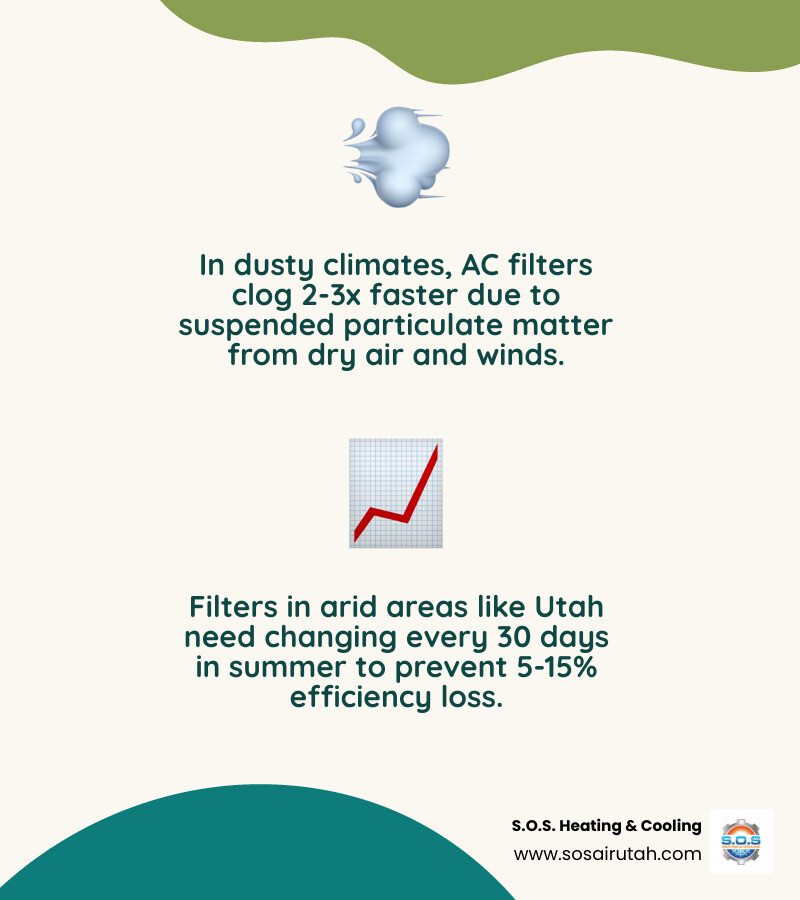
If you live anywhere near unpaved roads, active construction, or in a dry, windy region like Salt Lake City, the standard "replace every 90 days" rule on the package simply does not apply to you. Dusty climates load up filters two to three times faster than cleaner environments — and a clogged filter does not just hurt your air quality. It makes your AC work significantly harder, drives up your energy bill, and can shorten the life of your entire system.
Most homeowners only think about their filter when something goes wrong — the room stops cooling, the bill jumps, or a strange smell starts circulating. In a dusty climate, waiting that long is a mistake that can turn a $10 fix into a much bigger problem.
I'm Bryson Ninow, an HVAC professional with certifications including NATE, EPA, and DOPL, and a deep focus on indoor air quality and energy efficiency — I've seen in the Salt Lake City area how quickly dust, altitude, and dry air can destroy an unprepared HVAC filter. In this guide, I'll walk you through exactly how often to change your ac filter in dusty climates so you can protect your system and breathe easier all year long.
Why Dusty Climates Demand More Frequent Filter Changes
When you live in an arid region, the air is naturally filled with more particulate matter than in humid, coastal areas. In places like the Wasatch Front, we don't just deal with standard household dust; we face unique environmental challenges like Great Salt Lake dust, seasonal inversions, and fine mineral particulates that stay airborne longer due to low humidity.
The importance of air filter replacement cannot be overstated when these external factors are at play. In a humid climate, moisture helps dust particles clump together and fall to the ground. In our dry Utah air, those particles remain suspended, just waiting for your HVAC system to "inhale" them.
Furthermore, we have to consider altitude physics. Here in Salt Lake City, we are living at roughly 4,300 feet (and even higher in places like Mt. Olympus or Draper). At these altitudes, the air is thinner—meaning it has about 82% of the density found at sea level. To achieve the same amount of cooling, your HVAC system has to move 15-20% more air volume. Because your blower motor is processing more air to keep you comfortable, it is also pulling more dust through the filter every single minute.

How often to change your ac filter in dusty climates like Utah
For those of us living along the Wasatch Front—from Bountiful down to Riverton—the 30-day rule is your best friend during the peak summer months. Between the triple-digit heat and the dust stirred up by summer winds, a filter can go from clean to "caked" in just four weeks.
During our winter inversion periods, the air quality in the Salt Lake Valley can become some of the poorest in the nation. Fine particulates trapped in the valley are pulled into your home every time a door opens. To keep your indoor air breathable, we recommend shortening your filter change intervals to 45 days during the winter, even if you aren't running the AC. The minerals from the drying Great Salt Lake bed are particularly fine and abrasive, making air filter replacement in Salt Lake City, UT a critical monthly task for system health.
Factors That Shorten Your AC Filter Lifespan
While the climate is a major factor, your lifestyle inside the home also dictates how often to change your ac filter in dusty climates.
- Pet Dander: If you have furry family members, they are essentially "dust factories." Pets stir up settled dust and contribute hair and dander that can clog a filter in half the usual time.
- Construction Zones: If you live in a developing area like Herriman or South Jordan, construction dust is a constant battle. This dust is often much finer than organic dust and can saturate a filter in as little as two weeks.
- Home Occupancy: More people means more movement, which keeps dust circulating rather than settling.
- Wildfire Smoke: In recent years, smoke from regional wildfires has become a major factor in Utah. Smoke particles are incredibly small and sticky; they can create a "glaze" over your filter that restricts air almost entirely.
When a filter becomes too full, you might experience the "blow-by effect." This happens when the suction from the fan is so strong that it actually pulls dust around the edges of the filter frame because the filter itself is too clogged to let air through. This dust then settles on your blower motor and evaporator coils, acting like a thermal blanket. This causes the motor to run hot and can eventually lead to a total system burnout. Recognizing the signs your HVAC filter needs replacement early can save you from these expensive repairs.
Impact of high usage and how often to change your ac filter in dusty climates
During a Salt Lake City summer, your AC might run for 12 to 18 hours a day. If you have your thermostat set to "Fan ON" rather than "Auto," your system is filtering air 24/7. While this is great for air quality, it means you are hitting your filter's "mileage limit" much faster.
A clogged filter in a dusty environment can increase your energy consumption by 5-15%. Why? Because the blower motor has to work twice as hard to pull air through a wall of dirt. If you notice your system is "short-cycling" (turning on and off rapidly) or running longer than usual to reach the set temperature, it's likely time to replace your air conditioner filter.
Choosing the Right Filter Type for Arid Environments
Not all filters are created equal, especially when it comes to the HVAC filter Salt Lake City, UT homes require. The MERV (Minimum Efficiency Reporting Value) rating tells you how well a filter catches small particles.
| Filter Type | Typical MERV | Lifespan (Standard) | Lifespan (Dusty Climate) |
|---|---|---|---|
| Fiberglass | 1-4 | 30 Days | 20-30 Days (Avoid) |
| Pleated (Standard) | 5-8 | 90 Days | 30-60 Days |
| Pleated (High-Eff) | 11-13 | 90 Days | 30-45 Days |
| Media Filter | 11-16 | 6-12 Months | 3-5 Months |
| Washable Mesh | N/A | Wash Monthly | Wash every 2-3 weeks |
When choosing the right HVAC filter, we generally recommend avoiding the cheap, see-through fiberglass filters. They might be inexpensive, but they only catch the largest "dust bunnies," letting the fine Utah dust pass right through to your expensive equipment.
Balancing MERV ratings and how often to change your ac filter in dusty climates
There is a "sweet spot" for residential filtration. For most homes in the Salt Lake Valley, a MERV 8 to MERV 11 pleated filter provides the best balance. It catches the fine dust and allergens we deal with without creating too much static pressure.
Be careful with MERV 13 or higher filters. While they are great at catching viruses and smoke, they are very dense. In an older system, a MERV 13 filter can act like a brick, restricting airflow so much that it causes the evaporator coils to freeze up. If you want high-level filtration, it's best to consult with us to ensure your blower motor can handle the resistance.
Step-by-Step Guide to Checking and Replacing Your Filter
Checking your air conditioner filter in Salt Lake City, UT is a simple DIY task that takes less than five minutes. Here is how to do it safely:
- Turn the System OFF: Always turn your thermostat to the "OFF" position before opening the filter compartment. This prevents the fan from sucking in loose dust or debris while the filter is out.
- Locate the Filter: It is usually found in a slot on the side of the indoor air handler (often in the basement or a closet) or behind a large return air grille on a wall or ceiling.
- The "Light Test": This is the gold standard for checking a filter. Hold the filter up to a bright light or the sun. If you cannot see light passing through the fibers, the filter is clogged and needs to be replaced immediately, regardless of how many days it has been in use.
- Check the Arrow: Every filter has an arrow on the frame indicating airflow direction. The arrow should always point toward the furnace or air handler (away from the room).
- Note the Size: Look at the side of the old filter for the dimensions (e.g., 20x25x1). Using the wrong size allows "bypass air" to carry dust directly into your system.
Frequently Asked Questions about AC Filters in Dusty Areas
Can I wash a disposable pleated filter?
No. Disposable pleated filters are made of paper and specialized synthetic fibers. Getting them wet will destroy their structural integrity and can lead to mold growth. If you have a permanent, washable mesh filter, you can rinse it, but it must be 100% dry before you put it back. In our dry Utah climate, these usually dry in about 30 minutes in the shade.
Does a dirty filter really increase my energy bill?
Absolutely. Research from the Department of Energy shows that replacing a dirty filter can reduce your AC's energy use by 5% to 15%. In the middle of a hot July in Sandy or Draper, that can translate to a significant monthly saving on your utility bill.
What happens if I ignore my filter during a dust storm?
A single major windstorm or "haboob" can dump three months' worth of dust into your system in one afternoon. If the filter clogs completely, the lack of airflow will cause the temperature of your evaporator coils to drop below freezing. This leads to icing, where your AC unit literally turns into a block of ice. Once this happens, the system will stop cooling entirely and could lead to a "short-cycling" failure or a dead compressor.
Conclusion
Living in the beautiful but dusty Salt Lake City area means our HVAC systems work harder than most. By staying on top of your filter schedule, you aren't just improving your indoor air quality—you are performing the single most important piece of preventative maintenance possible for your home.
At S.O.S. Heating & Cooling, we've been serving families from Layton to South Jordan for years, and we know exactly what our local climate demands. Whether you need a professional tune-up or help selecting the perfect filtration system for your home, we are here to help 24/7. Don't let a $10 filter lead to a $1,000 repair.
Schedule your air conditioner filter service in Salt Lake City today and keep your home cool, clean, and efficient all summer long!
Explore Our Latest Insights and Updates in Plumbing Services

Why Your High Altitude Home Needs a Special Kind of AC Math
The Dynamic Duo of Home Cooling
Utah Energy Rebates: How to Save Big on High Efficiency Heating and Cooling