
The Ultimate Utah Water Heater Maintenance Checklist


.avif)

How Often to Flush Your Water Heater in Hard Water: Quick Answer for Utah Homeowners
How often to flush your water heater in hard water depends on your local water hardness level — and in Utah, that number matters more than most homeowners realize.
Here's the short answer:
| Water Hardness | Recommended Flush Frequency |
|---|---|
| Soft water (under 7 GPG / below 120 mg/L) | Once per year |
| Moderately hard (7–10 GPG / 120–180 mg/L) | Once per year |
| Hard water (10–15 GPG / 180–200 mg/L) | Every 6 months |
| Very hard water (above 15 GPG / above 200 mg/L) | Every 3–6 months |
Salt Lake City's water supply falls into the hard-to-very-hard range, which means the standard once-a-year advice you'll find on most manufacturer stickers simply isn't enough to protect your system.
Most homeowners don't think about their water heater until something goes wrong — a rumbling noise from the basement, a shower that runs cold too soon, or an energy bill that quietly creeps higher month after month. By then, sediment has often been building up for years. Minerals like calcium and magnesium dissolved in Utah's water supply precipitate out when heated, settling at the bottom of your tank as a dense, crusty layer that forces your heater to work harder, use more energy, and wear out faster.
The good news is that this is one of the most preventable problems in your home — if you know the right schedule to follow.
I'm Bryson Ninow, an HVAC and plumbing professional with hands-on experience helping Utah homeowners protect their systems against the real-world effects of hard water, including understanding how often to flush your water heater in hard water based on local conditions rather than generic guidelines. In the sections below, I'll walk you through everything you need to know to keep your water heater running efficiently for years to come.
Understanding Sediment and How Often to Flush Your Water Heater in Hard Water
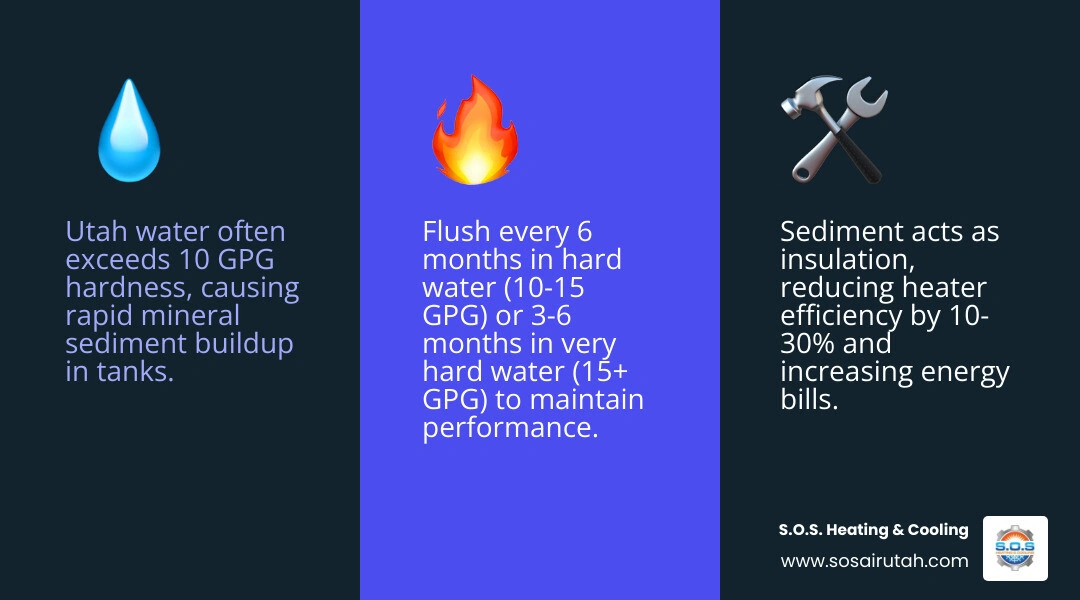
To understand why we emphasize maintenance so much, you have to look inside the tank. "Hard water" is essentially water that contains high concentrations of dissolved minerals, primarily calcium carbonate and magnesium. When this water is heated, these minerals undergo a chemical change and solidify, a process known as mineral precipitation.
These solids, or "scale," settle at the bottom of your tank. Over time, this buildup creates a thick, insulating layer of sediment. This layer acts as a physical barrier between the heat source (the burner or heating element) and the water. Imagine trying to boil a pot of water with a thick layer of sand at the bottom of the pot—it would take much longer and use much more energy.
This sediment isn't just an efficiency killer; it’s a tank killer. According to industry data, a sediment layer as thin as 6 mm can force a gas burner to work significantly harder, leading to a 10% to 30% drop in energy efficiency. Furthermore, this buildup can displace water, reducing your hot water capacity by 20% to 40%. If left unaddressed, this neglected maintenance can shorten a water heater's life from a healthy 15 years to just 6–8 years. If you're noticing these issues, it's worth checking out our Signs Your Water Heater Needs Replacement guide to see if the damage is already done.
Determining How Often to Flush Your Water Heater in Hard Water Based on Usage
While water hardness is the primary driver, your household's daily habits play a major role in how often to flush your water heater in hard water. Every time your water heater runs a cycle to recover after a long shower or a load of laundry, more minerals precipitate out.
- Large Households: If you have a family of five or more, your water heater is constantly cycling. More cycles mean more sediment. In these cases, we often recommend sticking to a strict 6-month schedule, regardless of your water's exact grain count.
- Tank Capacity: Smaller tanks (30–40 gallons) often experience faster sediment accumulation relative to their size because they have to work harder to keep up with demand.
- System Stress: High-demand homes often see a faster "recovery time" lag. If you notice it takes longer for the water to get hot after someone else has used it, sediment is likely the culprit. For residents in South Jordan, our Water Heater Repair South Jordan Tips can help you identify these performance dips early.
The Impact of Local Mineral Content on How Often to Flush Your Water Heater in Hard Water
Geography is destiny when it comes to plumbing. In Salt Lake City and the surrounding Wasatch Front, our water often comes from mountain runoff and deep wells that pass through mineral-rich limestone.
The USGS classifies water above 180 mg/L as "very hard." Much of the water in areas like Salt Lake City, Draper, and Sandy exceeds this threshold, often reaching 15–20 grains per gallon (GPG). When you are dealing with this level of mineral-heavy supply, the standard manufacturer's manual—which is written for average national water quality—becomes obsolete.
If you don't have a Water Softeners Salt Lake City UT system installed, your water heater is essentially acting as a giant mineral filter for your home. This is why our Water Heater Replacement SLC Guide emphasizes that local conditions dictate a much more aggressive maintenance schedule than what you might find on a generic DIY website.
Signs Your System Needs an Immediate Flush
You don't always need a calendar to tell you it's time for maintenance; your water heater will often tell you itself. Here are the most common warning signs that sediment has reached a critical level:
- Popping or Rumbling Noises: This is the most famous symptom, often described as "kettle-ing" or sounding like popcorn popping inside the tank. This happens when water gets trapped underneath the hardened sediment layer. As it heats up, it turns to steam and "pops" through the sediment layer to escape.
- Cloudy or Discolored Water: If your hot water looks "milky" or contains sandy, white particles, you’re seeing the actual mineral scale being stirred up and sent through your pipes.
- Metallic Smell or Taste: High mineral content and sediment can react with the tank's interior, leading to a distinct metallic or "rotten egg" odor.
- Slow Recovery and Temperature Fluctuations: If your hot water runs out faster than it used to, sediment is likely taking up space in the tank and insulating the water from the heat source.
- Visible Leaks: While flushing can't fix a leak, a Hot Water Heater Leaking from the bottom is often a sign that sediment has caused the tank to overheat and crack.
If you are hearing these sounds in your Holladay home, refer to our Water Heater Repair Guide Holladay UT for immediate troubleshooting steps.

Step-by-Step DIY Water Heater Flushing Guide
If you're handy and want to tackle this yourself, a standard flush takes about 30 to 60 minutes. However, safety is paramount. Always remember that you are dealing with high-voltage electricity or gas and scalding hot water.
- Safety First (Power Down): For electric heaters, turn off the circuit breaker. For gas heaters, turn the gas control knob to "Pilot." Never drain a heater that is actively powered, as this can burn out the heating elements or damage the tank.
- Shut Off Water: Close the cold water intake valve (usually located at the top of the heater).
- Connect a Hose: Attach a standard garden hose to the drain valve at the base of the tank. Run the other end to a floor drain, a driveway, or a large bucket.
- Open a Faucet: Open a hot water faucet somewhere in the house (like a bathtub). This prevents a vacuum from forming and allows the tank to drain smoothly.
- Open the Drain Valve: Carefully open the drain valve on the water heater. The water will be very hot, so use caution.
- The "Power Flush": Once the tank is empty, briefly turn the cold water intake valve back on for a few seconds. This "stirs up" the remaining sediment at the bottom so it can be flushed out. Repeat this until the water running through the hose is crystal clear.
- Refill the Tank: Close the drain valve and remove the hose. Turn the cold water intake back on. Wait until the tank is completely full and water is flowing steadily from the open hot water faucet in your house before turning the power or gas back on. This prevents "dry-firing," which can lead to an immediate Water Heater Element Repair need.
For a more detailed walkthrough tailored to our neighbors in the south valley, check out the Best Water Heater Repair South Jordan Guide.
Advanced Maintenance: Tankless Descaling and Anode Rods
Maintenance isn't just about the water inside the tank; it's about the components that protect the tank.
The Sacrificial Anode Rod
Every tank-style water heater has a "sacrificial" anode rod. Its sole job is to corrode so your tank doesn't. In hard water areas, these rods can be eaten away in as little as 2–3 years. If the rod is completely gone, the minerals in the water will start attacking the steel walls of your tank. We recommend inspecting the anode rod every time you perform a flush. If it looks like a thin wire or is covered in thick calcium "popcorn," it needs replacement. This simple check can be the difference between a 10-year tank and a 20-year tank, as noted in our Water Heater Replacement Draper UT Guide.
Tankless Water Heater Descaling
Tankless units don't have a large tank to collect sediment, but they are even more sensitive to hard water. The minerals settle inside the narrow pathways of the heat exchanger. Instead of a simple flush, tankless units require "descaling." This involves circulating a food-grade descaling solution (or white vinegar) through the unit using a pump for about 45–60 minutes.
In Utah, failing to descale a tankless unit annually can void your manufacturer's warranty, especially if your water hardness exceeds 9 GPG. To prevent this, many homeowners in areas like Sandy choose to install Water Softeners Sandy UT to protect these high-efficiency systems.
Frequently Asked Questions about Water Heater Maintenance
Do water softeners eliminate the need for flushing?
This is a common misconception. While a Water Softeners South Jordan UT system significantly reduces the rate of mineral buildup, it doesn't eliminate it entirely. Softeners replace calcium and magnesium with a small amount of sodium, but some residual minerals and tiny bits of rust from your pipes will still settle at the bottom of the tank. A softener allows you to move from a 6-month flush schedule to an annual one, but you shouldn't skip maintenance entirely. For even better protection, consider Water Filtration South Jordan UT to remove sediment before it even reaches the heater.
Can I flush a water heater myself or should I call a pro?
Many homeowners successfully flush their own tanks. However, there are risks. If your water heater hasn't been flushed in years, the drain valve may be seized or "welded" shut by mineral deposits. Forcing it can cause the valve to snap, leading to a flood. Additionally, if you have an older unit, removing the sediment might actually reveal "pinhole" leaks that the sediment was effectively plugging. If you're unsure, or if your unit is over 10 years old, it's safer to call a professional for an inspection, as seen in our Water Heater Replacement Guide Centerville UT.
How does flushing frequency differ for tank vs. tankless?
- Tank Heaters: Focus on sediment removal from the bottom of the tank. Frequency is 6–12 months.
- Tankless Heaters: Focus on chemical descaling of the heat exchanger. Frequency is strictly annual (or every 6 months if water is extremely hard).For those looking for the ultimate in water quality for both their appliances and their drinking water, a Reverse Osmosis Salt Lake City UT system can be a great addition to the home, though it typically serves specific taps rather than the whole-home hot water supply.
Conclusion
Understanding how often to flush your water heater in hard water is the key to avoiding cold showers and expensive emergency repairs. In our Utah climate, your water heater is one of the hardest-working appliances in your home. By committing to a regular flushing schedule—every 6 months for most local homes—you ensure your system runs at peak efficiency, keeping your energy bills low and your water hot.
At S.O.S. Heating & Cooling, we’ve been serving the Salt Lake Valley since 1984. Whether you need a routine maintenance flush, an anode rod replacement, or you're ready to explore a new system through our Water Heater Replacement Guide South Salt Lake UT, our team is here to help. We provide 24/7 emergency service and expert plumbing care to Bountiful, Draper, Sandy, and beyond.
Don't wait for the rumbling sounds to start. Schedule your professional water heater service today and give your water heater the care it needs to last for years to come.

Plumbing
Expert plumbing services offering reliable repairs, installations, maintenance, and emergency support.

Air Conditioning
Comprehensive air conditioning services include installation, repairs, maintenance, and energy-efficient solutions.
Heat Pumps
Enjoy year-round comfort with our energy-efficient and professional heat pump solutions.

Indoor Air Quality
Enhance your home’s air with our cutting-edge indoor air quality solutions you can trust.

Fireplaces
Transform your space into a warm and cozy atmosphere with our professional fireplace services.

Heating
Specialized heating services provide reliable installation, repair, system maintenance, and energy-optimization solutions.
Explore Our Latest Insights and Updates in Plumbing Services
How Freeze-Thaw Cycles Stress Utah Sewer Lines (and How to Avoid Damage)
How to Fix AC Leaking Water Inside Your Utah Home