
Step-by-Step Guide to Professional Pipeline Leak Detection in Utah Homes


.avif)

Why Understanding How Professional Pipeline Leak Detection Works in a Utah Home Can Save You Thousands
How professional pipe line leak detection works in a Utah home is something every homeowner in the Salt Lake City area should understand — because by the time a leak becomes visible, it has often already been quietly causing damage for weeks or months.
Here is a quick overview of how the process works:
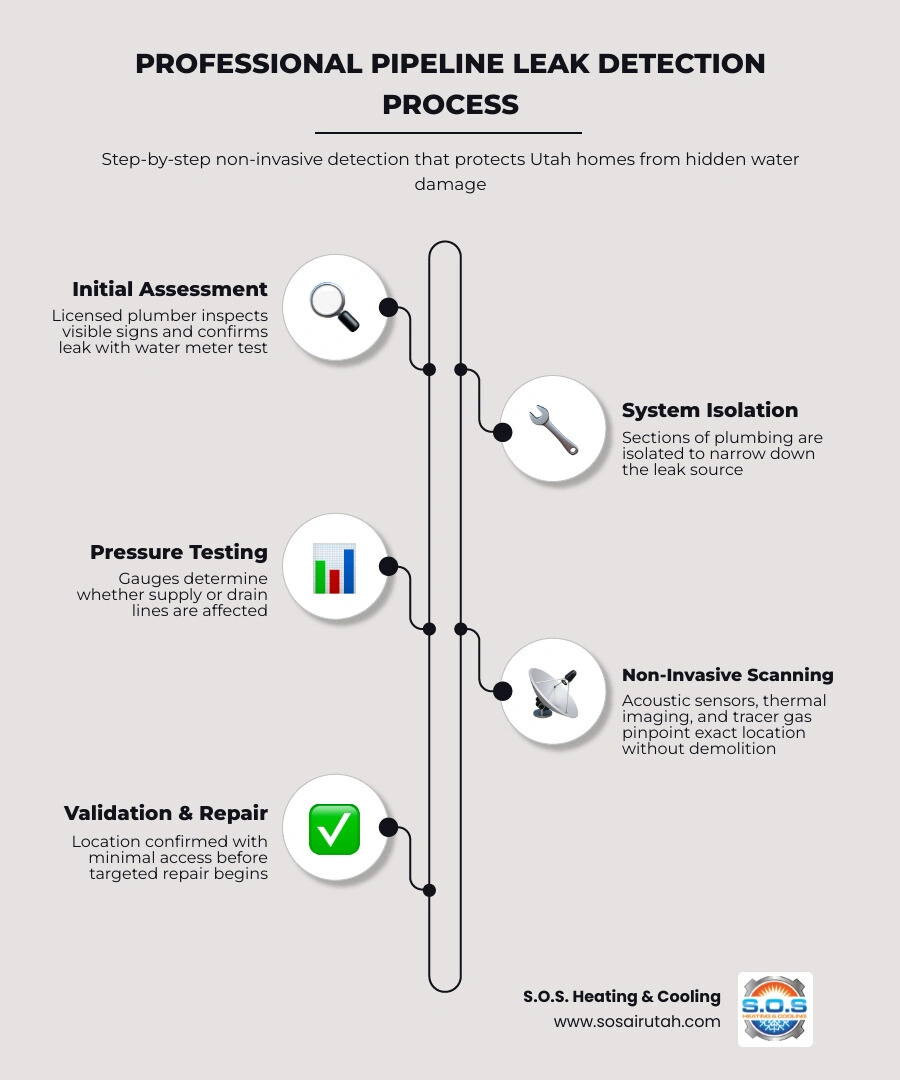
- Initial assessment - A licensed plumber inspects your home for visible signs and confirms a leak exists using a water meter test.
- System isolation - The plumber isolates sections of your plumbing to narrow down where the leak is coming from.
- Pressure testing - Pressure gauges confirm whether supply or drain lines are affected.
- Non-invasive scanning - Tools like acoustic sensors, thermal imaging cameras, and tracer gas equipment pinpoint the exact leak location without tearing open walls or floors.
- Validation and repair - The suspected location is confirmed with minimal access before repair work begins.
This matters more in Utah than many homeowners realize. The region's freeze-thaw cycles, clay-heavy soils, and aging pipe infrastructure — including older clay and cast-iron lines still common in Salt Lake City homes — create conditions where hidden leaks develop faster and cause more structural damage than in more temperate climates. According to the EPA, the average household's leaks waste more than 10,000 gallons of water annually, and 10 percent of homes lose roughly 90 gallons every single day to hidden leaks they don't even know about.
A small, silent leak behind your drywall or beneath your concrete slab is not a minor inconvenience. It is a slow-moving threat to your foundation, your indoor air quality, and your monthly water bill.
My name is Bryson Ninow, and through years of hands-on work in Utah's home services industry, I have seen how undetected leaks quietly escalate into expensive structural repairs and mold remediation jobs that could have been avoided with early professional intervention. In this guide, I will walk you through exactly how professional pipe line leak detection works in a Utah home so you know what to expect and when to act.
Common Signs of Hidden Water Leaks in Utah Properties
Because hidden leaks develop slowly behind closed walls or beneath concrete, they rarely present themselves with a dramatic burst of water. Instead, they leave subtle clues that you can spot if you know what to look for.
In our years serving communities from Salt Lake City to Kaysville, we have found that the most common warning signs of a hidden leak include:
- Unexplained spikes in your water bill: If your household water usage habits haven't changed but your monthly bill is steadily climbing, water is escaping somewhere in your system.
- Musty, damp odors: Water pooling in dark, unventilated spaces quickly leads to mold and mildew growth, which produces a distinct, earthy smell.
- A drop in water pressure: If your showers feel less powerful or your faucets are running slowly, a leak may be siphoning off pressure before the water reaches your fixtures.
- Warm or damp spots on your flooring: This is a classic indicator of a slab leak, especially if you notice a warm patch on your tile or carpet where a hot water line runs underneath.
- Sounds of running water: If you hear water rushing, dripping, or hissing behind your walls when all faucets, showers, and appliances are completely turned off, you are likely hearing an active leak.
Our local climate plays a massive role in how these leaks develop. In Utah, the dramatic seasonal temperature shifts stress your plumbing. During the freezing winters, pipes contract, and when the ground shifts during the spring thaw, the clay-heavy soils common in Utah Valley and Salt Lake County expand and contract. This ground movement puts immense physical pressure on buried lines, often cracking older supply pipes or loosening joints. For more practical advice on keeping your home's plumbing safe during seasonal transitions, check out our Pipe Repair Salt Lake City Tips.
Common Types of Leaks in Utah Homes
Plumbing systems in Utah face specific challenges depending on when the home was built and where the pipes are located. The most common leaks we encounter include:
- Slab Leaks: These occur when the water lines running beneath your home’s concrete foundation slab corrode, crack, or burst. Because slab leaks are buried under inches of concrete, they are incredibly difficult to spot without specialized acoustic and thermal equipment.
- Main Water Lines: The underground line that brings water from the municipal meter to your home is subject to soil shifting, tree root intrusion, and freeze-thaw damage.
- In-Wall and In-Ceiling Pipes: Leaks in these pipes often travel along the wooden framing of your home, meaning a wet spot on your living room ceiling might actually be caused by a leak located several feet away in an adjacent wall.
- Sewer Laterals: Older homes in historic SLC neighborhoods, Holladay, and Bountiful often still rely on clay or cast-iron sewer lateral pipes. Over time, these materials become brittle, crack, and collapse under the weight of shifting soil or invasive tree roots.
If you suspect you have a failing pipe or a damaged main line, exploring our comprehensive Pipe Repair Salt Lake City Guide can help you understand your options.
The Science Behind How Professional Pipe Line Leak Detection Works in a Utah Home
Professional leak detection is not about guessing or tearing open drywall to "search and destroy." It relies on physics and advanced diagnostic technology.
When water escapes from a pressurized pipe under your home, it creates friction as it forces its way through a crack or pinhole. This friction generates distinct acoustic vibrations that travel through the pipe wall and the surrounding soil or concrete. By using highly sensitive ground microphones, we can capture and amplify these sound frequencies to pinpoint the exact location of the escape point.
Similarly, escaping water alters the temperature of the surrounding building materials. For instance, a hot water line leaking under concrete will radiate heat upward, while a cold water leak behind drywall will create localized evaporative cooling. Infrared thermal cameras detect these microscopic thermal signatures, showing us exactly where the moisture is concentrated.
These non-invasive diagnostics allow us to find the exact source of the leak with surgical precision, protecting your home's structural integrity. If you are facing a sudden plumbing crisis, you can find immediate guidance in our Emergency Pipe Repair SLC UT Guide.
How Professional Pipe Line Leak Detection Works in a Utah Home
When we arrive at your home for a leak detection appointment, our primary goal is to locate the source of the problem with absolutely zero unnecessary demolition. The days of knocking holes in drywall or jackhammering concrete slabs just to find a pipe are long gone.
By utilizing advanced, non-invasive methods, we are able to preserve your home’s structural integrity and save you from costly post-repair cosmetic remodeling. Whether your home is in Woods Cross or Centerville, our approach is designed to be as clean, fast, and quiet as possible. For residents in these areas, you can learn more about local services through our Pipe Repair Woods Cross UT Guide and our Pipe Repair Centerville UT Guide.
Professional Plumbers vs. DIY Detection
While there are plenty of excellent DIY projects for homeowners, water leak detection is not one of them. Some online guides suggest buying cheap moisture meters or trying to listen to walls with a stethoscope, but these methods often lead to misdiagnosis.
A professional plumber brings specialized training, years of diagnostic experience, and medical-grade acoustic and thermal imaging equipment. We don't just find where the water is pooling; we trace it back to the exact point of origin. This level of diagnostic accuracy is critical for preventing secondary damage like structural dry rot, toxic black mold, and weakened foundations. If you are located in Holladay and want to ensure your home is handled by certified experts, refer to our Pipe Repair Guide Holladay UT.
Non-Invasive Technologies Used by Utah Leak Detection Experts
To find hidden leaks without digging up your yard or tearing down your plaster, we utilize a suite of advanced, military-grade diagnostic tools. Each technology serves a specific purpose, and we often combine them to cross-verify our findings.
| Technology | Primary Use Case | How It Works | Invasiveness |
|---|---|---|---|
| Acoustic Sensors | Pressurized supply lines, slab leaks | Amplifies sound vibrations of escaping water | Non-invasive (Zero damage) |
| Thermal Imaging | Hot/cold water lines behind walls or slabs | Detects temperature anomalies and moisture paths | Non-invasive (Zero damage) |
| Tracer Gas Testing | Tiny pinhole leaks, unpressurized lines | Injects safe 5% hydrogen / 95% nitrogen gas mix | Non-invasive (Zero damage) |
| Sewer Cameras | Sewer laterals, main drain lines | High-definition camera pushed through drain lines | Non-invasive (Accesses cleanouts) |
Acoustic Sensors and Ground Microphones
Acoustic leak detection is incredibly effective for pressurized water lines. When water escapes a pressurized pipe, it produces a distinct sound. Our technicians use highly sensitive ground microphones and acoustic listening discs to listen through concrete slabs, soil, and floorboards.
To pinpoint the leak, we use a method known as the "elephant foot" technique, moving the acoustic sensor every couple of feet along the path of the pipe. The sound of the leak will grow louder as we approach the exact point of failure, allowing us to find the leak down to the exact square inch. To learn more about how this technology is applied in local homes, read our Pipe Repair Guide Sandy UT.
Thermal Imaging and Tracer Gas Testing
When a leak is exceptionally small, or when the pipe is not highly pressurized, acoustic sensors might not capture enough sound. This is where thermal imaging and tracer gas testing shine.
Our infrared thermal cameras detect the subtle temperature variations caused by moisture behind tile, plaster, or stone. Evaporative cooling makes wet building materials appear as cooler, blue-toned zones on our screens, mapping out the precise path of the leak.
For the most stubborn, microscopic leaks, we use tracer gas testing. We drain the water from the suspected line and inject a completely safe, non-toxic, and non-combustible mixture of 5% hydrogen and 95% nitrogen. Because hydrogen molecules are the smallest element on the periodic table, they easily escape through even the smallest pinhole leak and rise through concrete, soil, and flooring. We then use an advanced gas sniffer (such as Sniffer 430 technology) capable of detecting hydrogen at just 1 part per million (ppm) to find the exact spot where the gas is escaping. If you need rapid, precise diagnostics in the South Jordan area, explore our 24-Hour Pipe Repair Guide South Jordan UT.
Step-by-Step: The Professional Leak Detection Process
When you hire us to locate a leak in your home, we follow a systematic, data-driven six-step process to ensure absolute accuracy:
- Site Walk and Visual Inspection: We begin by inspecting all visible plumbing fixtures, water heaters, and water-using appliances for obvious signs of moisture or mechanical failure.
- System Isolation and Meter Testing: We shut off all water fixtures inside the home and monitor your water meter. If the meter's low-flow indicator continues to spin, we know water is actively escaping the system.
- Pressure Testing: We install specialized pressure gauges on your supply lines to isolate the hot and cold water systems. A drop in pressure over a set period confirms which line is leaking.
- Utility Mapping: Using electromagnetic pipe locators, we map out the exact path of your underground or under-slab plumbing lines so we know exactly where to scan.
- Acoustic and Thermal Scanning: We use ground microphones, thermal cameras, or tracer gas to scan the mapped pipeline, narrowing down the leak to a precise location.
- Validation: Once we pinpoint the leak, we mark the exact spot with a small piece of tape or chalk. We cross-verify the location using a second technology (e.g., confirming an acoustic sound with a thermal scan) before discussing repair options.
If you suspect a leak and want to get it diagnosed affordably, check out our Affordable Pipe Repair SLC UT Guide.
What to Expect During Your Appointment
A typical residential leak detection appointment takes between one and three hours, depending on the size of your home and the complexity of your plumbing system.
Our professional technicians will arrive in a fully equipped service vehicle, respect your property by wearing protective shoe covers, and walk you through their findings in plain English. Once the leak is located, we will provide you with a detailed diagnostic report and an upfront, transparent recommendation for the repair. For commercial properties or larger residential estates in Salt Lake City, you can learn more about specialized services in our Commercial Pipe Repair SLC Guide.
Why Knowing How Professional Pipe Line Leak Detection Works in a Utah Home Saves Your Property
Understanding this process empowers you to act quickly, preventing catastrophic damage to your home. When you call in professionals early, you enjoy several key benefits:
- Preventing Toxic Mold Growth: Mold can begin growing on damp drywall in as little as 24 to 48 hours. Early detection stops the water source before mold can threaten your family’s health.
- Protecting Your Foundation: Water leaking under a concrete slab can wash away the supporting soil, leading to foundation cracking, sinking, and incredibly expensive structural failure.
- Conserving Water: Fixing even a small pinhole leak stops the waste of thousands of gallons of clean water, which is incredibly important for our local Utah environment.
- Rapid, Low-Cost Restoration: Because we pinpoint the exact spot of the leak, repairs require only minimal access, saving you from replacing entire walls or floors.
If you suspect you have an active leak in your home right now, take these immediate steps:
- Step 1: Locate your main water shut-off valve (usually in your basement, utility closet, or near the street) and turn it off.
- Step 2: Turn off all water-using appliances, including your washing machine and dishwasher.
- Step 3: Avoid using sinks, showers, or toilets to prevent sewer backups if the leak is on a drain line.
- Step 4: Call a licensed professional plumber immediately to schedule a non-invasive leak detection appointment.
Frequently Asked Questions About Utah Leak Detection
Does homeowners insurance cover leak detection in Utah?
In most cases, standard homeowners insurance policies cover the cost of "access and egress" — meaning they will pay for the professional leak detection service and the cost of repairing the drywall or concrete needed to reach the pipe, as well as any resulting water damage. However, this coverage typically applies only if the leak was sudden and accidental. Insurance policies generally do not cover the cost of repairing the actual plumbing pipe itself, which is considered standard home maintenance. We always recommend checking with your specific insurance provider, and we can provide detailed diagnostic reports to support your claim.
How long does it take to locate and repair a hidden leak?
Most professional leak detection inspections take between one and two hours. Once we locate the leak, simple repairs can often be completed the very same day. More complex issues, such as a deep slab leak or a damaged main water line, may take one to two days to resolve. In many cases, we can utilize trenchless pipe repair methods to fix underground lines without digging up your beautiful landscaping, saving you time and keeping your yard intact.
How can I prevent future pipeline leaks in my home?
The best way to prevent future plumbing leaks is through proactive maintenance:
- Install a Water Pressure Regulator: High water pressure stresses pipe joints. Keep your home's water pressure between 40 and 65 PSI.
- Schedule Regular Plumbing Inspections: Having a licensed plumber inspect your home every one to two years can catch minor issues before they become major leaks.
- Winterize Your Home: Ensure outdoor spigots are drained and insulated before the freezing Utah winter sets in.
- Use a Water Softener: Hard water (which is common in Salt Lake City and surrounding areas) can cause mineral buildup and accelerate pipe corrosion.
Conclusion
At S.O.S. Heating & Cooling, we are proud to provide reliable, professional plumbing and HVAC services across Salt Lake City and the surrounding communities. Whether you are dealing with a suspected slab leak, an unexplained spike in your utility bill, or need emergency assistance, our experienced team is here to help.
We offer 24/7 emergency plumbing repairs, priority service, and flexible financing options to ensure your home remains safe, dry, and comfortable. Don't let a hidden leak threaten your property's foundation or drain your wallet. Contact us today for professional, non-invasive diagnostics and peace of mind.

Plumbing
Expert plumbing services offering reliable repairs, installations, maintenance, and emergency support.

Air Conditioning
Comprehensive air conditioning services include installation, repairs, maintenance, and energy-efficient solutions.
Heat Pumps
Enjoy year-round comfort with our energy-efficient and professional heat pump solutions.

Indoor Air Quality
Enhance your home’s air with our cutting-edge indoor air quality solutions you can trust.

Fireplaces
Transform your space into a warm and cozy atmosphere with our professional fireplace services.

Heating
Specialized heating services provide reliable installation, repair, system maintenance, and energy-optimization solutions.
Explore Our Latest Insights and Updates in Plumbing Services
The Definitive Guide to Inversion Air Pollution Protection
All About AFUE Ratings for Utah Furnaces