

How Your AC Moves Heat from Inside to Out


.avif)

How Refrigerant Absorbs and Releases Heat to Cool Your Home
How refrigerant absorbs and releases heat is the core science behind every air conditioner, refrigerator, and heat pump on the market. In short, refrigerant is a specialized fluid that circulates through your AC system in a continuous loop, absorbing heat from inside your home and releasing it outdoors. It does this not by "creating cold," but by exploiting a simple physical principle: fluids absorb large amounts of energy when they evaporate, and release that energy when they condense back into a liquid.
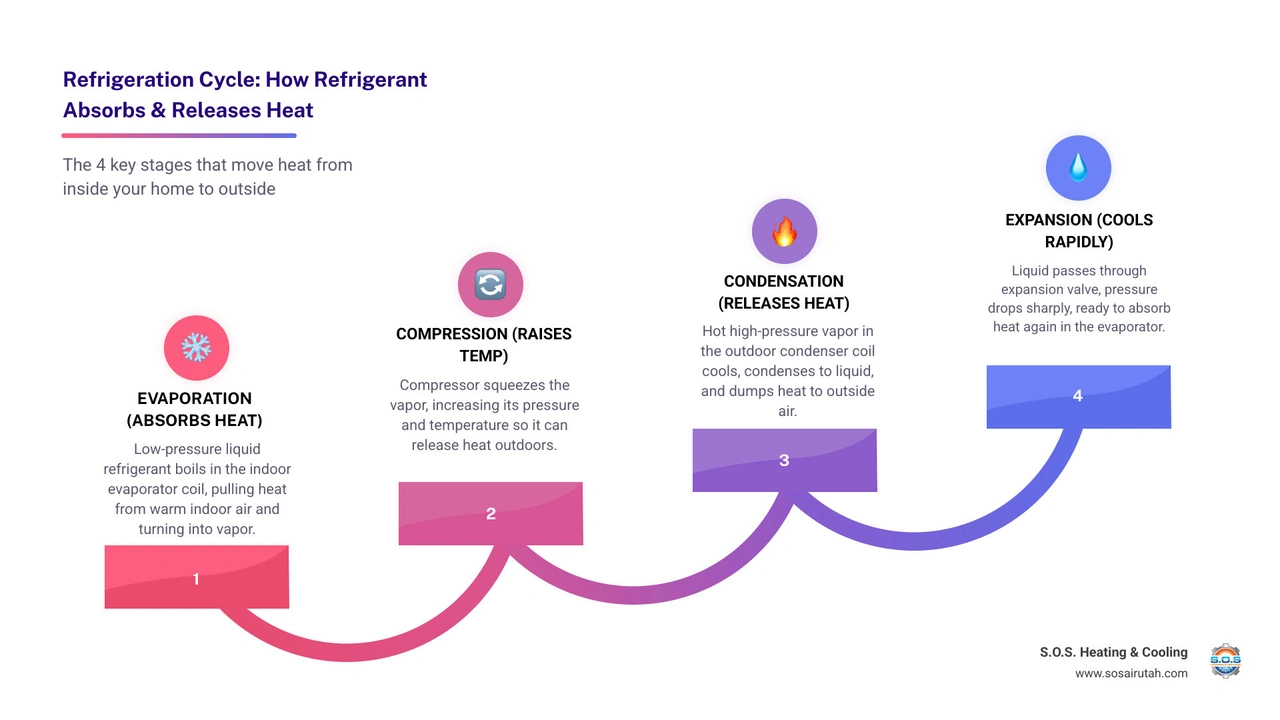
Here is a quick breakdown of how the process works:
- Absorption (Evaporator) - Low-pressure liquid refrigerant boils inside the indoor coil, absorbing heat from your home's air in the process.
- Compression (Compressor) - The refrigerant vapor is compressed, raising its temperature and pressure so it can shed heat outdoors.
- Release (Condenser) - High-pressure, high-temperature vapor flows to the outdoor coil, where it releases heat to the outside air and condenses back into a liquid.
- Expansion (Expansion Valve) - The liquid refrigerant passes through an expansion valve, its pressure and temperature drop rapidly, and the cycle starts over.
The reason this works so efficiently is latent heat — the energy a substance absorbs or releases during a phase change without a noticeable change in temperature. Refrigerants are engineered with very low boiling points, which allows them to evaporate and absorb heat even at room temperature, something ordinary water cannot do in a standard AC system.
My name is Bryson Ninow, and with certifications including EPA, NATE, and RMGA, I have spent years working hands-on with the refrigeration cycle that makes comfortable Salt Lake City homes possible — which means I understand exactly how refrigerant absorbs and releases heat in real-world systems. In this guide, I'll walk you through every stage of that process so you can understand what is happening inside your AC unit and why it matters.
What is Refrigerant and Why is it Essential for Cooling?
Think of refrigerant as the "lifeblood" of your HVAC system. Without it, your air conditioner is just a very expensive fan moving warm air around. A refrigerant is a specialized chemical compound that serves as a heat carrier, moving thermal energy from one location (your living room) to another (the backyard).
What makes a substance a good refrigerant? It comes down to its thermodynamic properties. Unlike water, which boils at 212°F at sea level, modern refrigerants like R-410A or R-454B have extremely low boiling points—often well below 0°F. This characteristic is vital because it allows the fluid to evaporate into a vapor with very little thermal energy applied. Even "cool" room air in a Salt Lake City home is hot enough to make these fluids boil instantly.
Refrigerants are engineered to be chemically stable, non-flammable (in most residential cases), and efficient at absorbing latent heat. Latent heat is the energy required to change the state of a substance without changing its temperature. By using a fluid that can easily flip-flop between liquid and gas, we can move a massive amount of heat using a relatively small amount of fluid. To dive deeper into the hardware that facilitates this, check out our guide on how air conditioning works: the science behind AC.
How Refrigerant Absorbs and Releases Heat Through Phase Changes
The secret to modern cooling isn't magic; it’s physics. Specifically, it involves manipulating enthalpy (the total heat content of a system) and entropy (the level of disorder in molecules). When a substance changes from a liquid to a gas, it needs energy to break the molecular bonds holding it together. It "grabs" this energy from its surroundings.
When the refrigerant is a liquid, its molecules are packed tightly. As it absorbs heat, those molecules begin to move faster and eventually break free into a gaseous state. During this phase change, the temperature of the refrigerant remains relatively stable because the thermal energy is being used to fuel the transition rather than raising the "sensible" temperature you’d feel on a thermometer.
Once that vapor is moved outdoors and compressed, the process reverses. By squeezing the gas and exposing it to outdoor air, we force those molecules back together, releasing the stored energy. This constant cycle allows us to achieve thermal equilibrium in your home, even when it’s 100°F in Murray or Holladay.

The Evaporator: How refrigerant absorbs and releases heat via boiling
The indoor portion of your AC system contains the evaporator coil. This is where the "absorption" phase happens. At this stage, the refrigerant enters the coil as a cold, low-pressure mixture of liquid and vapor.
Because the refrigerant’s boiling point is so low, the warm air from your home (which the blower fan pushes over the coils) is significantly hotter than the refrigerant. This causes the refrigerant to boil completely into a saturated vapor. As it boils, it extracts heat from the air, leaving the air much cooler before it is circulated back into your rooms.
Technicians often look for "superheating" here. This is the process of adding a few extra degrees of heat to the vapor after it has completely evaporated. This ensures that only 100% vapor enters the compressor, as liquid refrigerant can cause catastrophic mechanical failure.
The Condenser: How refrigerant absorbs and releases heat via cooling
Once the refrigerant has done its job indoors, it travels to the outdoor unit—the condenser. By the time it reaches the outdoor coils, the compressor has turned it into a high-pressure, high-temperature superheated vapor.
Because the compressor has raised the refrigerant's temperature to be much hotter than the outdoor air (even on a scorching July day in Salt Lake City), heat naturally flows from the hot coils to the "cooler" ambient air. As the outdoor fan blows air across these coils, the refrigerant loses its energy and condenses back into a saturated liquid. This is where the heat your AC "grabbed" from your kitchen or bedroom is finally dumped into the atmosphere.
The Mechanical Process: Compression and Expansion
While the phase changes do the heavy lifting of moving heat, the mechanical components—the compressor and the expansion valve—are the "engine" and "brakes" that make the cycle possible. They manipulate the pressure-temperature relationship to ensure heat always flows in the direction we want.
Increasing Temperature Through Compression
The compressor is often called the "heart" of the HVAC system. It takes the low-pressure vapor from the indoor unit and squeezes it. This does two things: it concentrates the heat energy and increases molecular collisions.
Think of a bike pump. When you pump air into a tire, the nozzle gets hot. This isn't just friction; it's physics. By forcing molecules into a smaller volume, you convert kinetic energy into internal heat. In an AC system, this raises the refrigerant's temperature above the outdoor temperature, which is essential for heat rejection. If you're noticing odd sounds or poor cooling, you might be resolving AC refrigerant pressure issues in Murray or your local area with a professional's help.
Rapid Cooling Through the Expansion Valve
After the refrigerant leaves the condenser as a high-pressure liquid, it needs to get cold again to absorb more heat. It does this by passing through the expansion valve (or metering device).
This valve acts like the nozzle on a deodorant spray can. When you hold the trigger, the fluid inside moves from a high-pressure environment to a low-pressure one, and the can becomes freezing cold. This "flash gas" process causes the refrigerant's temperature and pressure to drop rapidly. It exits the valve as a low-temperature liquid-vapor mix, ready to head back to the evaporator and start the whole process over again.
Common Refrigerants and Their Thermal Properties
Over the years, the types of refrigerants we use in Utah have evolved based on efficiency and environmental regulations. In May 2026, we are seeing a significant shift toward "A2L" refrigerants which offer a lower Global Warming Potential (GWP).
| Refrigerant Type | Boiling Point (at 1 atm) | Common Status | Heat Absorption Efficiency |
|---|---|---|---|
| R-22 (Freon) | -41.3°F | Phased out; Service only | High |
| R-410A (Puron) | -55.3°F | Current Standard (Phasing down) | Very High |
| R-454B (Puron Advance) | -59.8°F | Next-Gen Standard | Excellent |
| R-717 (Ammonia) | -28°F | Industrial Use | Superior |
The boiling point is the most critical factor. By choosing fluids that boil at such low temperatures, engineers can ensure that the evaporator is always colder than the air in your home, and the condenser (after compression) is always hotter than the air outside.
Frequently Asked Questions about Heat Exchange
Why is water not used as a refrigerant in standard home AC units?
While water is safe and "easy," its boiling point (212°F) is far too high for residential air conditioning. To make water boil at 70°F (to absorb heat from your home), you would have to create a near-perfect vacuum inside the system, which is mechanically difficult and expensive. Furthermore, water has a low volumetric efficiency, meaning you would need massive compressors and piping to move the same amount of heat that a small amount of R-410A can handle.
Does refrigerant ever get "used up" during the heat transfer cycle?
No. Refrigerant is not a fuel like gasoline; it is a working fluid. In a perfectly sealed, closed-loop system, the same refrigerant can circulate dozens of times per hour for decades. If your system is "low" on refrigerant, it means there is a leak. Simply "topping it off" without fixing the leak is like trying to fill a bucket with a hole in the bottom. To keep your system running right, it's important to know how to prevent AC refrigerant leaks.
How does the outdoor temperature affect how refrigerant absorbs and releases heat?
The efficiency of your AC depends on the "temperature gradient"—the difference between the refrigerant temperature and the air temperature. On a 105°F day in Salt Lake City, your condenser has to work much harder to "push" heat into the air because the air is already quite hot. This is why AC units run longer and use more electricity during heatwaves. Keeping your outdoor condenser coils clean of cottonwood seeds and dust is essential to maintaining this heat-release capability.
Conclusion
Understanding how refrigerant absorbs and releases heat helps you appreciate the complex work your HVAC system does every single day. From the molecular dance in the evaporator to the heavy-duty squeezing in the compressor, every stage of the refrigeration cycle is designed to keep your home a sanctuary against the Utah heat.
At S.O.S. Heating & Cooling, we specialize in keeping these systems in peak condition across the Salt Lake City area—from Bountiful to Draper and everywhere in between. Whether you need an emergency repair, a system tune-up to improve efficiency, or a consultation on the latest low-GWP refrigerants, our team is here 24/7 to help.
Don't wait for a breakdown to realize how important your refrigerant is. Schedule your expert air conditioning service today and ensure your home stays cool all summer long.

Plumbing
Expert plumbing services offering reliable repairs, installations, maintenance, and emergency support.

Air Conditioning
Comprehensive air conditioning services include installation, repairs, maintenance, and energy-efficient solutions.
Heat Pumps
Enjoy year-round comfort with our energy-efficient and professional heat pump solutions.

Indoor Air Quality
Enhance your home’s air with our cutting-edge indoor air quality solutions you can trust.

Fireplaces
Transform your space into a warm and cozy atmosphere with our professional fireplace services.

Heating
Specialized heating services provide reliable installation, repair, system maintenance, and energy-optimization solutions.
Explore Our Latest Insights and Updates in Plumbing Services
In Depth Guide to How Maintenance Extends AC Life in Wasatch Front Climate
The Complete Guide to Cold Climate Heat Pumps