

The Science of Sip: How Reverse Osmosis Levels Up Your Tap Water


.avif)

Why Understanding How Reverse Osmosis Improves Your Drinking Water Matters
How reverse osmosis improves your drinking water comes down to one powerful process: forcing water through a semi-permeable membrane so fine it blocks contaminants as small as 0.0001 microns — removing up to 99% of lead, PFAS, fluoride, nitrates, arsenic, and more while leaving you with cleaner, better-tasting water straight from your tap.
Here is a quick breakdown of what reverse osmosis does for your water:
- Removes harmful contaminants — lead, arsenic, PFAS ("forever chemicals"), nitrates, fluoride, and heavy metals
- Improves taste and odor — strips out chlorine and dissolved solids that make water smell or taste off
- Reduces total dissolved solids (TDS) — leaving water cleaner and clearer
- Works at the molecular level — filters particles far smaller than any standard pitcher or carbon filter can catch
- Delivers bottled-water quality on demand — right from your kitchen sink, without the plastic waste
If you have ever poured a glass of tap water and hesitated before drinking it — whether because of the smell, a slight chemical aftertaste, or just an uneasy feeling about what might be in it — you are not alone. Many homeowners across the Salt Lake City area deal with water that, while technically treated, still carries traces of chlorine, dissolved minerals, and contaminants that municipal systems are not always equipped to fully address. Hard water is a well-known challenge in Utah, where snowmelt filters through calcium-rich rock before it ever reaches your faucet. But hardness is just one piece of the puzzle. The question of what else is quietly making its way into your glass is what leads more and more homeowners to take a closer look at home filtration — and specifically, at reverse osmosis systems.
I'm Bryson Ninow, and through my work in the home services industry, I've seen how often water quality concerns come up for Utah homeowners and how much of a difference the right filtration system can make in understanding how reverse osmosis improves your drinking water. In the sections ahead, I'll walk you through exactly how the process works, what it removes, and what you should know before making a decision for your home.
Understanding the Process: How Reverse Osmosis Improves Your Drinking Water
To understand how reverse osmosis improves your drinking water, we first have to look at the science of "osmosis." In nature, osmosis is when water moves from a low-concentration area to a high-concentration area through a semi-permeable membrane. Think of tree roots absorbing water from the soil; it’s a natural balancing act.
Reverse osmosis (RO), as the name suggests, flips the script. Instead of letting nature take its course, we use external pressure (your home’s water pressure) to force water from a high-concentration side (the "dirty" side) to a low-concentration side (the "clean" side). This process is often called "hyperfiltration."
The heart of the system is the semi-permeable membrane. This isn't just a simple mesh screen. The pores in an RO membrane are approximately 0.0001 microns in size. To give you some perspective, a single grain of beach sand is about 62,500 times larger than these pores. This level of molecular separation is so precise that it can filter out dissolved inorganic solids, such as salts and heavy metals, that standard carbon filters simply can't touch.

In places like Reverse Osmosis Sandy UT and Reverse Osmosis Draper UT, we see a lot of interest in this technology because it provides a level of purity that is unrivaled by other home treatments. By the time the water passes through that membrane, it has been stripped of the vast majority of its total dissolved solids (TDS), leaving you with what we call "permeate"—pure, high-quality drinking water.
The Multi-Stage Journey of Pure Water
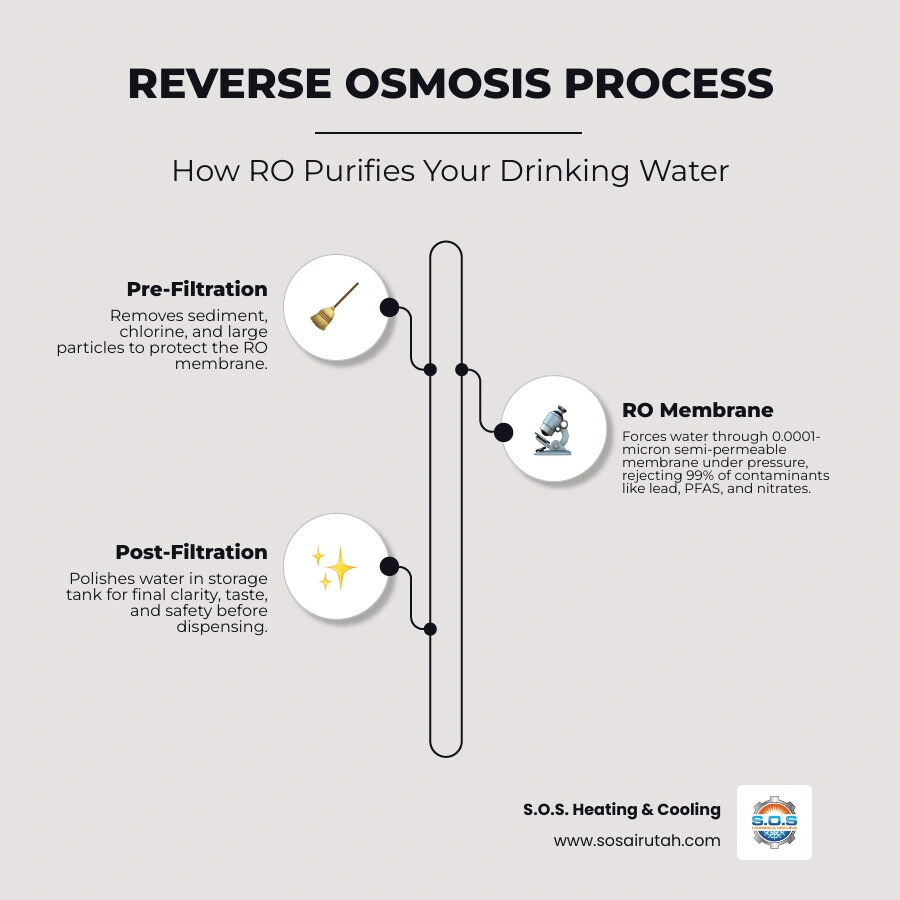
A typical reverse osmosis system isn't just a single filter; it’s a "treatment train" that involves several specialized stages. This multi-stage approach is essential because the RO membrane is actually quite delicate. If we sent raw tap water straight to the membrane, it would clog up with sediment or be eaten away by chlorine in no time.
Here is how a standard system functions step-by-step:
- Pre-filtration (Sediment Filter): The first stop for your water is a sediment filter. This stage catches the "big" stuff—rust, silt, and sand—that might be lurking in your pipes. This protects the rest of the system from physical damage.
- Carbon Stage: Next, the water flows through an activated carbon filter. This is a critical step because most of our municipal water in Utah is treated with chlorine. While chlorine is great for killing bacteria in the city mains, it can destroy a Thin-Film Composite (TFC) membrane. The carbon filter removes chlorine, odors, and organic compounds.
- The RO Membrane: This is where the magic happens. Under pressure, the water is pushed through the semi-permeable membrane, leaving up to 99% of contaminants behind to be flushed down the drain.
- Storage Tank: Because RO filtration is a slow, meticulous process, the system doesn't produce water at the same speed as your kitchen faucet. Instead, it fills a pressurized storage tank (usually holding 2-4 gallons) so you have plenty of pure water ready when you turn on the tap.
- Post-filtration (Polishing Filter): Before the water reaches your glass, it passes through one final carbon filter, often called a "polishing filter." This ensures any remaining tastes or odors from the storage tank are removed, leaving the water crisp and fresh.
We frequently install these systems for families in Reverse Osmosis Murray UT and Reverse Osmosis Holladay UT who want that "bottled water" experience right at their kitchen sink.
Removing Contaminants: How Reverse Osmosis Improves Your Drinking Water Safety
When we talk about how reverse osmosis improves your drinking water, safety is often the biggest motivator. While municipal water in the U.S. is generally safe, it can still contain substances that many people would rather avoid.
RO systems are incredibly effective at removing:
- Lead and Heavy Metals: Even if your city’s water is lead-free, older home plumbing can leach lead or copper into your water. RO systems reduce these heavy metals to below detectable levels.
- PFAS: Often called "forever chemicals," PFAS are a growing concern nationwide. RO is one of the few technologies proven to remove up to 99% of these pollutants.
- Nitrates and Arsenic: These are particularly concerning for those on private wells or in agricultural areas. RO is highly effective at stripping these out.
- Fluoride: While fluoride is added to many public water supplies for dental health, many of our customers in Reverse Osmosis Riverton UT and Reverse Osmosis Millcreek UT prefer to remove it from their drinking water and rely on toothpaste instead.
By achieving a 98% to 99% reduction in these contaminants, RO provides a level of "unbeatable peace of mind" for parents and health-conscious homeowners alike.
Enhancing Flavor: How Reverse Osmosis Improves Your Drinking Water Taste
Have you ever noticed that your tap water tastes a bit like a YMCA pool? That’s the chlorine talking. One of the most immediate ways how reverse osmosis improves your drinking water is by transforming the taste, odor, and appearance of what you drink.
By removing chlorine and Total Dissolved Solids (TDS), RO water becomes a "blank canvas." This has a surprising impact on your kitchen:
- Coffee and Tea: Without the interference of minerals and chemicals, the true flavor of your coffee beans or tea leaves can shine through.
- Soups and Cooking: Boiling pasta or making soup with RO water ensures that no off-flavors are absorbed into your food.
- Ice Cubes: RO water makes crystal-clear ice cubes that don't have that white, cloudy center (which is actually concentrated minerals).
In Reverse Osmosis South Jordan UT and Reverse Osmosis Farmington UT, many of our clients tell us that they actually find themselves drinking more water and fewer sugary drinks simply because the water tastes so much better.
Efficiency, Minerals, and Maintenance: What Homeowners Should Know
While reverse osmosis is a powerhouse of purification, it is important to be an informed owner. It is a more complex system than a simple carbon pitcher, and there are a few things to keep in mind regarding efficiency and upkeep.
| Feature | Standard Carbon Filter | Reverse Osmosis System |
|---|---|---|
| Pore Size | 0.5 - 10 microns | 0.0001 microns |
| Lead Removal | Partial (if certified) | Up to 99% |
| PFAS/Nitrate Removal | Minimal | High Efficiency |
| Taste Improvement | Good (Chlorine only) | Excellent (Complete) |
| Waste Water | None | Yes (Reject water) |
Efficiency and WaterSense
One common question is about "waste water." During the filtration process, the system uses water to wash away the rejected contaminants—this is called "brine" or "reject water." Think of it like washing your hands; you need a little water to rinse the dirt away.
In the past, RO systems were quite thirsty, sometimes wasting 5 to 10 gallons for every gallon of pure water produced. However, as of May 2026, modern technology has come a long way. Look for WaterSense labeled systems, which are required to send no more than 2.3 gallons down the drain per gallon produced. Some high-efficiency models can even achieve a 1:1 ratio.
Maintenance Schedule
To keep your system running at peak performance, a little TLC is required:
- Pre- and Post-Filters: These should typically be replaced every 6 to 12 months.
- RO Membrane: This is the workhorse of the system and usually lasts 2 to 3 years, depending on your local water quality.
- Sanitization: We recommend sanitizing the storage tank once a year during a filter change to keep everything fresh.
Regular maintenance is key for our neighbors in Reverse Osmosis Layton UT and Reverse Osmosis Centerville UT to ensure the flow rate stays high and the water stays pure.
Frequently Asked Questions about Reverse Osmosis
Does reverse osmosis remove beneficial minerals?
Yes, reverse osmosis is an "equal opportunity" filter—it removes the "bad" stuff along with minerals like calcium and magnesium. Some people worry about this, but most health experts and the WHO point out that we get the vast majority of our essential minerals from our diet (fruits, vegetables, and dairy), not from our water.
If you prefer the taste of mineral water or want to balance the pH, many of the systems we install include a remineralization cartridge. This adds a small, controlled amount of calcium and magnesium back into the water after it has been purified, giving it a more "rounded" alkaline taste.
How much water does a reverse osmosis system waste?
As mentioned, standard systems produce "reject water" to keep the membrane clean. While older systems had a 4:1 waste ratio, modern, high-efficiency units are much better. If you are concerned about water usage, we recommend point-of-use systems (under the sink) rather than whole-house RO. This ensures you are only purifying the water you actually drink and cook with, which significantly reduces overall water waste.
Is reverse osmosis water safe for infants and cooking?
Absolutely. In fact, many parents prefer RO water for mixing infant formula because it provides a "controlled composition." It ensures that babies aren't being exposed to high levels of nitrates (which can be dangerous for infants) or lead. For cooking, it is the gold standard, ensuring that your recipes aren't affected by the seasonal changes in municipal water chemistry.
Conclusion
At S.O.S. Heating & Cooling, we know that your home’s water is the lifeblood of your daily routine. Whether you are brewing your morning coffee in Salt Lake City or filling up a water bottle for a hike in the Wasatch Range, you deserve water that is as pure as it is refreshing.
Understanding how reverse osmosis improves your drinking water is the first step toward taking control of your home’s health. In Utah, our unique geology means we deal with some of the hardest water in the nation. While a water softener is great for protecting your pipes and appliances, a reverse osmosis system is the "final touch" that ensures the water you actually put into your body is of the highest possible quality.
We are proud to serve our neighbors in Reverse Osmosis Kaysville UT, Reverse Osmosis Bountiful UT, and across the entire valley. If you are ready to level up your tap water and say goodbye to the "pool water" taste for good, our team is here to help with Expert Plumbing Services and custom filtration solutions.
Give us a call today, and let’s make sure every sip you take is a pure one!
Explore Our Latest Insights and Updates in Plumbing Services
Don't Sweat the Bill: Easy Hacks to Keep Your Home Chilled

The Magic of Cold Air and How Your AC Makes It
How Your AC Moves Heat from Inside to Out