

The Cold Hard Truth About Your Next AC Purchase and New Refrigerants


.avif)

What the 2025-2026 Refrigerant Transition Means for Your Next AC Purchase
How the refrigerant transition affects your next ac purchase is something every Salt Lake City homeowner shopping for a new system in 2026 needs to understand before signing anything. Here is a quick breakdown:
- New systems use different refrigerants. As of January 1, 2025, no new residential AC equipment can be manufactured using R-410A. New units now use A2L refrigerants like R-454B or R-32.
- Your existing system is not illegal. If your current R-410A unit is running, you do not need to replace it right now.
- R-410A is getting more expensive to service. Reduced production allowances mean refrigerant costs for older systems are rising fast.
- New systems are more efficient. A2L refrigerant systems offer roughly 10-15% better energy efficiency than their R-410A predecessors.
- Retrofitting is not an option. You cannot swap new refrigerants into an old system — they require entirely different components.
- Federal incentives are available. Qualifying heat pumps may be eligible for a $2,000 federal tax credit, and central AC units for up to $600.
If your system is older, leaking, or breaking down more often, the math on repair versus replacement is shifting — and understanding the refrigerant transition is the first step to making a smart decision.
If you've been hearing terms like "AIM Act," "A2L," or "R-454B" lately and had no idea what any of it meant, you're not alone. The HVAC industry just completed one of its most significant regulatory shifts in decades. The EPA's phasedown of high-GWP refrigerants — driven by the American Innovation and Manufacturing (AIM) Act of 2020 — has fundamentally changed what goes into every new air conditioner and heat pump sold in the United States. For homeowners in Salt Lake City, that means the next time your AC gives out, the replacement conversation is going to look different than it did just a few years ago.
The good news? This transition does not have to be confusing or panic-inducing. The new systems are cleaner, more efficient, and already proven in markets across Europe and Asia. But there are real, practical things to know before you buy — especially when it comes to costs, safety, and whether sticking with your current system a little longer still makes sense.
I'm Bryson Ninow, an HVAC professional with certifications in EPA, NATE, RMGA, and DOPL, and I've spent years helping homeowners navigate exactly this kind of decision — including how the refrigerant transition affects your next ac purchase and what it means for your wallet and your home comfort. Let's walk through everything you need to know.
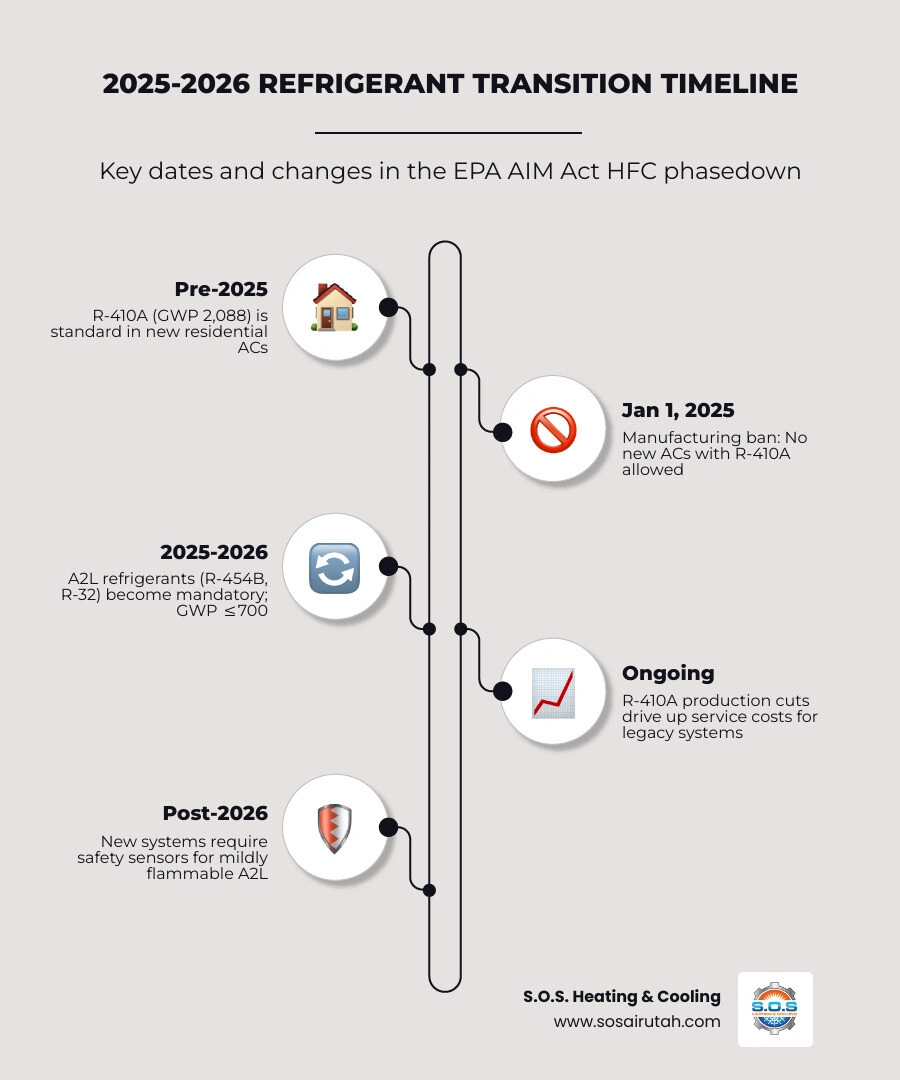
The 2025-2026 Phase-Out: Why R-410A is Disappearing
To understand why your next AC will look and act a little differently, we have to look at the chemistry under the hood. For the last two decades, R-410A (often called Puron) was the industry standard. It was a massive improvement over the old R-22 (Freon) because it didn't deplete the ozone layer. However, R-410A has a high Global Warming Potential (GWP).
In simple terms, GWP measures how much heat a gas traps in the atmosphere compared to CO2. R-410A has a GWP of 2,088. This means that one pound of R-410A released into the air is over 2,000 times more potent than a pound of carbon dioxide. Because of this, the EPA's AIM Act mandated a transition to refrigerants with a GWP of 700 or less.
As of January 1, 2025, manufacturers were prohibited from producing new central air conditioning units that use R-410A. While there was a one-year "grace period" that allowed contractors to install remaining R-410A inventory through January 1, 2026, we are now firmly in the era of new technology. This shift is designed to reduce the environmental impact of the HVAC industry by up to 78%.
When you are evaluating your aging HVAC system, it is important to realize that the "old" gas isn't coming back. Much like the transition from R-22 to R-410A years ago, this is a permanent industry-wide change. If you are also looking at your heating system, you might find that when to consider furnace replacement often coincides with these AC shifts, as many homeowners choose to upgrade both units at once to ensure total system compatibility and maximum efficiency.
How the refrigerant transition affects your next ac purchase and system technology
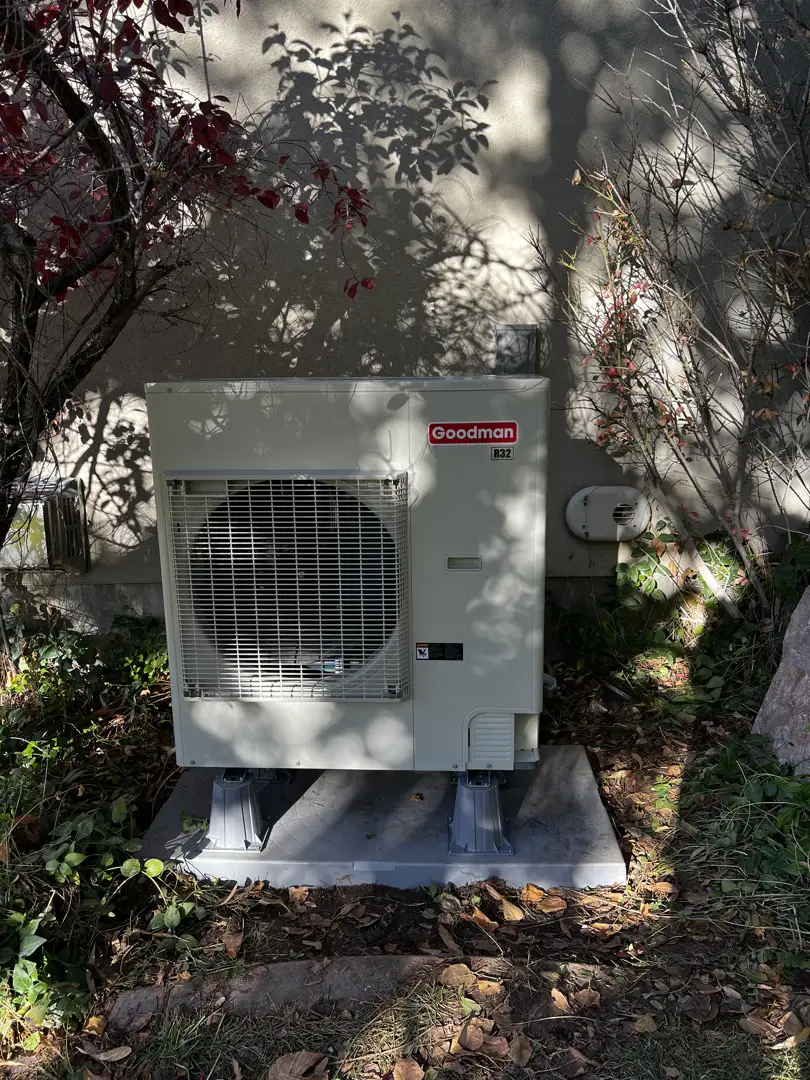
The transition has introduced two primary "new" refrigerants to the residential market: R-454B and R-32. While these names might sound like alphabet soup, they represent the future of home cooling. Most major manufacturers have settled on R-454B (a blend) for ducted systems, while others prefer R-32 (a single-component gas).
Both fall under the "A2L" classification. To handle these new gases, manufacturers had to redesign the internal components of AC units. This is why what you need to know before you replace your AC unit now includes an understanding of "Mitigation Boards" and "Refrigerant Detection Systems" (RDS).
| Feature | R-410A (Old Standard) | A2L (R-454B / R-32) |
|---|---|---|
| Global Warming Potential (GWP) | 2,088 | 466 – 675 |
| Efficiency Gain | Baseline | 10% – 15% Higher |
| Safety Features | Standard | Leak Sensors & Mitigation Boards |
| Flammability | A1 (Non-flammable) | A2L (Mildly Flammable) |
These new systems are "smarter." If the RDS detects a leak, the mitigation board automatically shuts down the compressor and engages the indoor blower fan to dissipate the refrigerant safely. It’s a level of proactive safety that simply didn't exist in older generations of equipment.
How the refrigerant transition affects your next ac purchase and installation safety
The term "mildly flammable" can sound a bit intimidating, but it’s important to put it into perspective. A2L refrigerants are incredibly difficult to ignite. In fact, they require a high-energy ignition source and a very specific concentration in the air to catch fire—conditions that are almost never present in a typical home.
Think of it this way: the refrigerant in your car's air conditioner has likely been an A2L variant since 2013. Millions of vehicles are currently driving around with this technology without issue. Furthermore, your home likely contains much more flammable substances, like hairspray, rubbing alcohol, or the natural gas used for your stove.
For us at S.O.S. Heating & Cooling, the biggest change is in the training. Our technicians have undergone specialized certification to handle A2L refrigerants. Installation now requires specific brazing techniques (using a nitrogen purge) and A2L-compatible tools like specialized manifold gauges and leak detectors. When you buy a new system in 2026, you aren't just buying new hardware; you're buying the expertise of a team that knows how to install it to the highest safety standards.
How the refrigerant transition affects your next ac purchase regarding energy efficiency
One of the brightest silver linings of this transition is the boost in energy efficiency. Because A2L refrigerants like R-32 and R-454B transfer heat more effectively than R-410A, the systems don't have to work as hard to cool your home.
In 2026, we are seeing new models that are 10-15% more energy efficient than the units they replaced. This translates directly into lower monthly utility bills for Salt Lake City residents. When you combine this with the newer SEER2 (Seasonal Energy Efficiency Ratio 2) standards, the energy savings over the 15-year lifespan of a system can be substantial.
To help offset the initial investment in this new technology, federal tax credits are more robust than ever:
- Heat Pumps: Up to a $2,000 federal tax credit for qualifying high-efficiency models.
- Central AC: Up to a $600 federal tax credit for qualifying units using low-GWP refrigerants.
These incentives make 2026 an ideal year to move away from old, inefficient R-410A systems and into a "future-proofed" setup.
Repair vs. Replace: Navigating Rising Service Costs
If you currently own one of the 80 million R-410A systems installed in American homes, you might be wondering about the "obsolescence trap." While your system isn't illegal, the cost to keep it running is climbing.
The EPA didn't just ban the manufacture of new units; they also slashed the production allowances for the R-410A gas itself. In 2026, production dropped to just 60% of the historical baseline. As supply shrinks and demand from those 80 million systems remains high, prices skyrocket. In just two years, we’ve seen the price of R-410A jump from roughly $22 per pound to $45 per pound at wholesale levels—and those costs are passed on to homeowners during repairs.
This makes the "Repair or Replacement" decision much tougher. If you have a significant leak in a 12-year-old system, you aren't just paying for the labor to fix the leak; you're paying for expensive, phased-out refrigerant to refill it.
When you consider AC replacement, you have to look at the long-term math. Spending a significant amount to "top off" a leaking R-410A system is often compared to putting air in a tire with a nail in it. It might get you through the summer, but the underlying problem remains, and the "air" is getting more expensive every year. Furthermore, retrofitting is impossible; you cannot simply put R-454B into an R-410A system because the pressures and internal oils are incompatible.
Frequently Asked Questions
Do I need to replace my existing R-410A system immediately?
Absolutely not. If your current air conditioner is humming along and keeping you cool, there is no reason to rip it out. The 2026 deadlines apply to the installation of new equipment, not the operation of existing units. You can continue to get your system serviced, cleaned, and repaired for as long as parts and refrigerant are available. However, if you start seeing signs it's time for furnace replacement or your AC is over 12-15 years old, it’s wise to start budgeting for a new A2L system rather than being surprised by a breakdown in the middle of a Utah heatwave.
How the refrigerant transition affects your next ac purchase for existing homeowners?
For homeowners who aren't ready to buy yet, the transition affects you through service costs. Because R-410A production is being phased down, "topping off" a leaking unit is no longer a cheap fix. We strongly recommend prioritizing leak repairs over simple refills. If your technician finds a leak, fixing it permanently will save you from the rising costs of R-410A in the future. At some point, the cost of the repair will outweigh the value of the aging unit, which is when most homeowners realize enough is enough: knowing when to replace your furnace and AC.
Can I use new A2L refrigerants in my old R-410A air conditioner?
No. This is a common question, and the answer is a firm "no." A2L refrigerants operate at different pressures and require different types of compressor oil than R-410A. More importantly, older systems lack the mandatory safety sensors and mitigation boards required by law for mildly flammable refrigerants. Attempting to "swap" gases would not only damage your system and void your warranty but could also create a safety hazard. If you want the benefits of the new refrigerant, a full system replacement (both the outdoor condenser and the indoor coil) is required.
Conclusion
The 2026 refrigerant transition is a major milestone for home comfort, but it doesn't have to be a headache. By moving to A2L refrigerants like R-454B and R-32, the HVAC industry is providing Salt Lake City homeowners with systems that are more efficient, better for the environment, and equipped with advanced safety technology.
At S.O.S. Heating & Cooling, we’ve spent the last several years preparing for this shift. Whether you live in Sandy, Draper, Layton, or right here in Salt Lake City, our team is fully trained and certified to help you navigate these changes. We offer 24/7 emergency repairs, flexible financing, and a commitment to making sure you understand exactly what you’re buying.
Don't let the "cold hard truth" of rising refrigerant costs catch you off guard. If your system is aging or you're curious about how much you could save with a new high-efficiency A2L unit, we’re here to help. Schedule your next air conditioning service with us today, and let’s make sure your home stays comfortable for years to come.
Explore Our Latest Insights and Updates in Plumbing Services
Central Air vs Mini Split for the Wasatch Front Homes and Utah Heat
Stop the Seasonal Stress: Managing Year-Round Maintenance Demands

Don't Let the Desert Dry You Out: Pro Tips for Home Humidity