
Breathe Easy and Save Money with the Perfect Filter Match


.avif)

How the Right Filter Improves Your AC Efficiency (And Why It Matters in Salt Lake City)
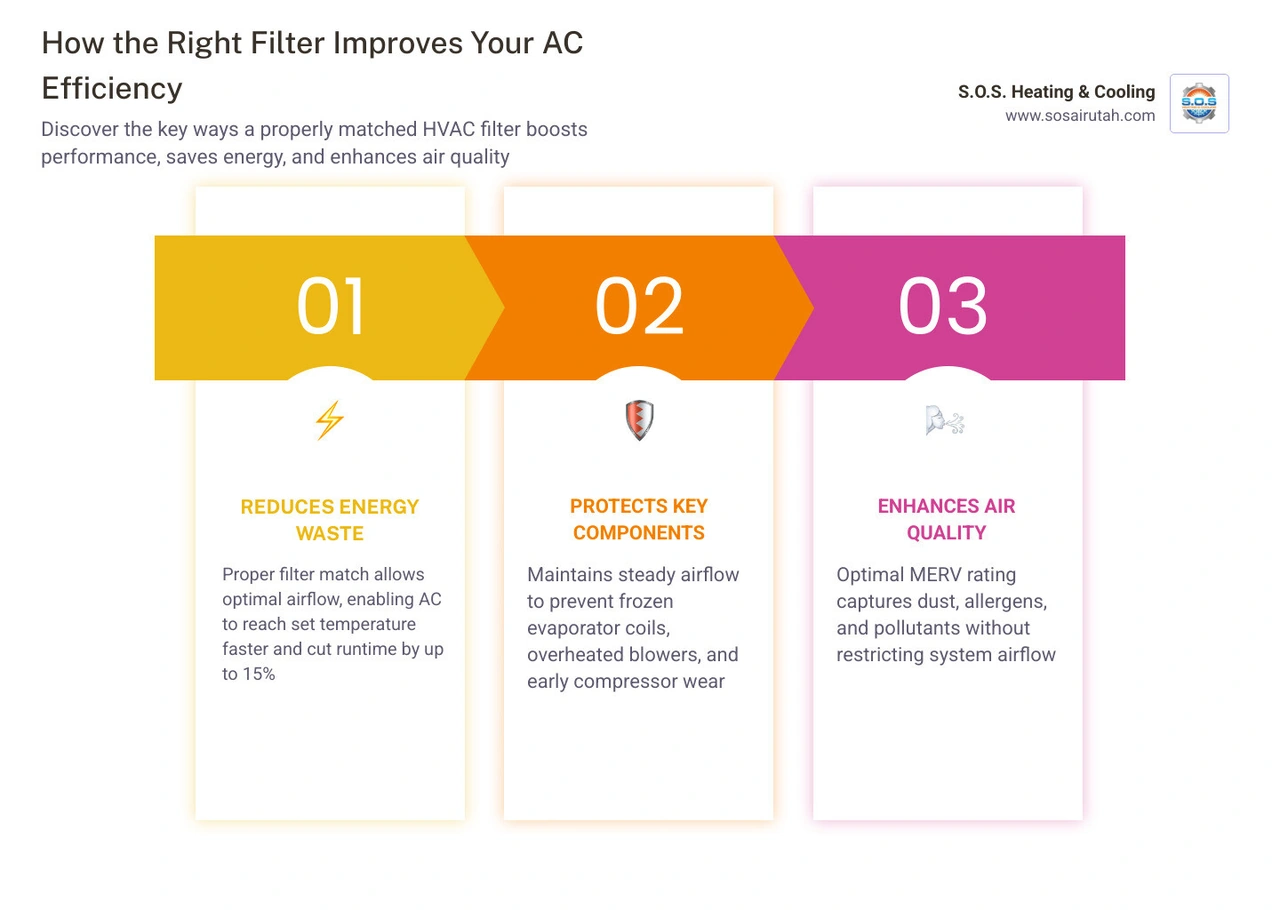
How the right filter improves your ac efficiency comes down to one core principle: the filter you choose directly controls how freely air moves through your system. Here's a quick breakdown:
- Reduces energy waste — A properly matched filter lets your AC reach your target temperature faster, cutting runtime and lowering your utility bill by up to 15%
- Protects critical components — Good airflow prevents frozen evaporator coils, overheated blower motors, and premature compressor failure
- Improves indoor air quality — The right MERV rating traps allergens, dust, and pollutants without strangling your system's airflow
- Extends system lifespan — Reduced strain on your equipment means fewer breakdowns and a longer-lasting AC
Most homeowners don't think twice about the filter sitting behind their return vent — until their energy bill spikes or their AC stops cooling properly. The truth is, that inexpensive rectangular panel is one of the biggest levers you have over your system's performance. Choose one that's too restrictive, and your blower motor works overtime. Choose one that's too loose, and dust coats your coils. The sweet spot is a filter matched to your specific system — and finding it is simpler than you might think.
I'm Bryson Ninow, an NATE-certified HVAC professional with years of hands-on experience helping Salt Lake City homeowners understand how the right filter improves your ac efficiency and keeps their systems running strong through Utah's demanding summers and inversion-heavy winters. In this guide, I'll walk you through everything you need to know to make the smartest filter choice for your home.
Understanding MERV Ratings and How the Right Filter Improves Your AC Efficiency
When you walk down the aisle of a hardware store in Murray or Sandy, you’ll see filters labeled with a MERV rating. MERV stands for Minimum Efficiency Reporting Value. It’s a scale from 1 to 20 that tells you exactly how good a filter is at catching particles of different sizes.
The higher the number, the smaller the particles it can trap. For example, a MERV 4 filter might only catch large clumps of dust and lint, while a MERV 16 filter can trap bacteria and tobacco smoke. Understanding this scale is the first step in Choosing the Right HVAC Filter.
Particle Capture and Residential Standards
In a typical residential setting, we aren't trying to create a sterile hospital operating room. We want to protect the AC equipment from "gunk" and keep the air breathable for our families. Most homes in the Salt Lake Valley operate best within the MERV 8 to 13 range.
| MERV Rating | Particle Size Captured | Common Contaminants Removed | Best Use Case |
|---|---|---|---|
| 1-4 | > 10.0 microns | Pollen, dust mites, lint | Basic equipment protection only |
| 5-8 | 3.0 - 10.0 microns | Mold spores, hair spray, dust | Standard residential use |
| 9-12 | 1.0 - 3.0 microns | Lead dust, auto emission, humidifier dust | Superior residential air quality |
| 13-16 | 0.3 - 1.0 microns | Bacteria, most smoke, sneeze droplets | High-end filtration / Allergy sufferers |
Why Higher MERV Isn't Always Better for Efficiency
It’s a common myth that a higher MERV rating is always "better." In reality, a filter that is too "tight" can act like a wall rather than a sieve. This creates something we call high static pressure.
Imagine trying to breathe through three thick sweaters—your lungs have to work much harder to get the same amount of air. Your AC blower motor faces the same struggle. If the filter is too restrictive for your specific system's design, the motor works overtime, consumes more electricity, and can eventually burn out. This is one of the most Common Air Filtration Problems we see when homeowners try to upgrade to "hospital-grade" filters without a system check.
Recommended MERV Ratings for Salt Lake City Homes
For most of our neighbors in South Jordan and Draper, we recommend a MERV 8 to MERV 11 filter. This provides a fantastic balance of airflow and filtration. If you have severe allergies or pets, a MERV 13 is often the "sweet spot." It captures pet dander and fine dust without putting an undue burden on your blower motor, provided the filter is changed regularly.
Comparing Filter Types: Finding Your Efficiency Sweet Spot
Not all filters are built the same way. The material used determines how the right filter improves your ac efficiency by balancing the "catch rate" with the "flow rate."
Fiberglass Filters
These are the thin, blue or white flat-panel filters you can often buy for a couple of dollars. While they are great for airflow because they offer almost no resistance, they are terrible for air quality. They only trap about 20% of large particles, meaning the rest of that dust is coating your AC coils and circulating back into your Holladay home. We generally view these as "better than nothing," but they don't do much for your health.
Pleated Media Filters
This is where efficiency happens. Pleated filters are made of polyester or cotton folds. By folding the material, manufacturers increase the surface area. More surface area means the filter can trap more dust without blocking the air. It’s like having a wider door for people to walk through—even if the door has a screen on it, more people can pass through at once because the opening is larger.
Electrostatic Filters
These filters use self-charging fibers to attract particles like a magnet. They are excellent for trapping small allergens. You can find them in both disposable and washable versions.
HEPA Limitations
HEPA (High-Efficiency Particulate Air) filters are the gold standard for air purity, trapping 99.97% of particles. However, they are rarely recommended for standard residential AC units. They are so thick that they can cause your evaporator coils to freeze or your compressor to fail because they restrict airflow too much. If you need HEPA-level cleaning, we usually recommend Choosing an Air Filtration System that works alongside your AC rather than inside it.
How the Right Filter Improves Your AC Efficiency Through Surface Area
If your system can accommodate it, moving from a 1-inch thick filter to a 4-inch or 5-inch media filter is a game-changer. A 4-inch pleated filter has significantly more surface area than a 1-inch filter. This allows it to hold much more dust (improving longevity) while maintaining a lower resistance to airflow. This lower resistance means your AC doesn't have to work as hard, which is exactly how the right filter improves your ac efficiency.
The Pros and Cons of Washable vs. Disposable Filters
Washable filters are environmentally friendly, but they require a lot of "elbow grease." You must let them dry completely before putting them back in. If you reinstall a damp filter, you are essentially inviting mold and bacteria to grow inside your ductwork. For most Salt Lake City residents, high-quality disposable pleated filters are the most efficient and hygienic choice.
The High Cost of Neglect: How Dirty Filters Kill Performance
We’ve all been there—life gets busy, and you forget to swap the filter for six months. But that neglect carries a heavy price tag. According to the Department of Energy, a clogged filter can reduce your HVAC efficiency by 5% to 15%.
Signs It’s Time to Replace Your Air Conditioner Filter
You don't always have to open the vent to know your filter is failing. Watch for these red flags:
- Rising Utility Bills: If your May 2026 power bill is significantly higher than last year without a heatwave, your AC is likely struggling to breathe.
- Weak Airflow: Feel the air coming out of your registers. If it feels like a faint whisper instead of a steady breeze, the filter is likely choked with dust.
- Dusty Surfaces: If you find yourself dusting your Millcreek home more often than usual, your filter has reached its "dust-loading capacity" and is letting debris bypass it.
- Musty Odors: A dirty filter traps moisture and organic matter, which can lead to a "dirty sock" smell.
If you notice these, your Hvac Filter Needs Replacement immediately.
How the Right Filter Improves Your AC Efficiency and Lowers Bills
When you use a clean, correctly sized filter, your AC runs in shorter cycles. It reaches the thermostat setting quickly and shuts off. A dirty filter forces the system to run 10-20% longer to move the same amount of cool air. Over a long Utah summer, that extra runtime adds up to hundreds of dollars in wasted electricity and years of unnecessary wear and tear on your compressor. Understanding the Air Filter Replacement Importance is the easiest way to keep your money in your pocket.
Maintenance Best Practices for Peak Cooling in 2026
To keep your system humming along in 2026, you need a strategy. It isn't just about what filter you buy, but how you manage it.
The 30-90 Day Cycle
In Salt Lake City, our air quality changes with the seasons. During the winter inversions or the height of summer pollen, you might need to change your filter every 30 days. If you live in a quiet home in Bountiful with no pets, you might get away with every 90 days. A good rule of thumb is to check it monthly; if you can't see light through the filter when holding it up to a lamp, it's time for a change. For more details, check our guide on the Time to Replace Your Air Conditioner Filter.
Proper Installation for Maximum Airflow
Believe it or not, there is a "front" and "back" to an air filter. Look for the arrows printed on the frame. These arrows should always point toward the AC unit (the air handler) and away from the return duct. Installing it backward reduces the filter's efficiency and can cause the filter media to collapse into the blower.
Also, ensure you are using the correct size. There is a difference between nominal size (the rounded numbers on the label) and actual size (the exact measurements). If your filter is too small, air will simply "bypass" it, carrying dust directly onto your sensitive evaporator coils. If you need help finding the right fit, we offer specialized Air Filter Replacement in Salt Lake City, UT.
When to Consult an HVAC Professional
Sometimes, the "standard" filter isn't enough. If you have hot or cold spots in your house, or if your blower motor seems excessively loud, you may have a static pressure issue. An S.O.S. Heating & Cooling technician can perform a static pressure test during a routine tune-up to see exactly how much resistance your system can handle. We can also help with filter cabinet upgrades if you want to move to a high-efficiency 4-inch media system.
Frequently Asked Questions about AC Efficiency
Can I run my AC without a filter temporarily?
Technically, yes, the system will turn on. However, we strongly advise against it. Even running your AC for a few days without a filter allows dust to coat the moisture-heavy evaporator coils. This creates a "mud" that is incredibly difficult to clean and can lead to mold growth and total system failure. It's simply not worth the risk.
Do high-efficiency filters cause frozen coils?
They certainly can if they aren't matched to your system. A high-MERV filter that restricts airflow causes the temperature of the evaporator coil to drop below freezing. Because there isn't enough warm air passing over the coil to keep it balanced, the condensation on the coil turns to ice. This ice blocks airflow further, creating a snowball effect that can destroy your compressor.
How often should I change filters if I have pets?
If you have furry friends in South Salt Lake or West Valley, we recommend checking your filter every 20-30 days. Pet hair and dander clog pleated filters much faster than standard household dust. Keeping a fresh filter is the best way to ensure your AC doesn't "choke" on pet fur.
Conclusion: Partner with S.O.S. Heating & Cooling for a Cooler Home
Finding how the right filter improves your ac efficiency is one of the simplest DIY tasks a homeowner can perform, but it has a massive impact on your comfort and your bank account. By choosing the right MERV rating, ensuring a perfect fit, and sticking to a replacement schedule, you're protecting the heart of your home's comfort system.
At S.O.S. Heating & Cooling, we’ve been serving the Salt Lake City area with pride, from Layton down to Herriman. We know the unique challenges our climate presents, from the dusty summer winds to the winter inversions. Whether you need a professional tune-up, a static pressure test, or help selecting the Air-Conditioner Filter in Salt Lake City, UT that fits your lifestyle, we are here to help 24/7.
Don't let a $20 filter cause a $2,000 repair. Take control of your AC efficiency today. If you're unsure which filter is right for your system, give us a call—we'll help you breathe easy and save money.

Plumbing
Expert plumbing services offering reliable repairs, installations, maintenance, and emergency support.

Air Conditioning
Comprehensive air conditioning services include installation, repairs, maintenance, and energy-efficient solutions.
Heat Pumps
Enjoy year-round comfort with our energy-efficient and professional heat pump solutions.

Indoor Air Quality
Enhance your home’s air with our cutting-edge indoor air quality solutions you can trust.

Fireplaces
Transform your space into a warm and cozy atmosphere with our professional fireplace services.

Heating
Specialized heating services provide reliable installation, repair, system maintenance, and energy-optimization solutions.
Explore Our Latest Insights and Updates in Plumbing Services
The Definitive Guide to Undersized AC Unit Signs and Problems

A Quick Start Guide to Deciding AC Repair vs Replace in Utah