

How to Extend Water Heater Life in Hard Water Areas


.avif)

How Hard Water in the Wasatch Front Is Quietly Destroying Your Water Heater
If you want to know how to extend the life of your water heater in a hard water area like the Wasatch Front, here is what works:
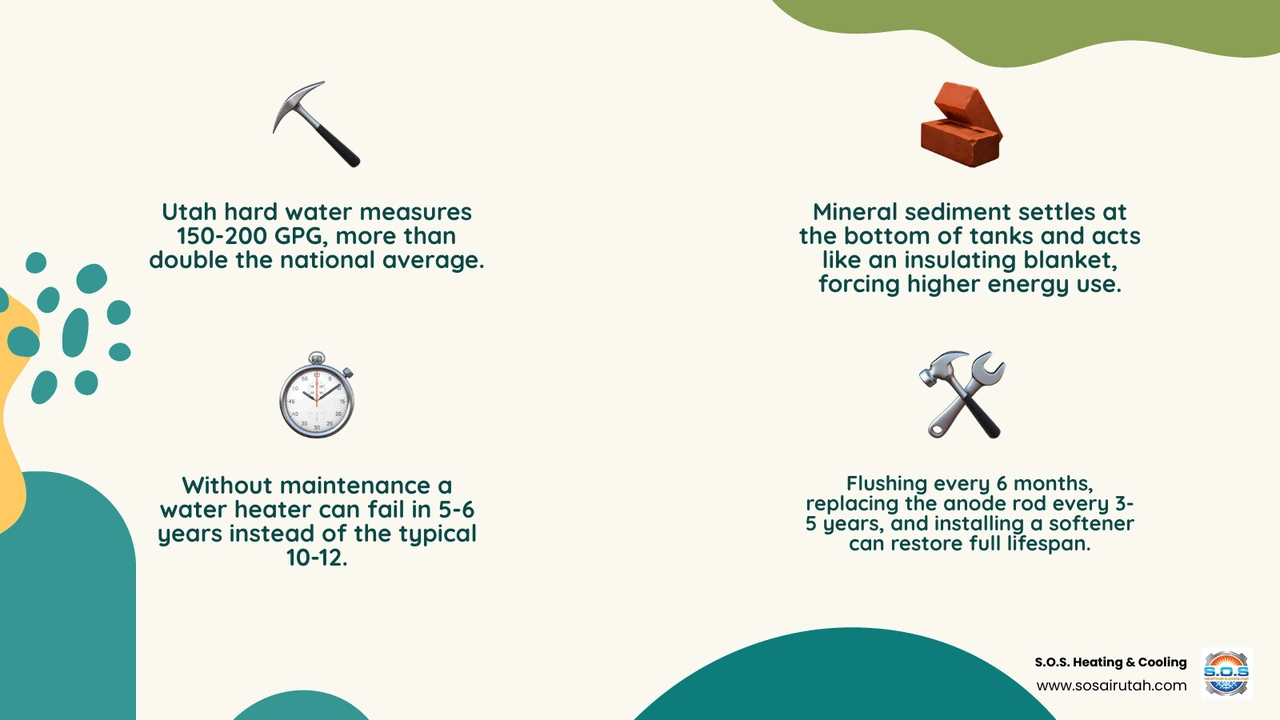
- Flush your water heater every 6 months to remove mineral sediment before it hardens
- Inspect and replace the anode rod every 3-5 years to prevent tank corrosion
- Install a whole-home water softener to reduce scale buildup by up to 99%
- Set your thermostat to 120°F to slow mineral precipitation inside the tank
- Schedule annual professional maintenance to catch problems before they become costly
Most Utah homeowners don't think about their water heater until something goes wrong — and by then, hard water has often already done serious damage. The Wasatch Front is one of the hardest water regions in the country, with mineral levels typically measuring 150-200 grains per gallon (GPG). That's more than double the national average of 60 GPG.
When that mineral-heavy water heats up inside your tank, calcium and magnesium separate out of solution and settle at the bottom as sediment. Over time, that sediment acts like an insulating blanket between the burner and the water — forcing your system to work harder, use more energy, and wear out faster. Without the right maintenance steps, a water heater that should last 10-12 years may only make it to 5 or 6.
I'm Bryson Ninow, an NATE-certified HVAC professional with years of hands-on experience helping Salt Lake City area homeowners protect their equipment from Utah's notoriously hard water — and knowing how to extend the life of your water heater in a hard water area like the Wasatch Front is one of the most practical things you can do to protect your home. In the sections below, I'll walk you through exactly what hard water does to your system and the specific steps that make the biggest difference.
Understanding the Wasatch Front Hard Water Challenge

To understand how to protect your system, it helps to understand why our water is so tough on appliances in the first place. When snow melts in the Wasatch Mountains, that water runs down into our local aquifers and reservoirs, flowing over and through deep layers of limestone and mineral-rich rock. Along the way, it dissolves and carries away high amounts of calcium and magnesium.
By the time that water reaches municipal systems in Salt Lake City, Sandy, Draper, or Layton, it is loaded with these minerals. While drinking this mineral-rich water is perfectly safe and even healthy, those same minerals become a plumbing nightmare when subjected to heat.
The concentration of these minerals is measured in Grains Per Gallon (GPG). According to water quality standards, anything over 7 GPG is considered "hard," and anything over 10.5 GPG is classified as "very hard." In our service areas, the water hardness frequently exceeds 15 GPG, making it exceptionally harsh. If you want to see how this affects your home overall, read about How Utah Hard Water Affects Your Plumbing and check out our detailed look at local conditions like the Water Quality in Woods Cross UT.
Why You Need to Know How to Extend the Life of Your Water Heater in a Hard Water Area Like the Wasatch Front
When hard water enters your water heater and is heated to typical household temperatures, a chemical reaction occurs. The dissolved calcium and magnesium precipitate out of the water, forming solid calcium carbonate—commonly known as limescale.
This scale doesn't just float harmlessly away; it settles directly onto the hottest surfaces inside your water heater. In a conventional gas water heater, this means a thick layer of rock forms over the burner at the bottom of the tank. In an electric water heater, the scale encases the heating elements like a concrete sleeve.
This buildup causes several severe issues:
- Thermal Stress: Because scale acts as a powerful thermal insulator, the bottom of your water heater tank must get much hotter than designed just to heat the water above it. This extreme heat weakens the steel tank and can crack the internal glass lining, leading to premature tank failure and catastrophic leaks.
- Efficiency Loss: Every 5 GPG of water hardness causes approximately a 4% loss in water heater efficiency. In areas with 150-200 GPG equivalent hardness, untreated water heaters can see their efficiency plummet by up to 24%, adding hundreds of dollars per year to your energy bills.
- Component Failure: Heating elements in electric models overheat and burn out rapidly when coated in scale, while gas control valves can become sluggish or fail completely.
Without proactive maintenance, you are essentially running your water heater on borrowed time. To learn more about this destructive process, you can read the Slug Hard Water Shortens Water Heater Lifespan Guide.
Signs of Hard Water Damage in Your Water Heater
You don't need x-ray vision to know if hard water is taking a toll on your system. Your water heater will usually start sending out distress signals:
- The "Kettle" Effect: If you hear popping, rumbling, or cracking sounds coming from your utility closet, that's the sound of water trapped beneath layers of sediment boiling and steam bubbles bursting through the mineral crust.
- Lukewarm Water or Slow Recovery: If your morning showers are getting shorter or it takes hours for your system to produce hot water again after a single load of laundry, scale is blocking the heat transfer.
- Rusty or Cloudy Water: Sediment buildup can stir up and find its way into your hot water lines, leading to discolored water or a metallic smell.
- Rising Energy Bills: If your utility bills are climbing but your hot water usage hasn't changed, your water heater is working overtime against a layer of rock.
If these symptoms sound familiar, your system is already struggling. For a broader look at how these issues present themselves throughout your property, check out the Signs of Hard Water Damage in Your Home and learn How Hard Water Affects Your Fixtures and Appliances.
How to Extend the Life of Your Water Heater in a Hard Water Area Like the Wasatch Front
Now that we know what we are up against, let's talk solutions. Extending the life of your water heater in Utah isn't about luck; it's about consistent, preventative maintenance. Whether you have a traditional storage tank or a modern tankless system, taking action now can double its remaining lifespan. For those looking to upgrade to a system designed to handle these conditions better, we have compiled a guide to the Best Water Heater Options Hard Water 2026.
Step-by-Step: How to Extend the Life of Your Water Heater in a Hard Water Area Like the Wasatch Front
Flushing your water heater is the single most effective DIY task you can perform. In soft water areas, an annual flush is plenty. However, along the Wasatch Front, we strongly recommend flushing your water heater every 6 months to prevent the sediment from solidifying into an unmovable block.
Here is how to safely flush a standard tank water heater:
- Safety First: Turn off the power source. For a gas water heater, turn the gas control valve to the "Pilot" or "Off" position. For an electric water heater, turn off the dedicated breaker at your main electrical panel. Never flush an electric water heater with the power on, or you will instantly burn out the heating elements.
- Shut Off the Water Supply: Close the cold water inlet valve at the top of the water heater.
- Connect a Garden Hose: Attach a heavy-duty garden hose to the drain valve located near the bottom of the tank. Route the other end of the hose to a safe drainage area, like a floor drain, utility sink, or outside. Tip: The water exiting the tank will be extremely hot, so keep pets and children away.
- Open a Hot Water Faucet: Open a hot water faucet somewhere in your home (like a bathroom sink or bathtub). This allows air into the system, breaking the vacuum and letting the tank drain smoothly.
- Open the Drain Valve: Carefully open the drain valve on the water heater. You may need a flathead screwdriver to open some plastic or brass valves. Let the tank drain completely.
- Flush the Sediment: Once the tank is empty, turn the cold water supply valve back on for 10-15 seconds, then shut it off again. This blast of cold water stirs up the stubborn sediment at the bottom of the tank so it can flow out of the drain hose. Repeat this "mini-flush" process until the water running out of the hose is completely clear.
- Refill and Restore Power: Close the drain valve and remove the hose. Turn the cold water supply back on to refill the tank. Keep the hot water faucet inside your home open until water flows out of it without sputtering air. Once the tank is completely full, restore power to the unit (turn the breaker back on or relight the gas pilot).
For more details on setting up a maintenance schedule that fits your specific neighborhood, read our guide on How Often to Flush Your Water Heater in Hard Water.
Inspecting and Replacing the Sacrificial Anode Rod
The anode rod is your water heater’s unsung hero. It is a long metal rod—usually made of magnesium, aluminum, or a zinc alloy—suspended inside the tank. Its sole job is to corrode so your steel tank doesn't have to. Because water chemistry naturally seeks out metal to corrode, it attacks the highly active anode rod first.
In hard water areas, anode rods degrade much faster than normal. If the anode rod is completely depleted, the corrosive elements in the water will immediately begin eating away at the steel walls of your tank, leading to rust, leaks, and a ruined system.
We recommend inspecting your anode rod every 2 to 3 years:
- If you see the core steel wire exposed, or if the rod has rusted down to less than half its original thickness, it is time to replace it.
- Pro Tip for Hard Water: If you have exceptionally hard water or use a water softener, consider upgrading to an aluminum or powered anode rod. Aluminum rods tend to withstand hard water conditions longer, while powered (impressed current) anodes use electrical pulses to prevent corrosion without degrading over time.
The Role of Water Softeners in Protecting Your Water Heater
While regular flushing and anode rod replacements are vital, they only treat the symptoms of hard water. If you want to eliminate the problem at the source, installing a whole-home water softener is the ultimate solution.
A water softener works through a process called ion exchange. As hard water enters your home, it passes through a tank filled with resin beads coated in sodium or potassium ions. The calcium and magnesium minerals in the water carry a strong positive charge, which causes them to cling to the resin beads, displacing the harmless sodium or potassium ions.
The water that leaves the softener and enters your water heater is virtually free of scale-forming minerals. In fact, softened water reduces scale buildup inside a gas water heater from 528 grams per year down to just 7 grams—a 99% reduction.
To explore how this investment safeguards your entire plumbing system, take a look at How a Water Softener Protects Your Plumbing and Appliances. If you are wondering about the economics of making this upgrade in Utah, read Is a Water Softener Worth the Investment in Utah and our comprehensive Water Softener Worth It Utah Guide 2026.
Lifespan and Efficiency Comparison
To put the impact of a water softener into perspective, let's look at how a standard 50-gallon gas water heater performs over a 10-year horizon with and without water softening in a typical Wasatch Front home:
| Feature / Metric | With Hard Water (No Softener) | With Softened Water |
|---|---|---|
| Average Lifespan | 5 to 7 Years (Premature Failure) | 10 to 15+ Years |
| Annual Scale Buildup | ~528 Grams (over 1 lb of rock) | ~7 Grams (negligible) |
| Efficiency Loss (Year 5) | 20% to 24% Loss | 0% to 1% Loss |
| Required Flushing Frequency | Every 6 Months | Every 12 to 24 Months |
| Anode Rod Lifespan | 2 to 3 Years | 3 to 5 Years |
| Heating Elements (Electric) | Frequent burnouts (every 2-3 years) | Rare failures (last 10+ years) |
Frequently Asked Questions About Hard Water and Water Heaters
Navigating water quality issues can be tricky. Here are some of the most common questions we hear from homeowners in Salt Lake City, Sandy, and surrounding communities. For a broader overview of how to treat your home's water, check out our Water Treatment Options for Utah Homes and the Water Treatment Guide Plumbing Appliances.
How often should you flush a water heater in Utah?
If you do not have a water softener, you should flush your water heater every 6 months. The mineral concentration along the Wasatch Front is simply too high to wait a full year. If you have a high-quality water softener installed, you can safely extend this maintenance window to once every 12 to 18 months just to clear out any minor sediment.
Can hard water damage a tankless water heater?
Yes—in fact, tankless water heaters can be even more sensitive to hard water than tank models. While tankless systems don't store water, they rely on incredibly narrow copper water passages within the heat exchanger to heat water instantly.
Mineral scale can quickly coat and clog these narrow passages, restricting water flow and causing the heat exchanger to overheat and fail. If you have a tankless water heater in Utah, annual descaling with a food-grade vinegar solution is absolutely mandatory to maintain your warranty and keep the system running.
When is it time to replace a water heater instead of repairing it?
If your water heater is over 8 years old, has a slow leak coming from the bottom of the tank, or is making extremely loud, persistent rumbling noises even after a thorough flush, it is usually time for a replacement.
Once the steel tank has corroded or the glass lining has fractured due to heavy sediment buildup, repairs are no longer safe or cost-effective. For more details on what to look for, see our guide on the Signs Your Water Heater Needs Replacement.
Conclusion
Living along the beautiful Wasatch Front shouldn't mean constantly replacing ruined water heaters. By implementing a proactive maintenance routine—including regular flushes, timely anode rod replacements, and considering a whole-home water softener—you can protect your investment, lower your monthly energy bills, and ensure your family always has access to reliable hot water.
At S.O.S. Heating & Cooling, we have been helping homeowners throughout Salt Lake City, Draper, Bountiful, and the surrounding areas keep their plumbing and HVAC systems running perfectly since day one. Whether you need a professional water heater flush, an anode rod replacement, a water softener installation, or a complete system upgrade, our team of friendly, experienced technicians is here to help. We offer 24/7 emergency services, flexible financing options, and no evaluation fees during business hours.
Don't wait for your water heater to leave you with a cold shower. Schedule professional water heater services with S.O.S. Heating & Cooling today and let us help you extend the life of your home's plumbing systems!
Explore Our Latest Insights and Updates in Plumbing Services
Why Your Skin and Furniture Crave a Winter Humidifier
Why Upgrading to a High Efficiency AC System is a Cool Move
Mini Split vs Central AC Cost Comparison for Savvy Homeowners