
How to Protect Your Home from Utah Wildfire Smoke with These Easy Changes


.avif)

Why Wildfire Smoke Season Is an HVAC Problem Every Utah Homeowner Needs to Take Seriously
Knowing how to prepare your HVAC system for wildfire smoke season in Utah could be one of the most important things you do for your family's health this year. Here is a quick overview of the key steps before we dive into the details:
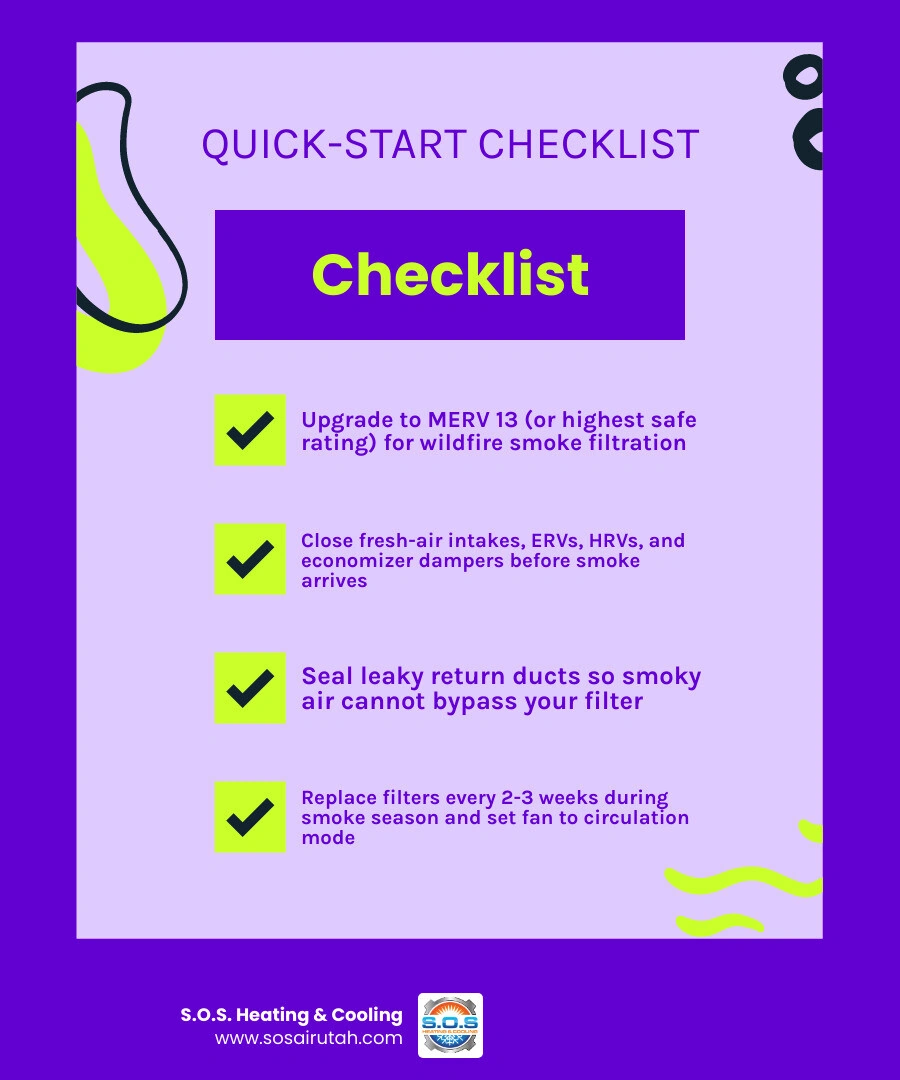
Quick-Start Checklist: Preparing Your HVAC for Utah Wildfire Smoke
- Upgrade your filter to MERV 13 (or the highest rating your system can safely handle)
- Check for and close fresh-air intakes, ERVs, HRVs, and economizer dampers before smoke arrives
- Seal leaky return ducts so smoky air cannot bypass your filter
- Set your thermostat fan to circulation mode or "On" during active smoke events
- Avoid evaporative coolers and single-hose portable ACs — both pull outdoor air directly inside
- Inspect and replace filters every 2 to 3 weeks during smoke season instead of the usual 60 to 90 days
- Set up a designated clean room with a portable HEPA air purifier for vulnerable family members
Wildfire smoke is no longer a rare event along the Wasatch Front. Smoke from fires burning across Utah, Idaho, Nevada, Oregon, California, and Canada can settle into Salt Lake, Davis, Weber, and Utah counties for days at a time. By August 2025, Utah had already burned 114,000 acres across 693 fires — 72 percent of them human-caused — and the trend is not reversing. Wildland fires now account for 52 percent of all fine particle (PM2.5) pollution in the United States, and emergency department visits for asthma and COPD surge 30 to 110 percent after extreme smoke days, even among people who stayed indoors. That last detail matters: staying inside only protects you if your HVAC system is actually filtering the air you are breathing.
Utah's geography makes the problem worse. The same bowl-shaped topography that traps winter inversions along the Wasatch Front also holds wildfire smoke close to the valley floor, sometimes for several days in a row. Roughly 60,000 Utah structures sit inside the state's mapped high-risk wildland-urban interface zone, and older homes throughout the Salt Lake Valley frequently have leaky return ducts that can pull unfiltered outdoor air directly into the airstream — bypassing whatever filter you have installed.
The good news is that your HVAC system, when properly prepared, is one of the most effective tools you have. A central air conditioner or heat pump running in recirculation mode with a high-efficiency filter can reduce indoor PM2.5 levels to roughly one-third of what is outside. But the key phrase is properly prepared — the wrong filter, an open fresh-air damper, or a cracked return duct can undo all of that protection.
I'm Bryson Ninow, an NATE-certified HVAC professional with hands-on experience helping Salt Lake area homeowners improve indoor air quality during both wildfire smoke events and winter inversions — the same skills that go into knowing how to prepare your HVAC system for wildfire smoke season in Utah are ones I apply every day. In the sections below, I'll walk you through exactly what to check, what to change, and how to keep your family breathing clean air when the smoke rolls in.
How to Prepare Your HVAC System for Wildfire Smoke Season in Utah
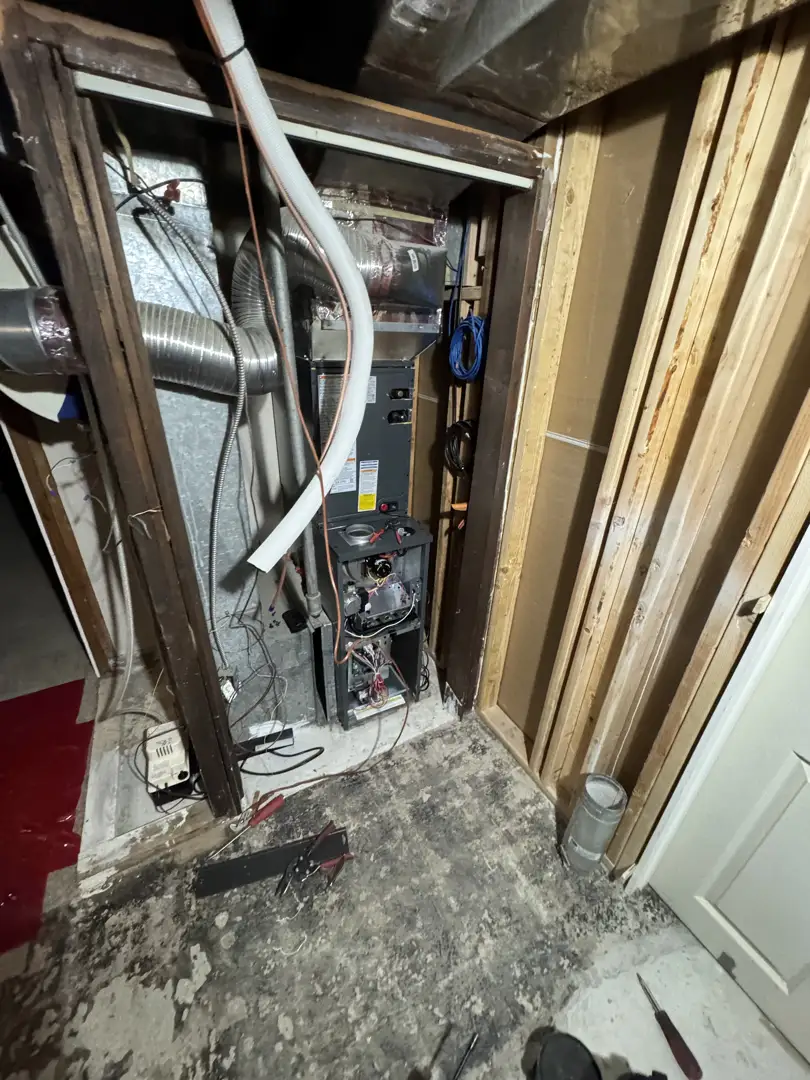
When smoke rolls down the Wasatch Front, your home should be your sanctuary. However, many homeowners do not realize that their heating and cooling systems are not automatically set up to defend against microscopic particles. Taking a proactive approach before the skies turn orange is the best way to ensure your system keeps you safe rather than circulating smoky air.
Proactive preparation starts with a comprehensive evaluation of your system's overall health and airflow. During a professional tune-up, a technician will check your system's static pressure (the resistance to airflow in your ductwork) and inspect the structural integrity of your air distribution system. If you want to make sure your home is fully protected, scheduling a seasonal checkup is a great first step. You can learn more about what a thorough inspection entails by reading our guide on HVAC Maintenance Utah.
Assessing Filter Fit and Upgrading to Thicker Media Cabinets
One of the most common issues we find in homes across Salt Lake City, Sandy, and Bountiful is "filter bypass." This happens when your air filter does not fit snugly within its slot. Even a tiny gap of a quarter-inch allows a massive amount of air—and the fine PM2.5 particles it carries—to slip right around the sides of the filter without being cleaned.
If you are using a standard 1-inch filter slot, upgrading to a high-efficiency filter can be tricky. Standard 1-inch filters with high MERV ratings are often incredibly restrictive, which can cause a severe pressure drop across your system, leading to weak airflow, noisy operation, and even frozen air conditioner coils.
The ultimate solution to this problem is upgrading to a 4-inch or 5-inch media filter cabinet. These thicker media filters have significantly more surface area (often folded into deep pleats), allowing them to capture microscopic smoke particles without choking your system's airflow. Installing a dedicated media cabinet requires a professional retrofitting of your ductwork right next to your furnace or air handler, but it is the single most impactful physical upgrade you can make to your central system. For a deeper dive into choosing the right size and type of filter for your home, take a look at our article on Choosing the Right HVAC Filter.
Sealing Leaky Return Ducts and Checking Fresh-Air Intakes
Your HVAC system is a closed loop—or at least, it is supposed to be. In many Utah homes, especially older properties in places like Murray, Holladay, and Millcreek, return ducts run through unconditioned spaces like dusty attics, crawl spaces, or unfinished basements. If these return ducts have loose joints, cracks, or unsealed connections, they create a vacuum that pulls air directly from those unconditioned spaces. During wildfire season, smoky air easily infiltrates your crawl space or attic and gets sucked directly into your home's breathing air, bypassing the filter entirely. Sealing these return leaks with professional duct mastic or foil tape is essential.
Additionally, many modern, airtight homes are equipped with mechanical ventilation systems. These include fresh-air intakes, economizers, or Energy Recovery Ventilators (ERVs) and Heat Recovery Ventilators (HRVs). While these systems are fantastic for bringing in fresh air under normal conditions, they are a direct pathway for smoke during a wildfire event. You must locate your outdoor air intake vents and know how to manually close the dampers or temporarily shut off your mechanical ventilation systems when the outdoor Air Quality Index (AQI) begins to climb.
Choosing the Right MERV Filter for Wildfire Smoke
Selecting the right filter is a balancing act between capturing microscopic smoke particles and maintaining healthy airflow through your equipment. The table below outlines how different MERV (Minimum Efficiency Reporting Value) ratings perform when faced with wildfire smoke:
| Filter Rating | PM2.5 Smoke Capture Efficiency | Airflow Resistance (Static Pressure) | Risk of HVAC Coil Freezing | Best Use Case |
|---|---|---|---|---|
| MERV 1–4 | < 20% (Virtually useless for smoke) | Very Low | None | Basic dust and lint protection only |
| MERV 8 | ~ 20% – 50% (Poor) | Low | Very Low | Standard residential dust/pollen control |
| MERV 11 | ~ 50% – 75% (Moderate) | Moderate | Low to Medium | Good everyday balance of filtration and airflow |
| MERV 13 | 85% – 95% (Excellent) | High (in 1-inch sizes) | Medium (High if dirty) | Recommended minimum for wildfire smoke |
| MERV 16 / HEPA | > 95% (Maximum) | Extremely High | Very High | Requires specialized high-flow media cabinets |
To find the perfect balance for your local climate and equipment, you can read more about our tailored solutions for Air Filtration Salt Lake City.
Why MERV 13 is the Gold Standard for Smoke Protection
Wildfire smoke is primarily composed of fine particulate matter that is 2.5 microns or smaller in diameter (PM2.5). To put that in perspective, a single human hair is about 70 microns wide. The most dangerous elements of wildfire smoke are the sub-micron particles (between 0.3 and 1.0 microns) because they can travel deep into your lungs and enter your bloodstream.
This is why the Environmental Protection Agency (EPA) recommends upgrading to at least a MERV 13 filter during wildfire smoke events. A MERV 13 filter is specifically designed to capture up to 85 to 95 percent of these tiny sub-micron particles. Standard MERV 8 filters, which most homeowners buy in bulk, only capture larger particles like dust mites and pollen, leaving your lungs completely exposed to the finest, most toxic elements of wildfire smoke.
How to Prepare Your HVAC System for Wildfire Smoke Season in Utah with the Right Filter Thickness
While upgrading to a MERV 13 filter is highly recommended, simply buying a standard 1-inch MERV 13 filter from the hardware store and sliding it into an older system can sometimes do more harm than good. Because 1-inch filters have limited surface area, making them tight enough to catch microscopic smoke particles also makes them incredibly restrictive to airflow. This restriction puts immense strain on your blower motor, increases your energy bills, and can drop the temperature of your air conditioning coils so low that they freeze solid, turning your AC into a block of ice.
This is where filter thickness becomes your best friend. A 4-inch or 5-inch pleated media filter has up to ten times the surface area of a 1-inch filter. Because the air has a much larger area to flow through, a 4-inch MERV 13 filter actually has less airflow resistance than a restrictive 1-inch MERV 11 filter. Before you make any major upgrades, a professional technician should perform a static pressure test to measure how much resistance your system can safely handle.
Operating Your Cooling System Safely During Smoke Events
Once your system is physically prepared, knowing how to operate it during an active smoke event is the next line of defense. Many homeowners wonder if they should turn their air conditioning off entirely when the outdoor air is thick with smoke. In almost all cases, the answer is no—running your central AC or heat pump is highly beneficial, provided you run it correctly.
Central air conditioners and heat pumps do not pull air from the outside to cool your home; they simply recirculate and cool the air that is already inside. However, you must take active steps to ensure your system is set to recirculation mode and that you aren't accidentally pulling smoky air indoors through secondary cooling appliances. For more strategies on keeping your home's air pristine year-round, check out our guide on Maintaining Optimal Indoor Air Quality.
Managing Thermostat Fan Settings: Auto, On, or Circulate
Under normal weather conditions, your thermostat fan is likely set to Auto, meaning the blower fan only runs when the system is actively heating or cooling. However, during a wildfire smoke event, you want continuous filtration to clean the air as it leaks into your home.
Switching your thermostat fan to On keeps the blower motor running constantly, passing your home's indoor air through your high-efficiency filter 24 hours a day. While this is highly effective for short-term smoke events, keep in mind that running the fan continuously can add $20 to $40 to your monthly electric bill and can slightly increase indoor humidity.
If your thermostat has a Circulate (or Circ) mode, this is often the perfect compromise. Circulate mode typically runs the fan for 20 to 30 minutes of every hour, providing consistent filtration without running the blower motor constantly. If you run your fan continuously, watch out for warning signs of system strain, such as a whistling noise from your return vents, a sudden drop in airflow, or uneven cooling across different rooms.
Why You Must Avoid Evaporative Coolers and Single-Hose Portable ACs
While central AC systems are safe to run, other common cooling methods in Utah can be disastrous during smoke season:
- Evaporative Coolers (Swamp Coolers): Swamp coolers work by pulling large volumes of hot, dry outdoor air through wet pads and blowing it into your home. If the outdoor air is filled with wildfire smoke, a swamp cooler will act like a giant vacuum, filling your entire house with toxic smoke in a matter of minutes. Avoid running swamp coolers entirely during high-AQI events.
- Single-Hose Portable ACs: These units pull air from inside the room, use it to cool the condenser, and blow the hot waste air out of a window hose. This creates strong negative pressure inside your home, which forces smoky outdoor air to be sucked in through every tiny crack, window gap, and door sweep.
- Window AC Units: These are generally safe to use only if you ensure the outdoor air damper is set to the closed position. If the damper is left open, it will pull smoky air directly inside.
Creating a Designated Clean Room and Managing Filter Changes
Even with an upgraded whole-home filter, extreme smoke events can overwhelm your home's natural defenses. This is especially true in older, draftier homes in areas like Salt Lake City or Bountiful. Creating a multi-layered defense system is the most reliable way to protect sensitive family members, such as children, seniors, or anyone with respiratory conditions. For more practical advice on building a healthy indoor environment, read our article on Improving Your Home's Indoor Air Quality.
How to Prepare Your HVAC System for Wildfire Smoke Season in Utah by Adjusting Filter Change Frequency
During a heavy wildfire smoke event, your air filter is working overtime. It is capturing thousands of times more microscopic particles than it would during a typical clear summer day. In our dry Utah climate, filters also load up quickly with fine dust, which acts like a cement when mixed with sticky wood smoke.
While you might normally change your HVAC filter every 60 to 90 days, you should check your filter weekly during active smoke season. If you pull the filter out and it has turned a dark, charcoal-gray or black color, it needs to be replaced immediately. Running a completely loaded filter chokes your system's airflow, which can damage your blower motor and completely stop your home from cooling. Always keep a backup supply of 3 to 4 high-efficiency filters on hand before the summer fire season begins.
Setting Up a Dedicated Clean Room with Portable Filtration
A "clean room" is a designated room in your home—ideally a bedroom where family members spend a significant amount of time—that is sealed off and equipped with extra filtration.
To set up a clean room:
- Choose a room with as few windows and doors as possible.
- Keep the door and windows closed at all times.
- Install temporary weather stripping or place a rolled-up towel at the bottom of the door.
- Run a portable HEPA air purifier continuously on its highest speed setting.
Running a portable HEPA purifier in a single room provides a massive boost to your central HVAC system. While your central system keeps the baseline air quality safe across the entire house, the portable unit can completely scrub the air in a localized space down to 99.97 percent purity. If you are interested in a whole-home solution that works directly inside your ductwork, you might also want to look into our professional Air Scrubber Installation Utah services.
Additional IAQ Steps and Post-Smoke Cleanup
To keep your indoor air as clean as possible during a wildfire event, pair your HVAC filtration with smart daily habits:
- Avoid Particle-Generating Activities: Do not burn candles, use gas stoves, fry food, or smoke indoors.
- Postpone Vacuuming: Unless your vacuum is equipped with a true sealed HEPA filter, vacuuming simply kicks settled dust and smoke particles back into your breathing zone.
- Wear N95 Masks Outdoors: If you must step outside to run errands in Salt Lake City or Layton, wear a well-fitting N95 or KN95 respirator. Standard cloth masks do not filter out PM2.5 particles.
- Monitor AQI Daily: Use local resources like the Utah Division of Air Quality (DAQ) or the EPA's AirNow Fire and Smoke Map to track real-time pollution levels.
- Post-Smoke Cleanup: Once the smoke clears, open your windows to flush out the home. Gently wipe down dusty indoor surfaces with a damp microfiber cloth, and replace your HVAC filter one final time to remove the trapped ash.
Frequently Asked Questions About Wildfire Smoke and HVAC Systems
Should I run my central AC when the outdoor air is smoky?
Yes, running your central air conditioner or heat pump is highly recommended during wildfire smoke events. Central systems do not pull outdoor air into your home to cool it; instead, they pull air from inside your rooms, pass it through your filter, cool it, and blow it back inside. Running your AC keeps your home comfortable while continuously filtering your indoor air. Just make sure your windows and doors remain tightly closed, and make sure any fresh-air intakes or mechanical ventilation systems are temporarily shut off or closed.
Can a standard HVAC filter remove the smell of wildfire smoke?
No, standard fiberglass or pleated MERV-rated filters are only designed to capture solid particulate matter, such as ash and fine soot. The strong, distinct smell of wildfire smoke is caused by gaseous pollutants and Volatile Organic Compounds (VOCs), which are far too small to be trapped by a standard air filter. To eliminate the actual smell of smoke, you need a filter or air purifier that contains a heavy layer of activated carbon, which chemically bonds with and neutralizes gaseous odors.
What are the warning signs that my high-MERV filter is restricting too much airflow?
If your system is struggling with a high-efficiency filter, it will usually let you know. Watch out for these common warning signs:
- Frozen Evaporator Coils: If you notice ice forming on the copper refrigerant lines near your indoor furnace or outdoor unit, your airflow is too low.
- Whistling or Whining Noises: A loud whistling sound coming from your return air vents indicates your system is desperate for air.
- Weak Airflow: If the air blowing out of your supply registers feels incredibly weak or barely noticeable.
- Short Cycling: If your air conditioner turns on and off rapidly every few minutes without actually cooling your home.
Conclusion
Preparing your home for wildfire smoke season is all about taking control of your indoor air quality before the skies turn gray. By upgrading to a high-efficiency MERV 13 filter, sealing leaky return ducts, managing your thermostat's fan settings, and avoiding outdoor air-pulling appliances like swamp coolers, you can create a safe, clean, and comfortable environment for your family to breathe easy all summer long.
At S.O.S. Heating & Cooling, we are dedicated to keeping your home safe and comfortable, no matter what the Utah weather throws your way. We proudly serve homeowners across the Salt Lake Valley and surrounding areas, including Salt Lake City, Sandy, Draper, South Jordan, Riverton, Millcreek, Murray, Holladay, Cottonwood Heights, Bountiful, and Layton. Whether you need a professional static pressure test, a media cabinet upgrade, or a comprehensive indoor air quality assessment, our friendly, NATE-certified technicians are here to help. We offer 24/7 emergency repairs, priority service for our partners, no evaluation fees during normal business hours, and flexible financing options to fit your family's needs.
Don't wait for the next smoke plume to drift over the Wasatch Front. Contact us today to schedule your system checkup or to explore our advanced Indoor Air Quality Services. Let's make sure your home is ready to keep you safe this season!
Explore Our Latest Insights and Updates in Plumbing Services
In Depth Guide to Utah Winter Inversion & Indoor Air Quality
How to Choose the Right Furnace for a Salt Lake Valley Home
Average Lifespan of a Central Air Conditioner in Hot Dry Utah Climate