
The Definitive Guide to Inversion Air Pollution Protection


.avif)

Why Knowing How to Protect Your Family from Inversion Air Pollution Inside Your Utah Home Could Be the Most Important Thing You Do This Winter
Knowing how to protect your family from inversion air pollution inside your Utah home starts with a few key actions you can take right now:
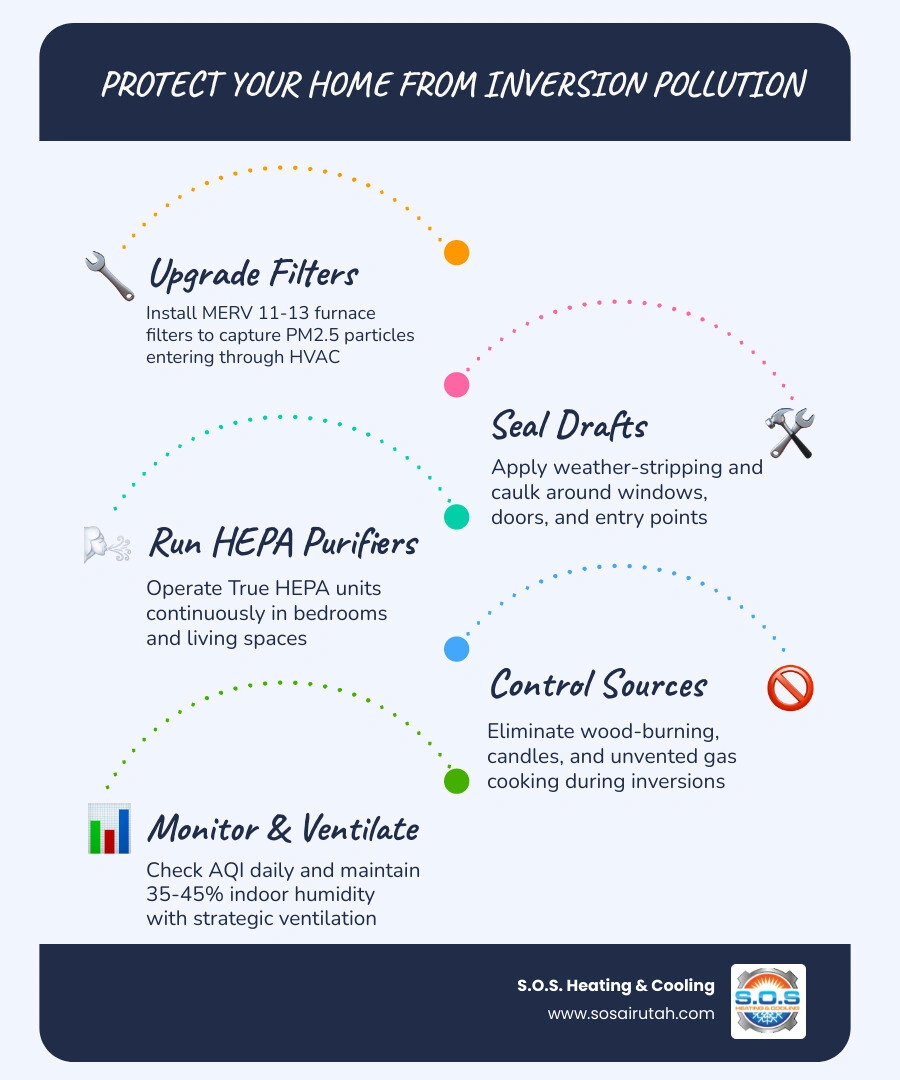
- Upgrade your furnace filter to MERV 11-13 to capture fine PM2.5 particles
- Keep windows and doors closed on poor air quality days and check AQI at air.utah.gov before ventilating
- Run a True HEPA air purifier continuously in your bedroom or main living area
- Reduce indoor pollution sources — avoid wood-burning, candles, and gas cooking without exhaust ventilation
- Seal drafts around windows and doors with weather-stripping or caulk
- Maintain indoor humidity between 35-45% using a whole-home or portable humidifier
- Monitor air quality with a consumer PM2.5 sensor to know when conditions inside your home are unsafe
Every winter, a familiar gray haze settles over the Salt Lake Valley. If you live along the Wasatch Front, you know it well. That layer of smog isn't just an eyesore — it's a serious health threat, and it doesn't stay outside.
Here's what surprises most Utah homeowners: the air inside your home can actually be more polluted than the air outside during an inversion. The EPA estimates that indoor air is typically 2 to 5 times more polluted than outdoor air — and during heavy inversion events, fine particles from vehicle exhaust, wood smoke, and industrial emissions work their way into your living spaces through gaps, cracks, and your HVAC system. The average person spends up to 90% of their time indoors, which means the air quality inside your home matters enormously — especially for children, the elderly, and anyone with asthma or other respiratory conditions.
This guide is here to cut through the confusion and give you clear, practical steps to protect the people you love most.
I'm Bryson Ninow, an HVAC professional certified in NATE, EPA, and indoor air quality solutions, with years of hands-on experience helping Utah families breathe easier during inversion season — and understanding how to protect your family from inversion air pollution inside your Utah home is something I work through with homeowners every single winter. In the sections that follow, I'll walk you through exactly how inversions work, how pollution enters your home, and what you can do about it — starting today.
Understanding Utah's Winter Inversions and Indoor Air Infiltration
To effectively guard our homes against winter pollution, we must first understand the unique meteorological and structural challenges we face in Northern Utah. Inversion season isn't just a weather report; it is a physical phenomenon that transforms our valleys into giant, sealed bowls of stagnant air.
During these periods, the air we breathe indoors is directly affected by what is happening outside. Even if we keep our doors and windows shut, outdoor pollutants find their way inside. To understand the terminology used by environmental scientists and HVAC technicians during these events, you can consult our Glossary of Indoor Air Quality Terminology to familiarize yourself with terms like PM2.5, static pressure, and air exchange rates.
The health consequences of these events are far-reaching. When fine particulate matter enters our lungs, it triggers inflammatory responses that can affect every system in the body. For instance, a landmark study conducted by the University of Utah revealed that short-term exposure to elevated nitrogen dioxide levels was linked to a 16% increase in the risk of miscarriage among pregnant women. Furthermore, researchers have noted that winter inversion events are linked to more than 200 additional cases of pneumonia each winter across the Wasatch Front.
Why Winter Weather Traps Pollution in Utah Valleys
Our beautiful geography is the primary culprit behind our poor winter air quality. Cities like Salt Lake City, Bountiful, Sandy, and Draper sit in deep mountain basins. Under normal conditions, warm air near the ground rises and disperses pollutants into the upper atmosphere.
However, during a winter temperature inversion, this pattern flips. After a snowstorm, the cold, snow-covered valley floor cools the air directly above it. Meanwhile, a high-pressure system moves in, bringing a layer of warm air overhead. This warm air acts like a lid on a pot, trapping the cold, dense air—and all our daily emissions—on the valley floor.
Because the surrounding mountains prevent horizontal air movement, the trapped air becomes increasingly stagnant. Day by day, the concentration of fine particulate matter (PM2.5) rises. In fact, local data shows that air pollution can double every single day that an inversion persists. This accumulation continues until a strong storm system or cold front passes through to break the atmospheric seal and restore healthy Air Quality to our valleys.
How Outdoor Smog Slips Into Your Living Spaces
A common misconception is that a closed house is a perfectly sealed box. In reality, homes "breathe" through a process known as natural air infiltration. Tiny cracks and gaps around our windows, doors, electrical outlets, and foundation walls allow outdoor air to seep inside.
During the winter, this infiltration is accelerated by the "stack effect." Warm air inside our homes rises and escapes through the roof and upper levels, creating a vacuum that pulls cold, pollution-heavy air in through the lower levels and basement.
Interestingly, the chemical makeup of inversion pollution changes as it crosses our threshold. A significant portion of Utah's winter PM2.5 consists of ammonium nitrate, which is formed when vehicle exhaust (which contributes about 50% of our winter air pollution) reacts with industrial emissions in the cold air. When these ammonium nitrate particles slip into our warm homes, they convert into a gaseous form.
Because of this chemical transition, indoor winter pollution levels are typically about 30% of outdoor levels. While this is lower than the outdoor concentration, it is still a significant health hazard, especially when combined with the everyday indoor pollutants we generate ourselves.
How to Protect Your Family from Inversion Air Pollution Inside Your Utah Home
Protecting our households requires a multi-layered defense strategy. We cannot control the weather, but we can control our immediate living environment. By focusing on source control, localized air cleaning, and draft reduction, we can create a safe haven for our families. To explore a comprehensive overview of how these strategies work together, you can read our guide on how to Improve Your Indoor Air Quality.
One of the most practical strategies during a severe inversion is the "clean air room" approach. Instead of trying to achieve perfect air purity across a sprawling multi-story home, we focus our efforts on a single, high-traffic room—typically a main bedroom or the family room. By sealing the drafts in this specific room and running a high-efficiency air purifier continuously, we can maintain a pocket of pristine air where our family can sleep and rest.
Practical Steps on How to Protect Your Family from Inversion Air Pollution Inside Your Utah Home
To fortify your home's envelope against the winter smog, we recommend focusing on physical barriers. Here is a practical checklist of home sealing techniques you can implement this weekend:
- Apply Weather-Stripping: Install high-quality foam or rubber weather-stripping around all exterior doors and windows to seal visible gaps.
- Seal Gaps with Caulk: Use silicone or acrylic caulk to seal cracks around window frames, baseboards, and where utility pipes enter your home.
- Install Door Sweeps: Slide heavy-duty door sweeps onto the bottoms of all exterior doors to block drafty air currents.
- Use Outlet Insulators: Place pre-cut foam gaskets behind electrical outlets and light switches on exterior walls to stop hidden air leaks.
- Practice Entryway Management: Keep exterior doors closed as much as possible, and consider setting up a "mudroom" zone where family members can remove shoes and jackets quickly to prevent outdoor air from rushing inside.
For homeowners looking for an advanced, passive line of defense, we often recommend looking into professional solutions like an Air Scrubber Installation Utah. These systems integrate directly into your existing ductwork, using active technology to neutralize airborne contaminants before they can circulate through your rooms.
Daily Habits to Minimize Indoor Pollutant Buildup
While sealing our homes keeps outdoor pollution out, it also traps indoor pollutants inside. To prevent our indoor air from becoming stagnant and toxic, we must adjust our daily routines during inversion season.
First and foremost, we must strictly observe local "no-burn" days. Burning wood in fireplaces or stoves during an inversion adds massive amounts of fine particles directly to our neighborhood air and can backdraft into our own living spaces.
Additionally, we should avoid burning candles, incense, or using scented aerosol sprays, which release volatile organic compounds (VOCs) and fine soot into our breathing zones. When cooking—especially on gas ranges—always run your range hood's exhaust fan to draw combustion gases and grease particles out of the kitchen.
Finally, implement a strict "no shoes" policy at the door. Shoes track in fine road dust, heavy metals, and vehicle exhaust residue that have settled on our sidewalks and driveways. Taking these simple steps will dramatically Enhance Your Homes Air Quality Today.
Upgrading Filtration: HVAC Filters vs. Portable Air Purifiers
When it comes to removing trapped particles from your indoor air, filtration is your primary line of defense. However, many homeowners are unsure whether they should upgrade their central HVAC filter or invest in portable air purifiers.
The short answer is that both play crucial, complementary roles. Your central heating system acts as the "lungs" of your home, moving large volumes of air through your ductwork, while portable purifiers provide targeted, localized cleaning in the rooms where you spend the most time. For a deeper look at your filtration options, check out our dedicated page on Air Filtration Salt Lake City UT.
Choosing the Right MERV Rating for Your Furnace Filter
Your furnace filter's ability to capture particles is measured by its Minimum Efficiency Reporting Value (MERV) rating, which ranges from 1 to 16. Standard, one-inch fiberglass filters typically have a MERV rating of 1 to 4; these are designed solely to protect your heating equipment from large dust bunnies, and they do virtually nothing to clean the air you breathe.
During inversion season, we recommend upgrading to a pleated MERV 11 or MERV 13 filter. A properly sized MERV 11 to 13 filter can reduce indoor PM2.5 concentrations by 80% to 90% even during severe inversion events.
However, you must exercise caution. High-MERV filters are denser, which means they create more resistance to airflow (known as static pressure). If your HVAC system's blower motor isn't designed to handle this resistance, it can restrict airflow, increase your energy bills, and even damage your furnace.
If you live in Sandy, you can explore customized filtration options at Whole Home Air Filtration Sandy UT, and residents in Murray can find tailored solutions at Whole Home Air Filtration Murray UT.
Deploying Portable HEPA Purifiers Effectively
If your central HVAC system cannot accommodate a high-MERV filter without airflow restriction, or if you want an extra layer of protection, portable air purifiers are an excellent investment. For maximum effectiveness, ensure the unit utilizes a True HEPA filter, which is certified to capture 99.97% of particles as small as 0.3 microns.
When shopping for a portable purifier, pay close attention to its Clean Air Delivery Rate (CADR), which indicates how many cubic feet of air the unit can clean per minute. Choose a unit with a CADR rating that matches or exceeds the square footage of the room where you plan to use it.
For the best results, place the purifier in your bedroom, position it at least two feet away from walls and furniture to allow for unrestricted airflow, and run it continuously on a medium or low setting rather than relying on "auto" mode. If you are located in Draper, you can learn more about integrating these systems into your home at Whole Home Air Filtration Draper UT.
Managing Ventilation and Humidity During Inversions
During a Utah winter, managing the balance between clean air, proper ventilation, and comfortable humidity can feel like a tightrope walk. If we seal our homes too tightly to keep out the smog, we risk trapping moisture, carbon dioxide, and indoor odors.
Conversely, if we open our windows to air out the house, we let the heavy inversion smog right in. Finding the sweet spot requires strategic ventilation and active humidity control.
| Feature | Energy Recovery Ventilator (ERV) | Heat Recovery Ventilator (HRV) |
|---|---|---|
| Primary Function | Exchanges indoor and outdoor air while transferring heat and moisture. | Exchanges indoor and outdoor air while transferring heat only. |
| Humidity Control | Helps retain indoor humidity during dry winter months. | Expels indoor moisture, making it ideal for homes with high indoor humidity. |
| Best Climate Fit | Perfect for Utah's arid winters, as it keeps dry air from getting drier. | Better suited for humid climates or tightly sealed homes with excess moisture. |
| Filtration Capability | Can be fitted with high-efficiency filters to clean incoming air. | Can be fitted with high-efficiency filters to clean incoming air. |
To help maintain this balance, a whole-home humidification system is often necessary. If you are located in Riverton, you can check out our specialized services at Whole Home Humidifiers Riverton UT.
Safe Ventilation Strategies When Outdoor Air is Unhealthy
When the outdoor Air Quality Index (AQI) climbs into the "Unhealthy for Sensitive Groups" or "Unhealthy" ranges, we must avoid natural ventilation entirely. Keep your windows and doors firmly shut. If you need to clear out a sudden burst of indoor pollution—such as smoke from a burnt dinner—do not open all your windows. Instead, run your kitchen range hood or bathroom exhaust fans on high for a brief, targeted period to pull the smoke out, and then let your filtration systems clean the remaining air.
For a long-term, high-performance ventilation solution, consider installing an Energy Recovery Ventilator (ERV) or Heat Recovery Ventilator (HRV). These systems are designed to bring fresh outdoor air into your home while exhausting stale indoor air.
Crucially, they pass the incoming air through a high-efficiency filter to strip away PM2.5 and other inversion pollutants before it enters your living spaces. This allows you to enjoy fresh, oxygen-rich air without exposing your family to the outdoor smog. You can read more about how proper ventilation and filtration can alleviate respiratory symptoms in our article on Air Filtration for Allergy Relief.
Balancing Humidity to Protect Your Respiratory Health
Utah's dry desert climate presents a unique challenge in the winter. When we pull cold, dry outdoor air into our homes and heat it up, the relative humidity (RH) can plummet to uncomfortable levels—often dropping below 15%. This extremely dry air dries out our nasal passages and respiratory tracts, making us far more susceptible to viruses, infections, and irritation from airborne particles.
To protect your respiratory health, aim to maintain your indoor relative humidity between 35% and 45%. Keeping your air within this optimal range helps your body's natural defense mechanisms—like the tiny cilia in your airway—trap and expel inhaled particles.
A whole-home humidifier, which installs directly onto your furnace, is the most effective way to maintain this balance consistently across your entire home. For residents in Sandy, you can find whole-home solutions at Whole Home Humidifiers Sandy UT, and those living in Millcreek can explore options at Whole Home Humidifiers Millcreek UT.
Frequently Asked Questions About Inversion Air Quality
Navigating indoor air quality during inversion season can raise plenty of questions. Many homeowners want to know how to measure their air quality or when it is time to call in a professional.
Monitoring your indoor air with consumer-grade PM2.5 sensors is a fantastic way to take control of your environment. To explore comprehensive testing and purification options in the Salt Lake area, visit our Indoor Air Quality Salt Lake City UT service page.
How can I tell if my home's air quality is being affected by an inversion?
The most accurate way to tell if inversion pollution is entering your home is to use a digital PM2.5 monitor. These affordable consumer devices provide real-time readings of fine particulate matter in micrograms per cubic meter. If your indoor PM2.5 levels rise above 12 to 15 micrograms per cubic meter, your indoor air is beginning to degrade.
In the absence of a monitor, you can look for physical indicators. If family members experience sudden, unexplained symptoms like dry, itchy, or gritty-feeling eyes, persistent throat irritation, mild headaches, or unusual fatigue while inside the house, these are strong signs of poor air quality.
Additionally, look at your windows. If you notice heavy condensation on the glass or a film of fine dust settling rapidly on your furniture, your home's air exchange and filtration systems are likely struggling to keep up with the outdoor conditions.
FAQs on How to Protect Your Family from Inversion Air Pollution Inside Your Utah Home
Q: Should I run my HVAC system's fan continuously during an inversion?
A: Yes, if you have upgraded to a high-quality MERV 11 or 13 filter. Switching your thermostat's fan setting from "Auto" to "On" keeps air moving through your filter constantly, providing continuous cleaning even when your furnace isn't actively heating the home.
Q: Can a standard air purifier remove the smells associated with inversions?
A: Particulate filters like HEPA are designed to capture solid particles, not gases or odors. To eliminate the chemical smells and VOCs associated with vehicle exhaust and smog, choose an air purifier or HVAC filter that includes a thick layer of activated carbon.
Q: Is it safe to use my gas fireplace during a severe inversion?
A: While gas fireplaces are cleaner than wood-burning ones, they still produce combustion byproducts like carbon monoxide and nitrogen dioxide. If your fireplace is unvented, avoid using it during inversions. If it is vented, ensure the flue is operating properly and that you have working carbon monoxide detectors nearby.
When should I call a professional for indoor air quality help?
While DIY steps like weather-stripping and using portable purifiers are excellent starting points, there are times when professional intervention is necessary. If you have upgraded your furnace filter and notice that your home is heating unevenly, or if your furnace is making unusual noises, your system may be struggling with airflow restriction. A professional technician can assess your system's static pressure and recommend a compatible high-efficiency filtration setup.
You should also seek professional help if family members continue to suffer from persistent respiratory issues, dry skin, or nosebleeds despite your best efforts. We can perform comprehensive air diagnostics, check your ductwork for leaks, and install whole-home humidifiers or air scrubbers to resolve these issues permanently.
If you are a Murray resident looking for professional humidification support, please visit Whole Home Humidifiers Murray UT.
Conclusion
Protecting your family from Utah's winter inversions doesn't have to be an overwhelming challenge. By understanding how temperature inversions trap pollution along the Wasatch Front and taking proactive steps—like upgrading your HVAC filtration, sealing air leaks, and maintaining healthy humidity—you can transform your home into a clean, comfortable sanctuary.
At S.O.S. Heating & Cooling, we are dedicated to helping our neighbors throughout the Salt Lake Valley breathe easier. Whether you live in Bountiful, Sandy, Draper, Murray, or Salt Lake City, our team of certified professionals is ready to help you find the perfect indoor air quality solutions for your home.
If you're ready to take control of your indoor air quality and protect your household this winter, we invite you to explore our comprehensive Indoor Air Quality services and schedule a consultation with us today.

Plumbing
Expert plumbing services offering reliable repairs, installations, maintenance, and emergency support.

Air Conditioning
Comprehensive air conditioning services include installation, repairs, maintenance, and energy-efficient solutions.
Heat Pumps
Enjoy year-round comfort with our energy-efficient and professional heat pump solutions.

Indoor Air Quality
Enhance your home’s air with our cutting-edge indoor air quality solutions you can trust.

Fireplaces
Transform your space into a warm and cozy atmosphere with our professional fireplace services.

Heating
Specialized heating services provide reliable installation, repair, system maintenance, and energy-optimization solutions.
Explore Our Latest Insights and Updates in Plumbing Services

A Practical Guide to Utah Inversion Season Air Filtration
How to Verify an HVAC and Plumbing Contractor Is Licensed in Utah