
A Practical Guide to Utah Inversion Season Air Filtration


.avif)

Why Utah Inversion Season Makes Whole Home Air Filtration Worth Every Penny
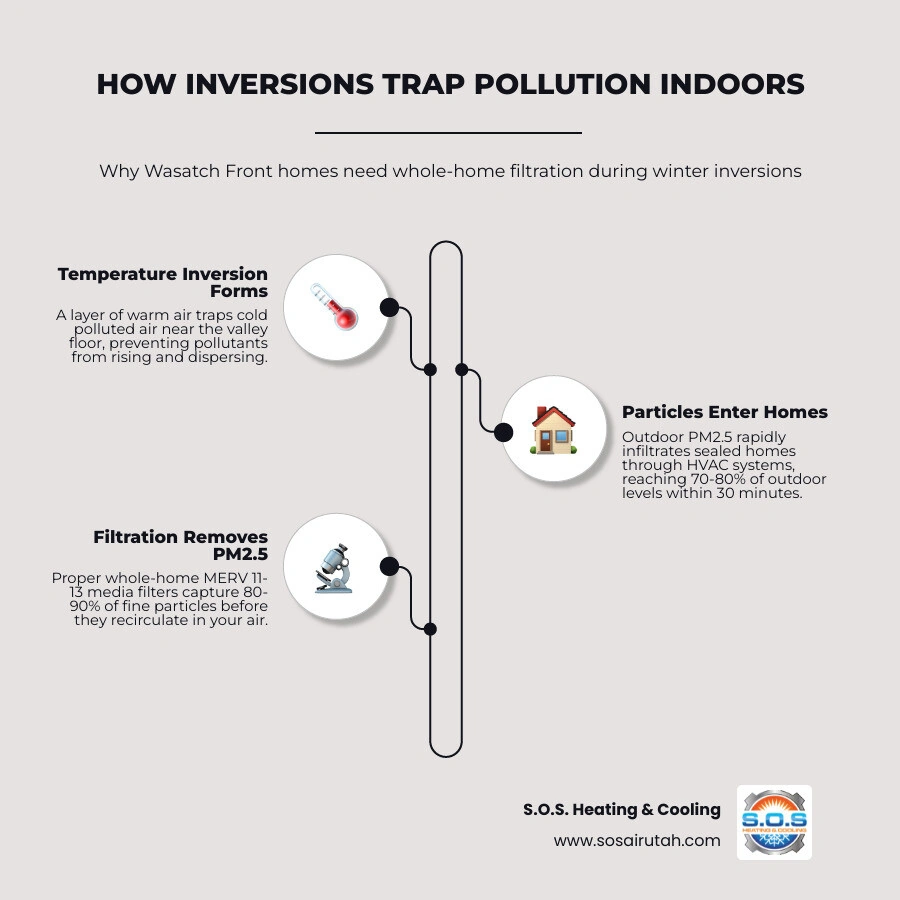
How Utah inversion season makes whole home air filtration a smart investment comes down to one uncomfortable truth: when inversions lock in over the Salt Lake Valley for days at a time, the air inside your home can actually be worse than the air outside. During severe inversion events, outdoor PM2.5 concentrations can exceed 50 micrograms per cubic meter — well past the EPA's "unhealthy for all groups" threshold — and research shows indoor PM2.5 can reach 70–80% of outdoor levels within just 30 minutes. Tightly sealed, energy-efficient homes trap those particles inside, where they recirculate through your HVAC system again and again. The result is that staying indoors, the very thing health officials recommend during inversions, only protects you if your home's air filtration is actually up to the job.
Here is a quick look at why whole-home filtration makes sense for Utah homeowners:
- Inversions are predictable and recurring. The Wasatch Front experiences sustained inversion events lasting 7–14 consecutive days every winter, making this a seasonal certainty, not a rare event.
- Standard 1-inch furnace filters fall short. They are designed to protect HVAC equipment, not to meaningfully reduce PM2.5 or fine particulate matter in the air you breathe.
- Whole-home systems deliver measurable results. A properly sized MERV 11–13 media air cleaner can reduce indoor PM2.5 concentrations by 80–90% even during severe inversion events.
- Indoor air is routinely more polluted than outdoor air. According to the EPA, indoor air pollution can be several times higher than outdoor levels — a problem made worse in sealed winter homes.
- Utah's climate adds extra challenges. Dry desert winters, gas heating, wildfire smoke, and valley geography compound the problem beyond what most U.S. homeowners face.
- The investment protects your HVAC system too. Cleaner air moving through your system means less particulate buildup on coils, motors, and ductwork — extending equipment life.
Winter along the Wasatch Front has a way of making the problem visible. You look toward the mountains and see sunshine above a thick layer of gray. What is harder to see is that same gray settling into your home through every gap, crack, and HVAC intake — hour after hour, day after day.
I'm Bryson Ninow, an HVAC professional with certifications in indoor air quality and energy efficiency, and I've spent years helping Salt Lake City-area homeowners understand exactly how Utah inversion season makes whole home air filtration a smart investment for their family's health and long-term home comfort. In this guide, I'll walk you through the science, the solutions, and the practical steps you can take right now.
Understanding the Science of Utah's Winter Inversions
To understand why our indoor air suffers so much in the winter, we have to look at the unique geography and meteorology of the Wasatch Front. Our beautiful home is flanked by the massive Wasatch Mountains to the east and the Oquirrh Mountains to the west, creating a giant geographic "bowl."
Under normal atmospheric conditions, warm air sits near the ground and cools as it rises into the upper atmosphere. Because warm air is less dense, it naturally rises, carrying emissions, dust, and other pollutants away from our neighborhoods.
During the winter, however, this cycle flips upside down. After a snowstorm, the white snow reflects the weak winter sunlight back into space, keeping the valley floor incredibly cold. On clear, calm winter nights, this cold, dense air pools at the bottom of our valley bowl. Meanwhile, a high-pressure system moving over the state acts like a warm blanket, capping the cold air beneath it.
This is a temperature inversion: a cold layer of air trapped under a warm cap of air. Because the cold air is heavy and dense, and there is no wind to stir things up, the atmosphere becomes completely stagnant. The warm air cap acts like a literal lid on a pot, sealing in everything we produce down below.
Every tailpipe emission, gas-furnace exhaust plume, and industrial output has nowhere to go. Over the course of a 7-to-14-day inversion, these pollutants chemically react in the stagnant air to form a dense soup of:
- PM2.5: Fine particulate matter less than 2.5 microns in diameter (about 30 times smaller than a human hair). These particles are small enough to bypass our respiratory system's natural defenses, traveling deep into our lungs and entering the bloodstream.
- Ozone and Smog: Ground-level ozone that irritates the airway.
- VOCs (Volatile Organic Compounds): Chemical gases emitted from fuels, paints, and household products.
These pollutants do not just stay outdoors. Because our homes must breathe to some degree, these microscopic particles slip indoors through tiny cracks around doors, windows, and ventilation intakes. The health risks are very real: winter inversions are linked to heightened asthma attacks, respiratory infections, and more than 200 additional cases of pneumonia each winter along the Wasatch Front. To learn more about how different times of year impact your home, check out our guide on Seasonal Effects on Indoor Air Quality.
The Closed-Box Effect: Why Indoor Air Quality Worsens in Winter
When the air quality index (AQI) turns orange or red, our natural instinct is to retreat indoors, shut the windows, and crank up the heat. While this keeps the worst of the visible smog out, it inadvertently triggers the "closed-box effect."
Modern homes in communities like South Jordan, Draper, and Layton are built to be highly energy-efficient. They are tightly sealed with advanced weather-stripping, house wraps, and double-pane windows. While this is fantastic for keeping your heating bills manageable, it creates a major indoor air quality problem.
Without fresh outdoor air to dilute indoor contaminants, your home becomes a closed loop. The pollutants that sneak in from the outdoor inversion get trapped. To make matters worse, we continuously generate our own indoor air pollution through daily activities:
- Cooking on gas stoves (which releases nitrogen dioxide and PM2.5)
- Using cleaning chemicals, aerosols, and scented candles (releasing VOCs)
- Pet dander, dust mites, and skin flakes shedding naturally
- Running wood-burning fireplaces or space heaters
When your HVAC system runs, it pulls air from your living spaces through the return ducts, passes it over the furnace heat exchanger, and blows it back out through the supply registers. If your system is equipped with a standard, cheap filter, those microscopic PM2.5 particles from the inversion simply pass right through the filter fibers. Your heating system essentially acts as a high-powered distribution network, continuously recirculating trapped pollutants throughout every single room. Understanding the Role of Indoor Air Quality in Your Home is the first step in breaking this cycle of recirculation.
How Utah Inversion Season Makes Whole Home Air Filtration a Smart Investment
If you are tired of breathing stale, dusty air every winter, upgrading to a whole-home air filtration system is one of the most practical home improvements you can make. Installing a centralized system directly into your ductwork ensures that every cubic foot of air circulating through your home is actively scrubbed clean.
Instead of relying on loud, bulky portable air purifiers that only clean a single room, a whole-home system works silently behind the scenes. It provides continuous health protection, immediate respiratory relief for asthma and allergy sufferers, and keeps your home feeling fresh.
Beyond the health benefits, whole-home filtration is an investment in your HVAC system’s longevity. When fine dust and particulate matter are allowed to bypass standard filters, they settle on your furnace's blower motor, electrical components, and the indoor A/C coil. This buildup forces your system to work harder, increasing wear and tear and shortening its lifespan. By keeping these components clean, you protect your heating system and maintain its energy efficiency. For homeowners in Salt Lake City, learning about Whole House Air Purification Salt Lake City UT is a great place to start exploring your options.
Understanding How Utah Inversion Season Makes Whole Home Air Filtration a Smart Investment
The primary weapon against inversion pollution is high-efficiency particle capture. When we look at how Utah inversion season makes whole home air filtration a smart investment, the capability of different filtration technologies to trap PM2.5 is the most critical factor.
Standard filters are simply too porous to catch fine particulate matter. To capture these microscopic pollutants, you need a system designed for high-efficiency filtration:
- Media Air Cleaners: These systems use deep, pleated filters (usually 4 to 5 inches thick) that provide a massive surface area. They can capture up to 80-90% of PM2.5 particles without severely restricting your system's airflow.
- Electronic Air Cleaners: These systems use an electrostatic charge to attract and trap particles like a magnet. The air passes through an ionizing section where particles receive an electrical charge, which are then collected on oppositely charged plates.
- Whole-Home HEPA Systems: These are bypass systems that pull a portion of your home's air through a certified HEPA filter, capturing 99.97% of particles as small as 0.3 microns.
Choosing the right setup depends on your home’s specific layout, your existing ductwork, and your family's health needs. If you are trying to decide which route to take, our article on Choosing an Air Filtration System breaks down the pros and cons of each technology.
Long-Term Health and Home Benefits: How Utah Inversion Season Makes Whole Home Air Filtration a Smart Investment
The benefits of upgrading your filtration extend far beyond the winter months. While the system works overtime during the winter inversion, it provides year-round protection against other common Utah air quality challenges, such as summer wildfire smoke and heavy spring pollen.
For families dealing with chronic respiratory conditions, the improvement in daily life is immediate. Removing airborne triggers leads to better sleep, fewer allergy symptoms, and reduced reliance on quick-relief medications. If you have loved ones who suffer from seasonal allergies or asthma, investing in Air Filtration for Allergy Relief can make your home a true safe haven from the outdoor air.
Additionally, a whole-home system dramatically reduces the amount of household dust settling on your furniture, electronics, and countertops. It keeps your living spaces cleaner with less effort and prevents fine dust from embedding in your carpets and upholstery, protecting your home's interior assets.
Comparing Filtration Technologies: Standard Filters vs. Whole-Home Systems
To make an informed decision, it helps to see how standard retail filters compare to professional-grade whole-home systems. The Minimum Efficiency Reporting Value (MERV) scale rates a filter's ability to capture particles between 0.3 and 10 microns. Higher MERV ratings mean tighter filtration, but they also require more pressure to push air through.
| Filter Type | MERV Rating | Particle Capture Efficiency (PM2.5) | Lifespan | Primary Function |
|---|---|---|---|---|
| Standard 1-Inch Fiberglass | MERV 1–4 | < 20% (Misses almost all PM2.5) | 30 Days | Protects HVAC equipment from large dust bunnies; does not clean breathable air. |
| Standard 1-Inch Pleated | MERV 8–11 | 20% – 60% (Fills up incredibly fast during inversions) | 30–90 Days | Captures basic dust, pollen, and pet dander; restricts airflow as it loads up. |
| Whole-Home Media Filter (4-5 Inch) | MERV 11–16 | 80% – 95% (Excellent PM2.5 capture) | 6–12 Months | Captures fine dust, mold spores, and inversion particles while maintaining excellent airflow. |
| Electronic Air Cleaners | Equivalent to MERV 12–15 | 85% – 99% (Captures particles down to 0.1 microns) | Lifetime (Washable cells) | Uses electrostatic charge to capture viruses, bacteria, and fine dust; low airflow resistance. |
| Whole-Home HEPA System | MERV 17–20 | 99.97% (Captures down to 0.3 microns) | 12–24 Months | Medical-grade air purification; installed as a bypass system to prevent HVAC airflow restriction. |
As you can see, standard 1-inch filters are simply not equipped to handle the heavy particulate load of a Wasatch Front winter. Upgrading to a thicker media filter or an electronic air cleaner is the most effective way to protect your household. For a deeper dive into finding the perfect match for your property, read our guide on the Best Air Purifier for Your Home.
Advanced IAQ Technologies for Utah's Unique Climate
While high-efficiency filtration is the cornerstone of winter air quality, Utah's unique mountain desert climate often requires a multi-layered approach. To achieve ultimate comfort and protection, you can pair your filtration system with other advanced indoor air quality (IAQ) technologies:
- UV Germicidal Lights: Installed inside your ductwork or near the indoor A/C coil, these lights emit powerful UV-C radiation that destroys the DNA of airborne viruses, bacteria, and mold spores, neutralizing them before they can circulate.
- Activated Carbon Filters: Standard filters cannot trap chemical gases, odors, or VOCs. Adding a heavy, thick activated carbon filter to your system allows these gaseous pollutants to be physically absorbed, eliminating cooking odors, paint fumes, and chemical smells.
- Energy Recovery Ventilators (ERVs): ERVs allow you to introduce fresh outdoor air into your home in a controlled manner. They use the outgoing stale air to pre-condition the incoming fresh air, recovering up to 70-80% of the heating energy so you do not spike your utility bills.
- Whole-Home Humidifiers: Our winters are incredibly dry. When cold outdoor air is warmed by your furnace, the indoor relative humidity can easily plummet to 10–20%. This extreme dryness causes cracked skin, painful nosebleeds, static electricity, and damages wood flooring and furniture. More importantly, dry air dries out your nasal passages, making you far more susceptible to respiratory viruses. Maintaining a healthy humidity level of 35-45% keeps your respiratory system hydrated and functioning properly. If you live in Salt Lake City, Draper, Sandy, or South Jordan, installing a Whole Home Humidifiers Salt Lake City UT system is a game-changer for winter comfort.
Practical Steps and Maintenance for Optimal Winter Air Quality
Upgrading your home’s filtration is a major step forward, but keeping your indoor air pristine during a heavy inversion season requires a few smart habits. Here is our recommended checklist for winter air quality maintenance:
- Inspect Your Filter Every 3 Weeks: While 4-inch media filters can last up to a year under normal conditions, the heavy particulate load of a Utah winter can clog them much faster. During active inversions, pull your filter out, hold it up to a bright light, and replace it if it is visibly gray or clogged.
- Never Run a Restrictive Filter on an Unprepared System: Upgrading to a high-MERV 1-inch filter can choke your furnace's airflow, causing the heat exchanger to overheat and potentially crack. Always consult with a professional to ensure your system can handle the static pressure of a high-efficiency filter.
- Utilize Your Thermostat's "Circulate" Mode: Most modern smart thermostats allow you to run your HVAC fan independently of your heating cycles. Setting your fan to "Circulate" or "On" ensures that your air is continuously passed through your filtration system, even when the furnace isn't actively heating.
- Create a "Clean Room": If someone in your home has severe asthma, designate their bedroom as a dedicated clean room. Keep the door closed, seal any drafts under the door, and run a high-quality portable HEPA purifier in that room continuously.
- Ventilate Wisely: Avoid opening windows during orange or red AQI days. If you must ventilate (for example, after burnt toast or heavy cleaning), wait for a green or yellow day, or run your kitchen and bathroom exhaust fans briefly to clear the air, then let your whole-home filtration system do the rest.
By taking these steps, you can keep your indoor air clean and healthy all winter long. For more practical advice on keeping your home's air fresh, read our guide on Maintaining Optimal Indoor Air Quality.
Frequently Asked Questions about Utah Inversion Air Quality
Why is Utah's winter air quality so poor compared to other states?
Our poor winter air quality is a direct result of our unique topography combined with cold weather patterns. The surrounding mountain ranges act as physical barriers that prevent horizontal winds from sweeping through our valleys. When snow covers the ground, it reflects heat, keeping the valley floor cold while high-pressure systems trap a layer of warm air aloft. This creates a stagnant, sealed bowl that accumulates emissions from cars, homes, and businesses, leading to rapidly rising PM2.5 levels. To understand how this affects your home's air, read more about Indoor Air Quality Salt Lake City UT.
Can my existing HVAC system handle a high-MERV whole-home filter?
It depends on the design of your system and the thickness of the filter rack. Standard 1-inch filter slots are generally not suited for MERV 13 or higher filters because they restrict airflow too much, which can damage your furnace motor. However, installing a dedicated 4-inch or 5-inch media cabinet or a bypass HEPA system allows you to achieve elite filtration without restricting airflow or risking damage to your equipment. A professional assessment is the best way to determine your system's compatibility. For more tips on preparing your HVAC system, check out our article on Enhancing Indoor Air Quality.
How often should I replace my whole-home air filter during inversion season?
While standard manufacturers suggest changing filters every 90 days, our local experience along the Wasatch Front shows that filters can load to full capacity in as little as 20 to 30 days during active, back-to-back winter inversions. We recommend inspecting your filter every three weeks from December through February and replacing it based on its actual condition rather than a calendar schedule. For a complete look at filter care, read our guide to Improve Your Indoor Air Quality.
Conclusion
At S.O.S. Heating & Cooling, we believe that your home should be a safe, comfortable sanctuary from the elements. While we cannot control the weather patterns or the smog settling over the Salt Lake Valley, we can help you take complete control of the air inside your home.
Upgrading to a whole-home air filtration system is a proactive, long-term investment in your family's health, daily comfort, and the lifespan of your heating and cooling equipment. Whether you live in Bountiful, Draper, South Jordan, Layton, or anywhere else along the Wasatch Front, our experienced team is here to help you find the perfect indoor air quality solution for your home.
Ready to take the first step toward cleaner, healthier indoor air? Contact S.O.S. Heating & Cooling today to schedule an indoor air quality assessment and discover how we can help you breathe easier this winter. For more information about our services, visit our Air Quality page.

Plumbing
Expert plumbing services offering reliable repairs, installations, maintenance, and emergency support.

Air Conditioning
Comprehensive air conditioning services include installation, repairs, maintenance, and energy-efficient solutions.

Heating
Specialized heating services provide reliable installation, repair, system maintenance, and energy-optimization solutions.

Indoor Air Quality
Enhance your home’s air with our cutting-edge indoor air quality solutions you can trust.

Fireplaces
Transform your space into a warm and cozy atmosphere with our professional fireplace services.

Heat Pumps
Enjoy year-round comfort with our energy-efficient and professional heat pump solutions.
Explore Our Latest Insights and Updates in Plumbing Services

Why Your House and Lungs Hate Extreme Humidity
Why Your HVAC Needs a Humidity Sidekick to Keep You Comfortable
Signs Your Home Is Too Dry or Too Humid
