

Utah Weather is Bi-Polar but Your AC Doesn't Have to Be


.avif)

Utah's Climate Demands More From Your AC — Here's Why Variable Speed Delivers
How variable speed AC handles Utah temperature swings comes down to one core capability: the ability to modulate output in real time, rather than blasting at full power or shutting off completely.
Quick answer for Utah homeowners:
- Variable speed AC uses an electrically commutated motor (ECM) that adjusts its speed anywhere from 25% to 100% of capacity
- Instead of short, aggressive cycles, it runs longer at lower speeds — matching the exact cooling demand at any given moment
- This means steady temperatures during Utah's brutal 100°F+ summer days and its cool nights, without the energy spikes of a single-stage system
- At Salt Lake City's 4,200–4,800 ft elevation, where air density runs 15–18% lower than at sea level, this precision modulation is especially critical for maintaining effective cooling
- The result: fewer temperature swings inside your home, lower energy bills, and less wear on the equipment
Utah's Wasatch Front is one of the most demanding climates for HVAC equipment in the country. Summer highs regularly push past 100°F, winter lows can dip to -5°F or colder, and the elevation quietly chips away at your system's rated capacity before it even turns on. A standard single-stage air conditioner — designed to run at 100% or not at all — was never built for this kind of range. It short-cycles on mild days, struggles to keep up on extreme ones, and swings your indoor temperature by as much as 2°F above or below your set point with every cycle. In a state where the thermometer can move 40 degrees between sunrise and late afternoon, that's a lot of discomfort to live with.
I'm Bryson Ninow, a NATE-certified HVAC professional with hands-on experience helping Salt Lake City–area homeowners find real solutions for understanding how variable speed AC handles Utah temperature swings across every season. I'll walk you through exactly how this technology works, why it's uniquely suited to Utah's climate, and how to know if it's the right upgrade for your home.

Understanding Variable Speed Technology in the Beehive State
To understand why variable speed is a game-changer for homes from Bountiful to Draper, we first need to look at the "brain" of the system. Traditional air conditioners are like a light switch: they are either 100% on or 100% off. When your thermostat calls for cooling, the system roars to life at maximum power until the target temperature is reached, then shuts down abruptly.
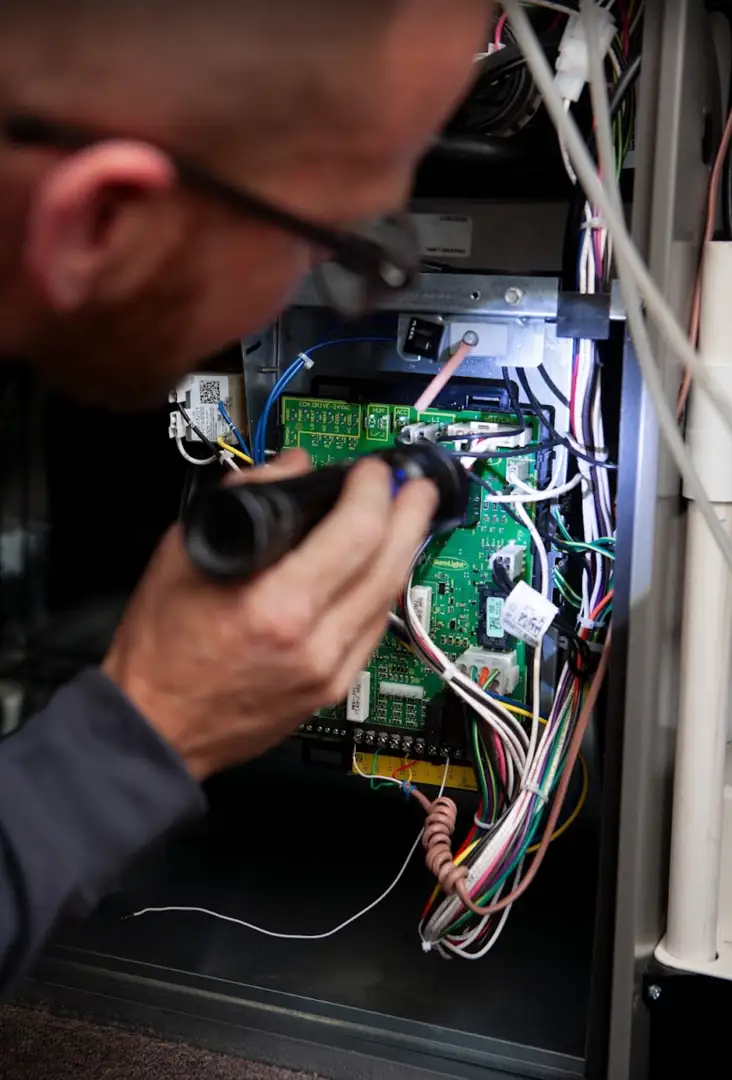
Variable speed technology, however, operates more like a dimmer switch. At the heart of these systems are Electrically Commutated Motors (ECM) and inverter-driven compressors. Instead of a single speed, these components can modulate their output in tiny increments—sometimes as small as 1% or even 1/10th of 1%.
When you dive into How Does Air Conditioning Work The Science Behind AC, you learn that cooling is about heat transfer. By modulating capacity, a variable speed system can "breathe" at exactly the rate required to offset the heat entering your home.
The Three Stages of HVAC Performance
- Single-Stage: 100% capacity only. High energy consumption during startup and frequent cycling.
- Two-Stage: Typically has a "high" (100%) and "low" (about 65-70%) setting. A step up, but still limited.
- Variable-Capacity: Modulates anywhere from 25% to 100%. This is the gold standard for handling the Wasatch Front's "bi-polar" weather.
How Variable Speed AC Handles Utah Temperature Swings and Elevation
Utah presents a unique physical challenge that many HVAC manufacturers (mostly based at sea level) don't always emphasize: air density. In Salt Lake City, Murray, and surrounding areas, we live at an elevation of roughly 4,200 to 4,800 feet. At this height, the air is thinner—about 15% to 18% less dense than at sea level.
Thinner air means there is less mass for your AC fan to move and less air for your furnace to burn. This is where how variable speed AC handles Utah temperature swings becomes a matter of physics. Because the air is less dense, a standard fixed-speed motor might move the "volume" of air it was designed for, but it isn't moving enough "mass" to carry away the heat effectively.
When we perform an AC Installation in Cottonwood Heights UT, we have to account for this "altitude derating." Variable speed systems are inherently better at this because their smart motors can sense the resistance (or lack thereof) in the ductwork and adjust their RPMs to ensure the correct airflow is maintained despite the thin mountain air.
Compensating for Lower Air Density at 4,500 Feet
In the HVAC world, we often see furnaces lose about 4% of their heating output for every 1,000 feet of elevation. While AC units don't lose capacity at the exact same rate, the lower air density makes heat exchange much harder. If your system isn't moving enough air mass, you might find your AC Not Cooling Properly What to Check list getting longer.
| Feature | Sea Level (0 ft) | Salt Lake City (~4,500 ft) |
|---|---|---|
| Air Density | 100% | ~82-85% |
| Furnace Output (100k BTU) | 100,000 BTU | ~82,000 BTU |
| AC Heat Exchange Efficiency | Optimal | Challenged by lower air mass |
| Variable Speed Benefit | Efficiency | Essential for Performance |
Maintaining Precision Comfort During Rapid Daily Shifts
Utah is famous for its diurnal temperature swings. It is not uncommon for a July day in South Jordan to start at a crisp 62°F and skyrocket to 101°F by 5:00 PM.
A single-stage system will stay off all morning, then once the heat hits, it will kick into high gear. As it nears the set point, it shuts off, but the "heat soak" from your attic (which can reach 150°F+) immediately starts warming the house back up. This leads to AC Compressor Short Cycling in Draper, where the unit turns on and off constantly, wearing out parts and leaving you with "hot spots."
Variable speed systems solve this by running at a low, steady 25-30% capacity for most of the day. They catch the heat as it enters, maintaining a temperature within 0.5 to 1 degree of your setting. This technology is also a cornerstone of Understanding Heat Pump Systems, which are becoming increasingly popular in Utah for their ability to handle both cooling and heating with the same modulating efficiency.
Maximizing Efficiency and Air Quality in a Dry Climate
Efficiency isn't just about using less power; it's about using power smarter. The most energy-intensive part of an AC's cycle is the startup. A single-stage unit requires a massive "jolt" of electricity—up to six times its running amperage—every time it starts.
Variable speed units ramp up slowly, avoiding those expensive peaks. In fact, a variable speed motor running at half speed uses roughly 75% less power than a single-stage motor running at full tilt. For Utah families, where heating and cooling can account for over half of the annual energy bill, these savings add up quickly.
Beyond the bill, there is the issue of air quality. We all know the "Utah itch"—that dry skin and scratchy throat that comes from our arid climate. While we focus on Maintaining Optimal Indoor Air Quality, we often forget that the AC plays a role in how the air feels, not just how cold it is.
How Variable Speed AC Handles Utah Temperature Swings and Humidity
Even though Utah is a desert, we do have humidity spikes during the late-summer monsoons. Furthermore, managing indoor humidity is a year-round task. Standard AC units often cycle off before they have a chance to properly dehumidify the air, leading to a "clammy" feeling.
Because variable speed units run longer cycles, they are much better at pulling moisture out of the air when needed. Conversely, in the winter, pairing these handlers with a humidifier ensures that the moisture is distributed evenly. If you've ever wondered What Causes AC Duct Condensation Millcreek, it is often due to uneven airflow and temperature gaps—problems that variable speed modulation helps eliminate. Proper Ventilation and Indoor Air Quality starts with consistent, gentle air movement.
Enhancing Filtration for Utah’s Dusty Environment
The Wasatch Front is prone to dust, pollen, and the occasional winter inversion. When your AC is off, the air in your home is stagnant, and particles settle on your furniture and in your lungs.
Variable speed systems allow the fan to run almost constantly at a very low, quiet speed. This means your indoor air is being filtered 24/7. By Improving Your Homes Indoor Air Quality through continuous filtration, you can significantly reduce allergens. Just remember that with more air passing through the system, Choosing the Right HVAC Filter becomes even more important. This constant cleaning isn't just for homes; it's why Indoor Air Quality and Employee Productivity are so closely linked in commercial spaces across Salt Lake City.
Long-Term Reliability and Maintenance for Utah Homeowners
One of the biggest myths about high-tech HVAC is that it’s more fragile. In reality, variable speed systems often last longer because they avoid the "stop-and-go" stress of traditional units. Think of it like a car: highway miles (steady speed) are much easier on the engine than city driving (constant braking and accelerating).
However, because these systems are more sophisticated, they do require a professional touch. Watching for AC Professional Maintenance Signs is key. You wouldn't take a Ferrari to a shop that only works on tractors, and the same logic applies to your high-efficiency AC. Regular check-ups, much like Essential Heating Maintenance Tips, ensure that the sensors and control boards stay in peak condition.
Reducing Wear and Tear During Peak Summer Months
In July and August, a Utah AC unit is under immense pressure. Single-stage units often "short cycle"—turning on for 8 minutes, off for 5, and back on again. This puts massive strain on the compressor and the capacitors.
Variable speed units reduce this mechanical stress by staying in "cruising mode." By operating at a lower capacity, the internal components generate less heat and experience less friction over time. When deciding whether you Should You Repair or Replace Your AC, consider the "life cycle cost." A system that prevents issues like AC Makes Grinding and Squealing Sounds through smoother operation is often the better long-term investment.
Troubleshooting and Seasonal Readiness
Even the best systems need an occasional look. If you find your AC Not Turning On What to Check First, it could be something as simple as a tripped breaker or a dirty filter. We always recommend some basic AC Troubleshooting Tips Before Calling a Pro, such as checking your thermostat settings and ensuring your outdoor unit isn't buried in cottonwood seeds or debris.
For those looking for the ultimate in Utah-ready tech, a Hybrid Heat Pump System (pairing a variable speed heat pump with a gas furnace) offers the best of both worlds: electric efficiency for 90% of the year and gas-powered "oomph" for those sub-zero January nights.
Frequently Asked Questions about Utah HVAC Performance
Is a variable speed system worth the investment for a Salt Lake City home?
Yes, especially if you plan on staying in your home for more than 5 years. The combination of lower monthly utility bills and the sheer increase in comfort (no more "hot upstairs, cold downstairs" syndrome) makes it a favorite for Wasatch Front residents. When we provide a Furnace Installation Salt Lake UT Guide, we always perform a Manual J load calculation. This ensures the system is sized perfectly for your home's insulation, window orientation, and our local elevation.
How variable speed ac handles utah temperature swings compared to two-stage units?
Think of a two-stage unit as having "low" and "high" gears. It’s better than a single-stage, but it still has gaps. A variable speed system has dozens of "gears," allowing it to match the cooling load exactly. While a two-stage unit might still allow a 2-degree temperature drift, a variable speed system keeps the home within half a degree of the target. This precision is what stops the "cycling" feeling that many homeowners find annoying.
Does Utah's high elevation affect the lifespan of variable speed motors?
Actually, variable speed motors (ECMs) are better equipped for high elevation. Because they can adjust their speed to maintain constant torque or airflow, they don't "struggle" against the static pressure of thin air the way a fixed-motor might. However, high elevation can be hard on all home appliances—even something like a Hot Water Heater Leaking can sometimes be traced back to the stresses of pressure and temperature changes in our mountain environment.
Conclusion: Consistent Comfort with S.O.S. Heating & Cooling
Living in Utah means accepting that the weather will change its mind five times before lunch. But your indoor environment shouldn't be a rollercoaster. Understanding how variable speed AC handles Utah temperature swings is the first step toward a home that feels like a sanctuary, regardless of whether it's 102°F in Sandy or 15°F in Layton.
At S.O.S. Heating & Cooling, we pride ourselves on being the Salt Lake City HVAC experts who actually understand the "Altitude Equation." We serve the entire valley—from Bountiful and Centerville down to Riverton and South Jordan. We offer 24/7 emergency repairs and flexible financing because we know that HVAC issues don't always happen during business hours.
If you're tired of the "woosh" of a loud AC and the hot-and-cold spots in your home, it’s time to see what variable speed can do for you. Whether you need a seasonal tune-up or a full system upgrade, our team is ready to help you achieve the consistent, quiet comfort you deserve.
Ready to level up your home comfort? Explore our Air Conditioning Services or give us a call today!
Explore Our Latest Insights and Updates in Plumbing Services
Is a Mini Split Better Than Central Air for Your Home?
The Silent Killer of Utah Water Heaters
The Ultimate Schedule for Changing Filters in High Dust Areas