

Finding Out if a Heat Pump Fits Your Home


.avif)

Is a Heat Pump Right for Your Home? Here's What to Know First
Is a heat pump right for your home is one of the most common questions Salt Lake City homeowners ask when it's time to upgrade their HVAC system — and for good reason. A heat pump can replace both your furnace and your central air conditioner with a single, energy-efficient unit. But it's not the perfect fit for every house.
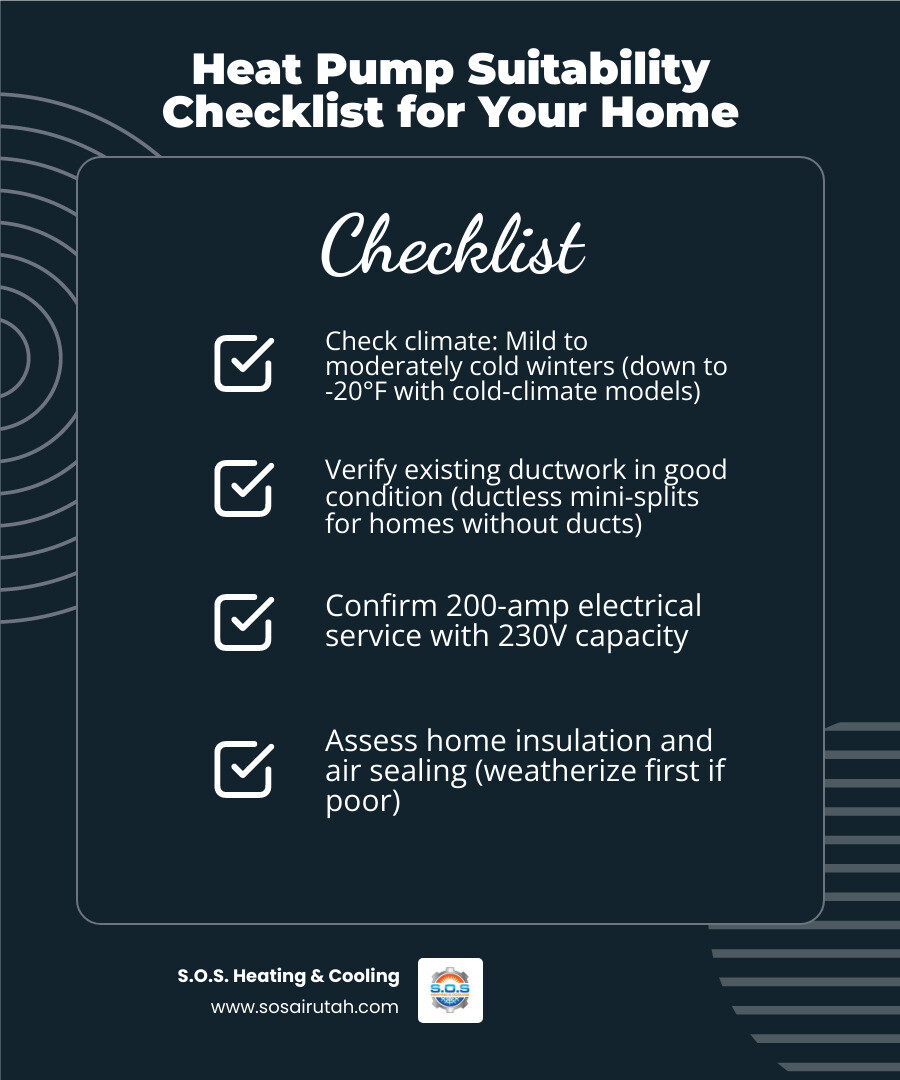
Here's a quick breakdown to help you decide:
| Factor | Heat Pump Likely a Good Fit | May Need a Different Approach |
|---|---|---|
| Climate | Mild to moderately cold winters | Extreme cold below -20°F without backup |
| Existing ductwork | Has ducts in good condition | No ducts (ductless mini-splits are still an option) |
| Electrical panel | 200-amp service with 230V capacity | Older panels needing an upgrade first |
| Current heating fuel | Electric resistance, oil, or propane | Natural gas (savings depend on local rates) |
| Home insulation | Well-insulated and air-sealed | Poorly insulated (weatherize first) |
| Home size | Any size with proper load calculation | Oversized or undersized system is a risk |
The short answer: most homes in Salt Lake City can benefit from a heat pump, especially with today's cold-climate models that operate effectively down to -20°F. The right fit depends on your home's infrastructure, your current fuel source, and how well your home holds heat.
Heat pumps work by moving heat rather than generating it — the same basic principle your refrigerator uses, just applied to your entire home. In winter, they pull heat energy from outdoor air and move it inside. In summer, they reverse the process. That's why they can reduce electricity use for heating by up to 75% compared to electric resistance systems like baseboard heaters, and cut heating-related carbon emissions by 40 to 70 percent compared to gas furnaces.
Still, there's a lot to consider before making the switch. Your ductwork, electrical capacity, insulation, and local climate all play a role in whether a heat pump will perform well and save you money over time. In 2023, heat pumps outsold gas furnaces nationwide for the first time — a sign that more homeowners are running the numbers and liking what they see.
I'm Bryson Ninow, an NATE-certified HVAC professional with hands-on experience helping Salt Lake City homeowners evaluate is a heat pump right for your home and navigate the full upgrade process, from load calculations to rebate programs. In this guide, I'll walk you through everything you need to make a confident, informed decision.
Understanding the Technology: How Heat Pumps Work
To truly grasp why these systems are having a "moment in the spotlight," you have to understand that a heat pump is essentially a heat transporter. It doesn't burn fuel to create warmth; instead, it uses electricity to shuffle thermal energy from one place to another.
At the heart of this process is the refrigeration cycle. Even when it feels frigid outside in Millcreek or Holladay, there is still thermal energy present in the air. The outdoor unit contains a refrigerant that absorbs this heat. As the refrigerant circulates, it passes through a compressor, which increases its temperature significantly. This hot gas then travels to the indoor air handler unit.
Inside, the heat is released into your home through evaporator coils, and a fan blows the warmed air through your vents. The "magic" happens thanks to a component called the reversing valve. This valve allows the system to change the direction of the refrigerant flow. In the summer, the process flips: the system pulls heat from inside your house and dumps it outside, acting exactly like a high-efficiency central air conditioner.
Modern systems have come a long way. We now utilize variable-speed compressors, which are often considered the "gold standard" for comfort. Unlike older "dinosaur" units that are either 100% on or 100% off, variable-speed models adjust their output to match your home's needs exactly. This leads to more uniform, consistent heating and avoids those annoying "gusts" of hot or cold air. For a deeper dive, you can read more about Understanding Heat Pump Systems.
However, like any complex machine, they require proper care. During winter, you might notice your outdoor unit frosting over. This is normal, and the system will occasionally enter a "defrost cycle" to melt the ice. If you notice issues with this process, it might be time for Diagnosing Heat Pump Defrost Cycle Problems to ensure your efficiency doesn't tank.
Determining if a Heat Pump is Right for Your Home
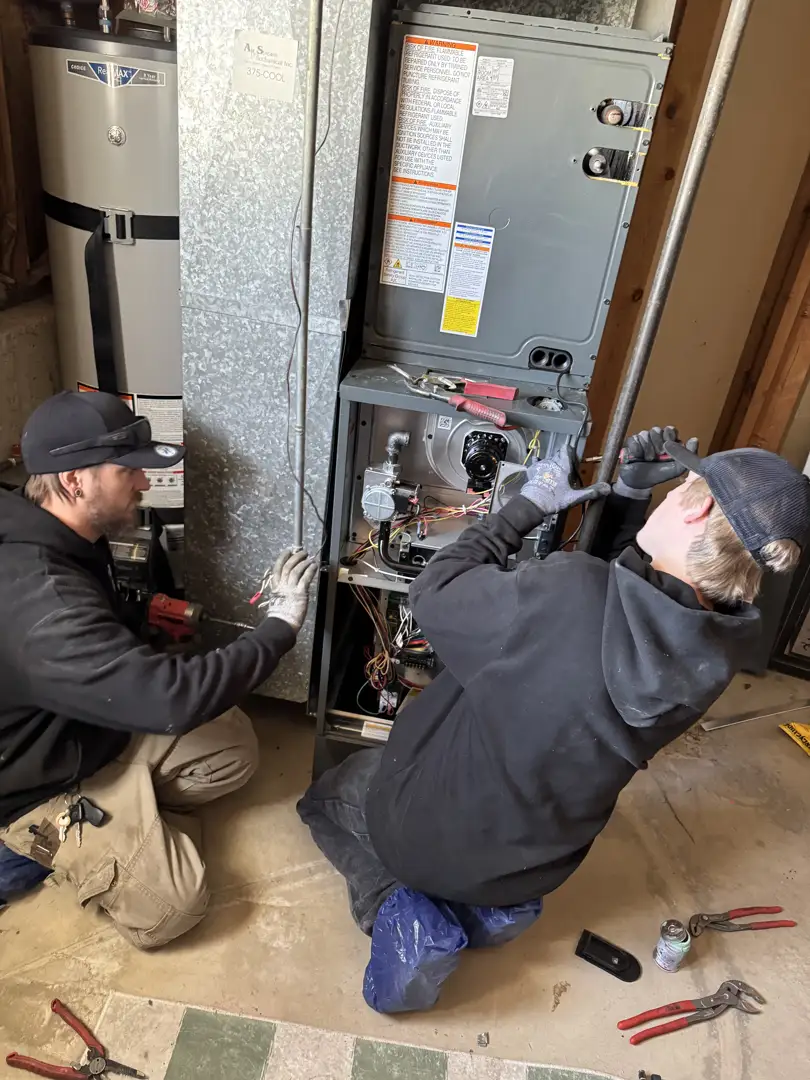
Before you commit to a new system, we need to look at your home’s "bones." Not every house is immediately ready for a heat pump without a few tweaks.
First, let's talk about power. Most modern heat pumps require a 230-volt connection. If your home in South Salt Lake or Murray still has an older electrical panel, you might need an upgrade. A 200-amp service is the modern standard and provides the "headroom" necessary to run a whole-home electric heating system alongside your other appliances.
Next is the "envelope" of your home. Because heat pumps deliver heat more steadily and at slightly lower temperatures than the "scorched earth" blast of a gas furnace, your home needs to hold onto that heat. We highly recommend prioritizing air sealing and attic insulation before your Heat Pump Installation. Think of your home like a balloon; even a small hole lets the "conditioned air" escape, forcing your system to work harder.
Finally, we never guess on size. We perform a Manual J load calculation, which takes into account your home’s square footage, window types, insulation levels, and local Salt Lake City climate data. An oversized unit will cycle on and off too frequently (short-cycling), while an undersized unit won't keep you warm when the snow starts falling in the Wasatch Mountains. You can explore more about Heat Pump Systems to see how we tailor these to specific Utah homes.
Assessing Infrastructure: Is a Heat Pump Right for Your Home’s Layout?
If your home already has a central furnace and AC, you likely have the ductwork ready to go. However, we have to ensure those ducts are in good shape. Older ducts can leak up to 30% of your conditioned air into your crawlspace or attic.
When evaluating home suitability, we look for:
- Duct Integrity: Are they sealed and insulated?
- Space Requirements: Is there 2 to 3 feet of clearance around the outdoor unit location?
- Voltage: Can your panel support the 230V requirement?
- Zoning Needs: Do you have "hot spots" or "cold spots" that need individual control?
For many of our neighbors, professional Heat Pump Installation Salt Lake City UT involves retrofitting these systems into existing layouts to maximize efficiency without a total home remodel.
Climate Considerations: Is a Heat Pump Right for Your Home in Salt Lake City?
Salt Lake City presents a unique challenge. We have extreme temperature swings, from 100°F summers to sub-zero winter nights in places like Summit Park or Mt. Olympus.
In the past, heat pumps struggled when the temperature dropped below 40°F. But May 2026 technology is a different beast. Modern cold-climate heat pumps are specifically engineered to provide 100% heating capacity even when it's 5°F outside, and they can still pull heat from the air at -20°F.
When we provide Heat Pump Service Salt Lake City UT, we focus on these temperature thresholds to ensure your system is optimized for our specific "Zone 5-6" climate.
Comparing Heat Pumps to Traditional HVAC Systems
When you're standing in your basement looking at an old furnace, it’s easy to wonder if you should just stick with what you know. Let’s look at how they stack up.
| Feature | Heat Pump | Gas Furnace + Central AC |
|---|---|---|
| Primary Energy | Electricity | Natural Gas + Electricity |
| Efficiency (Cooling) | High (Up to 25+ SEER2) | Standard (13-18 SEER2) |
| Efficiency (Heating) | 200% - 400% (COP) | 80% - 98% (AFUE) |
| Carbon Footprint | Lowest (Electric) | Higher (Combustion) |
| Maintenance | Single unit year-round | Two separate systems |
| Comfort | Steady, even temps | Hot blasts, then cooling |
While a gas furnace is often cheaper to install upfront, the long-term ROI of a heat pump is compelling. An ENERGY STAR certified model can provide heating for approximately 1/3 the cost of traditional electric resistance heating. For those in South Jordan, switching to Heat Pump Systems South Jordan UT can lead to significant annual savings, especially if you're currently using propane or oil.
Furthermore, if your AC is over 12 years old and struggling, replacing it with a heat pump gives you a brand-new heating system as a "bonus." If you ever run into trouble, Heat Pump Repair Salt Lake City UT is generally straightforward because the cooling components are identical to a standard AC.
Exploring System Varieties
Not every home needs a big ducted unit. We see a lot of variety in our service areas like Millcreek and Kaysville.
- Air-Source Heat Pumps: The most common, using outdoor air.
- Geothermal Systems: These use the constant 50°F-60°F temperature underground. They are incredibly efficient but require more space for ground loops.
- Ductless Mini-Splits: Perfect for historic homes or additions without ducts. You can see our work with Mini Splits Heat Pumps Salt Lake City for examples of zoned comfort.
- Ductless Solutions for Specific Areas: If you have a finished basement in Millcreek, Mini Splits Heat Pumps Millcreek UT can provide independent climate control without tearing up your ceiling.
Maximizing Efficiency in Cold Climates and Utah Winters
One of the biggest misconceptions we hear is: "Heat pumps don't work in the cold." If they can work in Maine and Norway, they can certainly handle a Layton winter.
The key is inverter technology. This allows the system to speed up or slow down to find the most efficient way to extract heat. However, for some homeowners in Draper or Sandy, we recommend a Hybrid Heat Pump System.
A hybrid (or dual-fuel) setup pairs a high-efficiency heat pump with a natural gas furnace. The system uses the heat pump during mild days (above 30°F-40°F) when it is most efficient. When the temperature hits a specific "balance point" — the temperature where the heat pump can no longer keep up with the home's heat loss — the gas furnace takes over. This gives you the best of both worlds: extreme efficiency and "emergency" heat for those record-breaking cold snaps.
Whether you need a Heat Pump Repair Draper UT or a new installation in Layton, understanding your home's balance point is vital. We can often set these systems to switch automatically, so you never even feel the transition. If you are in the north end of the valley, our experts in Heat Pump Repair Layton UT can help calibrate your hybrid system for peak performance.
Maintenance and Longevity for Your New System
A heat pump is a workhorse. Unlike a furnace that sleeps all summer or an AC that hibernates all winter, a heat pump works year-round. This means maintenance is non-negotiable.
We recommend Heat Pump Maintenance Salt Lake City UT twice a year — once before the cooling season and once before the heating season.
Your annual maintenance checklist should include:
- Filter Changes: Clean or replace filters monthly to keep airflow high.
- Coil Cleaning: Outdoor coils must be free of dirt, leaves, and snow.
- Refrigerant Check: Ensuring levels are correct is crucial for efficiency.
- Clearance: Maintaining 2 to 3 feet of space around the outdoor unit.
- Drain Lines: Checking for clogs to prevent water damage.
With proper care, a typical air-source heat pump lasts about 15 years. Geothermal systems can last even longer, with indoor components lasting 24 years and ground loops lasting over 50. If you’re in Sandy and notice your unit acting up, prompt Heat Pump Repair Sandy UT can prevent a small issue from becoming a total system failure. For those DIY-inclined homeowners, keeping an eye on Heat Pump Error Code Solutions in Millcreek can help you communicate better with your technician.
Frequently Asked Questions about Heat Pumps
Do heat pumps work in freezing temperatures?
Yes! Today’s cold-climate models are designed to perform at 100% capacity down to 5°F and continue providing heat even at -20°F. They use advanced defrost cycles to keep the outdoor coils clear of ice, ensuring they remain the primary heat source throughout most of a Utah winter.
Can I install a heat pump if I don't have ducts?
Absolutely. This is where Mini Splits Heat Pumps Bountiful UT shine. Ductless mini-splits consist of a small outdoor unit connected to one or more indoor heads. They are incredibly efficient and allow for "zoned" heating, meaning you only pay to heat the rooms you're actually using.
How long do heat pump systems typically last?
Most air-source heat pumps have a lifespan of 15 to 20 years. Because they run year-round, they may have a slightly shorter lifespan than a gas furnace (which can last 20+ years), but the energy savings over that decade and a half often more than make up for the difference.
Conclusion
At S.O.S. Heating & Cooling, we believe that for the vast majority of our neighbors in Salt Lake City, Draper, and Bountiful, the answer to is a heat pump right for your home is a resounding "yes." Between the environmental benefits of reducing your carbon footprint and the long-term ROI from lower utility bills, it is one of the smartest investments you can make in your home's infrastructure.
Beyond the numbers, there is the comfort factor. The steady, balanced air of a heat pump creates a more pleasant living environment than the "all-or-nothing" cycle of older systems. Plus, you get the peace of mind that comes with a single, streamlined system for all your climate needs.
If you’re ready to see how a heat pump can transform your home comfort, we’re here to help. From performing that crucial Manual J calculation to navigating the latest tax credits and rebates, our team is dedicated to energy-conscious living and customer satisfaction. Explore our Heat Pump Systems today and let's find the perfect fit for your unique home.
Explore Our Latest Insights and Updates in Plumbing Services
Stop Wasting Watts with Variable Speed AC Technology
Upgrading Your Kitchen Sink and Faucet Without the Headache
Why Your Skin and Furniture Crave a Winter Humidifier