

Everything You Need to Know About R410A vs R454B Refrigerant


.avif)

Why the Industry is Shifting: R410A vs R454B Refrigerant What You Need to Know
R410A vs R454B refrigerant what you need to know comes down to one major shift happening right now across the entire HVAC industry: the refrigerant that has powered most American homes for the past two decades is being phased out, and a newer, lower-impact alternative is taking its place.
Here is a quick-reference comparison to get you up to speed:
| Feature | R-410A | R-454B |
|---|---|---|
| Global Warming Potential (GWP) | 2,088 | 466 |
| GWP Reduction | - | 78% lower |
| Flammability Class | A1 (non-flammable) | A2L (mildly flammable) |
| New Equipment Allowed After Jan 1, 2025? | No | Yes |
| Drop-in Replacement for the Other? | No | No |
| Energy Efficiency | Baseline | ~3-5% better COP |
| High-Side Operating Pressure | ~400 psig | ~370 psig |
| Temperature Glide | Near zero | ~1.5°F |
| Still Available for Servicing Existing Units? | Yes, through 2036 | Yes |
The EPA's mandate under the American Innovation and Manufacturing (AIM) Act set January 1, 2025 as the deadline after which manufacturers could no longer produce residential HVAC equipment charged with R-410A. That deadline has already passed. If you are shopping for a new air conditioner or heat pump in Salt Lake City today, you are almost certainly looking at an R-454B system — whether you realize it or not.
Understanding the difference between these two refrigerants matters whether you own an older system, are planning an upgrade, or simply want to know what your HVAC technician is talking about at your next service visit.
I'm Bryson Ninow, an HVAC professional with certifications in EPA, NATE, RMGA, and DOPL, and helping Salt Lake City homeowners navigate exactly these kinds of changes — including r410a vs r454b refrigerant what you need to know — is a core part of what I do at S.O.S. Heating & Cooling. Read on for a clear, honest breakdown of everything that matters.
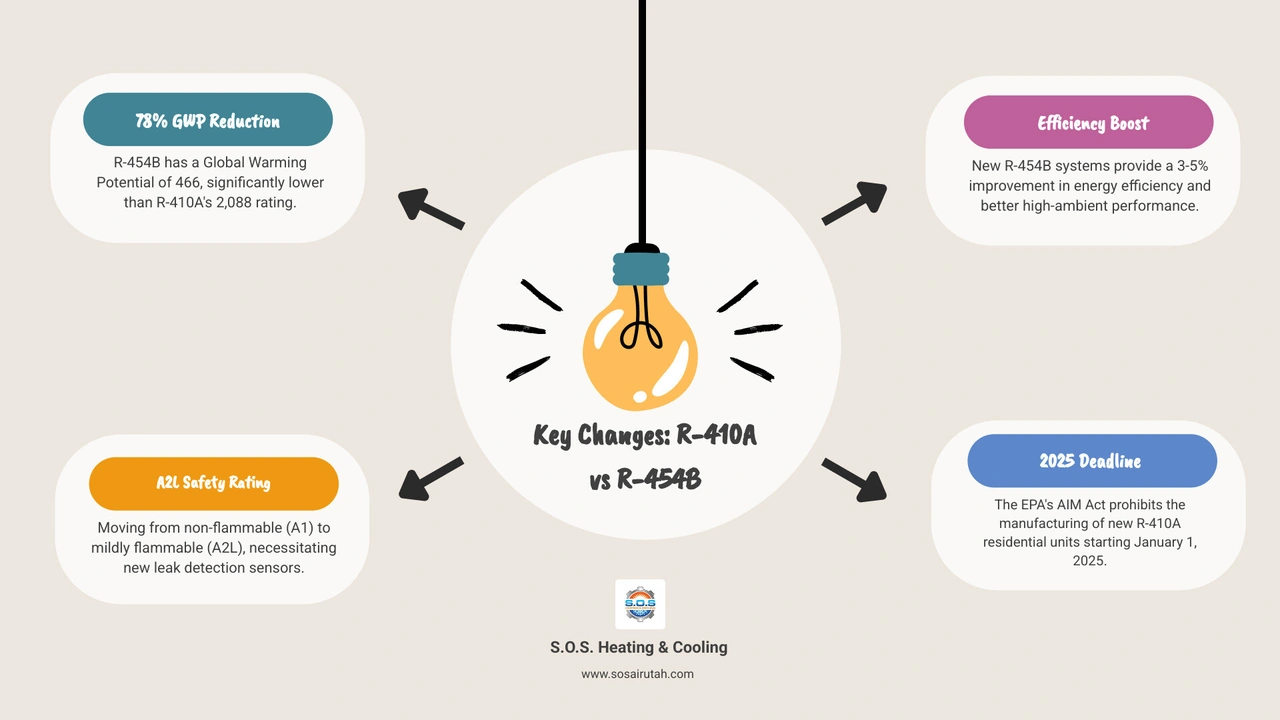
If it feels like the HVAC world is always changing the rules, you aren't wrong. However, this particular shift is driven by a very specific environmental goal. The primary reason for the transition is "Global Warming Potential," or GWP.
GWP is a measure of how much heat a greenhouse gas traps in the atmosphere relative to carbon dioxide. R-410A, while excellent at cooling your home, has a GWP of 2,088. This means that one pound of R-410A has the same warming impact as over a ton of CO2 if it leaks into the atmosphere. To combat this, the EPA's AIM Act mandated that new residential HVAC equipment must use refrigerants with a GWP of less than 700.
Enter R-454B. Often marketed under the trade name Opteon™ XL41, this refrigerant has a GWP of just 466. That is a massive 78% reduction compared to R-410A. R-454B is a blend of R-32 (a hydrofluorocarbon) and R-1234yf (a hydrofluoroolefin, or HFO). This chemical makeup gives it a much shorter atmospheric lifetime — only about 5.5 years compared to nearly 17 years for R-410A.
By making this switch, the industry is significantly reducing the long-term environmental footprint of home cooling. For those of us living along the Wasatch Front, from Bountiful down to Draper, staying cool in the summer is a necessity, and this transition ensures we can do so more sustainably. If you're curious about how these changes affect your specific setup, you can find more info about air conditioning services on our website.
Technical Comparison: Performance and Efficiency
When we look at the nuts and bolts of r410a vs r454b refrigerant what you need to know, the technical differences are fascinating. Manufacturers didn't just pick a new gas; they had to redesign systems to handle the unique properties of R-454B.
| Property | R-410A | R-454B |
|---|---|---|
| Composition | 50% R-32 / 50% R-125 | 68.9% R-32 / 31.1% R-1234yf |
| Critical Temperature | 160.3°F | 170.8°F |
| High-Side Pressure | ~400 psig | ~370 psig |
| Discharge Temp | Baseline | 3-5°C Lower |
| Heat Transfer Area | Standard | 10-20% Larger Required |
One of the biggest advantages of R-454B is that it operates at slightly lower pressures (about 5% lower) than R-410A. Lower pressure generally means less stress on the system's components, which can lead to better long-term reliability. Additionally, R-454B has a lower discharge temperature. This reduces the thermal stress on the compressor, which is often the most expensive part of your AC unit to replace.
However, because R-454B has a slightly lower cooling capacity per volume, manufacturers have had to increase the heat transfer surface area of the coils by 10% to 20% to match the performance of older R-410A units. This is why you might notice that newer outdoor condensers are a bit larger than the ones they replace.
Understanding R410A vs R454B Refrigerant What You Need to Know About Efficiency
The good news for your wallet is that R-454B isn't just better for the planet; it's also more efficient. On average, R-454B offers a 3% to 5% improvement in its Coefficient of Performance (COP) compared to R-410A.
In the high-ambient heat we often experience in Salt Lake City and South Jordan during July and August, R-454B actually shines. Because it has a higher critical temperature (170.8°F vs 160.3°F), it maintains its efficiency better when the outdoor temperatures soar. This translates to better SEER2 and HSPF2 ratings for new equipment. While the initial investment for these systems may be slightly higher, the energy savings — estimated at around $27 per year for a standard home — help offset those costs over time.
Operating Characteristics of R410A vs R454B Refrigerant What You Need to Know
One technical detail that your service technician will be keeping a close eye on is "temperature glide." R-410A is what we call a near-azeotropic blend, meaning its components evaporate and condense at almost the same temperature. Its glide is less than 0.1°F.
R-454B is a zeotropic blend with a temperature glide of about 1.5°F. This means as the refrigerant moves through the coils, the different gases in the blend evaporate at slightly different rates. For you, this means your technician has to be much more precise when setting "superheat" and "subcooling" during a maintenance visit. It also means R-454B must always be charged into the system as a liquid. If it were charged as a vapor, the gases would exit the tank at different rates (a process called fractionation), and the mixture inside your AC would be ruined.
Safety and Residential Use: The A2L Classification
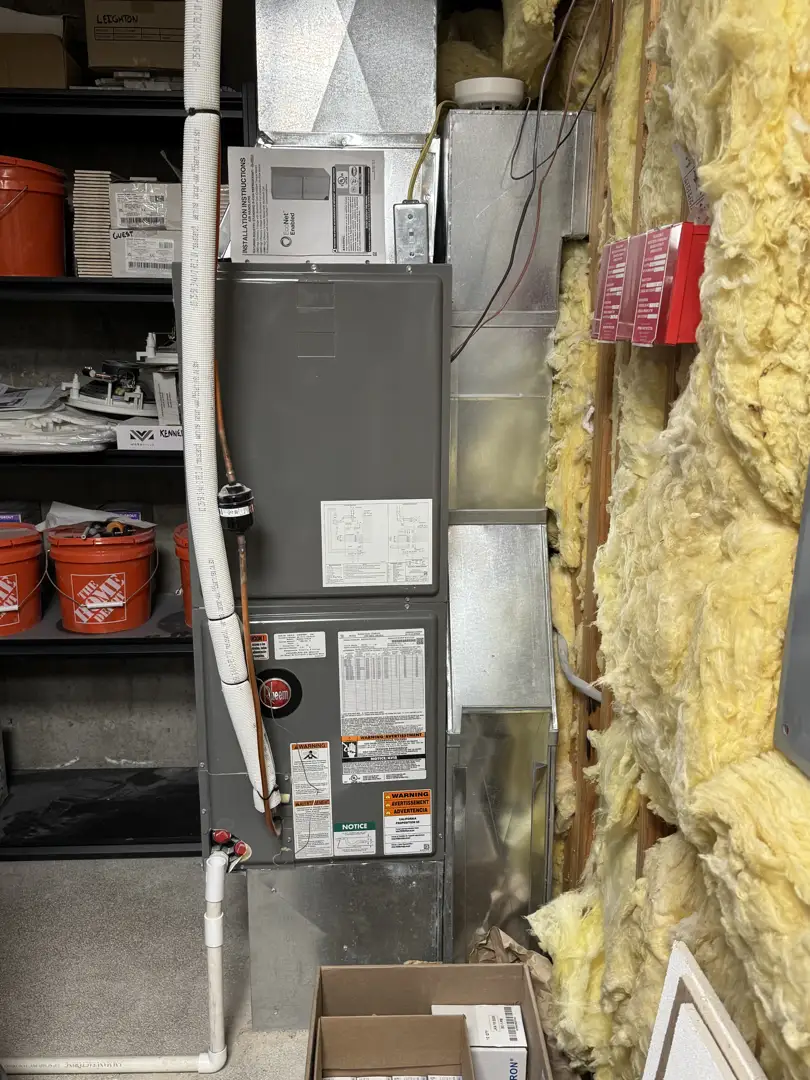
One of the most discussed topics regarding the new refrigerant is its safety rating. R-410A is classified as A1, which means it has low toxicity and is non-flammable. R-454B is classified as A2L.
What does A2L mean? It stands for:
- A: Low toxicity.
- 2L: Mildly flammable with a slow burning velocity.
To put this in perspective, A2L refrigerants are much harder to ignite than the natural gas used in your stove or the gasoline in your car. In fact, they require a very high-energy ignition source and a specific concentration in the air to catch fire. The burning velocity is so slow (about 5.2 cm/s) that even if it did ignite, the flame would likely struggle to sustain itself.
To ensure absolute safety in residential settings, the industry has adopted new UL 60335-2-40 standards. New R-454B systems come equipped with:
- Leak Detection Sensors: These are built into the indoor unit.
- Mitigation Boards: If a leak is detected, the system automatically shuts down the compressor.
- Blower Activation: The system will turn on the indoor fan to disperse the refrigerant, preventing it from reaching a concentration where it could become flammable.
At S.O.S. Heating & Cooling, we’ve made sure our team is fully trained on these new safety protocols. Whether we are in Millcreek or South Salt Lake, we follow these updated standards to the letter to ensure your home remains safe and comfortable.
What Homeowners Need to Do with Existing Systems
If you currently have a working R-410A system in your Sandy or Kaysville home, there is no need to panic. You are not required to replace your unit just because the refrigerant is being phased out.
Here is what you need to know about your current R-410A system:
- No Drop-in Replacements: You cannot simply "top off" or refill an R-410A system with R-454B. The pressures, oils, and safety components are completely different. Attempting to do so would likely destroy your compressor and void your warranty.
- Availability: R-410A will remain available for repairs for a long time. Under the AIM Act, production is being phased down gradually (40% reduction in 2024, 70% by 2029, and 85% by 2036).
- Rising Costs: As the supply of new R-410A decreases, the price per pound will inevitably go up. This is exactly what happened during the R-22 (Freon) phase-out years ago.
- Reclaimed Refrigerant: A large portion of the R-410A used for future repairs will come from "reclaimed" gas — refrigerant that has been recovered from old systems and purified to like-new standards.
Our best advice? Keep your current system well-maintained. Fixing small leaks now is much more cost-effective than waiting until R-410A becomes "stupid expensive" in a few years. If your system is nearing the end of its 15-to-20-year lifespan, it’s worth looking into a new R-454B system to future-proof your home. You can find more info about air conditioning services to help you decide when the time is right for an upgrade.
Frequently Asked Questions about Refrigerant Changes
Can R-454B be used in an older R-410A air conditioner?
The short answer is: Absolutely not. R-454B requires specific A2L-rated components, including spark-proof electrical parts and leak detection sensors that older R-410A units simply don't have. Furthermore, the expansion valves and seals in an R-410A system aren't designed for the chemical composition of R-454B. Using the wrong refrigerant is a major safety risk and a violation of EPA regulations.
How does R-454B compare to R-32?
You might hear some manufacturers talking about R-32. Both are A2L refrigerants, but there are key differences:
- GWP: R-454B has a lower GWP (466) than R-32 (675), giving it a larger "regulatory buffer" as environmental laws tighten.
- Composition: R-32 is a single-component gas, meaning it has zero glide and is easier to service. R-454B is a blend.
- Operating Map: R-454B generally offers a wider operating map, making it slightly better for heat pumps in cold climates.
- Proprietary Nature: R-454B is a patented blend (Opteon XL41), while R-32 is non-proprietary.
Most major U.S. brands like Carrier, Trane, and Lennox have chosen R-454B as their primary replacement for R-410A because of its lower GWP and better reliability for scroll compressors.
Are there federal incentives for upgrading to R-454B?
Yes! The Inflation Reduction Act (IRA) of 2022 provides significant incentives for homeowners who upgrade to high-efficiency systems. Under Section 25C, you may be eligible for a federal tax credit of up to $2,000 for qualifying heat pumps or $600 for high-efficiency central air conditioners. Since most R-454B systems are designed for high efficiency, they are often the perfect candidates for these credits.
Conclusion
Navigating HVAC can feel like learning a second language, but understanding r410a vs r454b refrigerant what you need to know is the first step in making smart decisions for your home's comfort and value. While the transition away from R-410A marks the end of an era, the move to R-454B brings better efficiency, a much smaller environmental footprint, and modern safety technology.
At S.O.S. Heating & Cooling, we are committed to helping our neighbors in Salt Lake City, Murray, Holladay, and the surrounding areas stay ahead of these changes. Whether you need a simple tune-up for your existing R-410A unit or you’re ready to explore a new, future-proof R-454B system, we are here to provide expert, honest service 24/7.
Don't wait for the summer heat to catch you off guard. Schedule your air conditioning service today and let us ensure your home stays perfectly cool for years to come.
Explore Our Latest Insights and Updates in Plumbing Services
Cheat Sheet to How Hard Water Scale Buildup Leads to Pipe Failure in the Wasatch Front
How Often to Inspect a Sewer Line in Salt Lake Valley
5 Most Common AC Repairs in Hot Dry Wasatch Front Climates