

Everything You Need to Know About Repair or Replace Air Conditioner in Salt Lake Valley


.avif)

Should I Repair or Replace My Air Conditioner in the Salt Lake Valley? Here's How to Decide
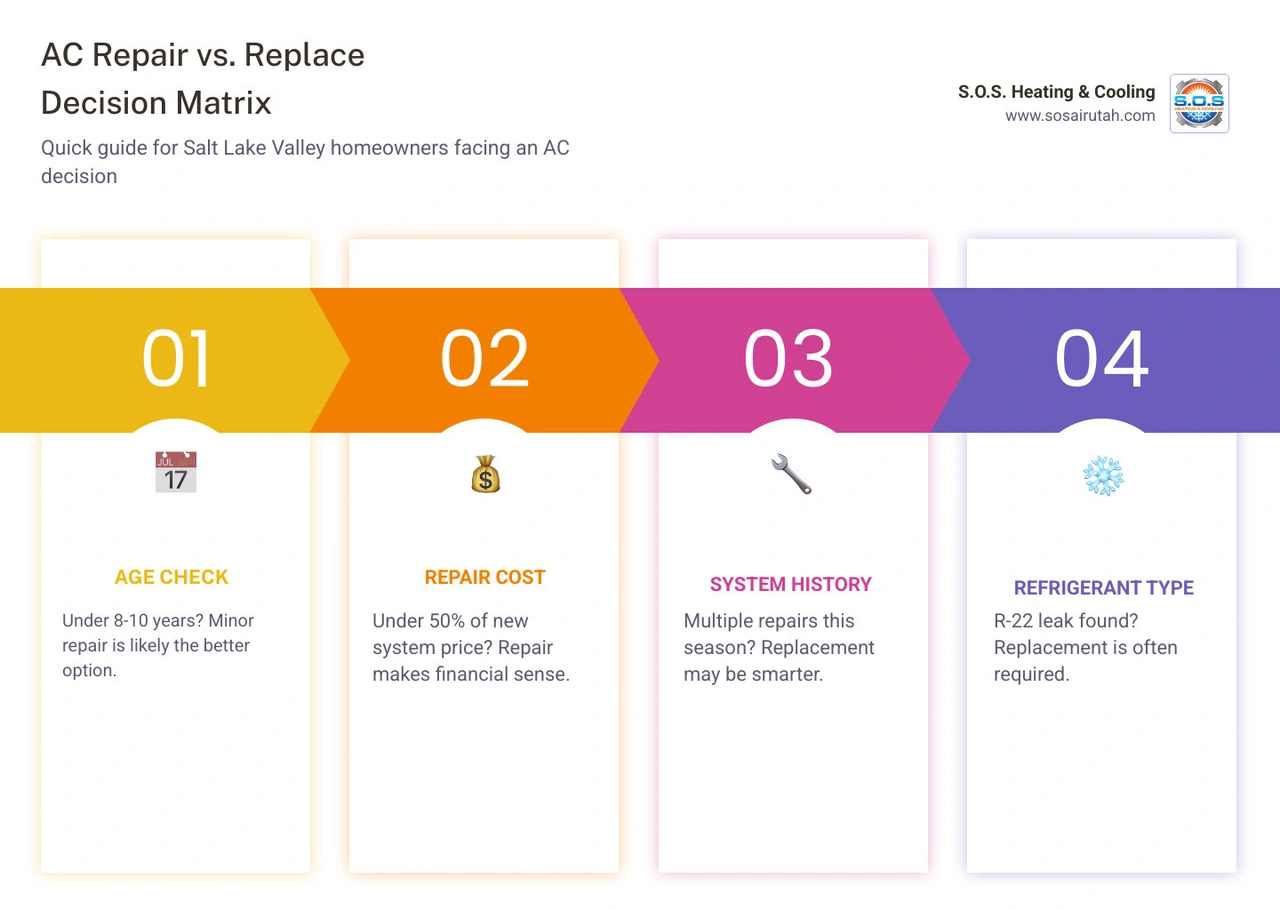
If you're wondering should I repair or replace my air conditioner in the Salt Lake Valley, here is the short answer:
Repair your AC if:
- The system is under 8–10 years old
- The repair is a single, minor component failure
- The repair cost is well under 50% of what a new system would cost
- The system has been well-maintained with no recent repair history
Replace your AC if:
- The system is 12 or more years old and needs a significant repair
- The repair cost exceeds 50% of the cost of a new system
- You've had two or more repairs in a single cooling season
- The system uses R-22 refrigerant and has developed a leak
- Your energy bills have been climbing without explanation
Most homeowners don't think about their air conditioner until something goes wrong — often on the hottest day of the year. One moment you're comfortable, and the next you're sweating through a Salt Lake City July, staring at a repair quote and wondering whether it's even worth it.
That question — whether to fix what you have or start fresh — is one of the most common and most stressful decisions a homeowner faces. And in the Salt Lake Valley, it's not as simple as it might seem elsewhere. Utah's high elevation, intense UV exposure, wide temperature swings, and winter inversion dust all put extra wear on cooling equipment, meaning local systems often age faster than national averages suggest.
The good news: there are clear, practical frameworks that take the guesswork out of this decision. This guide walks you through each one, tailored specifically to conditions here in the Salt Lake Valley.
I'm Bryson Ninow, an HVAC professional with certifications in NATE, EPA, and DOPL who has spent years helping Salt Lake Valley homeowners navigate the exact question of should I repair or replace my air conditioner in the Salt Lake Valley — and my goal here is to give you the honest, straightforward information you need to make the right call. Let's break it down step by step.
Key Factors: Should I Repair or Replace My Air Conditioner in the Salt Lake Valley?
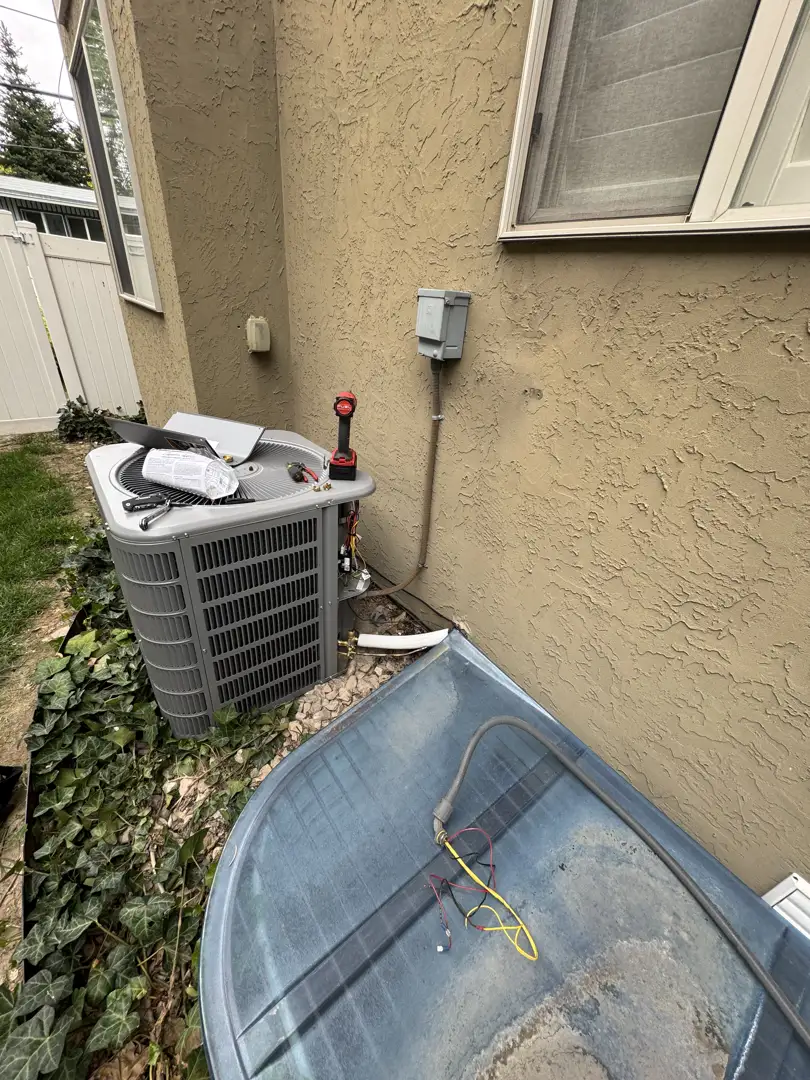
When your cooling system begins to falter, deciding on your next step requires looking at the system as a whole. You cannot judge an air conditioner solely by its ability to blow cold air today; you must evaluate its overall reliability, its past performance, and how well it keeps up with the demanding Utah climate.
The decision-making process should always balance immediate comfort against long-term financial sense. If you are constantly adjusting your thermostat, dealing with persistent hot spots in your home, or noticing that your system runs continuously without ever reaching your desired temperature, these are signs that your system’s performance is declining. When evaluating your options, we recommend starting with our comprehensive guide on Should You Repair or Replace Your AC to establish a baseline for your decision.
Age and Lifespan: Should I Repair or Replace My Air Conditioner in the Salt Lake Valley?
One of the most critical elements in this decision is the actual age of your equipment. While national resources often claim that central air conditioners last up to 20 years, the reality along the Wasatch Front is quite different.
In the Salt Lake Valley, the average lifespan of a central AC unit typically ranges from 12 to 16 years. This shortened lifespan is a direct result of our unique geographic and environmental conditions. As a system ages, its internal components—such as the fan motor, electrical contactors, capacitors, and the compressor—gradually degrade.
To understand where your system stands on this timeline, you can read our detailed breakdown on How Long Does an AC Unit Last. If your system is approaching or has exceeded the 12-year mark, even a minor component failure can be the first domino to fall in a series of costly breakdowns.
Environmental Stressors: Should I Repair or Replace My Air Conditioner in the Salt Lake Valley?
Why do air conditioners wear out faster in places like Bountiful, Sandy, Draper, and South Jordan compared to other parts of the country? Our high-desert climate exposes outdoor condenser units to extreme environmental stress.
First, our high elevation means we experience significantly higher UV radiation levels. This intense sunlight degrades the plastic and rubber components within your outdoor unit much faster than at sea level. Second, the Salt Lake Valley experiences dramatic temperature swings—scorching summer afternoons followed by freezing winter temperatures. This constant thermal expansion and contraction puts immense physical strain on copper lines and electrical connections.
Furthermore, our dry, dusty air combined with winter inversion events creates a layer of fine particulate matter that settles deep inside the condenser coils. If these coils are not regularly cleared, the system must work twice as hard to disperse heat, accelerating mechanical wear. You can learn more about how these local factors impact your system by reading about AC Wear and Tear in Salt Lake City's Climate and exploring How High-Desert Weather Affects AC Equipment Lifespan.
Mathematical Decision Frameworks for Homeowners
To remove emotion and guesswork from the equation, we rely on established mathematical frameworks. These rules of thumb help you analyze the financial viability of a repair versus a complete system upgrade, ensuring you don't throw good money after bad.
| Decision Factor | Favor Repair | Favor Replacement |
|---|---|---|
| System Age | Under 10 years old | Over 12 years old |
| Refrigerant Type | Modern R-410A / Low-GWP | Obsolete R-22 (Freon) |
| Repair Cost Ratio | Less than 50% of replacement cost | More than 50% of replacement cost |
| $5,000 Rule Score | Score is below 5,000 | Score is above 5,000 |
| Frequency of Repairs | First major issue in several years | Multiple service calls in one season |
| Energy Efficiency | Utility bills remain stable | Utility bills rising steadily |
The 50% Rule Explained
The 50% Rule is a straightforward economic threshold used across the HVAC industry. It states that if the cost of a single repair exceeds 50% of the value of a brand-new, fully installed replacement system, you should always opt for the replacement.
When you spend a significant amount on a major repair for an aging system, you are only warranting the specific part that was replaced. The rest of the aging components—including the expensive compressor—remain vulnerable to failure. Applying this rule prevents you from getting trapped in a "repair spiral," where you fix a capacitor in June, a fan motor in July, and are still left with an inefficient, unreliable system by August. For a deeper look at this financial tipping point, read our analysis on When Should You Replace Your Air Conditioner.
The $5,000 Rule Formula
Another highly reliable mathematical tool is the $5,000 Rule. This formula takes both the age of your system and the current repair estimate into account to determine the most logical path forward.
To apply the formula, simply multiply the age of your air conditioner (in years) by the exact repair estimate you received from your technician:
Age of System (Years) x Cost of Repair = Decision Score
If the resulting score is under 5,000, a repair is generally a safe and cost-effective option. If the score exceeds 5,000, the math strongly favors investing those funds into a brand-new, high-efficiency system instead.
For example, if you have an 8-year-old system facing a moderate repair, your score remains well below the threshold, indicating that repairing the unit is a smart choice. However, if you have a 12-year-old system facing that same repair, your score easily surpasses the threshold, signaling that a replacement is the better long-term financial move.
Technical Indicators: Compressor Health and Refrigerant Obsolescence
Beyond age and general wear, certain technical failures serve as immediate indicators that your air conditioner has reached the end of its useful life. When diagnostic testing reveals issues with the compressor or the refrigerant charge, the decision often becomes clear. If you suspect your system is experiencing these major issues, look out for the Signs Your AC Needs Repair.
The Critical Role of the Compressor
The compressor is often referred to as the heart of your air conditioning system. It is responsible for pumping refrigerant through the indoor and outdoor coils, facilitating the heat transfer process that cools your home.
Because the compressor is a highly complex, hermetically sealed mechanical component, replacing it is one of the most labor-intensive and expensive repairs in the industry. If the compressor fails on a system that is over 8 to 10 years old, replacing the compressor alone rarely makes sense. A failed compressor on an older unit is a strong indicator of systemic wear, and investing in a new compressor often backfires when other aging parts fail shortly after. If your system has stopped cooling entirely or is making loud, metallic noises, consult our guide on Signs Your AC Needs Immediate Repair to see if your compressor might be failing.
The R-22 Refrigerant Phase-Out
If your air conditioner was installed before 2010, there is a very high probability that it operates on R-22 refrigerant (commonly known as Freon). Due to federal environmental regulations aimed at protecting the ozone layer, the production and import of R-22 was completely banned in January 2020.
Today, the only R-22 available is reclaimed or recycled stock. This extreme scarcity has driven the cost of R-22 refrigerant to astronomical heights. If your pre-2010 system has developed a refrigerant leak, simply "topping it off" is no longer a viable or environmentally responsible solution. Because refrigerant operates in a closed loop, a low charge means you have a physical hole in your coils or lines. Spending money on expensive, obsolete refrigerant that will eventually leak back out is a textbook example of a sunk cost. If your R-22 system has a leak, a complete replacement is almost always the only logical choice.
System Efficiency and Environmental Factors in Utah
Upgrading your air conditioner isn't just about avoiding repairs; it's also an opportunity to drastically reduce your monthly energy consumption. Modern cooling systems are vastly more efficient than those manufactured a decade ago, meaning a replacement can quickly begin paying for itself in utility savings. If you are ready to explore your replacement options in the valley, learn more about our services for AC Replacement Salt Lake City.
Altitude and System Sizing
The Salt Lake Valley sits at an average elevation of over 4,200 feet. This altitude has a direct impact on how air conditioning systems perform. Because the air is thinner at higher elevations, it carries less heat per cubic foot than it would at sea level.
As a result, air conditioners installed along the Wasatch Front lose approximately 3% of their cooling capacity for every 1,000 feet of elevation. If a builder originally installed a standard "sea-level" sized unit without accounting for this loss, your system has likely been running longer and harder than necessary its entire life.
When we perform a replacement, we conduct a detailed Manual J load calculation. This scientific assessment takes our elevation, local climate, window orientation, and insulation levels into account to ensure your new system is perfectly sized for your specific home. To ensure your new system is designed correctly from day one, read about our approach to AC Installation Salt Lake City.
Utility Rebates and Incentives
To help offset the cost of transitioning to high-efficiency equipment, homeowners in our service areas—including Layton, Kaysville, Herriman, and Millcreek—can take advantage of excellent local utility rebates.
Rocky Mountain Power’s Wattsmart program offers generous rebates for qualifying high-efficiency air conditioners and premium heat pumps. Additionally, if you choose a dual-fuel system (which pairs an electric heat pump with a high-efficiency natural gas furnace), you may also qualify for rebates through Enbridge Gas's ThermWise program. When paired with federal energy tax credits, these incentives make upgrading to a modern, eco-friendly system highly accessible.
Frequently Asked Questions About AC Decisions in Utah
Making the right choice for your home can bring up many questions. To keep your system running smoothly while you decide, you can achieve a Better AC Lifespan with Regular Tune-Ups. Here are answers to some of the most common questions we hear from local homeowners.
How long do air conditioners typically last in the Salt Lake Valley?
In the Salt Lake Valley, central air conditioning units typically last between 12 and 16 years. While well-maintained systems can occasionally last longer, our high altitude, intense summer heat, and dusty winter inversions put significant physical stress on outdoor equipment, leading to faster wear than the national average.
When is a repair the right call for my cooling system?
A repair is generally the best choice if your air conditioner is under 10 years old, has a strong history of regular maintenance, and is experiencing a minor component failure (such as a bad capacitor, contactor, or simple fan motor). If the repair cost is low and the system is otherwise in good health, fixing the unit is a highly practical decision.
What rebates are available for replacing an AC in Utah?
Utah homeowners can access several valuable incentives, including Rocky Mountain Power’s Wattsmart rebates for high-efficiency cooling systems and Enbridge Gas ThermWise rebates for dual-fuel systems. Federal energy tax credits are also available for qualifying high-efficiency equipment, helping to lower the overall investment.
Conclusion
Deciding whether to repair or replace your air conditioner doesn't have to be a guessing game. By evaluating your system's age, understanding the unique environmental stressors of the Salt Lake Valley, and applying mathematical frameworks like the 50% Rule and the $5,000 Rule, you can make an objective, financially sound decision.
At S.O.S. Heating & Cooling, we are committed to providing honest, transparent guidance to homeowners throughout the Salt Lake Valley—from Bountiful and Farmington down to Draper and Herriman. We offer 24/7 emergency repairs, flexible financing options, and absolutely no evaluation fees during our normal business hours.
If you are facing a difficult AC decision and want a professional, pressure-free second opinion, we are here to help. Contact us today to schedule an expert assessment, and let us help you find the perfect path to lasting home comfort. For more detailed insights, you can always revisit our guide on Should You Repair or Replace Your AC.
Explore Our Latest Insights and Updates in Plumbing Services
Are Tankless Water Heater Benefits Real in Hard Water Areas?
Stop Wasting Watts with Variable Speed AC Technology
Upgrading Your Kitchen Sink and Faucet Without the Headache