

The Cold Hard Truth About When Replacing Your AC Makes More Sense


.avif)

The Honest Answer to Whether You Should Repair or Replace Your AC
Should you repair or replace your AC depends on a few key factors you can evaluate right now:
- Age: If your AC is under 10 years old and the repair is minor, repair is usually the smarter move. If it's 10–15+ years old, replacement deserves serious consideration.
- The $5,000 Rule: Multiply your unit's age by the estimated repair cost. If the result exceeds $5,000, replacing is typically the better financial decision.
- The 50% Rule: If the repair cost exceeds 50% of what a new system would cost, replace it.
- Refrigerant type: If your system uses R-22 (common in pre-2010 units), any significant repair is rarely worth it — that refrigerant is no longer produced in the U.S.
- Repair history: Three or more repairs in the past three years is a strong signal it's time to replace.
- Energy bills: A steady climb in your cooling costs — without a change in usage — often means your system is losing efficiency fast.
For most Salt Lake City homeowners, the decision comes down to this: a newer system with a minor, isolated problem is worth fixing. An aging unit with recurring issues, poor performance, or an outdated refrigerant is usually better replaced than propped up with another costly repair.
That said, there's no one-size-fits-all answer. The right choice depends on your system's condition, your home's cooling demands, and how long you plan to stay in your house. This guide walks you through every factor so you can make a confident, informed decision — without the pressure.
I'm Bryson Ninow, an NATE-certified HVAC professional with hands-on experience helping Salt Lake City homeowners navigate exactly this question of should you repair or replace your AC — and I've seen how the wrong call can cost families thousands of unnecessary dollars. Let's walk through everything you need to know so you can make the choice that actually makes sense for your home and budget.
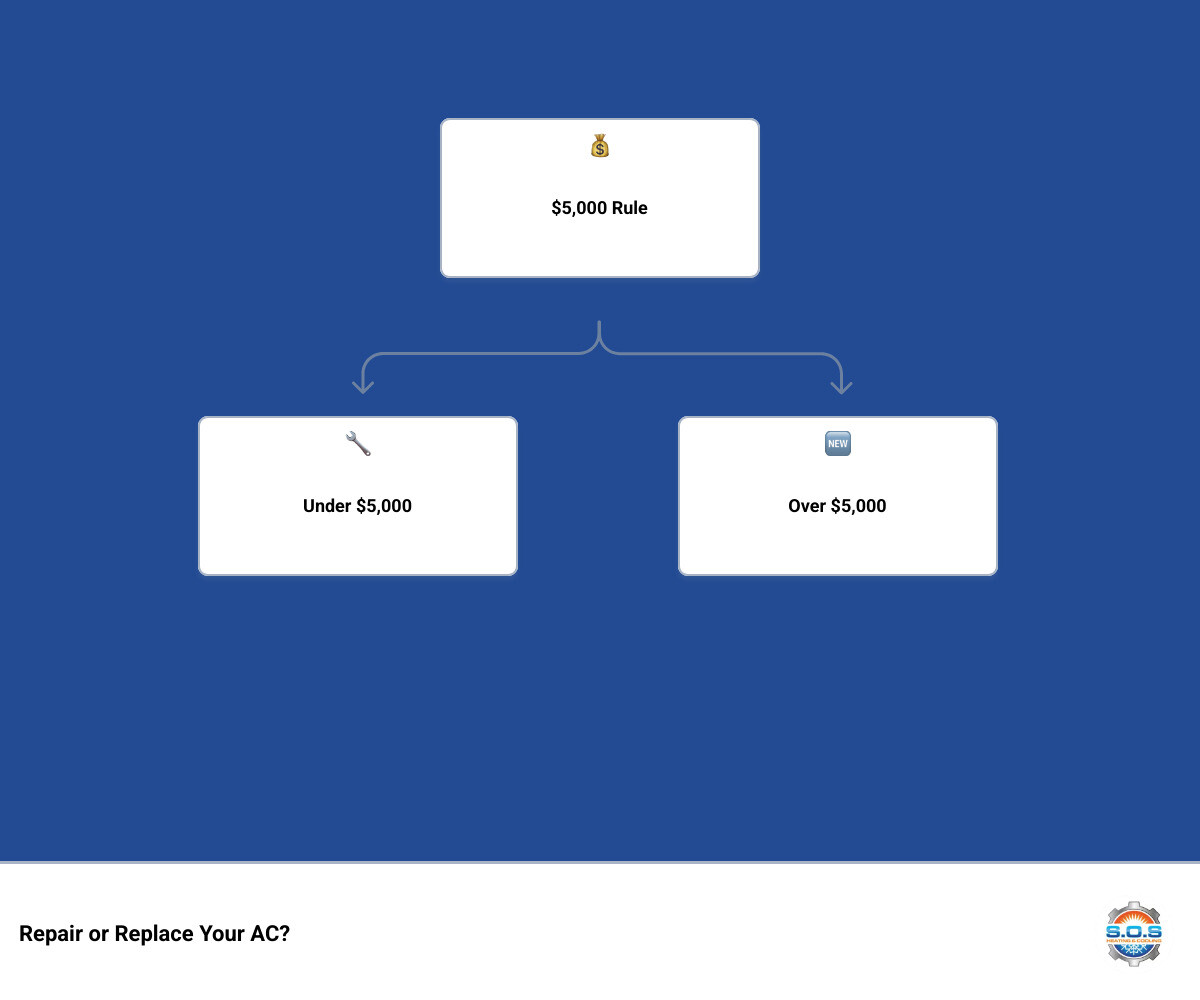
The $5,000 Rule: A Simple Formula for Your Decision
When you're staring down a repair estimate, it can be hard to think clearly—especially if your home is currently sitting at 85 degrees in the middle of a July heatwave. To take the emotion out of the equation, the HVAC industry uses a widely accepted mathematical threshold known as the "$5,000 Rule."
This rule is a quick way to determine if you are throwing "good money after bad." It helps homeowners in places like Bountiful and Draper see the long-term financial picture rather than just the immediate fix. If you want to dive deeper into the basics of this dilemma, our guide on AC Repair or Replacement offers a great starting point.
How to Calculate if You Should Repair or Replace Your AC
The math is surprisingly simple. You take the age of your air conditioning unit (in years) and multiply it by the estimated cost of the repair.
Formula: Age of Unit × Cost of Repair = Total
- If the total is less than $5,000, the repair is likely worth the investment.
- If the total is more than $5,000, you should seriously consider a full replacement.
For example, if you have an 8-year-old unit in Woods Cross that needs a minor electrical fix, the math clearly favors repair. However, if that same unit is 14 years old and needs a major component replaced, you’ll quickly breeze past that $5,000 threshold. This formula accounts for the fact that as a system nears the end of its 12–15 year lifespan, every dollar you spend on it has a lower "return on investment" because the next breakdown is likely just around the corner. If you find yourself on the lower end of this math, scheduling AC Repair Salt Lake City UT is your best bet to keep the cool air flowing.
Evaluating the 50% Rule for Major Components
Another helpful benchmark is the "50% Rule." This is even more straightforward: if the cost of a single repair exceeds 50% of the value of a brand-new system, it is time to stop repairing.
Major component failures—like a dead compressor or a leaking evaporator coil—are the most common reasons systems hit this 50% mark. These parts are the "heart" and "lungs" of your AC. When they fail on an older system, it's often a sign of a "failure cascade," where the stress of a failing part has already damaged other components. In these cases, investing in AC Replacement Salt Lake City UT ensures you aren't just putting a bandage on a system that is fundamentally worn out.
Key Signs It’s Time to Invest in a New System
Beyond the math, your AC will often give you physical "red flags" that it’s reaching the end of its rope.
| Symptom | Likely Repair | Replacement Indicator |
|---|---|---|
| Short Cycling | Dirty filter or faulty sensor | Oversized unit or failing compressor |
| Uneven Temps | Blocked vents or duct leaks | System can no longer keep up with load |
| Loud Noises | Loose belt or debris | Failing motor bearings or compressor |
| High Humidity | Clogged drain line | Inefficient cooling cycle/aging coils |
| Rising Bills | Lack of maintenance | Permanent loss of SEER efficiency |
If you notice these issues persisting despite regular service, it’s a sign that your Air Conditioning system is struggling to meet the demands of the Utah climate.
When Safety and Performance Dictate an Upgrade
Sometimes, the decision of should you repair or replace your AC is made for you by safety concerns. While modern AC units are very safe, older systems can develop electrical hazards, such as brittle wiring that poses a fire risk.
Furthermore, if your system is part of a "dual-fuel" or packaged setup involving a furnace, safety issues like cracked heat exchangers or carbon monoxide risks are immediate reasons to retire the equipment. If you smell burning or see scorched wires near your unit, don't wait—call for Air Conditioner Repair South Jordan UT immediately to assess whether the unit is safe to operate.
Why Refrigerant Type Matters When You Should Repair or Replace Your AC
One of the biggest "hidden" factors in this decision is the type of refrigerant your system uses. If your unit was manufactured before 2010, there is a high probability it uses R-22 (often called Freon).
The U.S. government began phasing out R-22 years ago because it depletes the ozone layer. As of 2020, it is no longer produced or imported. This means if you have a leak in an R-22 system in Draper or Riverton, the cost to "top it off" is astronomical because technicians have to rely on dwindling recycled stockpiles. We often tell our customers that if an R-22 system has a major leak or compressor failure, it is almost always better to choose replacement. Modern systems use R-410A or even newer, more eco-friendly alternatives that are cheaper to maintain and much better for the environment. For residents in the south end of the valley, checking with a pro for AC Repair Draper can help identify which refrigerant your system uses.
The Impact of Energy Efficiency and Modern Technology
Efficiency isn't just a buzzword; it's a direct reflection of your monthly budget. In 2026, the standards for AC efficiency are higher than ever. Older units might have a SEER (Seasonal Energy Efficiency Ratio) rating of 8 or 10. Modern standard units start at SEER2 13.4 (equivalent to the old SEER 14.3), and high-efficiency models can go well above 20.
Switching from an old SEER 9 unit to a modern SEER 14 system can reduce your energy consumption by more than 35%. If you opt for an ENERGY STAR certified model, you could save an additional 15% on top of that. Over the 15-year life of a system, those savings can actually pay for a significant portion of the AC Installation Salt Lake City.
Maximizing Incentives and Tax Credits in 2026
The financial "sting" of a new AC is greatly reduced in 2026 thanks to federal and local incentives. Under the Inflation Reduction Act, homeowners can qualify for federal tax credits of 30% (up to $2,000) for high-efficiency heat pumps.
Even if you are looking for a standard central air unit, there are often smaller tax credits and local utility rebates from companies like Rocky Mountain Power. These incentives are designed to make the jump to high-efficiency equipment much more affordable. If you live in Sandy, we can help you navigate AC Replacement Sandy UT while ensuring you capture every available rebate.
Troubleshooting Before You Make the Call
Before you panic and assume you need a brand-new system, there are a few DIY checks you should perform. Sometimes, a "broken" AC is just a system that needs a little TLC.
- Check the Filter: A clogged filter is the #1 cause of AC "failure." It restricts airflow, which can cause the coils to freeze and the system to shut down.
- Inspect the Thermostat: Ensure it has fresh batteries and is set to "Cool" rather than "Fan" or "Heat."
- Check the Breaker: Sometimes a power surge can trip the circuit breaker. Flip it all the way to "Off" and then back to "On."
- Clear the Outdoor Unit: Ensure there are at least two feet of clear space around your outdoor condenser. Leaves, tall grass, and "cottonwood fuzz" (a common Salt Lake City nuisance) can choke your system.
If these steps don't solve the problem, it’s time for a professional AC Tune Up to find the root cause.
Frequently Asked Questions About Should You Repair or Replace Your AC
Is it worth repairing a 10-year-old AC unit?
A 10-year-old AC is in its "late-life" stage. Whether it's worth repairing depends entirely on the nature of the problem. If it’s a simple fix like a capacitor or a fan motor (usually under $500), it’s absolutely worth it. However, if the compressor has failed or the coils are leaking, you are likely better off replacing it. At 10 years, you've already gotten the "best years" out of the machine, and the efficiency gains from a new unit will be substantial. For those in Murray, we can provide a detailed health check through our AC Repair Murray UT services.
How do I find my AC unit's age and refrigerant type?
You can find this information on the manufacturer's nameplate, which is a metal sticker located on the side of your outdoor condenser unit.
- Age: Look for the "MFR DATE" (Manufacture Date). If it's not there, write down the serial number. Most manufacturers hide the year and week of production in the first four digits of the serial number (e.g., "0421" might mean the 4th week of 2021).
- Refrigerant: The nameplate will clearly state "R-22," "R-410A," or "R-32."
If the plate is faded or missing, a professional AC Service Salt Lake City UT technician can identify the unit for you.
When is repairing the better financial choice?
Repair is the clear winner when:
- The unit is under 10 years old.
- The system is still under manufacturer warranty (most parts warranties last 5–10 years).
- The problem is a one-off issue, and the system has been reliable otherwise.
- You plan to move out of the house in the next year or two.
- The repair cost is low (think capacitors, contactors, or clearing a clogged drain line).
If you're in the South Jordan area and need a quick fix, our team for AC Repair South Jordan UT can get you back to comfort without breaking the bank.
Conclusion
Deciding should you repair or replace your AC doesn't have to be a guessing game. By using the $5,000 Rule, checking your refrigerant type, and weighing the long-term energy savings of modern technology, you can make a choice that protects your home's comfort and your family's finances.
At S.O.S. Heating & Cooling, we’ve spent years serving our neighbors from Bountiful to Herriman and everywhere in between. We know that every home in Salt Lake City is unique, and we’re here to provide the honest, expert advice you need to navigate the 2026 efficiency standards. Whether you need a life-extending repair or a high-efficiency upgrade, we’re ready to help. For a personalized assessment of your home's cooling system, check out our guide on AC Repair or Replacement or give us a call today.
Explore Our Latest Insights and Updates in Plumbing Services
Get More for Less: Your Guide to Affordable Water Heater Replacement in Salt Lake City
Don't Sweat It in Holladay with These AC Repair Tips
How to Unclog Toilet: 5 Methods that Guarantee Results