
How to Tell if Hard Water is Trashing Your Fixtures


.avif)

85% of U.S. Homes Have It — Do You Know the Signs of Hard Water Damage in Your Home?
The signs of hard water damage in your home are often hiding in plain sight — from the white crust around your faucets to the cloudy film on your glasses after a full dishwasher cycle. According to the U.S. Geological Survey, 85% of American homes deal with hard water, which forms when groundwater picks up dissolved minerals like calcium and magnesium as it moves through rock and soil. In Salt Lake City and the surrounding Utah communities, this problem is especially pronounced due to mineral-rich geology and mountain snowmelt — making it one of the hardest water regions in the country.
Here's a quick look at the most common signs to watch for:
- White, chalky buildup on faucets, showerheads, and fixtures
- Cloudy glassware and spotted dishes even after washing
- Soap scum that keeps coming back on tubs, tiles, and shower doors
- Stiff, scratchy laundry and faded colors after washing
- Dry, itchy skin and brittle hair after showering
- Low water pressure from mineral-clogged pipes
- Appliances wearing out faster than they should
- Rising energy bills from scale-insulated water heaters working overtime
Left unchecked, hard water silently drives up your utility costs, shortens the life of your appliances, and can cost you $800 or more per year in wasted energy and repairs — all without you realizing the water is the culprit.
I'm Bryson Ninow, an HVAC and home systems professional with hands-on experience helping Utah homeowners identify and address the signs of hard water damage in your home before they turn into costly repairs. Let's walk through exactly what to look for, room by room.
What is Hard Water and Why is it Common in Utah?
To understand the signs of hard water damage in your home, we first have to look at what's actually happening in our local environment. Hard water isn't "dirty" in the traditional sense; rather, it is water that contains high concentrations of dissolved minerals, primarily calcium and magnesium.
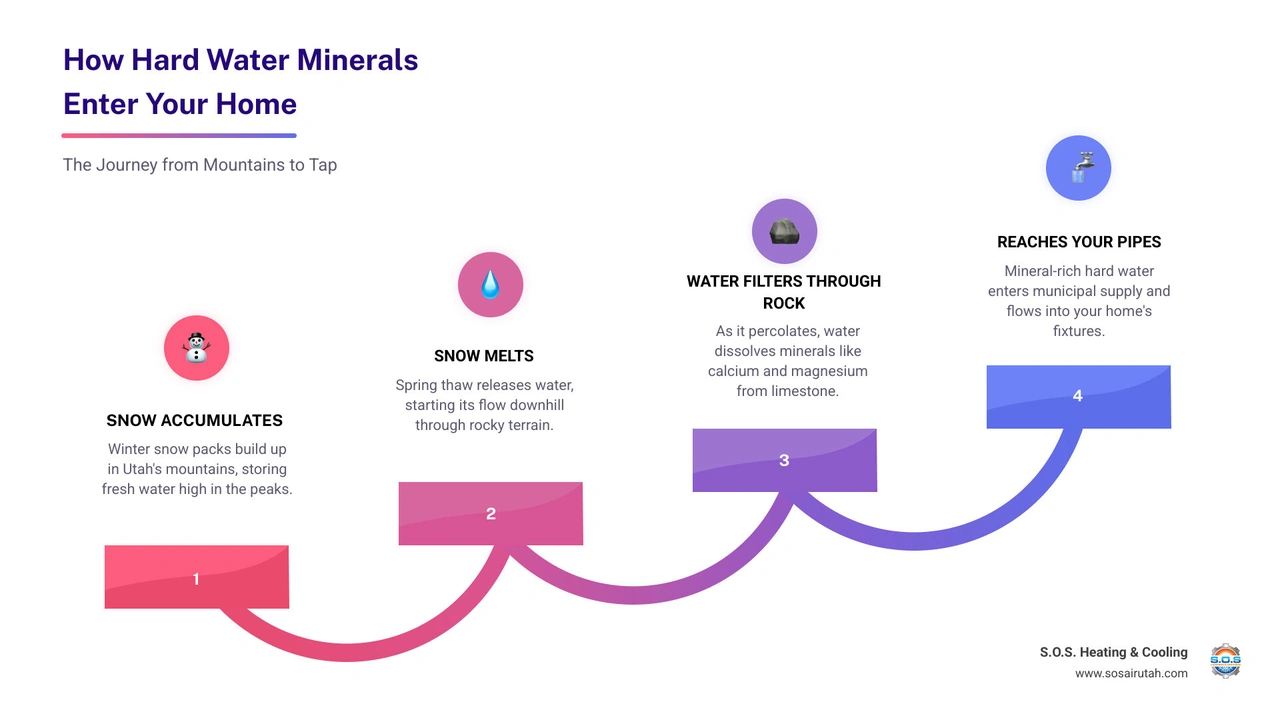
In the Salt Lake City area, we live in what some experts call a "perfect storm" for hard water. Our primary water source is mountain snowmelt. As that snow melts and travels down the mountains, it percolates through layers of calcium-rich rock and limestone. Water is a natural solvent, and as it moves, it acts like a sponge, soaking up these minerals.
Furthermore, Utah’s arid climate means we don't get frequent heavy rainfall to dilute these mineral concentrations in our underground reservoirs. By the time that water reaches your tap in places like Sandy or Millcreek, it is packed with "hardness" minerals. While these minerals are safe to drink, they are a nightmare for your home’s infrastructure. If you’re tired of scrubbing white crust off your taps, it might be time to look into Water Filtration Salt Lake City UT or Water Filtration Sandy UT to protect your property.
7 Common Signs of Hard Water Damage in Your Home
Hard water is a "persistent saboteur." It doesn't destroy your home overnight; instead, it slowly degrades everything it touches. If you’ve noticed that your chores seem harder than they used to be, or your fixtures look aged despite being relatively new, you’re likely seeing the effects of mineral accumulation.

One of the most frustrating aspects of hard water is how it interacts with soap. Instead of creating a rich lather, the minerals react with soap to form a "waxy, insoluble curd." This is the root cause of many household headaches.
To give you an idea of the difference, here is a comparison of how hard water impacts your daily life:
| Household Task | Hard Water Effect | Soft Water Effect |
|---|---|---|
| Dishwashing | Cloudy film and white spots on glass | Sparkling, streak-free glassware |
| Laundry | Stiff fabrics and fading colors | Soft clothes and vibrant colors |
| Showering | Soap scum on walls; dry skin/hair | Clean surfaces; hydrated skin |
| Cleaning Fixtures | Constant scrubbing of white "crust" | Easy wipe-down of surfaces |
| Soap Usage | Requires 2-4x more soap to lather | Minimal soap needed for big lather |
If these "hard water" symptoms sound familiar, residents in areas like Draper often find relief by installing Water Softeners Draper UT. It’s also a common issue for those in Water Softeners South Salt Lake UT, where the mineral content can be particularly aggressive on older plumbing systems.
Visible Mineral Buildup and Signs of Hard Water Damage in Your Home
The most obvious signs of hard water damage in your home are the white, chalky deposits known as limescale (calcium carbonate). You’ll typically see this first on your faucet aerators and showerheads. It starts as a light dusting and eventually turns into a hard, "crusty" white or grayish shell.
This buildup is more than just an eyesore. As it grows, it clogs the tiny holes in your showerhead, leading to uneven spray patterns or reduced flow. If you have to use a toothpick to poke out white gunk from your showerhead every month, you have a hard water problem. This is a primary reason homeowners seek out Water Softeners Millcreek UT to stop the scale before it reaches the faucet.
Cloudy Dishes and Stubborn Soap Scum
Have you ever pulled "clean" dishes out of the dishwasher only to find them covered in a murky film or white spots? That’s not food residue; it’s mineral deposits left behind as the water evaporates. Over time, these minerals can actually etch the surface of delicate glassware, causing permanent damage that no amount of scrubbing can fix.
In the bathroom, this manifests as soap scum — that stubborn, gray-white layer on shower doors and tiles. Because the minerals prevent soap from dissolving, the soap clings to the walls instead. You might also see dark reddish-brown or orange stains in sinks and toilets, which often indicates that your hard water also contains iron. For families in Kaysville dealing with these persistent stains, a Reverse Osmosis Kaysville UT system can be a game-changer for drinking water and fixture clarity.
Stiff Laundry and Faded Fabrics
Hard water is incredibly harsh on fabrics. The minerals get trapped within the fibers of your clothes, towels, and sheets. This makes your laundry feel scratchy and stiff. Even worse, the mineral buildup can act like tiny pieces of sandpaper, grinding against the fabric every time you move, which leads to premature fraying and holes.
You may also notice:
- Whites turning dingy, gray, or yellow.
- Bright colors fading 15% faster than they should.
- Towels losing their absorbency because they are coated in mineral "curd."
Homeowners looking to save their wardrobe in South Jordan often invest in Water Softeners South Jordan UT to ensure their clothes stay soft and vibrant for years.
How Hard Water Destroys Your Plumbing and Appliances
While the visible stains are annoying, the real signs of hard water damage in your home are the ones you can't see inside your walls and appliances. Hard water is often compared to "plaque in an artery" for your plumbing system.
Your water heater is especially vulnerable. As water is heated, the minerals precipitate out and settle at the bottom of the tank as sediment. This sediment acts as an insulator between the heating element and the water. As a result, your water heater has to work much harder and run longer to reach the desired temperature, which spikes your energy bills. This is a major concern for our customers in Water Softeners Layton UT and Water Filtration Bountiful UT.
Clogged Pipes and Low Water Pressure
Inside your pipes, limescale builds up layer by layer. Over years, this narrows the diameter of the pipe, significantly restricting water flow. If you’ve noticed a gradual drop in water pressure throughout your house, it might not be the city’s fault — it could be your pipes closing up.
Older galvanized steel pipes are particularly prone to this, as the minerals bond easily to the metal. This constriction can eventually lead to complete clogs or, in severe cases, pipe corrosion and leaks. We often see this in older homes in Water Filtration Riverton UT, where years of hard water have finally taken their toll on the plumbing.
Shortened Appliance Lifespan and Signs of Hard Water Damage in Your Home
Any appliance that uses water — dishwashers, washing machines, ice makers, and coffee pots — is at risk. Hard water can cause a washing machine to wear out 30% faster than normal. The minerals gum up the internal valves, damage rubber seals, and coat the heating elements.
In fact, appliances running on hard water can have their lifespan shortened up to 30 times faster than those running on soft water in extreme cases. If you find yourself replacing your dishwasher every five years instead of every ten, hard water is likely the culprit. To protect these expensive investments, many of our neighbors in Water Softeners Farmington UT and Water Softeners Centerville UT choose whole-home softening solutions.
The Impact on Your Skin, Hair, and Personal Health
Your home isn't the only thing suffering; your body feels the effects of hard water, too. Because hard water prevents soap and shampoo from rinsing away completely, it leaves a microscopic film on your skin and hair.
This film clogs pores and strips away natural oils, leading to:
- Dry, itchy skin: You might find yourself reaching for the lotion much more often than usual.
- Brittle, dull hair: Minerals like calcium and magnesium can make hair feel straw-like and cause colors (especially salon dyes) to fade or change shades.
- Aggravated skin conditions: Hard water has been linked to increased flare-ups of eczema and psoriasis, particularly in children.
Showering should be a relaxing escape, not a cause of irritation. For those in Reverse Osmosis Holladay UT or Reverse Osmosis Riverton UT, addressing water quality at the source can lead to noticeably healthier skin and hair.
Testing and Solutions for Hard Water Issues
If you suspect you have hard water, you don't have to guess. There are several ways to confirm your suspicions:
- The Soap Suds Test: Fill a clear bottle halfway with tap water, add a few drops of liquid dish soap, and shake it vigorously. If the water becomes cloudy and has very few suds, you have hard water. Soft water will create a thick layer of bubbles and remain clear.
- DIY Test Kits: You can purchase chemical strips that change color based on the "grains per gallon" (GPG) of hardness in your water.
- Professional Analysis: This is the most accurate method. We can test your water to provide a precise reading of mineral content, helping you choose the right system for your specific needs in Water Softeners Mt Olympus UT or Water Filtration Holladay UT.
Water Softeners and Filtration Systems
The most effective way to eliminate the signs of hard water damage in your home is a whole-home water softener. These systems use a process called "ion exchange." Inside the tank are thousands of tiny resin beads. As hard water enters, the calcium and magnesium ions stick to the beads, and the system replaces them with a tiny amount of sodium or potassium.
When the beads are full of minerals, the system "regenerates" by flushing them with a brine solution. This keeps your water soft 24/7, protecting your pipes, skin, and appliances. For high-purity drinking water, many homeowners also add a reverse osmosis system. These are incredibly popular in Reverse Osmosis Draper UT, Reverse Osmosis Sandy UT, and Reverse Osmosis Woods Cross UT.
Frequently Asked Questions about Hard Water
Is hard water safe to drink?
Yes, hard water is perfectly safe to drink. In fact, it contains essential minerals like calcium and magnesium that are beneficial for bone and cardiovascular health. However, many people find the taste to be "chalky" or metallic. If you prefer the taste of bottled water, a Reverse Osmosis Millcreek UT system can give you that same crisp taste right from your kitchen tap.
Does boiling water remove hardness?
Boiling only removes what is known as "temporary hardness" (calcium bicarbonate). As the water boils, the minerals precipitate out — which is why you see white flakes in your tea kettle. However, boiling doesn't remove "permanent" hardness (calcium sulfate) and isn't a practical solution for your whole home’s water needs. For a more permanent fix in Bountiful, check out Reverse Osmosis Bountiful UT.
How long do water softeners last?
A high-quality water softener typically lasts between 10 and 15 years, though premium systems can last 20 years or more with proper maintenance. Regular servicing ensures the resin beads stay effective and the valves operate smoothly. If your system is getting older in Murray, it might be time for an upgrade to a modern Reverse Osmosis Murray UT or softening unit.
Conclusion
The signs of hard water damage in your home are more than just a nuisance; they are a direct threat to your home’s efficiency and your family’s comfort. From the "artery-clogging" scale in your pipes to the $800+ in annual hidden costs, hard water is an expensive problem to ignore.
At S.O.S. Heating & Cooling, we’ve spent years helping our neighbors across the Wasatch Front reclaim their water quality. Whether you’re in Salt Lake City, Murray, or any of our surrounding service areas, we have the expertise to test your water and install a solution that fits your lifestyle.
Don't let Utah's minerals trash your fixtures any longer. If you’re ready to see the difference soft water can make, contact us today for Water Softeners Salt Lake City UT or Water Softeners Murray UT.
Protect your home with professional plumbing services and enjoy the peace of mind that comes with crystal-clear water and a more efficient home.

Plumbing
Expert plumbing services offering reliable repairs, installations, maintenance, and emergency support.

Air Conditioning
Comprehensive air conditioning services include installation, repairs, maintenance, and energy-efficient solutions.
Heat Pumps
Enjoy year-round comfort with our energy-efficient and professional heat pump solutions.

Indoor Air Quality
Enhance your home’s air with our cutting-edge indoor air quality solutions you can trust.

Fireplaces
Transform your space into a warm and cozy atmosphere with our professional fireplace services.

Heating
Specialized heating services provide reliable installation, repair, system maintenance, and energy-optimization solutions.
Explore Our Latest Insights and Updates in Plumbing Services
How to Fix AC Tripping the Breaker in Your Salt Lake Home

How to Fix Constant AC Running from Poor Insulation