

The Code Whisperer: Decoding Water Heater Regulations for Your Home


.avif)

Why Water Heater Code Compliance Protects Your Home and Wallet
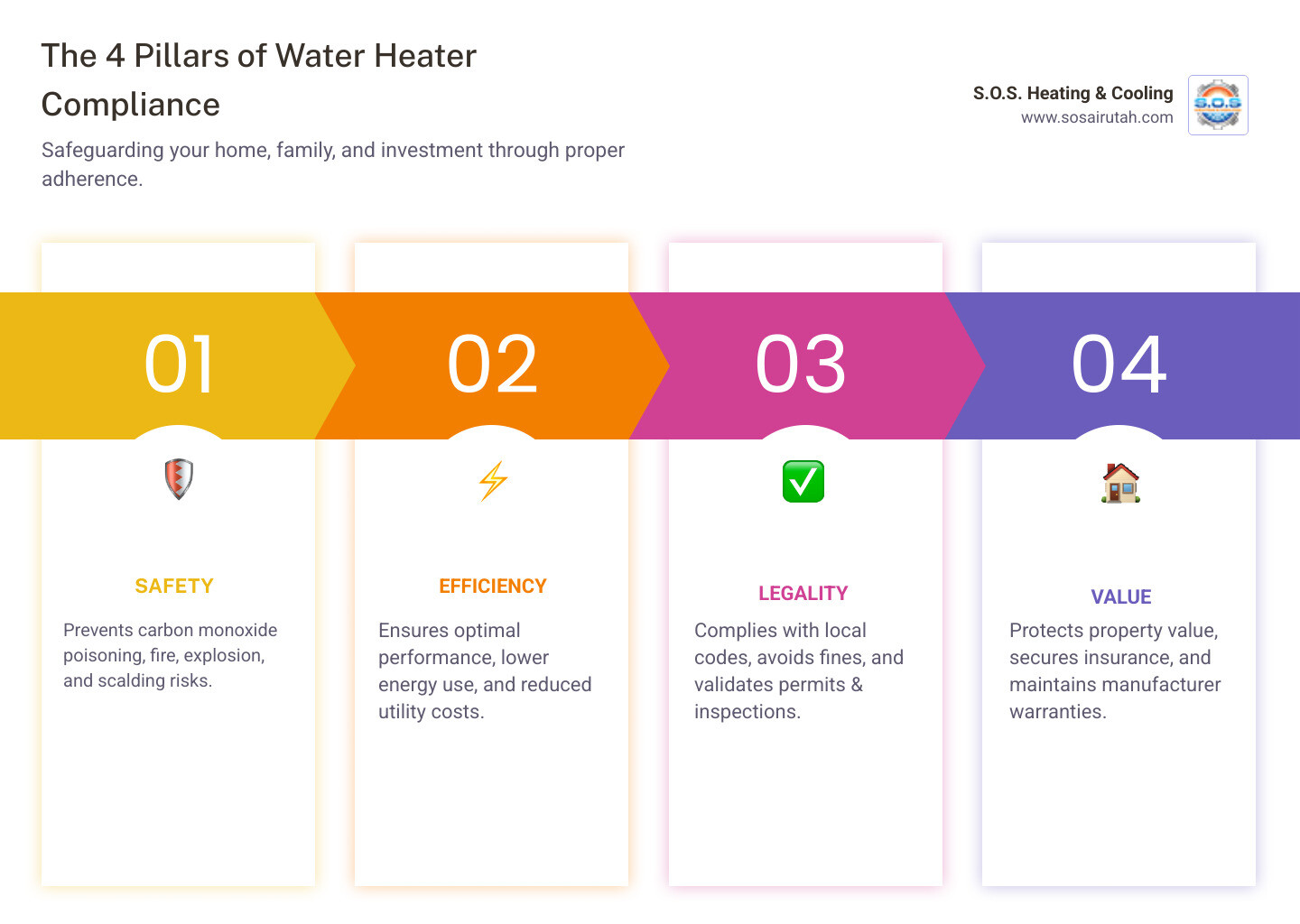
Water heater code compliance isn't just bureaucratic red tape—it's the difference between a safe, efficient home system and a potential disaster that could void your warranty, spike your insurance premiums, or even put your family at risk. When your water heater fails in Salt Lake City, UT, the temptation to cut corners on replacement can be strong, but understanding and following local building codes protects you from carbon monoxide poisoning, explosion risks, denied insurance claims, and costly rework down the line.
Quick Answer: Essential Water Heater Code Compliance Requirements
- Temperature & Pressure Relief Valve - Must be properly installed with a discharge pipe terminating safely
- Expansion Tank - Required on closed-loop systems to manage thermal expansion
- Proper Venting - Gas heaters need adequate combustion air and correctly sloped vent pipes
- Seismic Strapping - Mandatory in earthquake-prone areas to prevent tipping
- Drain Pan - Required when leaks could cause property damage
- Sediment Trap - Prevents debris from entering gas lines
- Pressure Regulator - Needed when home water pressure exceeds 80 PSI
- Correct Location - Gas heaters must be liftd 18" off garage floors
- Licensed Installation - Professional work ensures code compliance and protects warranties
- Permits & Inspections - Required in most jurisdictions to verify safety
If you're dealing with a water heater issue, understanding the signs your unit needs replacement can help you plan ahead, and when you're ready for professional service, S.O.S. Heating & Cooling offers expert water heater installation that meets all local requirements.
I'm Bryson Ninow, and in my years working with HVAC systems throughout Utah, I've seen how proper water heater code compliance prevents emergencies and protects homeowners from unexpected costs and safety hazards. My certifications include DOPL, RMGA, EPA, and NATE, and I'm passionate about helping families understand how following these regulations creates long-term peace of mind.
Why Water Heater Code Compliance is Non-Negotiable
Think of water heater code compliance as your home's invisible shield—protecting your family, your finances, and your peace of mind all at once. This isn't bureaucratic nitpicking. These codes exist because too many homeowners have learned painful lessons about what happens when installations cut corners.
When you're facing a water heater replacement, the temptation to skip permits or hire the cheapest installer can be strong. But that decision can come back to haunt you in ways you might not expect—from voided warranties to insurance nightmares, and in the worst cases, genuine safety emergencies that put your loved ones at risk.
The reality is simple: following code isn't optional. It's the foundation of a safe, valuable, and legally sound home.
The Primary Safety Reasons for Adhering to Code
Your water heater sits quietly in your utility room or garage, doing its job without fanfare. But when installation codes are ignored, that same appliance can become genuinely dangerous.
Carbon monoxide poisoning tops the list of serious risks for gas and propane water heaters. This silent killer has no smell, no color, and no warning signs until it's too late. Proper venting isn't a suggestion—it's literally life-saving. When combustion gases can't escape properly, they accumulate in your living spaces. Families have been hospitalized or worse because of improper venting. If you've ever had issues with your water heater pilot light, it might actually be signaling ventilation problems.
Fire hazards lurk in installations that don't respect clearance requirements. Those vent pipes get hot by design, and when they're too close to wood framing or other combustible materials, you're creating a fire risk. Electric water heaters aren't off the hook either—improper wiring can spark fires just as easily.
The explosion risk sounds like something from an action movie, but it's terrifyingly real. When a temperature and pressure relief valve fails or gets installed incorrectly, the pressure inside your water heater can build to catastrophic levels. Water heated beyond its boiling point stays liquid under pressure, but when that pressure releases suddenly, it flashes to steam in an instant. The resulting explosion can blow through walls and ceilings with devastating force.
Scalding prevention might seem less dramatic, but ask any parent who's had a child burned by too-hot tap water. Proper T&P valve function helps prevent water from reaching dangerous temperatures that can cause severe burns in seconds.
Gas leaks round out the major safety concerns. Faulty connections at your water heater can leak gas into your home, creating explosion and fire risks. This is exactly why codes require proper sediment traps—they prevent debris from entering gas lines and causing blockages or damage that could lead to leaks.
When safety issues arise, you need help fast. That's why we offer 24/7 emergency water heater repair throughout Utah.
The Financial & Legal Risks of Poor Water Heater Code Compliance
The safety reasons alone should convince anyone to follow water heater code compliance requirements. But if you need more motivation, consider how non-compliance can drain your bank account and create serious legal problems.
Voided warranties are probably the most common financial trap. Read the fine print on your water heater warranty, and you'll almost certainly find language stating that the warranty is void if installation doesn't follow local codes. Many manufacturers also require licensed professional installation. When your water heater fails three years in and you're expecting warranty coverage, finding you have to pay full price for a replacement is a brutal surprise.
Denied insurance claims can be even more devastating. Imagine your water heater causes flooding that damages your home, or a fire breaks out due to improper installation. Your insurance adjuster investigates and finds the installation wasn't code-compliant. Many homeowner policies have clauses that allow them to deny claims related to non-compliant installations. What should have been a covered claim becomes a financial disaster you're handling alone.
Local building departments don't mess around with fines and penalties either. Throughout Salt Lake County—whether you're in Murray, Sandy, or West Valley City—inspectors can issue citations for non-compliant work. These fines can start small but escalate quickly, especially if you're required to correct the violation and face additional penalties for delays.
Your property's resale value takes a hit when inspections reveal code violations. Home buyers are savvy, and their inspectors scrutinize every major system. A non-compliant water heater installation becomes a negotiating point—buyers will either demand you fix it before closing, ask for price reductions, or walk away entirely. Lenders and insurance companies may even refuse to close the deal until compliance is verified.
The cost of rework adds insult to injury. Correcting a non-compliant installation often costs more than doing it right initially. You're paying for labor twice, possibly new materials, permit fees, and inspection costs. It's the definition of penny-wise and pound-foolish.
Beyond homeowners, legal liabilities become serious for rental properties or commercial buildings. If a tenant or customer is injured due to a non-compliant water heater installation, you're facing potential lawsuits, settlements, and the kind of publicity no business wants.
This is exactly why professional water heater replacement isn't just convenient—it's essential protection for your investment and your family's safety. When you work with licensed professionals who understand local codes, you're buying peace of mind along with that new water heater.
Core Components of a Compliant Installation
When it comes to water heater code compliance, understanding the essential components isn't just about checking boxes—it's about ensuring every part of your system works together to keep your family safe and your home protected. Think of these components as a team, each player with a specific job that contributes to the overall success of your water heater installation.
Temperature & Pressure (T&P) Relief Valve and Discharge Pipe
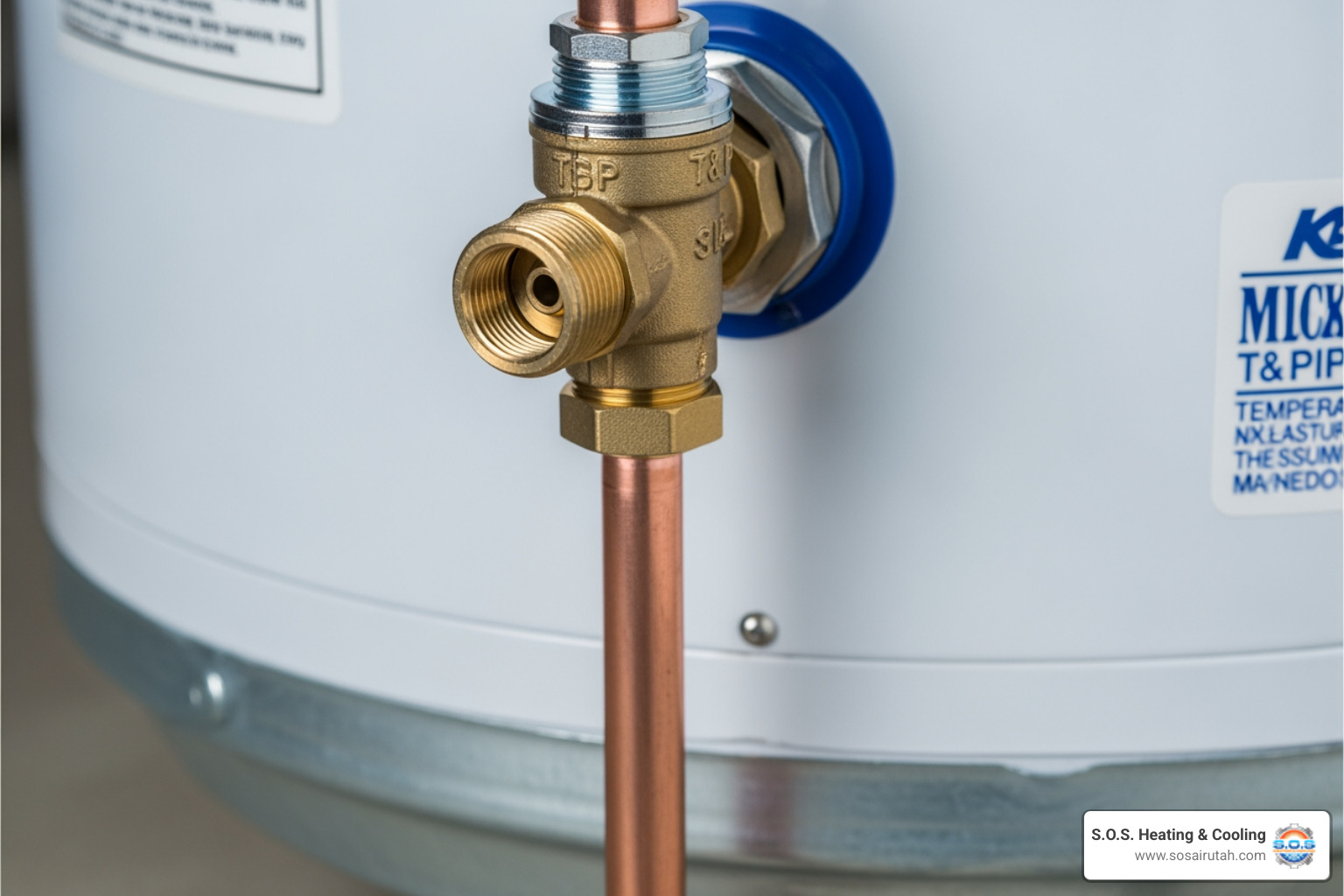
If your water heater had a superhero, it would be the Temperature and Pressure (T&P) relief valve. This small but mighty device stands between you and a potential disaster. Its job? Preventing your water heater from turning into a pressure cooker that could literally explode.
Proper T&P valve placement starts with installing the valve directly into the designated opening on your water heater, usually near the top of the tank. This isn't random—the valve needs to be positioned where it can accurately sense what's happening inside. When temperatures or pressures get too high, this valve opens to release the excess, protecting your home and family.
But the valve itself is only half the story. The discharge pipe material matters tremendously. You'll need copper, CPVC, or PEX—materials that can handle scalding hot water without melting or failing. Using standard PVC pipe here is one of the most common violations we see, and it's dangerous because PVC simply can't withstand the temperatures involved.
The pipe must maintain the correct diameter throughout its entire run, matching or exceeding the valve outlet size (typically 3/4 inch). Never reduce the size—doing so defeats the purpose of the safety valve. The pipe should run continuously downward with gravity drainage as its driving force, with no traps, valves, or obstructions blocking the flow.
Where this pipe ends up—the termination point—is equally critical. It needs to discharge somewhere safe, usually within 6 inches of the floor or into an indirect waste receptor like a floor drain. The water that comes out of this valve during an emergency will be extremely hot, so it can't terminate where someone might walk, or inside a wall where it could cause hidden damage.
Finally, there's the air gap requirement. The discharge pipe shouldn't connect directly to your drainage system. This air gap prevents contaminated water from potentially being sucked back into your clean water supply. These details are all spelled out in codes like Chapter 28 of the 2024 International Residential Code (IRC), which Utah jurisdictions follow closely. When we handle water heater installation in Salt Lake City, getting these details right is non-negotiable.
Expansion Tanks and Pressure Regulators
Water does something interesting when it heats up—it expands. In most cases, this isn't a problem because the extra volume just pushes back into your municipal water supply. But if your home has a closed-loop system, created by backflow prevention devices or pressure-reducing valves on your main line, that expanded water has nowhere to go.
This is where thermal expansion becomes a real issue. As your water heater does its job, the water inside gets hot and grows in volume. In a closed system, this creates pressure that builds and builds, stressing your pipes, fixtures, and the water heater itself. Over time, this pressure can cause leaks, damage appliances, and significantly shorten your water heater's lifespan.
Expansion tanks are mandated in many Utah municipalities specifically to handle this situation. The tank provides a cushion—a place for that expanded water to go—protecting your entire plumbing system from dangerous pressure spikes. While the IRC doesn't require them everywhere, local codes throughout Utah often do, and for good reason. We see the damage that occurs without them regularly during water heater repair calls in Salt Lake City.
Even if you don't have a closed system, high water pressure above 80 PSI creates its own set of problems. Excessive pressure causes banging pipes, premature appliance failure, and mysterious leaks that seem to spring up out of nowhere. Your plumbing simply isn't designed to handle that kind of constant stress.
That's where pressure regulator installation comes in. Installed on your main water supply line, a pressure regulator keeps your home's water pressure at a safe, consistent level—usually around 50-60 PSI. This single component protects everything in your home that touches water, from your faucets to your dishwasher to your water heater. It's an investment that pays dividends in prevented repairs and extended appliance life.
Seismic Strapping and Location-Based Requirements
Living in Utah means we need to think about earthquakes, even if we don't experience major ones frequently. When the ground shakes, an unsecured water heater can become a dangerous projectile, tipping over and rupturing gas lines or water connections.
Seismic strapping requirements exist specifically to prevent this scenario. In earthquake-prone areas—which includes most of Utah—buildings that fall into certain Seismic Design Categories specified in the IRC must have their water heaters properly braced. This typically means two heavy-duty straps: one in the upper third of the tank and one in the lower third, with the lower strap positioned at least 4 inches above the controls. Both straps must be anchored to structural members of your home, not just drywall.
Drain pan installation addresses a different but equally important concern—protecting your home from water damage. If your water heater sits in an attic, on a second floor, or in a finished basement, a leak could cause thousands of dollars in damage before you even notice it. A properly installed drain pan catches that water and, when connected to a drain line, directs it safely away.
We install these pans throughout communities like Murray, Draper, and Sandy, where building codes recognize that protecting against water damage is just as important as preventing fires or explosions. The pan won't stop a catastrophic tank rupture, but it will catch the slow drips and minor leaks that often go unnoticed until major damage has occurred. Interestingly, tankless water heaters typically don't require catch pans since they don't have a storage tank that could develop those sneaky leaks.
These components work together to create a water heater installation that's not just code-compliant, but genuinely safe and reliable for years to come.
Fuel-Specific Water Heater Code Compliance
Water heaters come in various types, and their fuel source—gas/propane or electric—significantly impacts the specific code requirements for installation. Understanding these distinctions is key to ensuring water heater code compliance.
| Feature | Gas/Propane Water Heaters to |
|---|
Explore Our Latest Insights and Updates in Plumbing Services
Why Upgrading to a High Efficiency AC System is a Cool Move
Mini Split vs Central AC Cost Comparison for Savvy Homeowners

A Step-by-Step Guide: How to Apply for Energy Rebates in Utah