

Why Utah Homeowners are Softening Up to Water Filtration


.avif)

Why Utah Homeowners Are Rethinking Their Home's Water Quality
Is a water softener worth it in Utah? Yes — for most Utah homeowners, it is one of the smartest home investments you can make. Here's a quick breakdown of why:
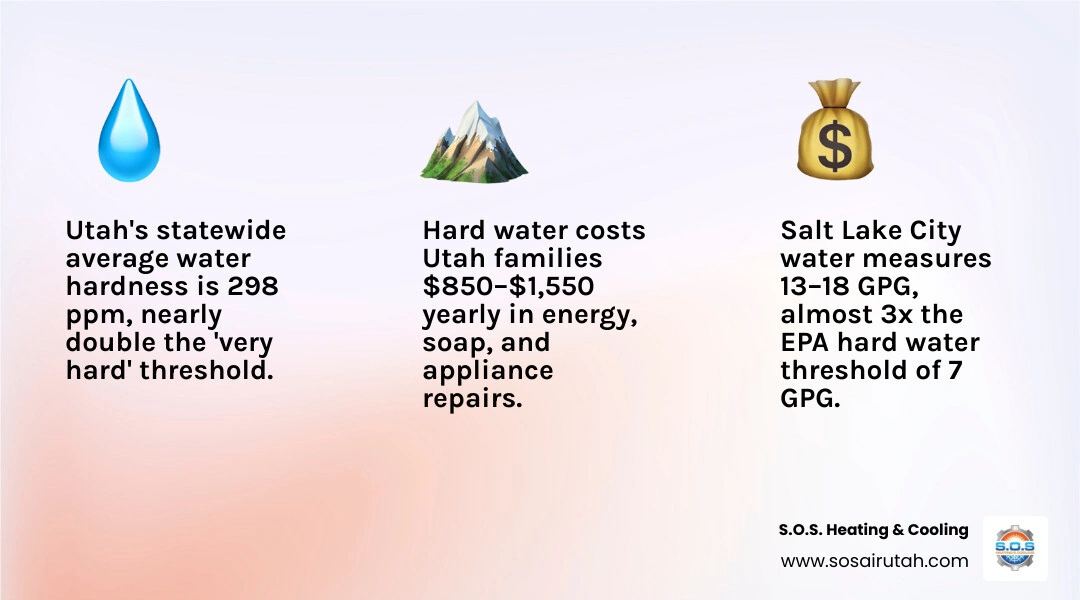
- Utah's water is extremely hard. The statewide average sits around 298 ppm, nearly double the threshold for "very hard" water.
- Salt Lake City's water measures 13–18 GPG — almost three times the EPA's hard water threshold of 7 GPG.
- Hard water costs Utah families an estimated $850–$1,550 per year in hidden expenses, including wasted energy, excess soap, and shortened appliance lifespans.
- Appliances last 30–50% longer with softened water, and water heaters in hard water areas often fail in 5–7 years instead of lasting 10–15.
- A water softener typically pays for itself within 3–5 years through combined savings on energy, cleaning products, and appliance maintenance.
If you've lived in Utah for even a short time, you've probably noticed the signs: white crusty buildup around faucets, spots on dishes fresh out of the dishwasher, skin that feels dry no matter how much lotion you use. That's not a cleaning problem — it's a water problem. Utah's geography is beautiful, but the same limestone, dolomite, and sandstone that shape the Wasatch Range also load your home's water supply with calcium and magnesium minerals. Those minerals don't just look bad on your shower doors — they quietly chip away at your plumbing, your appliances, and your wallet.
I'm Bryson Ninow, a home services professional with hands-on experience helping Utah homeowners protect their systems from the kind of invisible damage hard water causes every single day. Answering the question of is a water softener worth it in Utah is something I genuinely care about, because I've seen how much money and stress a well-matched system can save a family. Let's walk through what the research and real-world experience actually tell us.
The Reality of Utah’s Hard Water Profile

In Utah, "hard water" isn't just a buzzword; it’s a geological certainty. To understand why your faucets are constantly covered in white crust, we have to look at the ground beneath our feet. Most of our water comes from snowmelt in the Wasatch Range. As that water travels through layers of limestone, dolomite, and sandstone, it naturally dissolves and picks up high concentrations of calcium and magnesium.
The numbers are staggering. While the USGS classifies water as "hard" at 121–180 mg/L (milligrams per liter), Utah’s average water hardness is approximately 298 ppm (parts per million), which falls deep into the "very hard" category. To put that in perspective, any reading over 150 ppm is considered hard.
Local variations exist, but they all trend toward the extreme:
- Salt Lake City: Municipal water typically ranges between 13 and 18 Grains Per Gallon (GPG). The EPA considers anything over 7 GPG to be hard.
- Ogden: Average hardness sits around 170 ppm, still well above the threshold.
- Provo and South Jordan: Residents often see levels between 10 and 20+ GPG.
Whether you are looking for Water Softeners Salt Lake City UT or checking out a Water Softener Guide Woods Cross UT, the conclusion is usually the same: our water is among the hardest in the nation. This high mineral content is why residents in areas like Kaysville, UT often feel like they are fighting a losing battle against limescale.
Is a Water Softener Worth It in Utah?
When we ask if a system is a water softener worth it in Utah, we have to look at the "Hard Water Tax" that every untreated home pays. This isn't a bill that comes in the mail; it’s a series of hidden costs that drain your bank account over time.
Research shows that the annual hidden cost of hard water for a typical Utah family ranges from $850 to $1,550. This includes:
- Energy Inefficiency: Limescale is a fantastic insulator. While that sounds good for a house, it’s terrible for a heating element. Just 1/4 inch of scale buildup can force a water heater to work 25–48% harder, adding $200–$500 to your annual utility bills.
- Product Waste: Hard water minerals neutralize soap. Families in Draper and Sandy often find themselves using 50–75% more detergent, shampoo, and dish soap just to get a decent lather, costing an extra $300–$600 per year.
- Plumbing Protection: Over time, minerals narrow the diameter of your pipes, leading to reduced water pressure and, eventually, the need for a full home re-pipe, which can cost thousands.
For those in Millcreek, the investment in a softener typically pays for itself in just 3 to 5 years. Over a 15-year period, the savings on utilities and repairs can total between $2,250 and $6,000.
Determining if a water softener is worth it in Utah for your appliances
Your appliances are likely the most expensive items in your home, and hard water is their primary enemy. In Utah, appliances have a 30–50% shorter lifespan without a softening system.
The water heater is usually the first victim. In a hard water environment like Layton, a water heater might only last 5–7 years instead of the expected 10–15. Tankless systems are even more vulnerable; their narrow passages can become completely blocked by scale in as little as two years, often voiding the manufacturer's warranty.
Dishwashers and washing machines also suffer. Scale builds up on valves and heating coils, leading to premature mechanical failure. If you are in South Jordan, you might notice your dishwasher failing at year six when it should have lasted ten. Softening the water ensures these machines run efficiently and reach their full intended lifespan.
Why a water softener is worth it in Utah for your family's health
Beyond the financial aspect, there is the matter of personal comfort. Hard water doesn't just stick to pipes; it sticks to you. The minerals react with soap to create "soap scum" rather than a clean lather. This film stays on your skin, clogging pores and stripping away natural oils.
For families in Bountiful or Riverton dealing with eczema or sensitive skin, soft water can be a game-changer. It allows soaps to rinse away completely, reducing irritation. Your hair will also feel the difference—transitioning from brittle and "leathery" to soft and manageable. Furthermore, because soft water is more effective at cleaning, you can stop using harsh chemicals to scrub away the stubborn white stains in your showers.
Salt-Based vs. Salt-Free Systems for the Wasatch Front
Choosing the right technology is vital. Not all "water treatment" is created equal, especially when dealing with Utah's 15–30 GPG hardness levels.
| Feature | Salt-Based (Ion Exchange) | Salt-Free (Conditioner/TAC) |
|---|---|---|
| Primary Function | Removes minerals (Calcium/Magnesium) | Neutralizes minerals (Scale inhibition) |
| Water Feel | "Silky" or "Slippery" feel | Feels like normal hard water |
| Effect on Scale | Eliminates existing and new scale | Prevents new scale from sticking |
| Maintenance | Requires regular salt refills | Low maintenance (filter changes) |
| Best For | Extreme hardness (15+ GPG) | Moderate hardness or salt-restricted areas |
In South Salt Lake, we generally recommend salt-based ion exchange systems. These are the "gold standard" because they actually remove the minerals from the water supply. Salt-free systems, often called conditioners, use Template Assisted Crystallization (TAC) to change the mineral structure so they don't stick to surfaces. While they are great for the environment and low maintenance, they don't provide the "soft water feel" and are often overwhelmed by the extreme mineral levels found in Salt Lake City or South Jordan.
Maintenance and Long-Term System Performance
To ensure your system continues to provide a high return on investment, a little bit of care goes a long way. Modern high-efficiency systems are designed to be "set and forget," but they aren't entirely maintenance-free.
- Salt Refills: For an average family, you’ll likely need to add salt every 6–8 weeks. We recommend using high-purity salt pellets to prevent "mush" or "sludge" from building up in the brine tank.
- Salt Bridging: Occasionally, a hard crust can form in the salt tank, creating an empty space underneath where the water can't reach the salt. A quick check to break up any bridges ensures the system can regenerate properly.
- Demand-Initiated Regeneration (DIR): Older systems worked on timers, which wasted water and salt. We install systems with DIR technology that only regenerate when they’ve actually used their capacity, saving you money on every cycle.
- Annual Inspections: Residents in Centerville and Mt Olympus benefit from an annual professional check-up to ensure the valve settings are optimized for current water usage and that the resin bed is still performing at peak capacity.
Frequently Asked Questions about Utah Water Quality
Does Utah have the hardest water in the country?
While a few specific desert regions might have higher isolated readings, Utah consistently ranks among the top states for water hardness. Because our water is largely sourced from mountain snowmelt that filters through mineral-rich limestone, our statewide average of 298 ppm is nearly double what the USGS considers "very hard." In the Wasatch Front, we regularly deal with mineral concentrations that are three times the national average for "hard" water.
How long do water softeners last in the Wasatch Front?
A high-quality, professionally installed water softener typically has a lifespan of 10 to 15 years. The longevity depends heavily on the quality of the control valve and the resin. We recommend systems with 1-inch high-flow valves to maintain water pressure in multi-bathroom homes. Over time, the resin beads that catch the minerals will eventually wear down, but with proper maintenance and salt use, a decade-plus of service is the standard expectation.
Is renting or buying a water softener better in Utah?
While renting might seem attractive due to lower upfront costs, buying is almost always the smarter financial move for Utah homeowners.
- Equity: A purchased system adds value to your home and belongs to you.
- Total Cost: Over a 10-year period, renting typically costs about $4,800, while buying and maintaining a professional-grade system costs approximately $4,250.
- Quality: Rental units are often "fleet" models designed for national averages. When you buy, you can select a system specifically sized for Utah’s extreme 15–30 GPG hardness levels.
Conclusion
At S.O.S. Heating & Cooling, we’ve spent years seeing the difference that high-quality water filtration makes for our neighbors in Salt Lake City, Bountiful, Draper, and throughout the Wasatch Front. We understand that your home is your biggest investment, and protecting its plumbing and appliances from Utah’s harsh mineral profile is a priority.
From extending the life of your water heater to saving hundreds on your annual utility bills, the evidence is clear: is a water softener worth it in Utah? Absolutely. It transforms your daily routine, protects your property, and pays for itself in a few short years.
If you’re tired of scrubbing scale and dealing with dry skin, we are here to help. Our team provides expert installation and maintenance tailored to the specific water chemistry of your neighborhood. Schedule your Utah water softener consultation with us today and start experiencing the comfort of soft water.
Explore Our Latest Insights and Updates in Plumbing Services
How Often to Inspect a Sewer Line in Salt Lake Valley
5 Most Common AC Repairs in Hot Dry Wasatch Front Climates
Mini Splits vs Central AC: Efficiency in Utah