
What Humidity Level Should I Maintain in My Salt Lake City Home During Winter


.avif)

Why Winter Humidity Is a Real Problem for Salt Lake City Homeowners
If you've been wondering what humidity level should I maintain in my Salt Lake City home during winter, here's the short answer:
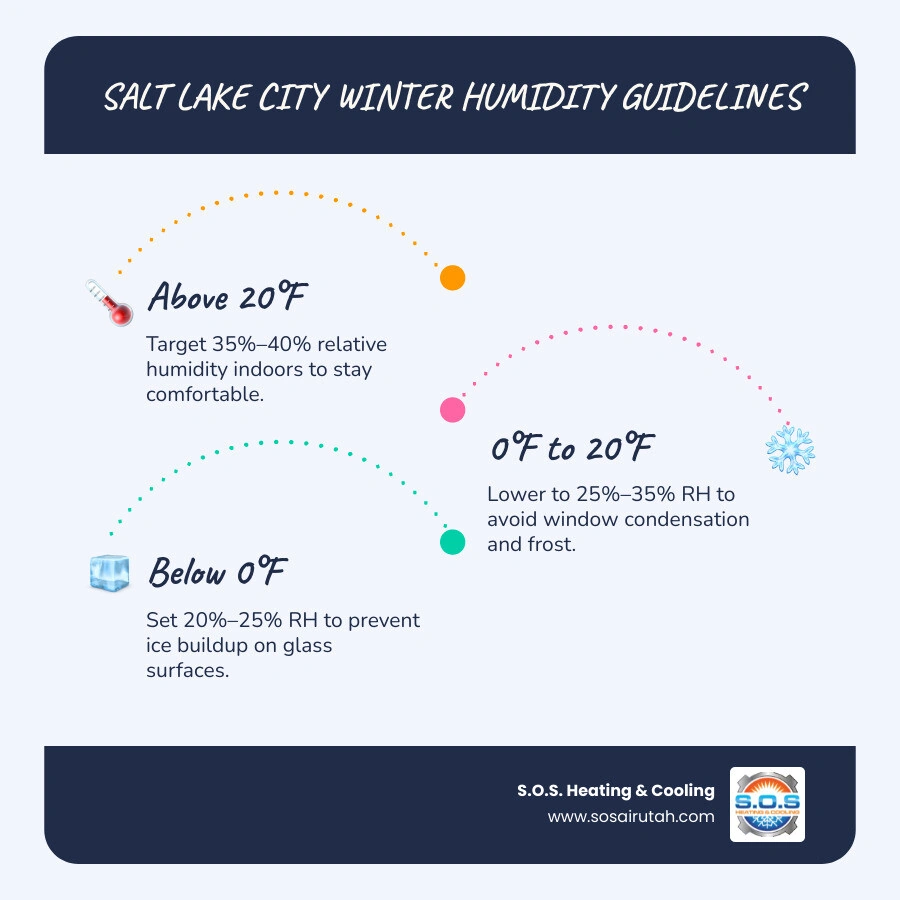
Target 30% to 40% relative humidity (RH) indoors during winter. When outdoor temperatures drop below 10°F, aim for the lower end — around 25% to 30% — to prevent condensation and frost on your windows.
| Outdoor Temperature | Recommended Indoor Humidity |
|---|---|
| Above 20°F | 35% – 40% RH |
| 10°F to 20°F | 30% – 35% RH |
| 0°F to 10°F | 25% – 30% RH |
| Below 0°F | 20% – 25% RH |
Salt Lake City winters are brutal on indoor air. The Wasatch Front sits in a high desert climate, and outdoor air here already carries very little moisture. When your furnace heats that cold, dry air, relative humidity inside your home can plummet to 10% to 20% — drier than many desert environments. That means dry skin, scratchy throats, static shocks off every doorknob, and even damage to your hardwood floors and furniture — all before January is over.
Most homeowners focus on the thermostat when winter hits. But temperature is only half the picture. Without proper humidity, your home can feel uncomfortable even at a perfectly set 70°F.
I'm Bryson Ninow, an HVAC professional with certifications in DOPL, RMGA, EPA, and NATE, and I've helped countless Salt Lake City homeowners solve the exact problem of what humidity level should I maintain in my Salt Lake City home during winter — from diagnosing dangerously dry air to recommending the right humidification systems for Utah's unique climate. In this guide, I'll walk you through everything you need to know to keep your home comfortable, healthy, and protected all season long.
What Humidity Level Should I Maintain in My Salt Lake City Home During Winter?
When the cold winds blow off the Great Salt Lake and settle over the valley, the air inside our homes changes dramatically. Finding the right balance of moisture is a delicate dance. If you let the air get too dry, you live with physical discomfort and risk structural damage to your home. If you pump too much moisture into the air, you end up with condensation running down your window panes, which can lead to structural rot and mold growth.
To keep your family comfortable and protect your property, we recommend aiming for the Ideal Indoor Humidity Levels for the Wasatch Front. For the vast majority of homes in Salt Lake City, Sandy, Draper, and Murray, keeping your indoor relative humidity between 30% and 40% during the coldest months strikes the perfect balance. This range is high enough to keep your skin hydrated and stop static electricity in its tracks, yet low enough to prevent moisture from pooling on cold glass surfaces. Understanding these Perfect Home Humidity Levels is the first step toward creating a truly comfortable indoor sanctuary.
The Science Behind Utah's Dry Winter Air
To understand why our homes feel like the Sahara Desert in January, we have to look at the unique geography and physics of the Wasatch Front. Salt Lake City sits in a high-elevation desert basin, heavily influenced by the rain shadow effect of the Sierra Nevada and Cascade ranges to the west, as well as our own local Wasatch Range. This means our baseline outdoor humidity is already quite low compared to the Midwest or coastal regions.
The second factor is pure thermodynamics: cold air simply cannot hold as much water vapor as warm air. When the outdoor temperature in Layton or Kaysville drops to 15°F, even if the outdoor relative humidity is a seemingly high 75%, the actual volume of water in that air is incredibly small.
When that freezing air leaks into your home through tiny gaps around doors and windows, your forced-air heating system goes to work. It takes that cold air and heats it up to a comfortable 70°F. Because warm air has a much higher moisture capacity, heating that air causes its relative humidity to drop exponentially. Without an active humidification system, that 15°F air with 75% RH outdoors instantly plummets to roughly 15% RH or lower once heated inside your home. Your furnace isn't actively destroying the water; it is simply expanding the air's capacity to hold water, making the existing moisture feel practically nonexistent.
Finding the Sweet Spot: 30% to 40% Relative Humidity
While organizations like the American Society of Heating, Refrigerating and Air-Conditioning Engineers (ASHRAE) recommend a broad indoor relative humidity range of 30% to 60% for general health and comfort, winter in Utah requires a more tailored approach. The Environmental Protection Agency (EPA) echoes a similar target of 30% to 50% year-round. However, if you attempt to maintain 50% humidity inside a Salt Lake home when it is 10°F outside, you will quickly run into trouble.
When warm, humid indoor air comes into contact with cold window glass, the air cools down rapidly. If it cools past its "dew point," the moisture condenses, turning into water droplets or even thick layers of frost along the bottom of your window frames. Over time, this pooling water ruins wood trim, peels paint, and creates a breeding ground for mold. This is why we must adjust our target downward as the outdoor temperature drops. Keeping your home in the 30% to 40% RH range ensures you remain comfortable without risking moisture damage.
The Hidden Dangers of Low Indoor Humidity
Many homeowners view dry indoor air as a minor seasonal annoyance — something that can be solved with an extra bottle of lotion or a few extra glasses of water. But chronic low humidity is a silent threat that impacts your health, your physical comfort, and the structural integrity of your home.
When relative humidity drops below the 30% threshold, the dry air acts like a sponge, aggressively pulling moisture out of everything it touches. This includes your skin, your respiratory tract, your wooden furniture, your floors, and even your pets. Understanding these risks is crucial, which is why we created our comprehensive Humidity Health Home Guide 2026 to help local residents protect their households. Additionally, learning How Low Humidity Affects Your Comfort and Your AC can prevent unexpected comfort issues when the seasons transition.
Impact on Health and Respiratory Comfort
Your body relies on a delicate moisture balance to keep its natural defense systems functioning properly. Your nasal passages and respiratory tract are lined with mucous membranes that capture dust, allergens, and pathogens before they can reach your lungs. When you breathe air that is consistently below 20% humidity, these membranes dry out, crack, and lose their protective abilities. This makes you far more susceptible to common winter ailments, including colds, sinus infections, and nosebleeds.
Furthermore, viruses thrive in dry air. Research, including studies from the Mount Sinai School of Medicine, shows that the influenza virus (and other airborne pathogens like measles) can survive longer and spread more easily when relative humidity drops below 40%. In dry air, infectious droplets expelled by a cough or sneeze stay suspended in the air longer because they are lighter. In balanced air (40% to 50% RH), these droplets absorb moisture, become heavier, and settle out of the air much faster.
Low humidity also leads to:
- Dry, itchy, and irritated eyes, which is especially problematic for contact lens wearers or those who spend long hours looking at screens.
- Disrupted sleep due to dry mouth, scratchy throat, and increased snoring.
- Flaring of chronic skin conditions such as eczema and psoriasis.
Understanding the Role of Indoor Air Quality in Your Home is essential to keeping your family healthy and happy through the cold winter months.
Damage to Hardwood Floors and Home Structure
Your body isn't the only thing suffering in a dry home. Wood is a hygroscopic material, meaning it acts like a natural sponge, absorbing and releasing moisture to stay in equilibrium with the surrounding air. When indoor humidity levels drop significantly during winter, wood begins to release its stored moisture, causing it to shrink and contract.
In homes across Salt Lake City, Bountiful, and Riverton, this shrinking manifests in several frustrating ways:
- Hardwood Floors: You may start noticing unsightly gaps between your floorboards that disappear when summer returns. Over time, chronic drying can cause the wood to cup, warp, or even split.
- Doors and Trim: Interior doors may suddenly fail to latch properly or stick in their frames because the door or the frame has shifted. Crown molding and baseboard joints can "pop" or pull apart, leaving visible gaps.
- Furniture and Musical Instruments: High-end wood furniture can develop cracks along its joints. Musical instruments made of wood, such as pianos, acoustic guitars, and violins, are incredibly sensitive to humidity changes. Without proper moisture control, they will quickly fall out of tune and can suffer permanent, expensive structural cracks.
How to Measure and Monitor Your Home's Moisture Levels
Before you can fix a problem, you have to measure it. Guessing the humidity level in your home based on "vibes" or how static-prone your blankets are is about as accurate as guessing your furnace's temperature by putting your hand near a vent.
Fortunately, keeping tabs on your indoor air quality is simple and inexpensive. By actively monitoring your moisture levels, you can take control of your environment and ensure you are always taking steps toward Enhancing Indoor Air Quality in your living space.
Signs Your Home is Too Dry
While a measuring tool is the gold standard, your home and body will drop plenty of hints when the air is desperately dry. Keep an eye out for these common warning signs:
- Frequent Static Shocks: If walking across your living room rug and touching a doorknob results in a miniature lightning storm at your fingertips, your humidity is too low.
- Physical Discomfort: Waking up with a scratchy throat, a dry mouth, chapped lips, or a crusty nose is a classic sign of dry indoor air.
- Struggling Houseplants: If your tropical houseplants are developing brown, crispy edges on their leaves despite regular watering, they are struggling to survive the dry indoor climate.
- Creaking Floors and Popping Trim: If your stairs and hardwood floors are suddenly much noisier when you walk on them, the wood is losing moisture and contracting.
Using a Digital Hygrometer for Accurate Readings
The absolute best way to monitor your indoor air is with a digital hygrometer. These small, battery-operated devices measure both temperature and relative humidity in real-time. They are highly accurate, inexpensive, and easy to read. Many modern smart thermostats also display relative humidity on their main screens, giving you a quick snapshot of your home's air quality.
To get the most accurate readings from your hygrometer, follow these best practices:
- Avoid Vents and Registers: Do not place the sensor directly in the path of supply registers or return vents, as this will give you an artificially high or low reading.
- Keep Away from Sunlight: Direct sunlight can heat the unit, throwing off both the temperature and relative humidity calculations.
- Avoid Moisture Sources: Keep the hygrometer away from kitchens and bathrooms, where cooking steam and hot showers create localized humidity spikes.
- Check Multiple Rooms: Humidity can vary between floors. If you live in a multi-story home in Draper or Sandy, place a sensor on each level to see if your moisture levels are consistent throughout the house.
Solutions for Maintaining the Perfect Winter Humidity
Once you've established that your home's humidity is falling below the recommended 30% to 40% range, it's time to take action. There are several ways to bring moisture back into your indoor air, ranging from simple lifestyle adjustments to advanced mechanical systems.
For a complete overview of your options, you can read about Whole Home Humidity Solutions Explained to see how modern technology can transform your living space. No matter which path you choose, understanding the Essential Role of Indoor Air Quality is key to making an informed decision for your family's comfort.
Portable Humidifiers vs. Whole-Home Systems
When looking to add moisture to a dry home, homeowners typically choose between portable room units and whole-home humidification systems.
- Portable Humidifiers: These are small, standalone devices designed to humidify a single room, such as a bedroom or nursery. They are highly accessible but come with significant drawbacks. They require daily refills, take up physical space, and need to be thoroughly cleaned with vinegar every two to three days to prevent mold and bacteria from growing in their water reservoirs. Furthermore, portable units cannot maintain consistent humidity across your entire home, leaving other rooms dry and unprotected.
- Whole-Home Humidifiers: These systems are professionally installed directly into your existing HVAC ductwork. They are connected to your home's water supply, meaning you never have to refill them. They work in tandem with your furnace to distribute moisture evenly through every register in your house. Best of all, they are controlled automatically by a digital humidistat, adjusting their output to maintain your exact target humidity level. For most families along the Wasatch Front, investing in Whole Home Humidifiers Salt Lake City UT is the most convenient and effective long-term solution.
How Whole-Home Humidifiers Integrate with Your HVAC System
Whole-home humidifiers work seamlessly with your heating system to deliver comfortable, balanced air. When your furnace turns on to heat your home, the humidifier introduces water vapor directly into the warm air stream before it is blown through your ductwork.
There are three primary types of whole-home systems available:
- Bypass Humidifiers: These systems redirect a portion of the warm air from your supply duct, pass it through a water-saturated pad (often called a water panel), and return it to the return duct. They are highly reliable, cost-effective, and use the furnace's blower fan to distribute moisture.
- Fan-Powered Humidifiers: Similar to bypass models, these units have their own built-in fan that actively pulls air across the water pad. This increases the evaporation rate and makes them a great option for larger homes or systems where space in the ductwork is limited.
- Steam Humidifiers: Often considered the "gold standard" of humidification, steam systems heat water electrically to create steam, which is then injected directly into your ductwork. Because they generate their own steam, they can operate independently of whether your furnace is actively heating. This makes them incredibly efficient and capable of maintaining precise humidity levels in large homes or properties with high-end wood finishes.
To learn more about how these systems function, check out How Adding a Humidifier Works with Your AC in Dry Weather. If you live in our surrounding service areas, we also offer specialized assistance for Whole Home Humidifiers Sandy UT, Whole Home Humidifiers Draper UT, Whole Home Humidifiers Murray UT, Whole Home Humidifiers Layton UT, and Whole Home Humidifiers Millcreek UT.
Frequently Asked Questions about Salt Lake City Winter Humidity
Managing indoor moisture can raise a lot of questions, especially when Utah's winter weather throws us for a loop. Here are some of the most common questions we hear from local homeowners.
What humidity level should i maintain in my salt lake city home during winter when temperatures drop below zero?
When the Wasatch Front experiences sub-zero temperatures, you must drop your indoor relative humidity target to 20% to 25%.
While this may feel slightly dry to your skin, it is absolutely necessary to protect your home. When it is extremely cold outside, your window glass becomes freezing cold. If your indoor humidity remains at 35% or 40%, the air hitting those windows will rapidly condense, forming thick layers of ice and frost. When the sun comes out and that ice melts, water will pool on your wooden sills and walls, leading to wood rot, peeling paint, and mold. Once the extreme cold snap passes, you can safely raise your humidistat back to the 30% to 40% range.
What humidity level should i maintain in my salt lake city home during winter to prevent mold?
To prevent mold growth, you should keep your indoor relative humidity below 40% during the winter, and never allow it to exceed 50% anywhere in your home.
Mold spores require moisture, oxygen, and an organic food source (like drywall or wood) to grow. While you can't easily remove drywall or oxygen from your home, you can absolutely control the moisture. By keeping your winter humidity in the 30% to 40% sweet spot, you provide enough moisture for personal comfort while keeping surfaces dry enough to prevent mold from taking hold. Additionally, always run your bathroom exhaust fans for at least 20 minutes after taking a shower to clear out localized steam.
Can a humidifier make my home feel warmer in the winter?
Yes, absolutely! There is a scientific reason why a humid day in the summer feels much hotter than a dry day at the exact same temperature. Moist air holds heat better than dry air, and it slows down the rate at which perspiration evaporates from your skin.
When your indoor air is bone-dry, moisture evaporates from your skin rapidly, which has a cooling effect on your body. This makes you feel chilly even if your thermostat is set to 72°F. By introducing proper humidity (around 35% to 40%), you slow down that evaporation process. As a result, 68°F with proper humidity can feel just as warm and cozy as 71°F in dry air. This allows you to turn your thermostat down a couple of degrees, leading to noticeable savings on your winter heating bills.
Conclusion
Answering the question of what humidity level should I maintain in my Salt Lake City home during winter is one of the easiest ways to transform your living space from a dry, static-filled environment into a cozy, healthy winter sanctuary. By aiming for that perfect 30% to 40% relative humidity range, you can protect your family's respiratory health, keep your skin hydrated, prevent static shocks, and safeguard your beautiful hardwood floors and wooden furniture from costly drying damage.
At S.O.S. Heating & Cooling, we are dedicated to helping families throughout the Salt Lake Valley enjoy unmatched indoor comfort all year long. Whether you are in Bountiful, South Jordan, Herriman, or Millcreek, our experienced, certified technicians are ready to help you find the perfect humidification solution for your home.
If you're ready to stop the winter itch, protect your property, and breathe easier, contact us today to schedule a professional indoor air quality consultation. Explore our premier services for Whole Home Humidifiers Salt Lake City UT and let us help you find your home's perfect moisture balance!

Plumbing
Expert plumbing services offering reliable repairs, installations, maintenance, and emergency support.

Air Conditioning
Comprehensive air conditioning services include installation, repairs, maintenance, and energy-efficient solutions.
Heat Pumps
Enjoy year-round comfort with our energy-efficient and professional heat pump solutions.

Indoor Air Quality
Enhance your home’s air with our cutting-edge indoor air quality solutions you can trust.

Fireplaces
Transform your space into a warm and cozy atmosphere with our professional fireplace services.

Heating
Specialized heating services provide reliable installation, repair, system maintenance, and energy-optimization solutions.
Explore Our Latest Insights and Updates in Plumbing Services
Ultimate Guide to Hard Water from Utah Aquifers Damaging Pipes and Fixtures
An Essential Guide to Pipe Replacement Age