
The Complete Guide to Cold Climate Heat Pumps


.avif)

Why Understanding What Is a Cold Climate Heat Pump and How It Differs From a Standard Unit Could Change How You Heat Your Home
What is a cold climate heat pump and how is it different from a standard unit? A cold climate heat pump (CCHP) is an advanced air-source heat pump engineered to deliver reliable, efficient heat even when outdoor temperatures drop well below freezing — down to -15°F or colder — while a standard heat pump begins losing significant heating capacity around 25°F to 35°F and increasingly depends on electric resistance backup heat to keep up.
Here is a quick side-by-side comparison:
| Feature | Standard Heat Pump | Cold Climate Heat Pump |
|---|---|---|
| Efficient operating range | Above ~30°F | Down to -15°F or -20°F |
| Capacity at 5°F | ~50% of rated capacity | 85-100% of rated capacity |
| Capacity at -13°F | ~20-40% of rated capacity | 70-85% of rated capacity |
| Compressor type | Single-stage or two-stage | Variable-speed inverter-driven |
| Backup heat reliance | Heavy below freezing | Minimal or none in many climates |
| Efficiency (COP) | ~300% (3x energy transferred) | Up to ~400% (nearly 4x energy transferred) |
| ENERGY STAR cold climate certified | No | Yes (COP ≥ 1.75 at 5°F required) |
| HSPF2 rating | 7.5–9.5 | 9.0–14.0+ |
The difference matters most on the coldest nights of the year — exactly when you need your heating system to perform at its best. Standard heat pumps were not designed for those conditions. Cold climate models were built specifically for them.
For Salt Lake City homeowners weighing a heat pump upgrade, this distinction is not just technical trivia. Utah winters can push overnight lows into the single digits in the Salt Lake Valley, and even colder in surrounding areas. Choosing the wrong type of heat pump can mean a system that leans heavily on expensive electric resistance backup heat all winter, erasing much of the efficiency advantage you were counting on.
I'm Bryson Ninow, and after years in the HVAC industry helping homeowners navigate energy-efficient upgrades — including guiding families through the process of understanding what is a cold climate heat pump and how is it different from a standard unit — I've seen how the right equipment choice translates into real winter comfort and real savings. I hold DOPL, RMGA, EPA, and NATE certifications, and I'm here to break this down in plain language so you can make a confident decision for your home.
What Is a Cold Climate Heat Pump and How Is It Different From a Standard Unit?
To understand how these systems differ, it helps to start with how they are alike. All air-source heat pumps work on the same basic principle: they do not actually "create" heat the way a gas furnace or electric baseboard does. Instead, they act as heat transporters. Even in freezing winter weather, there is still thermal energy present in the outdoor air. A heat pump absorbs this ambient heat and transfers it indoors.
When we look at Understanding Heat Pump Systems, we see that standard units perform beautifully in moderate temperatures. However, as the temperature drops, the physics of standard heat transfer becomes a major hurdle.
Understanding What Is a Cold Climate Heat Pump and How Is It Different From a Standard Unit
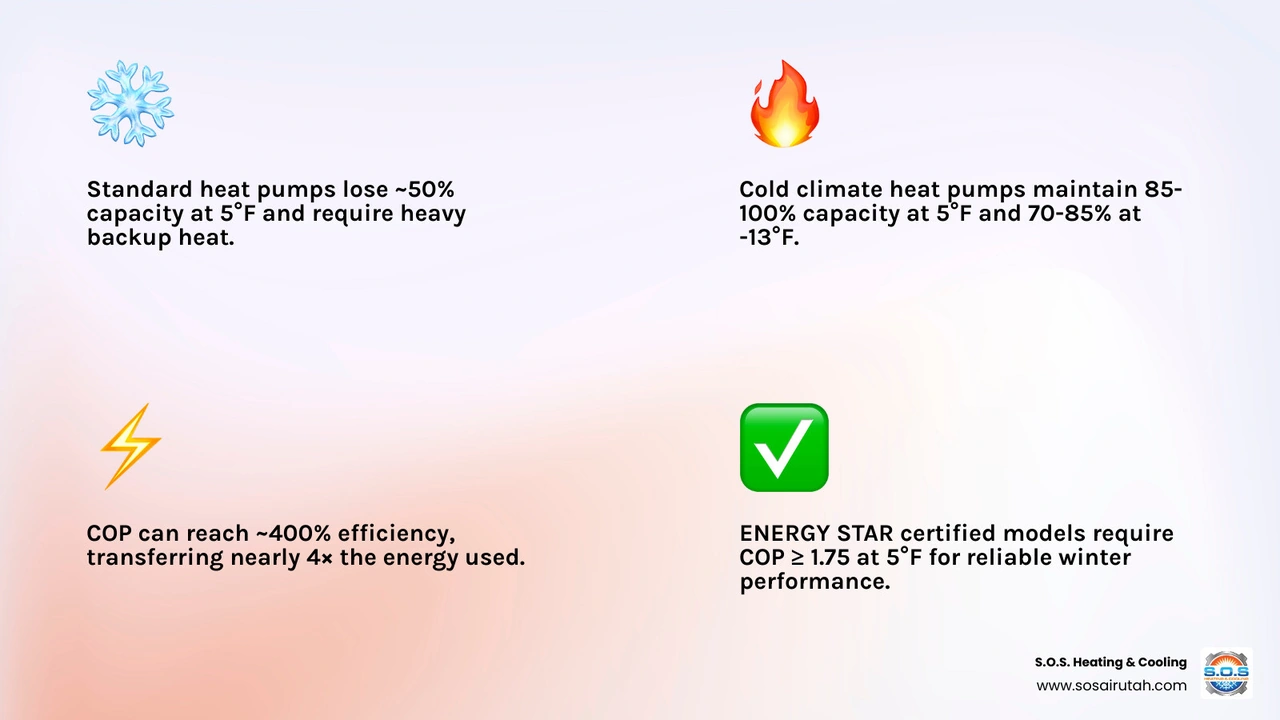
A standard heat pump is designed primarily for climates with mild winters. Once the outdoor temperature drops below freezing (32°F), a standard unit's ability to extract heat declines rapidly. By the time it hits 25°F, its heating capacity can drop to about 50%, forcing it to rely on auxiliary electric resistance heat strips. These heat strips consume massive amounts of electricity, which can cause winter utility bills to skyrocket.
In contrast, a cold climate heat pump is specifically engineered to overcome these sub-zero limitations. By utilizing specialized components, a CCHP can operate efficiently at temperatures down to -20°F. Instead of losing half of its heating output when the weather gets rough, a cold climate model can maintain 85% to 100% of its rated heating capacity at 5°F, and 70% to 85% at -13°F.
Key Performance Differences and Temperature Limits
The operational threshold is where the divide becomes most obvious:
- Standard Heat Pumps: These systems generally struggle below 30°F. While they will continue to run, their efficiency drops, and they cannot produce enough hot air to keep up with a home's heat loss.
- Cold Climate Heat Pumps: These units are designed to heat efficiently even below 5°F — with many operating down to -15°F or -20°F while only losing about 30% of their total capacity.
This means that while a standard unit is essentially a cooling system that can provide some light heating in the shoulder seasons, a CCHP is a true, year-round primary heating solution capable of handling a harsh Utah winter.
The Technology Behind Low-Temperature Heating
How does a cold climate heat pump manage to extract heat from sub-zero air when standard units freeze up and fail? The answer lies in advanced refrigeration engineering.

The Mechanics of What Is a Cold Climate Heat Pump and How Is It Different From a Standard Unit
Standard heat pumps typically use single-stage or two-stage compressors that run at either 100% capacity or 50% capacity. This on-and-off cycling is highly inefficient in extreme cold. Cold climate heat pumps, however, rely on several key technological innovations:
- Variable-Speed Inverter Compressors: These compressors can adjust their speed in tiny increments anywhere from 40% to 100% (and sometimes even higher in "boost" modes). When it is extremely cold, the compressor speeds up to pump more refrigerant through the system, extracting every available bit of outdoor heat.
- Enhanced Vapor Injection (EVI): This is a game-changing technology for sub-zero performance. EVI injects a portion of refrigerant vapor back into the compressor mid-cycle. This cools the compressor dome, allowing it to run at higher speeds and pressures without overheating, which significantly increases heating capacity at low ambient temperatures.
- Electronic Expansion Valves (EEVs): While standard systems use simple mechanical valves, CCHPs use electronic valves controlled by microprocessors. These adjust the refrigerant flow with extreme precision, maximizing efficiency as outdoor conditions change.
- Low Boiling Point Refrigerants: CCHPs use advanced refrigerants with very low boiling points (some as low as -44°F). This ensures the refrigerant remains cold enough to absorb heat from the outdoor air even when the outdoor temperature is well below zero.
Performance Metrics: HSPF2, COP, and Capacity Retention
When evaluating heat pumps, it is important to look past basic marketing claims and focus on standardized performance metrics:
- HSPF2 (Heating Seasonal Performance Factor 2): This represents a system's total heating output over a typical season divided by the total electric energy consumed. Standard heat pumps usually have an HSPF2 around 7.5 to 9.5. Cold climate models routinely achieve HSPF2 ratings of 9.0 to 14.0+.
- COP (Coefficient of Performance): This measures real-time efficiency. A COP of 1.0 means a system produces exactly as much energy as it consumes (like an electric baseboard). Standard air-source heat pumps are capable of transferring about 3x (300%) the energy they consume (a COP of 3.0) in mild weather. Cold climate heat pumps can reach nearly 400% efficiency (a COP of 4.0) under ideal conditions, and must maintain a COP of at least 1.75 at 5°F to qualify for ENERGY STAR cold climate certification.
- Capacity Retention at Low Temperatures: To earn the ENERGY STAR cold-climate label, a unit must prove that its heating capacity at 5°F is at least 70% of its capacity at 47°F. Leading CCHPs easily exceed this, maintaining up to 100% capacity at 5°F.
Organizations like the Northeast Energy Efficiency Partnerships (NEEP) maintain rigorous cold-climate air-source heat pump product lists, which require extensive low-temperature laboratory testing. Checking these databases ensures you are getting a verified cold-weather performer.
Sizing, Installation, and Maintenance for Utah Winters
Transitioning to a cold climate heat pump requires a careful approach to design and installation. In places like Salt Lake City, Sandy, Draper, and Murray, winter weather can bring heavy snow and sustained freezing temperatures.
Sizing What Is a Cold Climate Heat Pump and How Is It Different From a Standard Unit for Utah Homes
When deciding Is a Heat Pump Right for Your Home, proper sizing is the most critical step. Historically, traditional heat pumps were sized primarily for cooling loads. However, sizing a CCHP for cooling in Utah's climate will result in a system that is significantly undersized for our heating needs.
To get it right, we perform a detailed ACCA Manual J load calculation. This calculation takes into account your home's insulation, window quality, layout, and local design temperatures. When installing a system, we size it to meet the heating load at our local winter design temperatures. Because CCHPs use variable-capacity inverter compressors, they can "turn down" their output during the summer, preventing the short-cycling issues that traditional, oversized cooling systems face.
If you need a brand-new system or are looking to upgrade, our team handles professional Heat Pump Installation Salt Lake City UT and complete Heat Pump Replacement Salt Lake City UT to ensure your equipment is sized perfectly for the Wasatch Front.
Installation Best Practices and Supplemental Heat Strategies
Installing a heat pump in a cold climate requires specific outdoor considerations:
- Elevating the Outdoor Unit: Outdoor units must be mounted on a sturdy stand or wall bracket at least 18 inches above the ground. This keeps the outdoor coil clear of heavy snow accumulation and allows melted frost to drain freely during defrost cycles.
- Defrost Cycle Management: When temperatures drop below 32°F, moisture can freeze on the outdoor coils. The heat pump will occasionally run a brief defrost cycle (usually lasting about 15 minutes) to melt this ice. Proper placement on a gabled side of the home prevents falling roof snow or dripping ice from damaging the unit.
- Supplemental Heat Strategies: While a CCHP can handle the vast majority of your winter heating, many homeowners choose a Hybrid Heat Pump System (also called a dual-fuel system). This pairs the heat pump with a high-efficiency gas furnace. The heat pump handles the heating down to its "balance point" (often around 15°F to 20°F), and the gas furnace kicks in during extreme sub-zero cold snaps.
- Ductless Applications: If your home lacks ductwork or has hard-to-heat rooms, you might Consider Mini Split Heat Pumps. These ductless systems are incredibly efficient and are among the highest-performing cold climate options available.
Maintenance and Lifespan Considerations
With proper care, a modern cold climate heat pump can easily last 15 to 20 years. However, because these systems work hard year-round for both heating and cooling, keeping up with basic maintenance is essential:
- Keep the Unit Clear: Regularly check the outdoor unit during winter storms to ensure snow and ice are not blocking the airflow.
- Clean the Filters: Ductless wall heads and central air handlers need clean filters to maintain the high airflow rates (typically 400 to 500 CFM per ton) required for optimal heat transfer.
- Schedule Professional Tune-Ups: Just like standard systems, CCHPs benefit from annual professional service. If your system ever acts up or needs a pre-season check, our technicians provide prompt Heat Pump Repair Salt Lake City UT and comprehensive Heat Pump Tune Up Salt Lake City UT to keep things running efficiently.
Frequently Asked Questions about Cold Climate Heat Pumps
Do cold climate heat pumps really work below zero?
Yes. Modern cold climate heat pumps are specifically engineered to extract heat in sub-zero conditions. Real-world field testing conducted by the Department of Energy across extremely cold regions has shown that these units continue to deliver comfortable, reliable heat at temperatures as low as -15°F to -22°F. While they do lose some capacity in extreme cold, they retain enough strength to keep homes warm without relying entirely on backup heat.
Can a cold climate heat pump completely replace a gas furnace?
In many homes, yes. If your home is well-insulated and has modern double-pane windows, a properly sized cold climate heat pump can handle 100% of your heating needs. However, in older, draftier homes, or for homeowners who want peace of mind during extreme winter storms, a dual-fuel setup (pairing a CCHP with a gas furnace) is often the most practical and comfortable option.
What incentives or tax credits are available for cold climate heat pumps in 2026?
Under the federal Inflation Reduction Act, homeowners can qualify for a tax credit of 30% of the total installation cost (up to a maximum of $2,000) for qualifying ENERGY STAR cold climate heat pumps. Additionally, many local Utah utilities offer substantial rebates for upgrading to high-efficiency electric heating. When you evaluate the Cost for Ductless Heat Pump or ducted systems, factoring in these incentives can make the upgrade highly cost-effective.
Conclusion
Choosing between a standard heat pump and a cold climate model comes down to where you live and how you want your home to feel during the coldest months of the year. For Utah homeowners, investing in cold climate technology ensures your system won't leave you in the cold when temperatures drop.
At S.O.S. Heating & Cooling, we are proud to provide top-tier HVAC and plumbing services across the Salt Lake Valley, including Bountiful, Centerville, Draper, Layton, Murray, Riverton, Sandy, and Salt Lake City. We offer 24/7 emergency repairs, priority service for our maintenance partners, and no evaluation fees during normal business hours.
If you are ready to explore your options for a warmer, more efficient home this winter, check out our S.O.S. Heating & Cooling Sandy UT Systems page or contact us today to schedule an in-home consultation!

Plumbing
Expert plumbing services offering reliable repairs, installations, maintenance, and emergency support.

Air Conditioning
Comprehensive air conditioning services include installation, repairs, maintenance, and energy-efficient solutions.
Heat Pumps
Enjoy year-round comfort with our energy-efficient and professional heat pump solutions.

Indoor Air Quality
Enhance your home’s air with our cutting-edge indoor air quality solutions you can trust.

Fireplaces
Transform your space into a warm and cozy atmosphere with our professional fireplace services.

Heating
Specialized heating services provide reliable installation, repair, system maintenance, and energy-optimization solutions.
Explore Our Latest Insights and Updates in Plumbing Services
The Complete Guide to Trenchless Sewer Repair in Salt Lake
Tankless vs Tank Water Heater: Utah Homeowner Guide