
How to Prevent AC Capacitor Failure in Utah Summer Heat


.avif)

Why AC Capacitors Fail So Often in Utah's Summer Heat
Why do AC capacitors fail so often in utah summer heat comes down to a straightforward but brutal reality: Utah summers push these small electrical components well beyond what they were designed to handle.
Here is a quick breakdown of the main reasons:
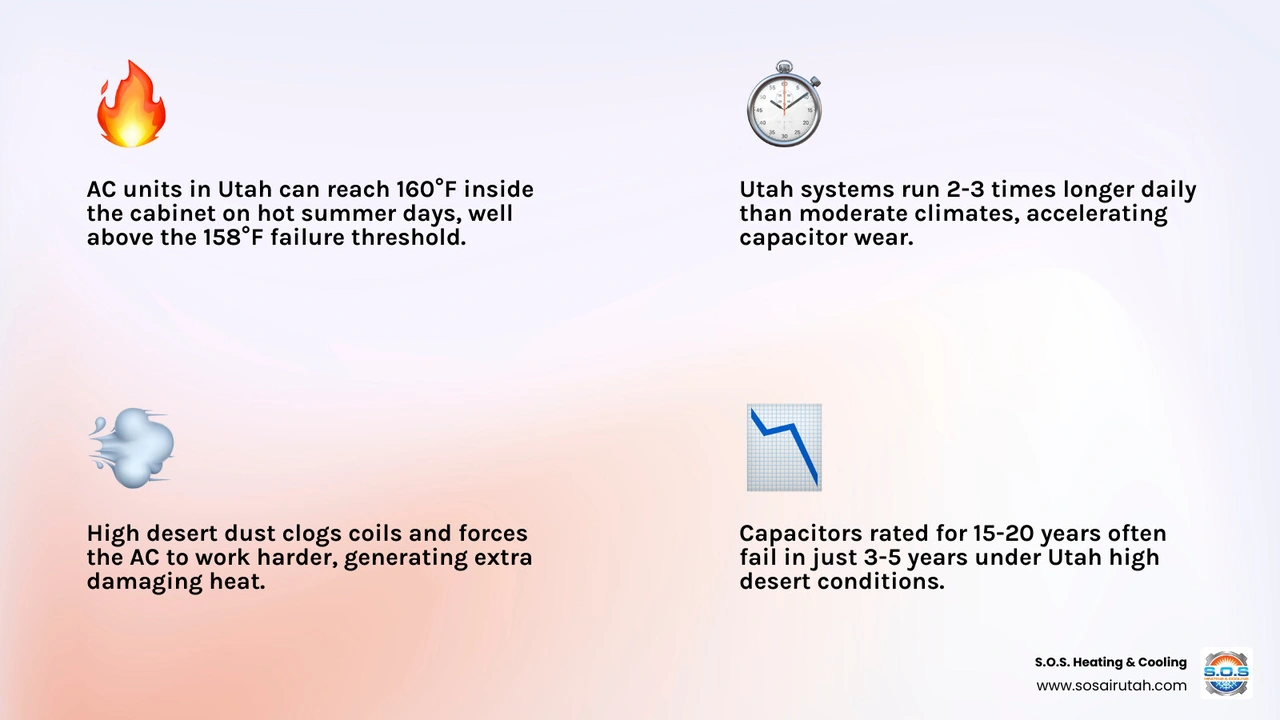
- Extreme ambient temperatures — Salt Lake Valley regularly sees temperatures above 100°F, and the electrical cabinet inside your outdoor AC unit can reach 160°F or higher on peak summer afternoons
- Extended run times — Utah systems run far longer each day than AC units in moderate climates, putting constant stress on capacitor components
- Chemical breakdown — The electrolytic fluid inside capacitors degrades rapidly when internal temperatures exceed the 158°F design threshold, causing capacitance to drop
- High desert dust — Abrasive airborne particles clog condenser coils, forcing the system to work harder and generate even more heat
- Daily temperature swings — Utah's 20–40°F swings between day and night cause repeated thermal expansion and contraction that weakens capacitor structure over time
- Winter inversion buildup — Particulate matter that settles into dormant AC equipment during inversion season compounds the stress your capacitor faces when summer starts
The result is that capacitors rated to last 15–20 years often fail in as little as 3–5 years in Utah's high desert conditions — and they tend to quit at the worst possible moment, on the hottest day of the year.
I'm Bryson Ninow, an NATE-certified HVAC professional with years of experience helping Salt Lake City homeowners understand why AC capacitors fail so often in utah summer heat and what they can do about it before an emergency leaves them without cooling. In the sections below, I'll walk you through exactly what causes these failures, how to spot the warning signs early, and the practical steps you can take to protect your system this summer.
What is an AC Capacitor and What Does It Do?
Before we dive into why these parts give out, we need to understand what they actually do. Think of your air conditioner's capacitor as a powerful, short-term battery. While your home’s electrical panel provides plenty of continuous power to run standard household appliances, it doesn't supply quite enough instantaneous "kick" to start up the heavy-duty electric motors inside your air conditioner.
This is where the capacitor comes in. It stores up electrical energy and releases it in a massive, concentrated burst to get your system up and running. Once the motors are spinning, the capacitor continues to deliver a steady, phase-shifted flow of electricity to keep everything running smoothly and efficiently.
Inside a typical residential AC unit, you will encounter three main types of capacitors:
- Start Capacitor: This component provides the initial high-torque electrical boost required to get the compressor motor moving from a complete standstill. Once the motor reaches about 75% of its operating speed, the start capacitor drops out of the electrical circuit.
- Run Capacitor: This part stays active throughout the entire cooling cycle. It provides continuous electrical energy to keep both the compressor and the outdoor condenser fan motor spinning at a steady, efficient rate.
- Dual Run Capacitor: Most modern residential air conditioners use a space-saving dual run capacitor. This single cylindrical metal "can" combines both start and run functions, featuring three distinct terminals on top to connect the compressor, the fan motor, and the common power line.
Capacitors are rated and measured using two primary electrical specifications: voltage and microfarads (µF). Voltage ratings (typically 370V or 440V in residential systems) indicate the maximum electrical pressure the component can safely handle. Microfarads measure the overall storage capacity of the unit.
If a capacitor's microfarad output drops even 10% below its rated value, the connected motors will struggle to start, draw excessive electrical current, and rapidly overheat. Understanding how these electrical demands interact with modern system designs can help you see How Advanced AC Technology Improves Your Home Comfort while keeping your monthly utility bills in check.
Why Do AC Capacitors Fail So Often in Utah Summer Heat?
If you live along the Wasatch Front—whether in Salt Lake City, Sandy, Draper, or Layton—you know that our summers are no joke. The combination of intense high-altitude sunlight, low relative humidity, and sustained triple-digit temperatures creates a punishing environment for outdoor machinery.
But why is the capacitor always the first part to quit? To answer that, we have to look at how high desert weather directly impacts your air conditioner's lifespan. The relentless heat forces your system to run for hours on end, which places an incredible thermal and physical load on every electrical component. You can read more about this regional challenge in our guide on How High Desert Weather Affects AC Equipment Lifespan.
The Science Behind Why Do AC Capacitors Fail So Often in Utah Summer Heat
At its core, a capacitor is an electrochemical device. Inside its protective metal casing are layers of thin metal foil separated by a microscopic insulating layer called the dielectric material, which is saturated with a specialized electrolytic fluid. This fluid is highly sensitive to changes in temperature.
Most standard residential capacitors are rated to withstand internal temperatures up to 158°F (70°C). While a 100°F afternoon in West Valley City or South Jordan might seem well below that limit, the temperature inside your AC unit's metal electrical cabinet is a completely different story.
When the sun beats down on a south- or west-facing condenser unit, radiant heat transfers directly into the metal housing. Combined with the heat generated by the electrical current flowing through the wires, cabinet temperatures easily climb to 160°F or 175°F.
Under these extreme conditions, the electrolytic fluid inside the capacitor begins to vaporize and expand. This causes the internal pressure to rise, leading to:
- Thermal expansion and contraction: The physical structure of the capacitor expands during the blazing afternoon heat and contracts during our cool, high-desert nights (which can drop by 30°F or more). This constant flexing weakens the internal seals.
- Chemical breakdown: The high heat permanently degrades the chemical composition of the dielectric material, destroying its ability to store an electrical charge.
- Bulging and leaking: As pressure builds, the top of the capacitor's metal cylinder will physically bulge outward. In severe cases, the safety seal ruptures, and the non-conductive oil leaks out, leaving the capacitor completely dead.
With the summer 2026 cooling season pushing systems to their absolute limits, these chemical and physical breakdowns are happening faster than ever before.
How High Desert Dust and Inversions Accelerate Wear
The heat isn't the only environmental factor working against your air conditioner in Utah. Our unique geography brings two other major challenges: abrasive high desert dust and winter inversion particles.
During the dry summer months, windstorms sweep across the valley floor, carrying fine, sandy dust from construction sites and desert landscapes. This dust settles deep inside your outdoor condenser unit, coating the aluminum fins and clogging the condenser coils.
When coils are choked with dirt, the system cannot release heat efficiently. The compressor has to work twice as hard to cool your home, which dramatically increases the electrical current (amperage) running through the system. This extra current generates even more heat inside the electrical cabinet, accelerating the destruction of your capacitor.
Furthermore, our winter inversion season plays a surprising role in summer breakdowns. During the winter, heavy particulate matter and pollutants settle in the valley, creating a sticky, grimy layer on dormant outdoor equipment. When summer arrives, this leftover winter grime acts as an insulating blanket, trapping heat inside the unit from day one. This cycle demonstrates How Seasonal Extremes Create Year-Round Maintenance Demands for homeowners across the Wasatch Front.
Common Signs Your AC Capacitor is Failing
A failing capacitor rarely goes out in complete silence. Usually, your system will give you several clear warning signs that a breakdown is imminent. Recognizing these symptoms early can save you from a hot, sleepless night in Kaysville or Herriman.
- The Outdoor Unit Hums but Won't Start: This is the classic textbook sign of a dead capacitor. You will hear a loud, steady electrical humming noise coming from your outdoor unit, but the condenser fan blade won't spin, and the compressor won't kick on. The motor is trying to start, but it lacks the necessary startup torque.
- Hard Starting: If your air conditioner stutters, clicks repeatedly, or sounds like it is struggling to get going when a cooling cycle begins, it is "hard starting." This means your capacitor is weak and can barely deliver enough energy to turn the motor over.
- Warm Air Blowing from Vents: If your indoor blower fan is running but the outdoor compressor can't start due to a failed run capacitor, your system will simply circulate lukewarm indoor air throughout your home.
- Short Cycling: A weak capacitor can cause your air conditioning system to turn on and off rapidly. Because the capacitor cannot maintain a steady electrical current, the motors overheat and trip their internal thermal safety switches, shutting the system down prematurely.
- Unusually High Energy Bills: When a capacitor's microfarad output drops, the compressor and fan motors must draw significantly more electrical current to do the same amount of work. This drop in efficiency can cause your monthly electricity costs to spike.
If you notice any of these issues, it is crucial to address them immediately. Running your system with a failing capacitor places immense strain on your expensive compressor motor. For a complete guide on handling these urgent cooling issues, check out our AC Repair Bountiful UT Complete Guide.
How to Prevent AC Capacitor Failure This Summer
While you can't change Utah's climate, you can take several practical, proactive steps to protect your air conditioner's capacitor from premature failure.
- Provide Proper Shade: Direct afternoon sunlight can raise your condenser's operating temperature by 10 to 15 degrees. Installing a trellis, planting a screen of bushes, or setting up a professional shade structure on the south or west side of your unit can keep it significantly cooler. Just ensure any plants or structures are kept at least 24 inches away from the unit to maintain proper airflow.
- Keep the Condenser Clean: Regularly wash away high desert dust and cottonwood seeds from your outdoor condenser coils. Turn off the power to the unit at the outdoor disconnect box, and use a gentle garden hose (never a pressure washer, which can bend the delicate aluminum fins) to rinse the coils from the top down.
- Install Dedicated HVAC Surge Protection: Power surges and voltage fluctuations from summer storms or grid strain can instantly destroy a capacitor's internal dielectric layer. Installing a specialized surge protector at your AC's outdoor disconnect box provides an essential line of defense.
- Schedule Professional Inspections: A technician can use a digital multimeter to measure your capacitor's exact microfarad output during a routine checkup, catching a weak component long before it leaves you stranded in the heat.
To help you understand the value of staying ahead of these issues, here is a quick comparison of proactive vs. reactive capacitor care:
| Feature | Proactive Replacement (During Maintenance) | Reactive Replacement (After Failure) |
|---|---|---|
| Timing | Scheduled at your convenience in spring | Emergency call during a peak summer heatwave |
| System Health | Protects the compressor from electrical strain | Risks permanent, expensive damage to the compressor |
| Comfort Level | Zero cooling downtime for your family | Hours or days without AC during triple-digit heat |
| Diagnostic Cost | Often included in standard maintenance plans | May involve after-hours or emergency service fees |
Why Proactive Maintenance is Key to Preventing Why Do AC Capacitors Fail So Often in Utah Summer Heat
The single most effective way to prevent a sudden summer breakdown is to schedule a professional spring tune-up. During a maintenance visit, an experienced technician will open the electrical cabinet and use a high-precision multimeter to test the capacitor's microfarad (µF) output.
Most capacitors are designed with a manufacturer tolerance of ±5% or ±6%. If a capacitor rated for 45 µF reads at 38 µF, it is operating well outside its safe tolerance. While the system might still run, the motors are drawing excessive amperage and wearing down. Catching this during a routine inspection allows for an easy, stress-free replacement.
To learn more about how we keep your system running efficiently, explore our guide on AC Maintenance for Optimal Function and discover Why Regular AC Tune-Ups Are Vital for preserving your system's overall lifespan.
The Dangers of DIY Capacitor Replacement
With plenty of instructional videos online, some homeowners are tempted to purchase a cheap replacement capacitor online and install it themselves. We strongly advise against this.
Capacitors are high-voltage storage devices. Because they are designed to store a massive electrical charge, they hold a potentially lethal electrical current even when the power to your home and AC unit is completely turned off.
Handling a charged capacitor without the proper training, safety gear, and discharging tools can result in severe electrical shock, painful burns, or worse. Additionally, installing a capacitor with the incorrect microfarad or voltage rating can instantly destroy your fan motor or burn out your compressor, turning a simple repair into a massive, expensive system replacement. Always leave high-voltage electrical work to licensed professionals.
Frequently Asked Questions about Utah AC Capacitors
What is the average lifespan of an AC capacitor in Utah?
In mild, moderate climates, a high-quality AC capacitor can easily last 10 to 15 years. However, in Utah's demanding high desert climate, the reality is much shorter. Due to intense summer heat, extended run times, and dusty conditions, most capacitors along the Wasatch Front last between 3 to 5 years. If your system is unmaintained or sits in direct, unshaded afternoon sunlight, it may fail even sooner.
Can a bad capacitor damage my AC compressor?
Yes, absolutely. This is the most dangerous consequence of ignoring a weak capacitor. When a run capacitor loses its storage capacity, the compressor motor has to work much harder to spin, causing it to draw excessive electrical current. This extra amperage generates extreme heat within the compressor's internal windings. Over time, this thermal overload will degrade the compressor's lubricating oil and burn out the motor windings, leading to a catastrophic cascade failure that requires an expensive compressor or complete system replacement.
How often should I have my AC capacitor tested?
We highly recommend having your AC capacitor tested at least once a year, ideally during your professional spring tune-up before the hot summer weather arrives. Testing the capacitor annually allows technicians to catch declining microfarad levels and replace the part proactively, saving you from summer breakdowns. For a detailed look at what a professional inspection includes, check out our AC Tune-Up Checklist What Your Technician Should Check and our comprehensive AC Maintenance Sandy UT Complete Guide.
Conclusion
Understanding why do ac capacitors fail so often in utah summer heat is the first step toward protecting your home's comfort and avoiding unexpected breakdowns. The combination of intense high desert heat, abrasive dust, and daily thermal cycling makes our local climate incredibly tough on electrical components. Fortunately, with consistent maintenance, proper shading, and proactive testing, you can keep your cooling system running reliably all summer long.
At S.O.S. Heating & Cooling, we are dedicated to keeping families across the Salt Lake Valley safe and comfortable. We proudly serve homeowners in Salt Lake City, Sandy, Draper, Bountiful, Layton, South Jordan, Riverton, and the surrounding communities. With our 24/7 emergency repair services, zero evaluation fees during business hours, and flexible financing options, we make it easy to get the professional service you need, exactly when you need it.
Don't wait for the peak of summer heat to find out if your AC is up to the task. Contact us today to schedule your professional system tune-up, or reach out for fast, reliable service if your system is showing signs of trouble with our expert team for AC Repair Salt Lake City UT.

Plumbing
Expert plumbing services offering reliable repairs, installations, maintenance, and emergency support.

Air Conditioning
Comprehensive air conditioning services include installation, repairs, maintenance, and energy-efficient solutions.
Heat Pumps
Enjoy year-round comfort with our energy-efficient and professional heat pump solutions.

Indoor Air Quality
Enhance your home’s air with our cutting-edge indoor air quality solutions you can trust.

Fireplaces
Transform your space into a warm and cozy atmosphere with our professional fireplace services.

Heating
Specialized heating services provide reliable installation, repair, system maintenance, and energy-optimization solutions.
Explore Our Latest Insights and Updates in Plumbing Services
In Depth Guide to Dominion Energy Rebates for High Efficiency Furnace Replacement in the Salt Lake Valley
The Easiest Way to Stop Tree Roots From Infiltrating Drain Lines