

How to Troubleshoot AC Not Cooling but Running


.avif)

Why Your AC Is Running But Not Cooling in the Salt Lake Valley
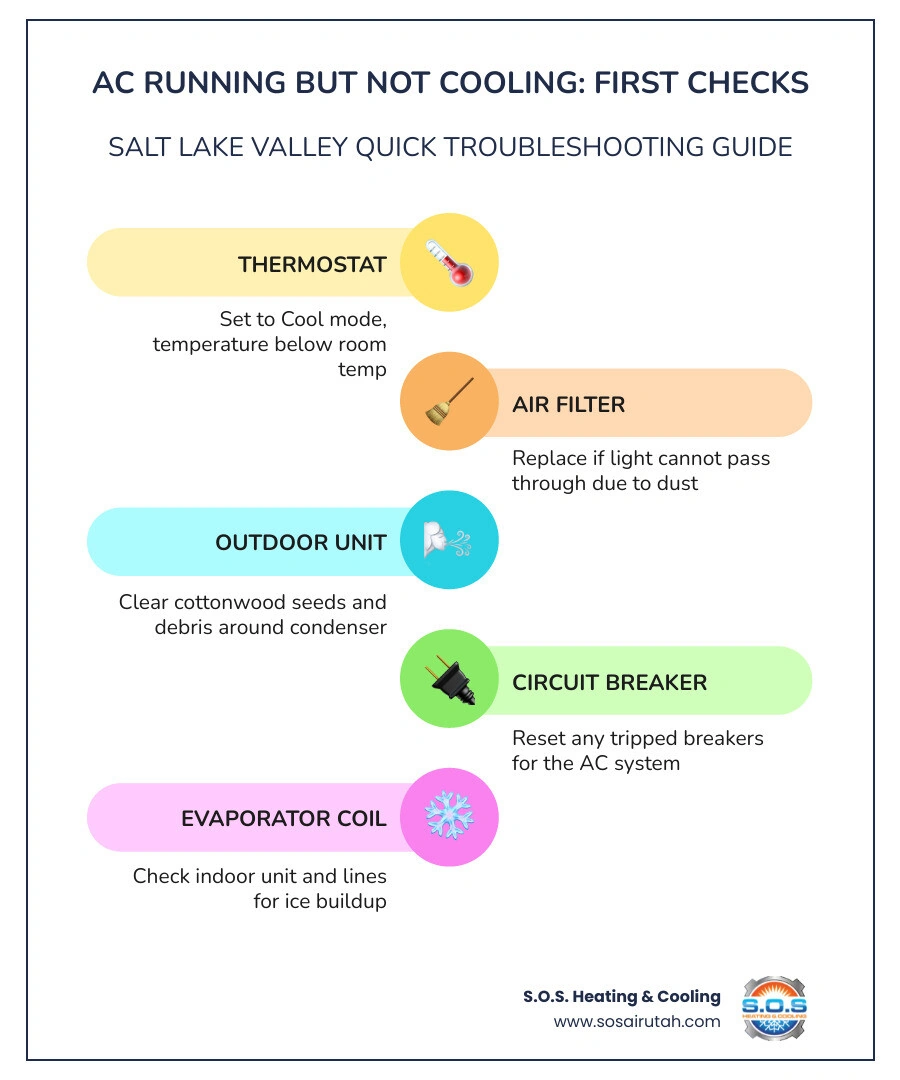
If you're dealing with ac not cooling but running what to check first in the Salt Lake Valley, here's a quick answer before we dive deeper:
Check these first, in order:
- Thermostat settings - Make sure it's set to "Cool" mode, not "Fan Only," and the temperature is set below the current room temperature
- Air filter - A clogged filter is the most common cause; replace it if you can't see light through it
- Outdoor condenser unit - Clear any debris, weeds, or cottonwood seeds blocking airflow around the unit
- Circuit breakers - Check your electrical panel for any tripped breakers tied to the AC system
- Evaporator coil - Look for ice buildup on the indoor unit or refrigerant lines
- Refrigerant levels - If you hear hissing or notice ice buildup after the filter is clean, you likely have a leak
- Capacitor or compressor - If the outdoor unit hums but won't fully start, this is the likely cause
On a hot Salt Lake City summer day, there's nothing more frustrating than hearing your air conditioner running while your house keeps getting warmer. The problem is more common than you might think — and in Utah's dry, dusty climate, the causes tend to show up faster and more frequently than in other parts of the country.
The Salt Lake Valley's combination of intense summer heat, high dust levels, active construction, and cottonwood season creates the perfect conditions for AC stress. Filters clog faster here. Condenser units get coated in grit and seed fluff. Temperature swings put extra strain on components that are already working hard. The good news is that many of the most common causes are things you can check yourself in under ten minutes — before picking up the phone.
I'm Bryson Ninow, an NATE-certified HVAC technician with hands-on experience diagnosing why an ac is not cooling but running, and what to check first specifically in the Salt Lake Valley's unique climate conditions. In the sections below, I'll walk you through every check — from the simplest thermostat fix to the signs that it's time to call a pro.
AC Not Cooling But Running What to Check First in the Salt Lake Valley
When the summer sun beats down on the Wasatch Front, our homes should be our cool sanctuaries. But if your air conditioner is humming along and your indoor temperature is still climbing, you are dealing with one of the most common summer headaches.
In the Salt Lake Valley, troubleshooting this issue requires looking at the system as a whole. Because our dry air carries a high concentration of dust, pollen, and construction debris, systems here operate under unique environmental stressors. Before you assume your system has suffered a catastrophic mechanical failure, it is best to run through a quick sequence of diagnostic steps. Many "no-cool" service calls turn out to be simple issues that homeowners can address on their own.
By performing a few simple checks, you can save yourself time and avoid unnecessary stress. If you want to systematically rule out the basic issues, reviewing AC Troubleshooting Tips Before Calling a Pro is an excellent place to start. Let's break down the very first things you should inspect when your air conditioner runs but fails to lower the indoor temperature.

AC Not Cooling But Running What to Check First in the Salt Lake Valley: Thermostat Settings
It might sound too simple to be true, but the thermostat is the brain of your HVAC system, and it is remarkably easy for its settings to get thrown off. We have seen cases where a toddler accidentally bumped the display, or a well-meaning family member adjusted the settings without letting anyone else know.
First, verify that your thermostat is set to COOL mode rather than HEAT or OFF. Next, check the fan setting. If the fan is set to ON, the blower motor will run continuously, circulating air through your home even when the outdoor compressor is not actively cooling. This can blow lukewarm, unconditioned air into your rooms, making it feel as though your system is failing. Switching the fan setting to AUTO ensures the fan only blows when the system is actively cooling the air.
Don't forget to check the physical condition of the thermostat itself. If the screen is blank or flickering, it may need fresh batteries. A weak battery can cause the thermostat to lose its calibration or fail to send the signal to kick on the outdoor condenser. Also, ensure the thermostat isn't mounted in direct sunlight or near a heat-producing appliance, which can trick the sensor into reading the indoor air as much hotter than it actually is.
AC Not Cooling But Running What to Check First in the Salt Lake Valley: Air Filters
If your thermostat settings are correct, the absolute next stop on your troubleshooting journey must be the air filter. A dirty, clogged air filter is the single most common cause of an air conditioner running without cooling, accounting for up to 30% of cooling-related service calls in hot, dry climates.
When an air filter is caked in dust, it acts like a wall, severely restricting the volume of air that can pass through your system. Without adequate airflow, your air conditioner cannot pull the warm air out of your living spaces, nor can it distribute conditioned air back through your vents. This lack of airflow also causes the temperature of the indoor evaporator coil to drop rapidly, leading to frozen coils and a complete system choke.
To determine if your filter is the culprit, perform the "Light Test." Take the filter out and hold it up to a light source. If you cannot see light passing through the fibers, your filter is suffocating your system. In the Salt Lake Valley, the combination of dry summer winds, regional dust storms, and heavy construction means filters load up much faster than the manufacturer's standard 90-day recommendation. Homeowners along the Wasatch Front often need monthly filter changes during peak summer. To understand the full impact of this simple maintenance step, read about How Dirty Air Filters Destroy Your AC Performance.
Inspecting the Outdoor Condenser and Indoor Coils
Once you have verified that your indoor airflow is clear and your thermostat is operating correctly, it is time to inspect the physical coils that make the cooling process possible. Your air conditioner relies on two main coils: the outdoor condenser coil and the indoor evaporator coil. Both must be clean and unobstructed to transfer heat out of your home.
Start by heading outside to inspect your outdoor condenser unit. The condenser's job is to release the heat absorbed from inside your home into the outdoor air. However, in neighborhoods like Bountiful, Murray, and Millcreek, cottonwood seeds and lawn clippings can blanket the delicate metal fins of the outdoor unit, creating a thick, insulating layer. If the condenser coils are blocked, the heat remains trapped in the system, and your AC will blow warm air even while running continuously.
When inspecting the outdoor unit, apply the "2-foot rule":
- Maintain at least 2 feet of clear space around the entire perimeter of the condenser.
- Keep bushes, weeds, and decorative plants trimmed back.
- Ensure there is at least 5 feet of clearance directly above the unit so hot air can escape freely.
- If the coils are dirty, turn off the power at the breaker and gently rinse them with a garden hose. Never use a pressure washer, as the high-pressure stream will bend the delicate aluminum fins and permanently restrict airflow.
Next, you need to check the indoor evaporator coil for ice. If you notice weak airflow, or if your home feels unusually humid, your evaporator coil may have frozen over. When ice forms on the coil, it acts as an insulator, blocking the refrigerant from absorbing heat.
If you suspect a frozen coil, here is the proper thawing process:
- Turn the thermostat to OFF immediately to prevent compressor damage.
- Switch the fan setting to ON to force warm room air over the frozen coil, helping it melt.
- Check the condensate drain line to ensure the melting ice doesn't overflow your drain pan.
- Allow the system to thaw completely (this can take anywhere from 4 to 24 hours) before attempting to run it again.
For a deeper look into dealing with frozen components or sudden system failures, check out our guide on What to Do When Your AC Stops Cooling.
Identifying Mechanical, Electrical, and Refrigerant Issues
If your thermostat is set correctly, your filter is clean, and your coils are free of debris, the issue likely stems from a mechanical, electrical, or refrigerant problem. Because these systems are complex, identifying the specific symptoms can help you determine whether you can resolve the issue safely or if it is time to call in the professionals.
To help you quickly distinguish between airflow-related problems and mechanical or refrigerant failures, refer to the comparison table below:
| Symptom | Likely Airflow Issue | Likely Refrigerant / Mechanical Issue |
|---|---|---|
| Airflow Strength | Very weak or barely noticeable at the registers | Normal blower strength, but the air is warm or lukewarm |
| Noises | Whistling or straining sounds near the return grille | Hissing, bubbling, or metallic clanking from the unit |
| Ice Formation | Ice on the indoor evaporator coil or indoor copper lines | Ice forming on the outdoor refrigerant lines or compressor |
| System Behavior | Short cycling or shutting down completely | Running continuously for hours without dropping the temperature |
| Thermostat Status | Temperature matches setting but airflow is poor | Temperature on display keeps rising despite system running |
One of the most common mechanical failures during a hot Utah summer is a bad capacitor. The capacitor acts like a heavy-duty battery, providing the initial electrical jolt needed to start the compressor and the outdoor fan motor. When a capacitor fails — often due to the intense heat of July and August — the outdoor fan may spin, but the compressor will fail to start. You might hear a distinct humming or clicking sound coming from the outdoor unit, but no cold air will be produced.
Another common electrical issue is a tripped circuit breaker. Your air conditioner uses two separate breakers: one for the indoor blower fan and one for the outdoor condenser. If the outdoor breaker trips, the indoor fan will continue to run, blowing warm, unconditioned air throughout your home, giving the illusion that the entire system is running when the cooling component is actually offline. If you are experiencing electrical anomalies, you may also want to read about Why Your AC Won't Turn On in Holladay to see how local electrical strains impact home cooling systems.
Lastly, low refrigerant is a major contributor to poor cooling performance. Your air conditioner's refrigerant operates in a closed loop; it is never "used up" or consumed. If your refrigerant levels are low, it always indicates a leak. Signs of a refrigerant leak include a gradual loss of cooling capacity over several weeks, ice buildup on the copper refrigerant lines, and a distinct hissing or bubbling sound near the indoor or outdoor coils. For more information on identifying these specific warning signs, refer to Why Is My AC Blowing Warm Air Troubleshooting Steps.
When to Call a Professional HVAC Technician
While basic troubleshooting steps like swapping out a dirty air filter or hosing down the outdoor condenser are safe and easy for homeowners to perform, there comes a point where DIY fixes must stop. Modern air conditioning systems are highly complex, pressurized machines that utilize high-voltage electrical circuits and chemical refrigerants. Attempting to repair these components without proper training can result in severe injury, system damage, or voiding your manufacturer’s warranty.
You should call a licensed professional immediately if you encounter any of the following situations:
- Handling Refrigerant: Refrigerant is a hazardous substance regulated by the EPA. It is illegal to handle, recharge, or repair refrigerant lines without an EPA certification. If your system has a leak, a technician must locate the breach, weld the copper tubing, and vacuum the system before recharging it to the precise manufacturer specifications.
- Electrical Repairs: Replacing a failed capacitor, a burnt contactor, or resolving a breaker that repeatedly trips requires specialized diagnostic tools like multimeters. Working inside the electrical disconnect box carries a high risk of electrical shock.
- Compressor Failures: The compressor is the heart of your air conditioning system. If it fails or locks up, it requires professional diagnostic equipment to determine if the component can be saved or if a full system replacement is necessary.
- Repeated Ice Buildup: If you have replaced your filter and thawed your system, but ice continues to form on your coils within 24 to 48 hours, there is a deeper systemic issue — such as a failing blower motor or a refrigerant leak — that requires professional attention.
Leaving a malfunctioning system running can quickly turn a minor, inexpensive repair into a major component failure. If you are unsure whether your system is experiencing a minor hiccup or a major breakdown, review the Signs Your AC Needs Immediate Repair. If your system is reaching the end of its operational lifespan, you can also explore our guidance on AC Repair or Replacement to make an informed decision for your home.
Frequently Asked Questions About AC Troubleshooting
Should I turn off my AC if it is running but not cooling?
Yes, you should turn off your air conditioner immediately if it is running but failing to cool your home. Allowing a malfunctioning AC to run continuously places immense strain on the compressor and the blower motor. If the issue is caused by a frozen evaporator coil or low refrigerant, running the unit can cause liquid refrigerant to flood back into the compressor, causing permanent mechanical damage. Turning the system off protects these expensive components from burning out while you troubleshoot or wait for a technician.
Why is my AC blowing warm air but the outdoor unit is running?
If your outdoor unit appears to be running but the air coming from your vents is warm, the most likely culprit is a failed capacitor or a failing compressor. The outdoor unit contains both a fan motor and a compressor. If the capacitor fails, the fan may still spin, but the compressor (which pumps the refrigerant) will not turn on. Other common causes include a major refrigerant leak or extremely dirty condenser coils that prevent heat transfer. For a step-by-step diagnostic guide on this specific symptom, read AC Not Cooling Properly What to Check.
How does Utah's dry climate affect my air conditioner?
Utah’s dry, high-altitude climate presents unique challenges for air conditioning systems. Because our air is so dry, it holds less heat naturally, meaning your AC has to work harder to move heat out of your home during peak summer temperature swings. Additionally, the Wasatch Front is prone to dust storms, pollen spikes, and heavy construction dust. This airborne debris clogs air filters and coats outdoor condenser coils much faster than in humid regions, requiring more frequent maintenance to prevent airflow restrictions and frozen coils.
Conclusion
When your air conditioner runs but fails to cool your home in the Salt Lake Valley, taking quick action can save you from a sleepless, sweltering night. By starting with the basics — verifying your thermostat settings, performing the light test on your air filter, and ensuring your outdoor condenser unit has at least two feet of clear space — you can resolve many common cooling issues on your own.
However, when DIY troubleshooting steps aren't enough, or if you suspect an electrical, mechanical, or refrigerant issue, the team at S.O.S. Heating & Cooling is here to help. We proudly serve homeowners throughout the Salt Lake Valley, including Salt Lake City, Sandy, Draper, South Jordan, Murray, Holladay, Bountiful, Layton, and the surrounding areas. With our 24/7 emergency repair services, no evaluation fees during business hours, and flexible financing options, we focus on your convenience and complete satisfaction.
Don't let a minor cooling issue turn into a major summer breakdown. If you've run through your checklist and your home is still warm, contact S.O.S. Heating & Cooling today to schedule your professional AC diagnostic. For more helpful tips on keeping your system running smoothly all summer long, review our comprehensive guide on AC Troubleshooting Tips Before Calling a Pro.
Explore Our Latest Insights and Updates in Plumbing Services
Don't Let Your Humidifier and AC Fight Like Siblings
Your Pipes are Screaming because of Hard Water Buildup
How to Choose a Water Heater That Handles Mineral Buildup Like a Pro