

How a Dirty Filter Raises Your Energy Bill in Dry Utah Climate


.avif)

Why a Dirty Filter Raises Your Energy Bill in Utah's Dry Climate
How a dirty filter raises your energy bill in a dry Utah climate comes down to one simple problem: your HVAC system has to work much harder to move air through a clogged filter, and in Utah, that problem hits harder than almost anywhere else in the country.
Here is the short answer:
- A dirty filter restricts airflow, forcing your blower motor to strain against increased resistance
- Your system runs longer to reach the same thermostat setting, burning more electricity every cycle
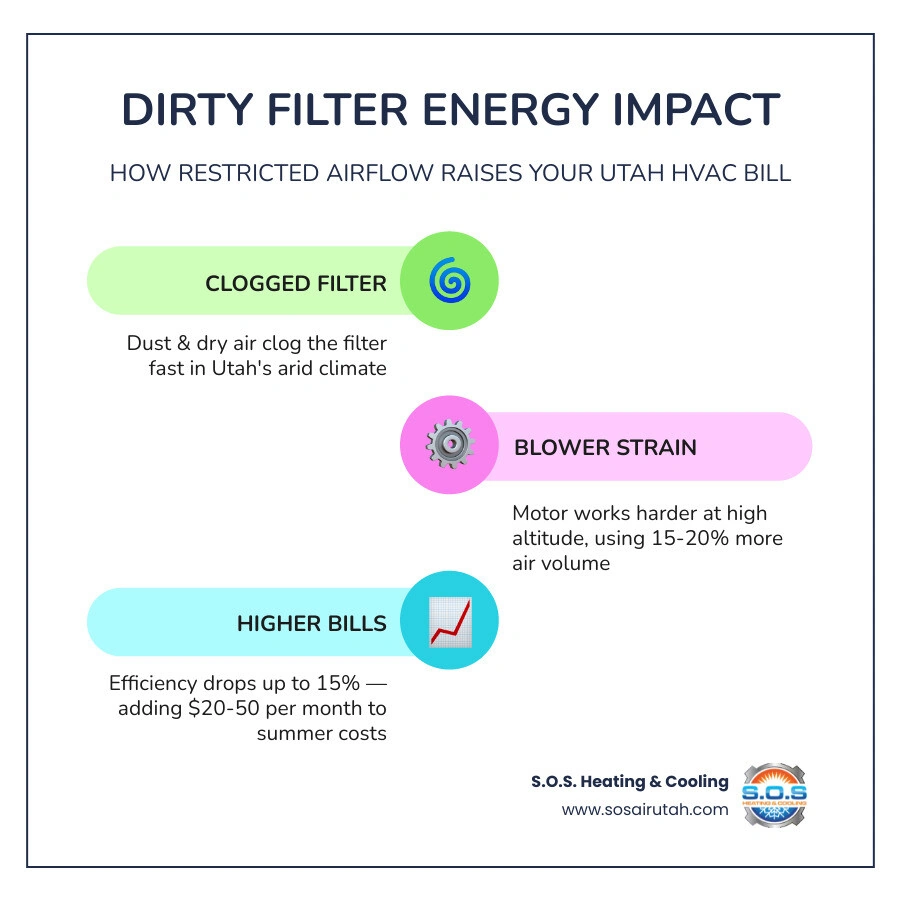
- Utah's altitude (around 4,300 feet in Salt Lake City) means your HVAC already moves 15–20% more air volume than systems at sea level — a clogged filter amplifies that extra load
- The dry climate keeps dust particles suspended in the air longer, so filters clog faster than in humid regions
- The result: a dirty filter can reduce your AC's efficiency by up to 15%, adding a noticeable amount to your summer electric bill each month
If your energy bills have been creeping up this summer with no obvious explanation, a neglected air filter is one of the first things worth checking.
Utah's combination of low humidity, high altitude, Great Salt Lake dust, and heavy wildfire smoke seasons creates conditions where a standard 90-day filter change schedule simply is not enough. What takes three months to happen in a coastal city can happen in three to four weeks along the Wasatch Front — and every week past that point, your system is paying the price in wasted energy.
I'm Bryson Ninow, an HVAC professional with years of hands-on experience helping Salt Lake City homeowners understand exactly how a dirty filter raises your energy bill in a dry Utah climate and what to do about it. In this guide, I'll walk you through the science, the warning signs, and the simple steps that can bring those bills back down.
The Physics of Altitude and Aridity: Why Utah Homes Face Unique HVAC Strain

To understand why a simple piece of cardboard and pleated fabric can dictate your monthly expenses, we have to look at the unique geographical and meteorological factors of the Wasatch Front. If you live in Salt Lake City, Sandy, Draper, or Layton, your air conditioner does not operate under the same physical conditions as an air conditioner in a humid, sea-level city.
First, let's talk about altitude. The Salt Lake Valley sits at roughly 4,300 feet above sea level, with surrounding communities like Park City or Herriman climbing even higher. At this elevation, the air is thinner. Specifically, the air density along the Wasatch Front is only about 82% of what it is at sea level.
Because the air is thinner, it contains fewer molecules per cubic foot. This means that to transfer the same amount of heat out of your home, your HVAC system must move roughly 15% to 20% more air volume than a system located at sea level. Your blower motor is already engineered to run faster and longer just to compensate for this lack of air density. When you introduce a dirty filter into this equation, you are essentially choking a system that is already breathing thin mountain air. To learn more about how our unique geography impacts your home systems, check out our guide on How the Wasatch Front Climate Affects Your HVAC and Plumbing.
Second, Utah’s dry climate plays a massive role in how quickly filters clog. In humid regions, moisture in the air binds to dust, pollen, and pet dander, causing these particles to become heavy and fall to the ground. In Utah, where summer relative humidity routinely drops below 15%, there is no moisture to weigh these particles down. Dust remains suspended in the air indefinitely, floating freely until it is sucked directly into your return vents.
How a Dirty Filter Raises Your Energy Bill in a Dry Utah Climate by Restricting Airflow
When we talk about airflow restriction, we are talking about static pressure. Think of your HVAC system like a set of lungs. When you put a thick, dust-caked barrier in front of the return vent, your system has to exert far more effort to draw in air. This resistance is known as high static pressure.
To overcome this resistance, the blower motor has to work overtime. If your system uses a standard motor, the restricted airflow means less cool air is distributed throughout your home, forcing the air conditioner to run for hours on end to lower the indoor temperature by just a few degrees. If your system is running longer, it is consuming more kilowatt-hours, which shows up directly on your Rocky Mountain Power bill.
This sustained strain does not just raise your operational costs; it physically wears down the internal components of your AC. For a deeper look at this mechanical wear and tear, read about How Dirty Air Filters Destroy Your AC Performance.
The Impact of Great Salt Lake Dust and Inversion Particulates
Our local environment has its own specific types of airborne debris that are highly efficient at sealing up your air filter. One of the most significant contributors is dust originating from the dried portions of the Great Salt Lake bed. This dust is not typical soil; it consists of incredibly fine, highly abrasive mineral particulates. Because these particles are so small and light, they easily bypass basic fiberglass filters or quickly pack the pleats of high-quality filters, turning them into solid, air-impermeable blocks.
Additionally, our geographical basin is famous for temperature inversions. While we most commonly associate inversions with winter smog, the same atmospheric trapping occurs during summer heatwaves, locking in vehicle emissions, dust, and wildfire smoke. These fine PM2.5 particulates settle inside our homes, loading your HVAC filter with a dark, greasy layer of soot that blocks air much faster than standard household dust. Maintaining proper indoor air quality in these conditions is a delicate balancing act, which we discuss in detail in our article on Ideal Indoor Humidity Levels for the Wasatch Front.
How a Dirty Filter Raises Your Energy Bill in a Dry Utah Climate
Now that we understand the environmental forces at play, let's look at the actual numbers. According to data from the U.S. Department of Energy, replacing a dirty, clogged air filter with a clean one can reduce your air conditioner's energy consumption by 5% to 15%.
To put that into perspective for a typical Wasatch Front summer: a dirty filter can easily add a significant percentage to your monthly cooling bill. Over the course of our long, dry cooling season—which typically stretches from late May through September—that adds up to a substantial amount of money wasted on nothing but restricted air.
When your filter is clogged, the system's efficiency drops rapidly. The air conditioner cannot draw enough warm air across the cold evaporator coils to facilitate proper heat exchange. As a result, the cooling cycle that should have taken 15 minutes now takes 30 or 45 minutes. You can read more about maximizing your system's efficiency in our guide on How High-Efficiency AC Systems Reduce Summer Costs.
Short Cycling vs. Extended Run Times
A dirty air filter generally forces your system into one of two highly inefficient operating patterns: extended run times or short cycling. Both of these patterns are absolute poison for your energy bill and your equipment’s health.
- Extended Run Times: Because the restricted airflow prevents your AC from effectively distributing cool air, the thermostat remains unsatisfied. Your system will run continuously for hours during the hottest parts of the day. Because the compressor (the most energy-hungry part of your AC) is running without a break, your power meter spins rapidly.
- Short Cycling: This occurs when the airflow is so severely restricted that the air surrounding the evaporator coil drops below freezing. The moisture on the coil freezes solid, turning the coil into a block of ice. Once the coil freezes, safety sensors or temperature limits trip, causing the system to shut down abruptly. After the ice melts slightly, the system starts up again, only to freeze and shut down minutes later.
This rapid on-and-off cycling draws massive surges of electricity every time the compressor starts up, causing immediate spikes in your energy bill. It also accelerates equipment degradation, which we cover in our article on How High Desert Weather Affects AC Equipment Lifespan.
The Domino Effect on Your Blower Motor
The blower motor is the unsung hero of your HVAC system, responsible for pushing air through your ductwork and across your home. In modern homes, you are likely to have either a standard Permanent Split Capacitor (PSC) motor or a high-efficiency Electronically Commutated Motor (ECM). A dirty filter affects these two motors differently, but both scenarios end up costing you money.
A standard PSC motor runs at a fixed speed. When the filter clogs, the motor cannot pull enough air, so it simply spins with less resistance, moving far less air. While it might draw slightly less wattage in this choked state, your AC has to run twice as long to cool the house, resulting in a net increase in energy use.
An ECM or variable-speed motor, however, is designed to maintain a constant airflow regardless of static pressure. When the filter clogs, the smart controls in the ECM detect the resistance and ramp up the motor's speed and torque to force air through the blockage. While this keeps your home comfortable, it causes the motor to draw significantly more wattage—sometimes doubling its energy consumption to overcome the dirty filter. You can read more about how these motors adapt in our article on How Variable Speed Technology Saves Energy.
Choosing the Right Filter and Maintenance Schedule for Arid Environments
Managing your energy bills in Utah’s dry climate requires a strategic approach to filter selection. Not all filters are created equal, and choosing the wrong type can actually restrict your airflow just as badly as a dirty filter.
| Filter Type | MERV Rating | Best Suited For | Airflow Impact | Recommended Replacement Interval |
|---|---|---|---|---|
| Fiberglass (Flat) | MERV 1–4 | Protecting basic equipment components | Very Low | Every 30 days (Not recommended for dust/allergies) |
| Standard Pleated | MERV 8 | Average Utah homes without heavy pets | Moderate | Every 30–45 days in Summer / 60 days in Winter |
| High-Efficiency Pleated | MERV 11 | Homes with pets, mild allergies, or near construction | Moderate-High | Every 30–45 days during peak seasons |
| Maximum Filtration | MERV 13+ | Severe asthma, allergies, or heavy wildfire smoke periods | High (Requires system check) | Every 30 days (Monitor closely for pressure drop) |
For most homes along the Wasatch Front, MERV 11 is the sweet spot. It provides excellent filtration of fine dust, pollen, and smoke particles without putting excessive strain on your blower motor. However, if you are using a MERV 11 or MERV 13 filter, you must be diligent about replacement. Because these filters trap much smaller particles, they clog significantly faster in our dusty environment. To help you select the ideal match for your equipment, read our guide on How the Right Filter Improves Your AC Efficiency.
How a Dirty Filter Raises Your Energy Bill in a Dry Utah Climate and How to Prevent It
Preventing energy spikes from a clogged filter does not require professional training; it just requires consistency. Here is our recommended protocol for Utah homeowners:
- The 30-Day Summer Rule: During June, July, and August, check your filter every 30 days. Do not rely on the "3-month" manufacturer guideline printed on the box—that rating is calculated for moderate climates with low ambient dust.
- Perform the Light Test: If you are unsure whether a filter needs to be replaced, hold it up to a bright light source (like the sun or a strong flashlight). If you cannot see light passing through the pleats, the air cannot pass through easily either. Replace it immediately.
- Ensure Correct Installation: Always check the airflow arrow printed on the side of the filter frame. The arrow must point in the direction of the blower motor (away from the return duct and toward the furnace/air handler unit). Installing a filter backward reduces its dust-holding capacity and can cause the filter to collapse into the fan.
- Seal the Edges: Make sure the filter fits snugly in its slot. Gaps around the edges allow dusty air to bypass the filter entirely, coating your indoor coils in grime and lowering efficiency.
For more essential details on how to execute these steps properly, check out our resource on Air Filter Replacement Importance.
Seasonal Adjustments for the Wasatch Front
Your filter replacement schedule should mirror Utah’s changing seasons.
- Spring (March to May): As the snow melts and the valley winds kick up, agricultural dust and tree pollen flood the air. Check your filter every 45 days.
- Summer (June to August): This is peak air conditioner season. High temperatures require constant system operation, and dry south winds carry desert dust. Stick strictly to a 30-day replacement cycle. For more summer-specific advice, read our Summer AC Efficiency Tips for High-Desert Homes.
- Wildfire Season (Late Summer): When smoke from regional wildfires drifts into the Salt Lake Valley, the fine ash and soot can clog a brand-new filter in as little as two weeks. Check your filter weekly during active smoke events.
- Winter (December to February): During inversion events, fine particulate matter builds up inside tightly sealed homes. Change your furnace filter every 60 days to protect your heating system and maintain indoor air quality.
Frequently Asked Questions About Utah AC Filters and Energy Bills
Can a dirty air filter cause my AC to freeze up in the summer?
Yes, absolutely. This is one of the most common service calls we receive in Cottonwood Heights, Sandy, and Murray during July. When airflow is severely restricted by a dirty filter, there is not enough warm indoor air passing over the cold evaporator coil to keep it warm. The temperature of the coil drops below 32°F, causing the condensation on the coil to freeze solid.
Once your coil is encased in ice, it blocks all remaining airflow. Your home will start warming up, and you might notice water pooling around your furnace as the ice slowly melts. If this happens, turn your AC off immediately at the thermostat and let it thaw completely before attempting to replace the filter. Running the system with a frozen coil can destroy your compressor, leading to an expensive replacement. If your system is struggling with this issue, read our guide on the Time to Replace Your Air Conditioner Filter.
How often should I change my AC filter during a Utah summer?
For the average home along the Wasatch Front, we highly recommend replacing your filter every 30 days during the peak summer months (June through August).
However, you should shorten this interval to every 20 to 30 days if you meet any of the following criteria:
- You have shedding pets (dogs or cats)
- You live in a rapidly developing area with active construction dust (such as Herriman, South Jordan, or Riverton)
- You suffer from seasonal allergies or asthma
- You live near unpaved roads or open fields where dry winds kick up dirt
Staying on top of this schedule is the single easiest DIY task to keep your cooling system running smoothly, as detailed in our AC Maintenance Guide Salt Lake City.
Will upgrading to a high-MERV filter save me more money?
Not necessarily. While a higher MERV rating (like MERV 13 or 14) is excellent at capturing microscopic particles, it is also much denser. This density inherently restricts airflow more than a standard MERV 8 or 11 filter.
If your HVAC system's blower motor is not designed to handle the high static pressure of a thick MERV 13 filter, upgrading can actually mimic the effects of a dirty filter—restricting airflow, increasing blower motor strain, and raising your energy bill. For most residential systems in Utah, we recommend sticking to a high-quality pleated MERV 11 filter. It offers the perfect balance of excellent particle capture and healthy, unrestricted airflow. To learn how to balance filtration and airflow for peak performance, read about Optimizing Your AC's Performance.
Conclusion
Keeping your utility bills manageable during a hot, dry Utah summer does not have to be a mystery. While we often look for complex solutions to rising energy costs, the most powerful tool you have is sitting right inside your return air slot. By understanding how a dirty filter raises your energy bill in a dry Utah climate—and taking proactive steps to prevent airflow restriction—you can keep your home comfortable, protect your expensive cooling equipment, and keep your hard-earned money in your wallet.
While changing your filter monthly is an excellent habit, your system still needs professional attention to perform at its peak. Dust and fine mineral debris from our high-desert climate can bypass even the best filters over time, settling on your internal coils and fan blades.
At S.O.S. Heating & Cooling, we have been keeping homes along the Wasatch Front cool and efficient for years. Whether you live in Bountiful, Draper, Sandy, or Salt Lake City, our team of professional technicians is ready to help you optimize your system for our demanding climate. To ensure your system is clean, calibrated, and ready to handle the summer heat efficiently, read about how we can help extend your Better AC Lifespan with Regular Tune-Ups.
Don't let a clogged filter or dirty system drain your budget this summer. Schedule professional AC repair in Salt Lake City with S.O.S. Heating & Cooling today, or give us a call to schedule your comprehensive seasonal maintenance tune-up!
Explore Our Latest Insights and Updates in Plumbing Services
A Practical Guide to Furnace Lifespan in Utah

All About How Wildfire Smoke Affects Indoor Air Quality in the Salt Lake Valley
The Ins and Outs of Whole Home Air Purifiers and HVAC Integration