

The Science of the Freeze and How Airflow Blocks Turn Coils to Ice
Why Dirty Filters Cause Frozen Evaporator Coils — And What It Means for Your AC Understanding how dirty filters cause frozen evaporator…
Why Dirty Filters Cause Frozen Evaporator Coils — And What It Means for Your AC
Understanding how dirty filters cause frozen evaporator coils starts with one simple idea: your AC needs a steady flow of warm air to keep working properly.
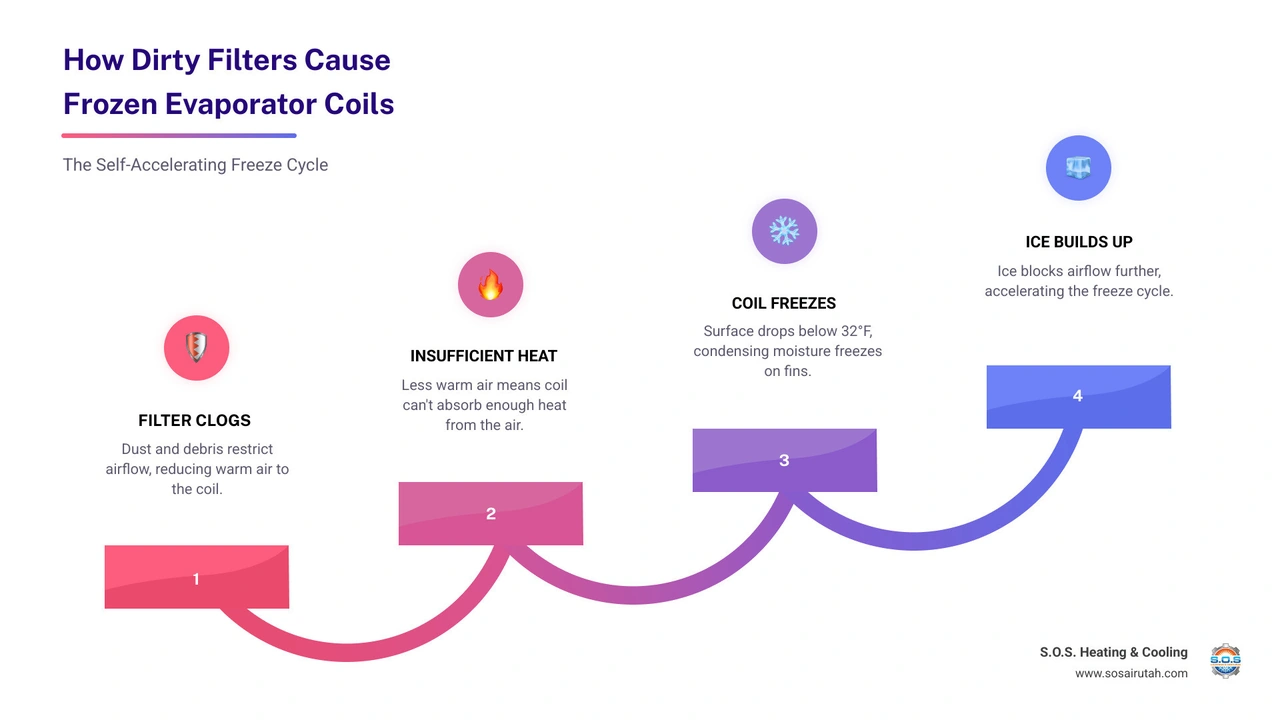
Here is how the problem unfolds:
- Filter clogs with dust and debris — airflow through the system drops significantly
- Less warm air reaches the evaporator coil — the coil cannot absorb enough heat
- Refrigerant inside the coil stays too cold — coil surface temperature falls below 32°F
- Moisture in the air freezes on contact — ice begins forming on the coil fins
- Ice blocks airflow further — the freeze cycle accelerates and compounds itself
This is not a rare or unusual problem. A filter that looks gray and clogged is already choking your system. In fact, research shows that airflow and dirt account for roughly 90% of all frozen coil cases — and a dust layer as thin as 0.02 inches on the coil surface can cut heat transfer efficiency by up to 15%.
For homeowners in Salt Lake City, where summer temperatures push AC systems hard, a neglected filter can turn a minor maintenance issue into an emergency repair — fast.
I'm Bryson Ninow, an HVAC professional with certifications in EPA, NATE, and RMGA, and I've seen how often a simple dirty filter is the root cause behind a frozen evaporator coil and the expensive repairs that follow. Understanding how dirty filters cause frozen evaporator coils is one of the most practical things a homeowner can know, and I'll walk you through the full picture below.
Understanding the Evaporator Coil and Heat Exchange
To grasp the "why" behind the ice, we first need to look at the "how" of cooling. Your air conditioner doesn't actually "create" cold; it removes heat. The evaporator coil, located inside your indoor unit (often near the furnace or in the attic), is the primary site for this magic trick.
Inside these coils, a substance called refrigerant circulates. As your home's warm air is blown over the cold coils, the refrigerant undergoes a phase change. It transforms from a cold liquid into a gas, absorbing heat from the air in the process. This involves two types of heat:
- Sensible Heat: This is the actual temperature of the air you feel.
- Latent Heat: This is the moisture (humidity) in the air.
As the coil absorbs heat, the moisture in the air condenses on the cold metal surfaces—much like water droplets forming on a cold soda can on a July day in Draper. This condensate is supposed to drip into a pan and flow out of your home. However, the aluminum fins on these coils are incredibly delicate and sensitive. If the balance of airflow and heat exchange is disrupted, that condensation doesn't stay liquid for long.
When the airflow is weak, the refrigerant doesn't have enough "heat work" to do. It stays excessively cold, and that condensation turns into a layer of frost. If you’ve noticed that some rooms feel warmer than others while your system struggles, you might be seeing the early stages of Why Your AC Has Poor Cooling Distribution, which is often a precursor to a total freeze-up.
How Dirty Filters Cause Frozen Evaporator Coils
The air filter is your system’s first line of defense, but it can quickly become its greatest bottleneck. The primary way how dirty filters cause frozen evaporator coils is through sheer physical restriction.
Think of your HVAC system like a set of lungs. If you try to breathe through a thick wool blanket, your lungs have to work much harder, and you get less oxygen. When a filter is caked with Salt Lake City dust, pet dander, and pollen, the blower motor struggles to pull air through the mesh.
When airflow drops, the volume of warm indoor air crossing the evaporator coil decreases. Because there isn't enough heat to keep the refrigerant "warm" (relatively speaking), the temperature of the copper tubing and aluminum fins drops below the freezing point of 32°F. At this stage, the physics of the dew point takes over. The moisture that naturally condenses out of our Utah air hits that sub-freezing metal and flash-freezes instantly.
This is why Air Filter Replacement Importance cannot be overstated. A clean filter ensures the coil always has a "heat load" to process, keeping the temperatures safely above freezing.
The Physics of How Dirty Filters Cause Frozen Evaporator Coils
There is a specific mathematical threshold for cooling. Most residential systems require approximately 350 to 400 Cubic Feet per Minute (CFM) of airflow per ton of cooling capacity. If your 3-ton unit is only getting 800 CFM because of a clogged filter instead of the required 1,200 CFM, you are in the danger zone.
Statistics show that systems operating below this 350 CFM threshold can lose up to 30% of their cooling capacity almost immediately. Furthermore, cleanliness matters on a microscopic level. Even a 0.02-inch layer of dust—about the thickness of a few sheets of paper—on the evaporator coil itself can reduce heat transfer efficiency by 15%. This makes the system far more prone to icing because the refrigerant can't "reach" the heat through the dust barrier. If you find yourself wondering why there is Ice Forming on Your AC Unit: Causes and What to Do, the answer is almost always a breakdown in this thermodynamic balance.
Why Restricted Airflow Leads to Ice Accumulation
Once the first thin layer of frost forms, a "snowball effect" begins. Ice is actually a fantastic insulator. As it coats the coil, it creates a physical barrier that prevents any remaining airflow from reaching the refrigerant.
This leads to a self-feeding freeze cycle:
- Ice forms, narrowing the gaps between the coil fins.
- Airflow is restricted even further.
- The coil gets even colder because no warm air can touch it.
- More ice forms, eventually turning the entire coil into a solid block of ice.
At this point, your AC has essentially become an expensive ice maker. The air coming out of your vents will drop to a whisper, and the air that does manage to squeak through won't be cold because it's essentially blowing over a "mini glacier" that has blocked the heat exchange process entirely.
Identifying the Signs of a Frozen AC System
How do you know if your system is a victim of the freeze? You don't always have to open the air handler to find out. Here are the red flags we see most often in Millcreek and Sandy homes:
- Weak Airflow: You feel very little air coming out of the registers, even though the fan is running.
- Warm Air: The air coming out of the vents feels lukewarm or even warm.
- Hissing or Bubbling Noises: This can indicate the refrigerant is struggling to move through a restricted or frozen area.
- Visual Ice: You might see frost on the "suction line" (the larger, insulated copper pipe) outside near the condenser or inside near the indoor unit.
- Excessive Water: As the ice periodically melts and refreezes, you may see water pooling around the base of your furnace or dripping from the emergency drain line.
If you catch these signs early, you can often Fix AC That Freezes Up in Salt Lake City before permanent damage occurs.
Distinguishing Between Dirty Filters and Low Refrigerant
While dirty filters are the #1 cause, low refrigerant is a close second. Both cause the coil to freeze, but they do so for different reasons.
- Dirty Filter: Causes a drop in pressure because the fan can't pull air. The system is "starved" for heat.
- Low Refrigerant: A leak in the system reduces the pressure of the refrigerant. In HVAC physics, a drop in pressure always results in a drop in temperature.
A system with just a 10% refrigerant undercharge can see coil surface temperatures fall by 5–8°C (about 9–14°F) lower than designed. This is often enough to trigger frost within 30 minutes of operation. If your filters are brand new but the system is still icing up, it’s a strong sign of a refrigerant leak that needs professional repair.
Environmental Factors and Humidity Risks
Even in our relatively arid climate along the Wasatch Front, humidity plays a role. During those "monsoon" weeks in late summer when humidity rises above 65%, the risk of evaporator frost increases by 20–25%.
In high-humidity conditions, the coil has to work harder to remove moisture. If the airflow is even slightly restricted by a filter, that extra moisture provides the "fuel" for ice to grow much faster. This is why a filter that might have lasted three months in the dry spring may only last 30 days during a humid August in South Jordan or Riverton.
Step-by-Step Guide to Thawing and Fixing Your AC
If you discover a block of ice on your coils, stop! Do not try to scrape the ice off with a screwdriver or knife. The aluminum fins and copper tubing are incredibly fragile; one slip can cause a massive refrigerant leak and turn a simple fix into a total system replacement.
Follow these steps to thaw your system safely:
- Turn Off the Cooling: Set your thermostat to "Off." This stops the cooling cycle and prevents the compressor from working against a "brick wall" of ice.
- Switch Fan to "On": Change the fan setting from "Auto" to "On." This keeps the blower motor running, which forces relatively warm indoor air over the ice to melt it.
- Wait: Depending on the severity of the ice, it can take 4 to 8 hours for a coil to thaw completely.
- Monitor the Drain: Keep an eye on your condensate pan and drain line. A large block of ice contains a lot of water, and if your drain is even slightly clogged, it could overflow and cause water damage to your home.
- Check the Filter: This is the perfect time to Time to Replace Your Air Conditioner Filter. If it’s dirty, replace it immediately.
How Dirty Filters Cause Frozen Evaporator Coils and When to Replace Them
We recommend the "Light Test." Hold your filter up to a bright light or the sun. If you can’t see light through the fibers, your AC can’t "breathe" through it either.
When choosing a replacement, the MERV rating (Minimum Efficiency Reporting Value) is key. While high-MERV filters (MERV 13+) catch more allergens, they also create more resistance. For most Salt Lake City homes, a MERV 8 to 11 filter provides the best balance of air quality and airflow. You can learn more about Choosing the Right HVAC Filter to ensure you aren't accidentally suffocating your system with a filter that is "too good."
Generally, you should check your filter every 30 days and replace it at least every 90 days. If you have pets or live in a dustier area like Herriman or West Jordan, monthly changes are often necessary during the peak of summer 2026.
Professional Maintenance Beyond the Filter
Sometimes, changing the filter isn't enough. If dust has bypassed a poor-fitting filter for years, the coil itself might be caked in grime.
| Task | DIY Capability | Professional Requirement |
|---|---|---|
| Filter Replacement | High (Every 1-3 months) | Included in tune-ups |
| Coil Cleaning | Low (Risk of fin damage) | Recommended annually |
| Refrigerant Check | None (Requires EPA license) | Recommended annually |
| Blower Motor Cleaning | Low (Electrical risk) | Every 2-3 years |
| UV Light Install | Medium | For long-term mold prevention |
Professional cleaning involves specialized, no-rinse foaming cleaners that dissolve the 0.02-inch dust layers we mentioned earlier. We also recommend UV air purification systems, which sit near the coil and kill organic growth (like mold or bacteria) that can act as "glue" for dust. If you are unsure which path to take, Choosing an Conditioner Filter and scheduling a professional inspection is the safest bet.
Frequently Asked Questions about Frozen Coils
Can a dirty filter cause ice on the outdoor condenser?
Yes, indirectly. While the freezing starts at the indoor evaporator coil, it can "travel" down the refrigerant lines all the way to the outdoor unit. This is a sign of a severe freeze. If this happens, you risk "liquid slugging"—where liquid refrigerant returns to the compressor (which is only designed to handle gas). This can destroy the compressor, the most expensive part of your system.
How long does it take for a frozen coil to thaw safely?
Expect a 4 to 8-hour window. Using a hair dryer or heat gun is generally discouraged as the uneven heat can stress the metal components. The "Fan Only" method is the safest way to ensure a natural, even melt.
What happens if I run my AC with a frozen coil?
You are essentially paying for electricity to run a machine that isn't cooling your home. Beyond the high energy bills, you are putting immense strain on the blower motor and the compressor. Continuous operation with a frozen coil will eventually lead to a total system failure and a much higher repair bill than a simple filter change.
Conclusion
At S.O.S. Heating & Cooling, we’ve served the Salt Lake City area for years, and we know that a comfortable home starts with a healthy HVAC system. Understanding how dirty filters cause frozen evaporator coils is the first step in preventing summer breakdowns. Whether you are in Bountiful, Draper, or anywhere in between, a little preventative maintenance goes a long way.
If you’ve thawed your system, changed your filter, and the ice keeps coming back, don't wait for the compressor to fail. We offer 24/7 emergency repairs and no evaluation fees during business hours to keep your family cool and safe.
Schedule your air conditioner filter service in Salt Lake City today and let us help you keep the ice in your drinks, not on your AC! If your system needs attention, our team provides fast, upfront AC repair across the Wasatch Front.
Contact Us

Let's Get You From Distress to Rest
No heat, no cool, a backed-up drain, or just due for a tune-up? Call now or request service and our local team will be on the way — upfront pricing, no surprises.