
How to Calculate Energy Savings From a New AC Replacement in the Wasatch Front


.avif)

How Energy Savings From a New AC Offset Replacement in the Wasatch Front Pays for Itself
How energy savings from a new AC offset replacement in the Wasatch Front works is straightforward: a modern high-efficiency system uses significantly less electricity to cool your home than an older unit, and those monthly savings gradually cancel out what you spent on the new equipment. Here is a quick breakdown of what that looks like in practice:
| Old System | New System | Estimated Cooling Bill Reduction |
|---|---|---|
| 10 SEER | 14 SEER2 | ~28% |
| 10 SEER | 16 SEER2 | ~37% |
| 10 SEER | 18 SEER2 | ~44% |
| 10 SEER | 20 SEER2 | ~50% |
Key savings facts for Wasatch Front homeowners:
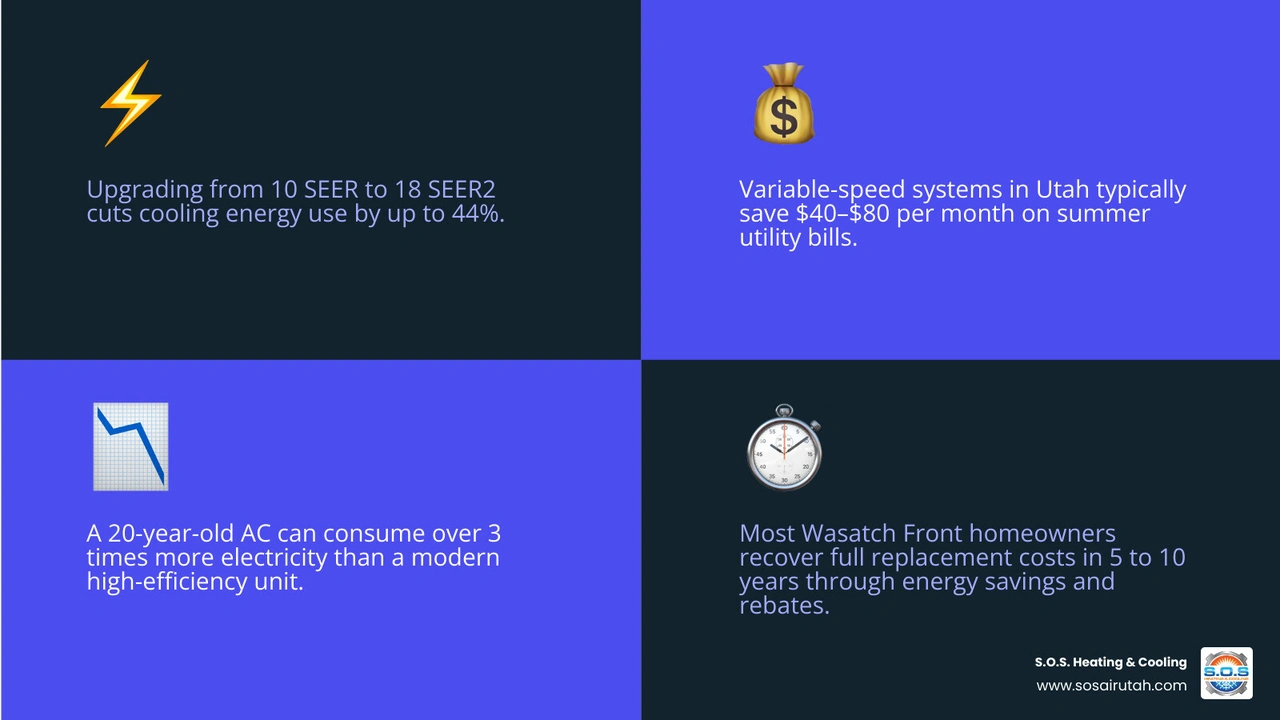
- Upgrading from a 10 SEER unit to an 18 SEER2 system can cut cooling bills by 35% or more
- Variable-speed systems typically save $40 to $80 per month during peak cooling season
- A 20-year-old AC may use over 3x the electricity of a modern equivalent
- Utility rebates from Rocky Mountain Power and Enbridge Gas can meaningfully reduce upfront costs
- Most high-efficiency upgrades pay for themselves within 5 to 10 years
Last July, families across the Wasatch Front watched their utility bills spike while upstairs bedrooms stayed uncomfortably warm — a sign that aging, inefficient AC systems were working overtime just to keep up with Utah's brutal summer heat. If your system is more than 10 to 12 years old, that monthly struggle is likely costing you far more than a replacement would.
I'm Bryson Ninow, an NATE-certified HVAC professional with years of hands-on experience helping Wasatch Front homeowners understand how energy savings from a new AC offset replacement in the Wasatch Front can make upgrading a smart financial decision, not just a comfort one. In the sections below, I'll walk you through the real numbers, Utah-specific factors, and the incentives available in 2026 so you can make a confident, informed choice.
How Energy Savings From a New AC Offset Replacement in the Wasatch Front
When your air conditioner begins to falter under the weight of a July heatwave, it is easy to view replacement purely as an unwanted expense. However, upgrading your home's cooling system is actually a unique home improvement investment that directly lowers your ongoing monthly overhead. Unlike a kitchen remodel or a new deck, a high-efficiency AC actively pays you back.
By understanding how high efficiency AC systems reduce summer costs, you can see how much of your hard-earned money is currently being wasted on utility bills. Homeowners across the Wasatch Front who have invested in energy-efficient upgrades report average overall energy savings ranging from 20% to 40%. When you look at the cooling portion of your utility bill alone, those savings can be even more dramatic.
Older air conditioners operate like old, gas-guzzling vehicles. They require a massive amount of energy just to provide standard performance. Over time, mechanical wear and tear further degrades their internal components, meaning an older 10 SEER unit might actually be operating closer to an 8 SEER level. By investing in an efficient AC system, you immediately stop this financial leak. The reduction in your monthly electricity consumption acts as a direct offset, helping the new equipment pay for itself over its operational lifespan.
Understanding SEER2 and Real-World Efficiency Gains
To accurately estimate your potential financial returns, you must first understand how modern efficiency is measured. Historically, air conditioners were rated using SEER (Seasonal Energy Efficiency Ratio). However, in 2023, the Department of Energy transitioned to the stricter SEER2 testing standards. SEER2 evaluates equipment under more realistic external static pressure conditions, making its ratings roughly 5% lower than legacy SEER ratings for the same unit, but far more accurate to real-world home performance.
To put this in perspective, let's look at electricity consumption. A 20-year-old AC system might use as much as 6 kWh of electricity to cool an average-sized house along the Wasatch Front. By contrast, a modern, high-efficiency system can cool that exact same house using as little as 1.71 kWh. This massive drop in power consumption is exactly how much a high efficiency AC system saves for local families.
| System Efficiency Tier | Typical SEER2 Rating | Average Cooling Bill Reduction (vs. 10 SEER) | Primary Technology Used |
|---|---|---|---|
| Base Efficiency | 13.4 - 14.3 SEER2 | 23% to 28% | Single-Stage Compressor |
| Mid-Efficiency | 15.2 - 16.5 SEER2 | 30% to 37% | Two-Stage Compressor |
| High-Efficiency | 17.2 - 20+ SEER2 | 40% to 50%+ | Variable-Speed Compressor |
For most homes in Salt Lake City, Sandy, and Layton, upgrading to a mid-efficiency system in the 15 to 17 SEER2 range represents the "sweet spot" where you achieve an excellent balance of lower upfront equipment costs and rapid monthly utility savings.
How Energy Savings From a New AC Offset Replacement in the Wasatch Front for Multi-Level Homes
Multi-level homes in communities like Draper, Kaysville, and Bountiful present a unique cooling challenge. Because warm air naturally rises, top-floor bedrooms often remain uncomfortably hot while the basement feels like an icebox. In an attempt to make the upstairs livable, homeowners often crank their thermostats down, forcing a single-stage AC to run continuously and waste massive amounts of energy.
When planning a replacement, it is crucial to review what you need to know before you replace your AC unit. One of the most effective ways to solve multi-level temperature imbalances is by pairing a high-efficiency variable-speed AC with a zoning system.
Zoning systems use motorized dampers inside your ductwork to direct cool air precisely where it is needed, controlled by independent thermostats on each floor. Implementing zoning can achieve up to a 30% reduction in cooling energy consumption in multi-level homes. Instead of cooling the entire house to fix a hot spot upstairs, your new system target-cools only the active zones, preventing wasted energy and maximizing your monthly savings.
The Financial Math: Payback Periods and ROI Frameworks
Calculating the return on investment (ROI) for a new air conditioner involves weighing the upfront installation cost against the combined value of annual energy savings, avoided repair bills, and available financial incentives.
In Utah, the payback period for a high-efficiency system typically ranges between 5 and 10 years, depending on your local utility rates, how frequently you run your system, and which incentives you claim. Fortunately, in 2026, there are several powerful programs that can significantly lower your net investment:
- Federal Tax Credits (Section 25C): Under the Inflation Reduction Act, homeowners can claim federal tax credits of up to $600 for qualifying high-efficiency central air units, or up to $2,000 for qualifying cold-climate heat pumps.
- Rocky Mountain Power Wattsmart Rebates: Electric customers along the Wasatch Front can access rebates ranging from $200 to $1,200+ for qualifying high-efficiency AC units and heat pumps.
- Enbridge Gas ThermWise Rebates: If you opt for an ultra-efficient dual-fuel system (pairing a high-efficiency gas furnace with an electric heat pump), you can stack gas utility rebates of $700 to $1,200 on top of your electric rebates.
To make sure you don't miss out on these savings, we recommend reviewing our guide on Utah energy rebates for HVAC upgrades and learning how to apply for energy rebates in Utah before your installation begins. Navigating the Inflation Reduction Act benefits for Utah homeowners and securing Rocky Mountain Power rebates for Wasatch Front homeowners can easily offset a massive portion of your upgrade, accelerating your payback timeline by several years.
Applying the 50% and $5,000 Rules to Your Decision
If you are currently dealing with a broken or struggling AC unit, you might be wondering whether it makes more sense to pay for a repair or invest in a replacement. To remove the emotion from this decision, we recommend using two trusted industry frameworks: the 50% Rule and the $5,000 Rule.
- The 50% Rule: If the cost of a single repair estimate exceeds 50% of the cost of a brand-new system, you should always replace the unit. Spending half the value of a new system on an old, out-of-warranty machine is rarely a sound financial move.
- The $5,000 Rule: Multiply the age of your air conditioner by the cost of the repair. If the resulting number is greater than $5,000, replacement is the smarter long-term choice.
Let's look at a couple of real-world examples:
- Scenario A: Your 12-year-old AC needs a $450 repair. (12 x $450 = $5,400). Because this exceeds the $5,000 threshold and the system is at the end of its typical lifespan, replacing the unit is highly recommended.
- Scenario B: Your 6-year-old system needs a $300 repair. (6 x $300 = $1,800). In this case, repairing the unit is the logical choice.
If you are still on the fence, take a moment to read our detailed breakdown on should you repair or replace your AC and learn when should you replace your air conditioner to make the most cost-effective choice for your household.
How Energy Savings From a New AC Offset Replacement in the Wasatch Front Mitigate Rising Repair Costs
Another major factor in the financial equation is the rapidly escalating cost of maintaining older, out-of-warranty cooling systems. When an old air conditioner breaks down, the cost of the repair itself is only part of the problem; you must also factor in the ongoing cost of operating an inefficient machine.
Choosing between AC repair vs new unit long term savings requires looking at the big picture. When you pay to patch up an old system, you are locking yourself into another summer of high utility bills. Furthermore, older systems are far more prone to sequential breakdowns — a fan motor failure this year, followed by a failed capacitor or a refrigerant leak the next.
By comparing the cost of repairing old AC vs buying a new system, you will often find that the money spent on repeated repairs, combined with the extra electricity wasted by the old unit, quickly approaches the cost of a monthly payment on a brand-new, highly efficient system that is fully covered by a 10-year parts and labor warranty.
Utah-Specific Climate Factors Affecting AC Performance
The Wasatch Front features a unique high-desert climate that places extreme demands on residential cooling systems. From June through August, cities like Salt Lake City, Murray, and Riverton regularly experience temperatures exceeding 90°F, often pushing past 100°F. At the same time, our winters bring freezing temperatures and heavy snow, which can trigger severe valley inversions that trap particulate air pollution.
These extreme temperature swings and high-altitude UV exposure can accelerate wear on your outdoor condensing unit. Understanding how high desert weather affects AC equipment lifespan is essential when selecting a new system. A standard system built for mild, humid coastal climates will struggle to perform efficiently in Utah's dry, dusty, and hot environment.
Altitude and Dry Air Challenges on the Wasatch Front
Our altitude along the Wasatch Front — ranging from 4,200 feet in Salt Lake City to over 4,500 feet in Layton and Draper — has a direct physical impact on how air conditioning equipment operates.
Because the air is thinner at higher altitudes, it carries less density and volume. This means your air conditioner must work harder to move the same mass of air across the indoor evaporator coil to remove heat. In fact, an AC system loses roughly 3% of its rated cooling capacity for every 1,000 feet of elevation.
To learn more about this phenomenon, read our guide on how high altitude affects your HVAC performance. If a contractor uses a generic national sizing calculator without adjusting for Utah’s altitude, they will likely install an undersized system that runs constantly, erasing your expected energy savings and wearing out the compressor prematurely.
Variable-Speed vs. Single-Stage Compressors in High-Desert Climates
To combat our high-desert climate efficiently, compressor technology plays a massive role. Traditional single-stage air conditioners operate on a simple "on/off" cycle. When your thermostat calls for cooling, the compressor runs at 100% capacity, blasting cold air until the target temperature is met, and then shuts off. This constant cycling creates significant temperature swings and draws a massive amount of startup wattage.
By contrast, modern two-stage and variable-speed systems offer vastly superior performance:
- Two-Stage Compressors: These units have a high and a low setting (typically running at about 65% capacity on mild days and 100% capacity on the hottest afternoons).
- Variable-Speed Compressors: The gold standard of comfort, these systems can adjust their output incrementally anywhere from 25% to 100% capacity, matching your home's cooling needs in real-time.
To understand how these systems operate, check out how variable speed technology saves energy. Because variable-speed systems run for longer periods at lower, whisper-quiet speeds, they avoid the energy-intensive "hard starts" of single-stage units, saving between $300 and $600 annually on energy bills.
When deciding if are two stage and variable speed systems worth the extra cost, the answer for most Wasatch Front homeowners is a resounding yes. Beyond the utility savings, these systems run continuously at low speeds, which keeps air moving through your home's filtration system. This constant filtration is incredibly beneficial during winter and summer inversion periods when outdoor air quality is poor.
Maximizing Efficiency: Sizing, Ductwork, and the 2025–2026 Refrigerant Transition
Getting the maximum possible energy savings from your new air conditioner depends heavily on the quality of the installation and the condition of your home’s existing infrastructure. Simply buying the highest-rated SEER2 unit on the market won't guarantee low utility bills if the system is improperly matched to your home.
Before installing a new system, it is highly recommended to perform necessary system maintenance and prep. Reading about how spring prep prevents expensive summer breakdowns and how spring maintenance extends your AC lifespan highlights how keeping your system clean and optimized preserves its high-efficiency ratings over its 15- to 20-year lifespan.
Manual J Sizing and Duct Integrity
To achieve the 20% to 40% energy savings promised by modern equipment, your HVAC contractor must perform a proper Manual J load calculation. This scientific calculation factors in your home's exact square footage, insulation levels, window orientations, ceiling heights, and local climate data to determine the precise cooling capacity (measured in tons) your home requires.
Sizing is critical. To see why, read about how proper AC sizing affects comfort. An oversized unit will cool the home too quickly, causing it to "short-cycle" (turning on and off rapidly). This prevents the system from running long enough to remove humidity and creates massive energy spikes. Conversely, you can read about how improperly sized systems shorten equipment life to see how an undersized unit will run constantly, driving up your power bills and burning out the compressor.
Additionally, your ductwork must be inspected and sealed. In pre-1990 homes along the Wasatch Front, leaky, uninsulated ducts can lose 20% to 30% of their conditioned air into unconditioned spaces like attics or crawlspaces. Installing a new high-efficiency AC without sealing your ducts is like buying a hybrid car and driving it with a flat tire.
The Impact of the A2L Refrigerant Transition
Every homeowner shopping for a new air conditioner in 2026 needs to be aware of the major environmental transition currently reshaping the HVAC industry. Under the federal AIM Act, the Environmental Protection Agency (EPA) has phased out the production and import of R-410A refrigerant (the standard coolant used for the last two decades) in favor of new, environmentally friendly A2L refrigerants (such as R-454B and R-32).
What does this mean for you?
- Rising Repair Costs for Older Units: Because R-410A production has dropped to 60% of its historical baseline as of 2026, the cost of R-410A has skyrocketed (often doubling in price per pound). If your older system develops a refrigerant leak, repairing it will be incredibly expensive.
- Improved Efficiency on New Systems: A2L refrigerant systems are not only better for the planet, but they also offer roughly 10% to 15% better energy efficiency than their R-410A predecessors due to superior thermodynamic properties.
- Safety and Technology: Modern A2L systems are designed with built-in safety sensors and mitigation boards that automatically shut down the system and engage the indoor blower fan in the highly unlikely event of a leak.
Because A2L systems require specialized tools, nitrogen purging during installation, and certified technician training, working with a highly trained, licensed local team is more important than ever.
Frequently Asked Questions About Wasatch Front AC Replacements
What is the typical payback period for a high-efficiency AC in Utah?
For most homeowners along the Wasatch Front, a high-efficiency AC upgrade pays for itself within 5 to 10 years. The exact timeline depends on how much you run your system, your local Rocky Mountain Power electricity rates, and whether you take advantage of federal tax credits and utility rebates to offset the upfront installation costs.
How do Rocky Mountain Power and Enbridge Gas rebates work in 2026?
To qualify for Rocky Mountain Power Wattsmart rebates, your new air conditioner or heat pump must meet specific SEER2 and EER2 efficiency thresholds. For Enbridge Gas ThermWise rebates, you typically must install a qualifying high-efficiency furnace or a dual-fuel heat pump system. All applications must be submitted by a licensed contractor within 180 days of installation.
Can I replace just my outdoor AC unit and keep my old indoor coil?
No. Mixing a brand-new outdoor condenser with an old indoor evaporator coil is highly discouraged and often voids the manufacturer's warranty. Because modern systems use different refrigerants (A2L vs. R-410A) and operate under different pressures, your indoor and outdoor components must be a perfectly matched pair certified by the AHRI (Air-Conditioning, Heating, and Refrigeration Institute) to deliver their rated efficiency and performance.
Conclusion
Upgrading to a high-efficiency air conditioner is one of the most effective ways to lower your monthly overhead, protect your home from rising energy costs, and ensure your family stays perfectly comfortable through Utah's intense summer heat. By combining modern SEER2 technology, variable-speed compressors, and local utility rebates, a new system is an investment that truly pays for itself over time.
At S.O.S. Heating & Cooling, we have spent years keeping our neighbors comfortable across the Salt Lake Valley and surrounding areas, including Bountiful, Centerville, Cottonwood Heights, Draper, Farmington, Herriman, Holladay, Kaysville, Layton, Millcreek, Mt. Olympus, Murray, Riverton, Salt Lake City, Sandy, South Jordan, South Salt Lake, and Woods Cross. We focus on customer convenience and satisfaction by offering 24/7 emergency repairs, priority service for our partners, flexible financing, and absolutely no evaluation fees during normal business hours.
Ready to see how much you could save? Consult with the experts at S.O.S. Heating & Cooling for a personalized AC repair or replacement analysis today, and let us help you design the perfect, high-efficiency comfort system for your Utah home!
Explore Our Latest Insights and Updates in Plumbing Services
How to Choose the Right Furnace for a Salt Lake Valley Home
Average Lifespan of a Central Air Conditioner in Hot Dry Utah Climate
How Heat Pumps Work for Heating and Cooling in Utah