Is Your AC Over-Staged? The Truth About Extra Costs and Benefits
Are Two Stage and Variable Speed Systems Worth the Extra Cost? Here's the Short Answer Are two stage and variable speed systems worth the…
Are Two Stage and Variable Speed Systems Worth the Extra Cost? Here's the Short Answer
Are two stage and variable speed systems worth the extra cost — and the honest answer is: it depends on your climate, how long you plan to stay in your home, and whether your ductwork can support the technology.
Here's a quick breakdown to help you decide:
| System Type | Best For | Energy Savings vs. Single-Stage | Payback Period |
|---|---|---|---|
| Single-Stage | Rentals, short-term stays, tight budgets | Baseline | N/A |
| Two-Stage | Moderate climates, mid-range budgets | 10–20% | 5–7 years |
| Variable Speed | Hot/humid climates, long-term homeowners | 25–40% | 7–10 years |
The Department of Energy estimates that heating and cooling account for roughly 30% of a home's total energy use. That makes your choice of HVAC system one of the most financially significant decisions you'll make as a homeowner. A single-stage system runs at full blast every time it kicks on — like a light switch with no dimmer. A two-stage system adds a lower gear. A variable-speed system does something closer to cruise control, constantly adjusting output to match exactly what your home needs at any given moment.
The result? Better comfort, lower bills, and — depending on your situation — a system that pays for itself well before it needs replacing.
I'm Bryson Ninow, an NATE-certified HVAC professional with hands-on experience helping Salt Lake City homeowners navigate exactly this question of are two stage and variable speed systems worth the extra cost. I've seen how the right system — properly sized and installed — transforms both comfort and monthly utility bills for families across the Wasatch Front.
Are two stage and variable speed systems worth the extra cost?

When we sit down with homeowners in places like Draper or Layton, the conversation usually starts with the "sticker shock" of premium equipment. It is true that the upfront premium for advanced staging is higher than a standard single-stage unit. However, looking only at the initial price is like buying a car based solely on the down payment while ignoring the gas mileage.
To determine if are two stage and variable speed systems worth the extra cost, we have to look at the long-term ROI. In our May 2026 market, energy rates aren't getting any lower. High-efficiency systems utilize SEER2 (Seasonal Energy Efficiency Ratio) ratings to measure performance. While a single-stage unit might sit at a 14 or 15 SEER2, variable-speed systems can soar to 20 or even 26 SEER2.
Before you pull the trigger on a new unit, it is vital to understand What You Need to Know Before You Replace Your AC Unit. The "worth" of these systems is found in the intersection of monthly savings and daily lifestyle.
Why variable speed systems worth the extra cost are the gold standard for comfort
If you have ever felt "heavy" air in your home or noticed that you’re constantly adjusting the thermostat because you’re either too hot or too cold, you’re experiencing the limitations of single-stage cooling. Variable-speed systems are the gold standard because they offer 0.5-degree precision.
Instead of the system blasting 100% cold air and then shutting off (the "sweat-chill cycle"), a variable-speed unit modulates. It might run at 30% capacity for a long time, gently circulating air. This leads to:
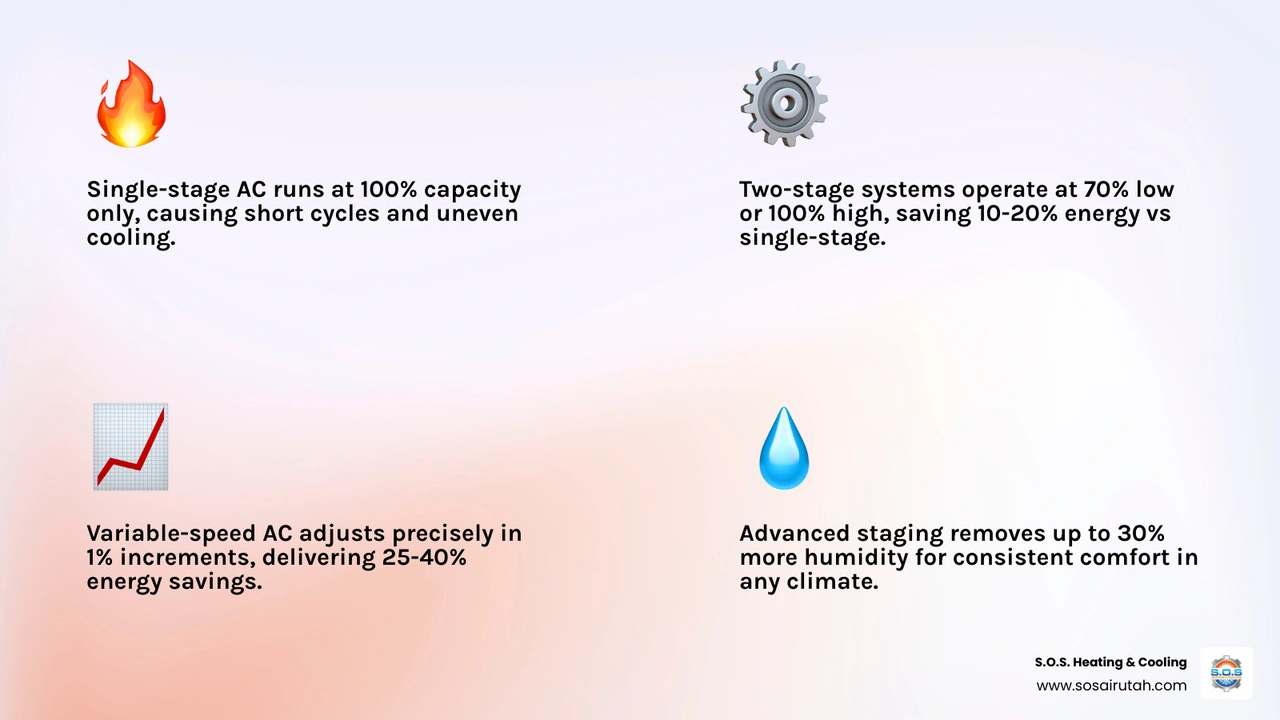
- Superior Humidity Control: By running longer cycles at lower speeds, the evaporator coil has more time to pull moisture out of the air. These systems can remove up to 30% more humidity than standard units.
- Whisper-Quiet Operation: Because they don't constantly "hard start" at full power, noise levels are significantly lower—often 50-55 decibels, which is about the volume of a quiet library.
- Better Air Filtration: Since the fan runs more consistently at lower speeds, your air is being pulled through your filters more often, catching more dust and allergens.
To keep these high-performance machines running at their peak, check out our AC Tune-Up Guide for Wasatch Front Homeowners.
Deciding if two stage systems worth the extra cost are right for your home
For many families in South Jordan or Bountiful, a two-stage system represents the "sweet spot." It offers about 80% of the benefits of variable speed at roughly 60% of the added cost.
A two-stage system typically has two settings: high (100% capacity) for those scorching July afternoons and low (usually around 70% capacity) for milder days. This reduced capacity allows for longer run times, which significantly helps with dehumidification and reduces "short-cycling"—the frequent starting and stopping that wears out motors.
If you are currently debating Should You Repair or Replace Your AC, a two-stage system is often the most logical upgrade for a moderate budget that still prioritizes comfort.
The Mechanics of Efficiency: How Staging Impacts Your Bill
The secret to why these systems save money lies in "part-load efficiency." Most of the time, your home doesn't actually need 100% of your AC's cooling power. It might only need 25% to maintain the temperature on a 75-degree day.
Single-stage systems are incredibly inefficient because they can't "throttle down." It’s like driving a car that only has two speeds: stopped or 100 mph. You’d burn through a lot of gas (and brakes) in city traffic. Variable-speed systems use inverter technology to act like a dimmer switch, using only the exact amount of electricity needed. This can result in a 25-40% reduction in energy consumption compared to older, single-stage models. For a deeper dive into how this technology works in different formats, see our page on Understanding Heat Pump Systems.
Real-world energy savings in 2026
What does this look like for your wallet? In a typical 2,000-square-foot home along the Wasatch Front, switching to a variable-speed system can save between $40 and $80 on monthly utility bills during the peak cooling season.
Over a 15-year lifespan, these savings add up. Industry data suggests that a variable-speed system can save between $8,000 and $12,000 in total energy costs compared to a single-stage unit. These systems are designed to meet or exceed the latest DOE standards, ensuring that your investment stays relevant as energy regulations tighten. If you're looking for the ultimate efficiency, you might even consider a Hybrid Heat Pump System which combines electric and gas heating.
Payback periods and ROI timelines
When calculating ROI, we look at the "payback period"—the time it takes for energy savings to cover the extra upfront cost of the upgrade.
- Two-Stage Systems: Typically reach the payback point in 5 to 7 years.
- Variable-Speed Systems: Usually take 7 to 10 years to pay back the premium.
However, these timelines can be shortened significantly by utilizing federal tax credits (like those under the Inflation Reduction Act) and local utility rebates. When you factor in the increased home value and the reduced likelihood of early repairs, the AC Repair or Replacement decision becomes much clearer.
When Premium Systems Underperform: The Ductwork Factor
Here is a truth many HVAC companies won't tell you: a variable-speed system is only as good as the ducts it’s attached to. Because these systems move air more slowly and at lower temperatures during dehumidification cycles, they are very sensitive to duct design.
If you have uninsulated "hard pipe" ducts in a crawlspace or attic, the cold air from a variable-speed unit can cause the metal to reach the "dew point." This leads to "sweating" ducts, which can cause mold growth or water damage to your ceilings. Furthermore, bad ductwork can lose 25-40% of airflow. If your home has restricted or leaky ducts, the advanced sensors in a variable-speed unit might struggle to maintain static pressure, causing the system to underperform. Regular HVAC Maintenance Utah should always include a duct inspection.
The importance of proper HVAC sizing
Choosing between stages doesn't matter if the unit is the wrong size for your home. We always perform a Manual J load calculation, which considers your home’s square footage, insulation levels, window orientation, and even the number of people living there.
An oversized variable-speed system will still short-cycle, defeating the purpose of the technology. An undersized two-stage system will just run on "high" all day, wasting energy. Proper sizing is the foundation of any Furnace Replacement Ultimate Guide or AC installation.
Longevity and Maintenance: Protecting Your Investment
One of the best arguments for why are two stage and variable speed systems worth the extra cost is equipment longevity.
- Single-Stage: 12–15 years
- Two-Stage: 16–18 years
- Variable-Speed: 18–22 years
Variable-speed systems last longer because they use "soft start" technology. The most stressful moment for any motor is the "inrush" of electricity when it jumps from zero to 100%. By ramping up slowly, variable-speed units experience far less mechanical stress.
However, these systems are more complex. They use specialized control boards and sensors that require expert technicians to service. While they break down less often, the parts can be more expensive. Knowing Enough is Enough: Knowing When to Replace Your Furnace or AC helps you plan for these lifecycle costs.
Frequently Asked Questions about AC Staging
Is a variable speed AC better for high humidity?
Absolutely. Moisture removal happens when warm, humid air passes over a cold evaporator coil. Because variable-speed systems run for longer periods at a lower speed, the air spends more time in contact with the coil. This allows the system to remove up to 30% more humidity than a single-stage unit, which often shuts off before it can properly dehumidify the home.
Can I use a standard thermostat with a variable speed system?
Generally, no. True variable-speed systems require "communicating" thermostats. Unlike a standard thermostat that just tells the unit "on" or "off," a communicating control uses proprietary protocols to tell the system exactly what percentage of power to use. Using a standard thermostat (like a basic Nest or Ecobee) on a variable-speed system often "cripples" the unit, forcing it to act like a two-stage system and wasting the technology you paid for.
Does a two-stage system help with hot and cold spots?
Yes. Hot and cold spots are often caused by the AC turning off too quickly before the air has had a chance to circulate to the furthest corners of the house. Because a two-stage system stays on longer (at 70% capacity), it keeps air moving through the ducts for a greater portion of the hour, leading to much more even temperature distribution throughout the home.
Conclusion
At S.O.S. Heating & Cooling, we’ve spent years serving our neighbors from Salt Lake City to Farmington and down to Herriman. We know that every home along the Wasatch Front has unique needs. When asking are two stage and variable speed systems worth the extra cost, the answer usually comes down to your personal comfort goals.
If you plan on staying in your home for the next decade and want the quietest, most consistent environment possible, variable speed is a phenomenal investment. If you want a significant upgrade over standard cooling without the highest price tag, two-stage is your best bet.
Ready to see which system fits your home? We provide personalized load calculations and efficiency analyses for homeowners in Bountiful, Sandy, Riverton, and throughout the valley. More info about air conditioning services is just a click away, or give us a call to schedule your consultation today!
Contact Us
Let's Get You From Distress to Rest
No heat, no cool, a backed-up drain, or just due for a tune-up? Call now or request service and our local team will be on the way — upfront pricing, no surprises.