

A Practical Guide to Furnace Lifespan in Utah


.avif)

How Many Heating Seasons Can You Expect from a Gas Furnace in Utah?
How many heating seasons can you expect from a gas furnace in Utah depends primarily on two things: the type of furnace you have and how consistently it has been maintained. Here is a quick breakdown:
| Furnace Type | AFUE Rating | Expected Heating Seasons |
|---|---|---|
| Entry-level | Below 80% | 12–15 seasons |
| Mid-range | 80–89% | 15–20 seasons |
| High-efficiency | 90%+ | 20–25 seasons |
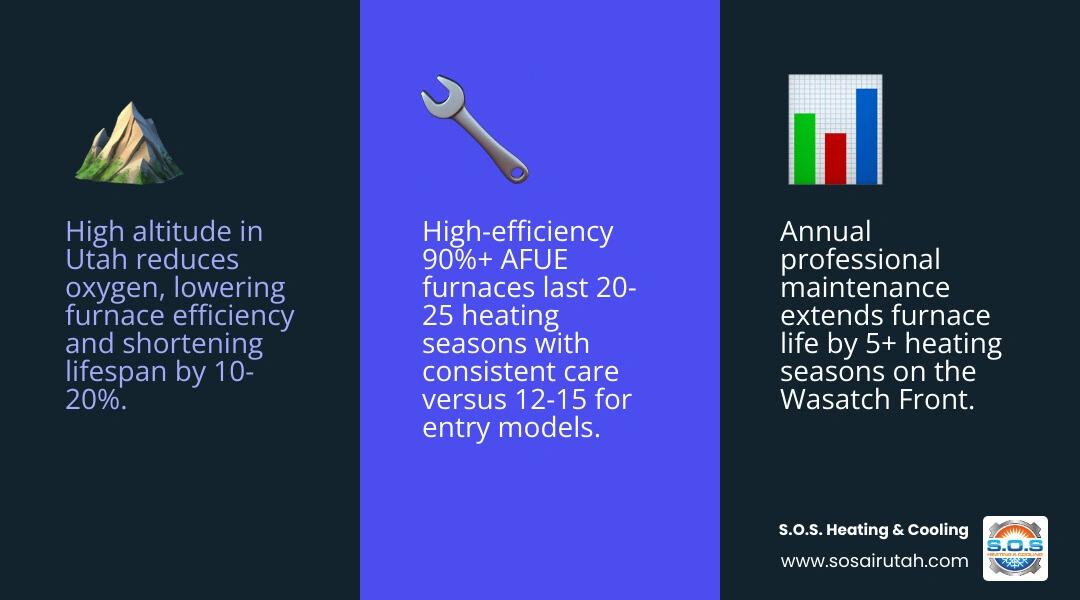
Utah's long, cold winters and high-altitude conditions mean your furnace works harder than systems in milder climates — which makes maintenance and proper sizing even more critical here on the Wasatch Front. A well-maintained high-efficiency furnace can carry you through two decades of heating seasons. A neglected one may not make it to twelve.
We have seen both outcomes firsthand. Furnaces lasting 23 years with consistent filter changes and annual tune-ups. Furnaces failing at 11 years because no one was paying attention. The difference almost always traces back to one thing: whether anyone was actually taking care of the system.
I'm Bryson Ninow, an experienced HVAC professional with years of hands-on experience helping Utah homeowners get the most out of their heating systems — including answering the exact question of how many heating seasons can you expect from a gas furnace in Utah for homes ranging from Salt Lake City to the higher-elevation communities along the Wasatch Front. In this guide, I'll walk you through everything you need to know to protect your investment and make a smart decision when the time comes.
Standard Lifespan Benchmarks
When we talk about furnace age and service life, we are looking at the overall durability of the physical components under normal operating conditions. In a typical climate, a standard natural gas furnace has an expected service life of 15 to 20 years. However, "standard" is a relative term.
The baseline efficiency of your unit, measured by its Annual Fuel Utilization Efficiency (AFUE) rating, plays a massive role in how many heating seasons it can handle. Older systems, or those built as entry-level models, often operate at an 80% AFUE rating or lower. While these systems are mechanically simpler, they must run longer and cycle more frequently to keep your home warm, which accelerates physical wear and tear.
As a furnace ages, its combustion efficiency naturally begins to decline. Over two decades, neglected internal components can experience a non-linear degradation pattern. A system that started its life operating at 80% efficiency might only deliver 60% to 70% efficiency by its fifteenth year. This means it has to burn more gas and run its blower motor longer to achieve the same indoor temperature, creating a compounding cycle of wear that eventually leads to a terminal mechanical breakdown.
How Many Heating Seasons Can You Expect from a Gas Furnace in Utah at High Altitudes?
Operating a combustion appliance along the Wasatch Front introduces a major variable: high altitude. Whether you live in Salt Lake City, up in the foothills of Mt. Olympus, or in higher-elevation communities like Herriman and Draper, the altitude significantly impacts how your furnace breathes.
At elevations between 4,200 and 5,000+ feet above sea level, the air density is roughly 15% to 18% lower than it is at sea level. Because the air is thinner, there is less oxygen available to support the combustion process inside your furnace's burner assembly. If a standard gas furnace is installed straight out of the box without altitude adjustments, it will run "fuel-rich." This incomplete combustion leads to soot buildup, dirty burners, and elevated levels of carbon monoxide, all of which rapidly degrade the heat exchanger.
To prevent this, HVAC manufacturers require derating the heating capacity of the furnace. Typically, a gas furnace must be derated by approximately 4% for every 1,000 feet of elevation above sea level. This means a furnace rated for 100,000 BTUs at sea level will only deliver about 82,000 effective BTUs in the Salt Lake Valley.
If your installer did not perform these calculations or adjust the gas pressure and orifice sizes during installation, your furnace will constantly struggle. It will either short-cycle or run continuously to meet the thermostat's demands, compressing twenty years of wear into a single decade of heating seasons.
Environmental Factors Affecting Utah Furnaces
Utah's weather is famous for its dramatic shifts. Our unique geography means our heating and cooling systems must transition rapidly between extreme demand states, putting unique stress on residential HVAC systems. To understand how these regional realities affect your home, take a look at our detailed guide on How the Wasatch Front Climate Affects Your HVAC and Plumbing.
Temperature Swings and Dry Air
The Wasatch Front experiences annual temperature swings of over 100 degrees Fahrenheit, shifting from scorching summer afternoons to sub-zero winter nights. When the winter freeze sets in, our indoor heating systems run almost continuously.
Compounding this thermal stress is Utah's notoriously dry air. We live in one of the driest states in the nation. During the winter, outdoor relative humidity drops, and once that cold air is brought inside and heated, indoor relative humidity can easily plummet below 20% if a whole-home humidifier isn't active.
Dry air does not retain heat as effectively as humid air. This physical reality often prompts homeowners to turn their thermostats up higher to feel comfortable, increasing the overall workload on the system. Furthermore, dry air contributes to static electricity and dust accumulation. This airborne dust settles on the furnace's internal components, coating the blower wheel and restricting airflow.
The physical expansion and contraction of the metal heat exchanger during these intense, dry heating cycles is extreme. When the furnace fires up, the heat exchanger rapidly expands; when it shuts down, it cools and contracts. Over thousands of cycles, this constant movement causes metal fatigue, which is the primary cause of cracked heat exchangers.
High-Efficiency vs. Standard Models
When choosing a replacement system, Utah homeowners must weigh the differences between standard-efficiency models and high-efficiency condensing furnaces.
A standard 80% AFUE furnace utilizes a single heat exchanger and vents hot combustion gases directly through a metal flue. Because these gases must remain hot enough to rise naturally up the chimney, a significant amount of heat is intentionally wasted.
In contrast, a high-efficiency condensing furnace (operating at 90% to 98% AFUE) utilizes a secondary heat exchanger. This secondary chamber extracts additional heat from the exhaust gases until the water vapor condenses into liquid. Because the exhaust is cool, it can be safely vented through inexpensive PVC pipes.
In terms of lifespan, a high-efficiency condensing furnace can routinely last 20 to 25 heating seasons with proper maintenance. However, because these systems utilize complex components—such as secondary heat exchangers, condensate drain lines, and variable-speed inducer motors—they are more sensitive to neglect. If the condensate drain line freezes or becomes clogged with mineral deposits (a common issue due to Utah’s hard water), the system will shut down safely but will require professional service to restore operation.
Maximizing Your System's Lifespan
While climate and altitude establish the baseline, your daily habits and maintenance routines ultimately dictate how many heating seasons your system will survive. Our local weather demands proactive care; you can learn more about managing these transitions in our resource on How Seasonal Extremes Create Year-Round Maintenance Demands.
How Many Heating Seasons Can You Expect from a Gas Furnace in Utah with Regular Maintenance?
With professional preventative maintenance, a high-quality gas furnace in Utah can easily last 15 to 20 years, with premium models pushing past 22 to 25 heating seasons.
Annual professional tune-ups do more than just clean the dust out of the cabinet. A professional technician will perform a comprehensive safety and performance inspection, which includes:
- Checking safety controls and limit switches to prevent overheating.
- Measuring gas pressure and adjusting burners for proper high-altitude combustion.
- Inspecting the heat exchanger with specialized cameras to detect micro-cracks before they leak dangerous gases.
- Testing the blower motor capacitor and amp draw to prevent electrical failures.
- Cleaning the flame sensor to prevent sudden system shutdowns.
These steps keep your system running at peak combustion efficiency, reducing fuel consumption and minimizing physical wear on the mechanical assemblies.
Crucial DIY Maintenance Steps
You do not need to be a licensed technician to protect your furnace. Homeowners can take several simple, highly effective steps to extend their system's lifespan:
- Replace Air Filters Regularly: Change your air filter every 1 to 3 months. In Utah's dry, dusty climate, filters clog quickly. A clogged filter restricts return airflow, forcing the heat exchanger to retain too much heat. This triggers the high-limit switch, causing the system to short-cycle (turn on and off rapidly). Short-cycling is an absolute lifespan killer.
- Choose the Right MERV Rating: Use a filter with a MERV rating between 8 and 11. Avoid ultra-restrictive MERV 13+ filters unless your system's ductwork was specifically designed to handle the high static pressure.
- Keep Vents and Registers Clear: Ensure that at least 80% of your home's supply registers and return grilles are open and unobstructed by furniture, drapes, or toys. Closing off too many vents increases static pressure inside the ductwork, causing the blower motor to run hot and eventually burn out.
- Maintain Outdoor Vent Clearance: If you have a high-efficiency condensing furnace, keep the outdoor PVC intake and exhaust pipes clear of snow drifts, ice buildup, and autumn leaves. A blocked vent will immediately trigger a pressure switch safety shutdown.
Knowing When to Repair vs. Replace
No matter how well you care for your heating system, there comes a day when repairs are no longer practical. Recognizing the line between a simple fix and a mandatory upgrade is essential for your safety and your wallet. For a deeper look at the process, read our Furnace Replacement: The Ultimate Guide and review our practical Heating System Replacement Tips for Homeowners.
Warning Signs of Furnace Failure
Your furnace will rarely fail completely without drop-testing your patience first. Keep an ear and an eye out for these classic warning signs:
- Uneven Heating: If some rooms in your Layton or Sandy home feel like a freezer while others are sweltering, your furnace is struggling to distribute air consistently.
- Strange Noises: Squealing, banging, rattling, or thumping noises indicate failing blower motor bearings, a cracked belt, or loose internal components.
- A Yellow Burner Flame: A healthy natural gas flame should burn a crisp, steady blue. A flickering yellow or orange flame indicates incomplete combustion, which means your system is producing elevated levels of carbon monoxide.
- Frequent Cycling: If your furnace turns on and off every few minutes, it is likely overheating due to restricted airflow or a failing limit switch.
- Rising Utility Bills: A sudden, unexplained spike in your monthly gas bill means your system's efficiency has degraded to the point where it is running far longer than it should to heat your home.
The Replacement Decision Framework
When faced with a major repair bill, how do you decide whether to fix the old unit or invest in a new one? We recommend using two primary decision triggers:
- The Cracked Heat Exchanger Rule: Under ANSI Z21.47 standards, a cracked heat exchanger is classified as a Category I safety hazard. It allows carbon monoxide and other toxic combustion byproducts to leak directly into your home's breathing air. If your heat exchanger is cracked and your furnace is out of warranty, replacement is your only safe option.
- The Age-Times-Repair Rule: Consider the age of your furnace in relation to the frequency and severity of repairs. If an older system requires frequent, major repairs to stay operational, those cumulative expenses quickly outweigh the value of the unit. In these cases, investing in a modern, reliable upgrade is often the more practical long-term decision.
Additionally, consider the efficiency floor. Upgrading an old, 60% efficient furnace to a modern 95%+ AFUE condensing model can reduce your heating energy consumption by up to 30%, helping the new system pay for itself over time through lower monthly utility bills.
Frequently Asked Questions About Utah Furnace Lifespan
Should I replace my 20-year-old furnace?
In almost all cases along the Wasatch Front, yes. Even if a 20-year-old furnace is still running, it is operating at the absolute limit of its safe mechanical service life. Older systems lack modern safety controls, and their heat exchangers are highly susceptible to sudden, dangerous cracks. Furthermore, a 20-year-old unit is likely running at a fraction of its original efficiency, costing you significantly more on your monthly gas bills than a modern, high-efficiency upgrade would.
Does Utah's altitude affect furnace performance?
Absolutely. Because the air density is 15% to 18% lower at our elevations (4,200 to 5,000+ feet), furnaces must be properly derated and adjusted by a professional technician during installation. This involves adjusting the gas manifold pressure and sometimes changing the burner orifices to ensure the correct fuel-to-oxygen ratio. Without these adjustments, the system will suffer from poor combustion efficiency, heavy soot buildup, and premature component failure.
What is the average lifespan of a heat pump vs. a gas furnace in Utah?
In Utah's climate, a gas furnace typically lasts 15 to 20 years (or more with excellent maintenance), while a standard air-source heat pump generally lasts 10 to 15 years. This difference in lifespan is due to annual cycle counts. A gas furnace only runs during the cold winter months, remaining dormant all spring and summer. A heat pump, however, runs year-round—providing heating in the winter and reversing its cycle to provide cooling in the summer. This continuous operation doubles its annual wear and tear.
Conclusion
At S.O.S. Heating & Cooling, we have spent years helping homeowners throughout Salt Lake City and the surrounding communities keep their homes warm, safe, and efficient. We proudly serve families in Bountiful, Centerville, Cottonwood Heights, Draper, Farmington, Herriman, Holladay, Kaysville, Layton, Millcreek, Mt. Olympus, Murray, Riverton, Sandy, South Jordan, South Salt Lake, and Woods Cross.
Whether you need a quick seasonal tune-up to prepare for the first hard freeze, emergency repairs on a freezing January night, or a comprehensive home comfort upgrade, our team is here to help. We offer 24/7 emergency repairs, priority service for our maintenance partners, and reliable support to make sure your home stays comfortable when you need it most.
Don't wait for your heating system to leave you in the cold. Contact us today to schedule your annual tune-up or explore our professional furnace repair services to keep your system running safely for many heating seasons to come.
Explore Our Latest Insights and Updates in Plumbing Services

A Practical Guide to Drain Cleaning Frequency in the Wasatch Front
The Ins and Outs of How Hard Utah Water Causes Mineral Buildup in Toilet and Drain Lines
How Often to Service Your AC in Dry Utah Climate