

A Practical Guide to Drain Cleaning Frequency in the Wasatch Front


.avif)

How Often Should Drains Be Professionally Cleaned in the Wasatch Front
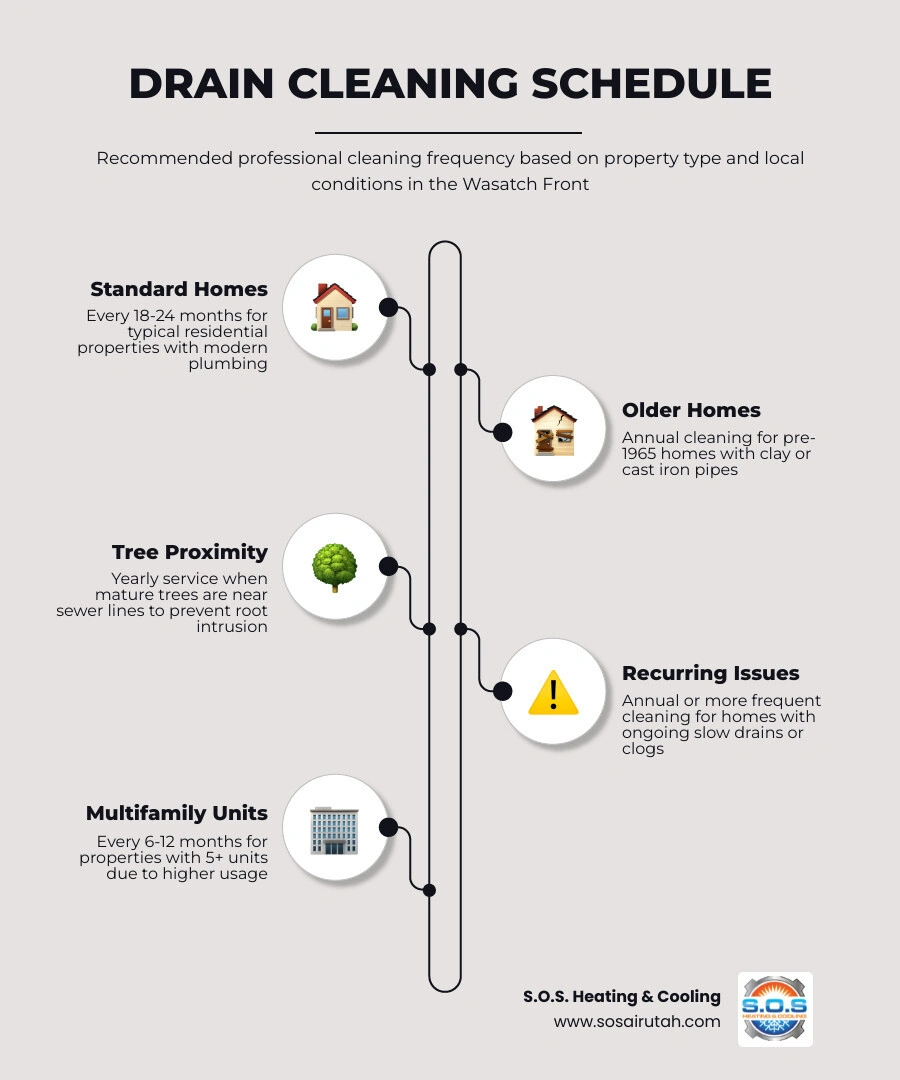
How often should drains be professionally cleaned in the Wasatch Front depends on your home's age, pipe material, and local environmental conditions — but here's a quick answer most Utah homeowners can use right now:
Recommended Professional Drain Cleaning Frequency:
| Property Type | Recommended Frequency |
|---|---|
| Standard residential home | Every 18 to 24 months |
| Older home (pre-1965) or clay/cast iron pipes | Annually |
| Home with mature trees near sewer line | Annually |
| Home with recurring slow drains or clogs | Annually or sooner |
| Multifamily property (5+ units) | Every 6 to 12 months |
Most plumbing experts agree that annual professional drain cleaning prevents up to 85% of major plumbing system failures — and for Wasatch Front homeowners dealing with hard water, clay soil, and freeze-thaw cycles, staying on schedule matters even more than it does in other parts of the country.
Here's the reality: most homeowners don't think about their drains until something goes wrong. A single slow sink becomes a backed-up shower, then a gurgling toilet, and suddenly you're dealing with an emergency that could have been avoided entirely with routine maintenance. The Salt Lake Valley's unique combination of mineral-heavy mountain water, aging mid-century infrastructure, and seasonal snowmelt creates conditions that stress residential plumbing faster than national averages suggest.
This guide will walk you through exactly what frequency makes sense for your home, what local factors accelerate buildup, and how to recognize the warning signs before a minor clog turns into a costly repair.
I'm Bryson Ninow, a home services professional serving the Wasatch Front, and helping Utah homeowners understand how often drains should be professionally cleaned in the Wasatch Front is part of the preventative care guidance I bring to every visit. Read on for the full breakdown — whether you're dealing with a recurring problem right now or simply want to stay ahead of one.
We often overlook the vital network of pipes operating silently beneath our floors and behind our walls. Yet, keeping these pathways clear is one of the most critical aspects of maintaining your property's value and structural integrity.
When you establish a consistent, preventative maintenance schedule, you aren't just avoiding the immediate headache of a clogged kitchen sink; you are actively extending the lifespan of your entire plumbing system by up to 40%. Investing in professional care before major obstructions form is highly cost-effective. In fact, routine preventative drain maintenance can reduce overall plumbing repair costs by up to 70% over a home's lifetime.
By understanding How Regular Drain Maintenance Prevents Costly Backups, you can transition from a reactive approach to a proactive strategy that keeps your household running smoothly year-round.
Standard Residential Timelines for Utah Homes
For a typical single-family home along the Wasatch Front—whether you are located in Salt Lake City, Sandy, or Draper—scheduling a professional hydro-jetting or deep mechanical cleaning every 18 to 24 months is generally sufficient to keep your pipes clear and flowing properly. This baseline interval assumes a standard household size of three to four people with normal water usage habits.
However, household size and daily habits play a massive role in how quickly debris accumulates. If you have a large family, frequently host guests, or have children who might occasionally flush questionable items, your baseline timeline should lean closer to the 12-to-18-month mark. Over time, hair, soap scum, culinary grease, and organic matter bond together to form thick, waterproof mats along the inner walls of your pipes.
If you are already noticing that multiple fixtures are draining slower than usual, it is time to search for a trusted Clogged Drain Service Near Me to clear the lines and establish a clean baseline.
High-Risk Properties and Older Wasatch Front Neighborhoods
If your home is located in one of our beautiful, historic Wasatch Front neighborhoods—such as the Avenues in Salt Lake City, older sections of Murray, or established areas in Cottonwood Heights—your plumbing system requires a completely different level of attention. Many homes built between 1920 and 1965 still rely on their original cast iron stacks or clay tile main sewer lines.
Cast iron pipes are highly susceptible to internal rust and scale accumulation. As the metal corrodes over decades, it develops a rough, uneven texture that easily snags hair, toilet paper, and grease, narrowing the pipe's usable diameter. Clay pipes, on the other hand, are highly vulnerable to joint displacement and root intrusion.
For these high-risk properties, we strongly recommend a professional drain inspection and cleaning once a year. If you live in Murray, checking out our Clogged Drain Murray UT Complete Guide can provide deeper insight into the unique structural challenges of mid-century plumbing systems in our local communities.
Unique Environmental Factors Affecting Utah Plumbing
Living along the Wasatch Front means enjoying breathtaking mountain views and distinct seasonal changes, but it also means subjecting your home's plumbing to some of the harshest environmental conditions in the country. Our local geography directly influences what happens inside your sewer lines.
From the minerals in our water supply to the physical movement of the earth beneath our feet, Utah's natural elements constantly work against your pipes. Staying informed about these regional challenges is the first step in protecting your home. If you want a comprehensive overview of how these local dynamics interact with your home's waste lines, our Drain Cleaning Salt Lake City Guide is an excellent resource to review.
Hard Water and Mineral Scale Accumulation
The Wasatch Front is notorious for having some of the hardest water in the United States. Because our municipal water is sourced primarily from mountain snowmelt and underground aquifers, it carries incredibly high concentrations of dissolved minerals, specifically calcium and magnesium. As this water flows through your drains, it leaves behind microscopic mineral deposits.
Over several years, these deposits build up into a rock-hard substance known as limescale. This scale forms a rough, sandpaper-like lining inside your pipes, which acts as a trap for grease, food particles, and hair. A pipe that started with a four-inch diameter can easily be restricted to half its usable size due to gradual mineral scale accumulation.
To prevent these mineral deposits from permanently choking your plumbing system, regular professional intervention is essential. You can find practical, local advice on managing this issue by reading through our Clogged Drain Salt Lake City Tips.
Clay Soil, Freeze-Thaw Cycles, and Spring Runoff
Our local soil and climate also play a significant role in drain health. Much of the Salt Lake Valley features clay-rich soil, which is highly prone to shifting. During our freezing winters, the ground contracts, and during our hot, dry summers, it expands and cracks. This constant shifting puts physical stress on buried sewer lines, often creating "bellies" (sagging sections where waste pools) or causing pipe joints to separate.
Furthermore, spring snowmelt brings a massive volume of groundwater down from the mountains. When groundwater levels rise rapidly, water can seep into even the tiniest cracks in your sewer line, overwhelming your system.
If your drains are already partially restricted by scale or debris, this sudden influx of external water can cause immediate backups into your basement floor drains. Annual drain cleaning before the spring runoff season ensures your system has the maximum capacity to handle these seasonal environmental pressures.
Warning Signs Your Wasatch Front Drains Need Immediate Attention
Plumbing disasters rarely happen entirely out of the blue. In almost every case, your drainage system will try to warn you that a blockage is developing long before sewage begins backing up into your living spaces.
Learning to recognize these early warning signs can save you thousands of dollars in emergency restoration costs and prevent serious damage to your property. If you are currently noticing unusual behavior from your fixtures, it is wise to familiarize yourself with Drain and Sewer Line Problems Signs and Solutions to determine your next steps.
Early Indicators of a Clogged Drain
The earliest signs of a developing drain issue are often subtle, but they should never be ignored. You might notice that water pools around your feet during a shower, or that the kitchen sink takes several minutes to empty after you do the dishes.
Another classic warning sign is a distinct gurgling or bubbling sound coming from your pipes. This sound occurs when air trapped behind a partial blockage struggles to escape through the standing water.
Additionally, lingering foul odors—caused by bacteria feeding on decomposing food scraps, hair, and soap scum trapped in your lines—are a clear indication that organic debris has built up to an unhealthy level. If you are currently struggling with a stubborn tub, you can learn how to resolve it safely by reading our guide on how to Fix a Slow Draining Bathtub.
Red Flags of a Main Sewer Line Blockage
While a single slow sink is a localized problem, a main sewer line blockage is a plumbing emergency that threatens your entire household's sanitation. The most critical red flag of a main line issue is multiple fixture backups occurring simultaneously. For example, if you flush your toilet and water bubbles up into your bathtub, or if running your washing machine causes water to overflow from your basement floor drain, the main sewer line is almost certainly blocked.
You may also notice a persistent smell of sewer gas (hydrogen sulfide) in your yard or basement, or discover patches of unusually lush, green grass over your buried sewer line, indicating a leak.
When these symptoms appear, you must stop using water immediately to prevent a major backup and consult our guide on Solutions for a Clogged Drain to protect your home.
Professional Methods vs. DIY Drain Cleaning
When faced with a slow drain, many homeowners instinctively reach for a quick DIY fix. While a plunger can resolve minor, shallow blockages, attempting to tackle deep-seated clogs or main line issues on your own often leads to temporary results or, worse, severe pipe damage.
To understand why professional methods are superior, it helps to look at how DIY tools compare to commercial-grade solutions:
| Feature | DIY Snaking & Chemicals | Professional Hydro-Jetting & Camera |
|---|---|---|
| Method of Action | Punches a small hole through the clog or uses acid to melt it | Blasts away 100% of debris using high-pressure water |
| Pipe Safety | High risk of chemical corrosion or physical pipe puncture | Extremely safe when calibrated by a licensed technician |
| Effectiveness | Temporary; leaves grease and scale behind on pipe walls | Restores the pipe's full original diameter |
| Diagnostic Capability | Blind guessing; no way to see underlying structural issues | High-definition camera inspects joints, roots, and cracks |
| Long-Term Value | Clogs quickly reform as debris catches on remaining residue | Keeps pipes clean and flowing for 18 to 24 months |
Choosing the right approach depends on the severity of the issue, but for long-term pipe health, professional Drain Blockage Removal is always the safest and most effective path forward.
Why DIY Chemical Cleaners and Snakes Fall Short
The liquid chemical drain cleaners sold at local home improvement stores are essentially highly concentrated acids or lye. While they can melt away hair or grease, they generate intense chemical heat in the process. This heat can warp or soften modern PVC pipes and rapidly accelerate corrosion in older cast iron or galvanized steel lines, leading to a condition known as "pipe rot."
Furthermore, hand-cranked retail drain snakes are typically short (only 15 to 25 feet) and lack the power to clear tough blockages. At best, a manual snake will simply punch a small hole through a soft clog, allowing water to drain temporarily while leaving the bulk of the grease and scale stuck to the pipe walls. Within a few weeks, the clog will reform.
For safer, more sustainable alternatives, read our expert Plumbing Tips for Clogged Drains.
The Power of Hydro-Jetting and Camera Inspections
Professional plumbers utilize advanced technologies that completely restore your pipes rather than just poking holes in clogs. The modern gold standard of drain cleaning is hydro-jetting. This process uses a specialized hose and multi-directional nozzle to blast highly pressurized water—up to 4,000 PSI—through your lines. This intense water pressure scours the entire inner diameter of the pipe, shearing away tree roots, emulsifying grease, and completely removing rock-hard hard water mineral scale without damaging the pipe itself.
Before any hydro-jetting begins, we perform a high-definition video camera inspection. By running a flexible, waterproof camera down your line, we can see exactly what is causing your drainage issues. This allows us to locate structural damage, separated joints, or heavy root intrusion, ensuring we use the exact right pressure settings and techniques to clean your pipes safely and effectively.
Frequently Asked Questions About Utah Drain Maintenance
How often should drains be professionally cleaned in the Wasatch front for older homes?
If your Wasatch Front home was built before 1965—common in older areas of Salt Lake City, Murray, and Holladay—you should schedule a professional drain inspection and cleaning once a year. Older plumbing systems typically feature cast iron or clay tile pipes, which are highly susceptible to internal corrosion, heavy mineral scale buildup, and structural shifting. An annual inspection allows us to catch minor joint separations and scale accumulation before they lead to catastrophic pipe collapses or sewage backups.
How often should drains be professionally cleaned in the Wasatch front if I have mature trees?
Properties with mature trees—especially water-seeking species like cottonwoods, maples, and elms—require professional drain cleaning at least once a year. Tree roots can sense the warmth and moisture inside your sewer line and will actively grow toward it, entering through microscopic cracks or loose pipe joints. Once inside, they feed on the organic waste, quickly growing into thick root root balls that completely block water flow. Annual hydro-jetting shears these roots away cleanly, preventing them from destroying your underground pipes.
Can hard water cause permanent damage to my home's pipes?
Yes. Over time, the heavy concentrations of calcium and magnesium in Utah's water form a rock-hard mineral scale that bonds directly to the interior of your pipes. This scale not only restricts water flow but also creates a highly abrasive surface that accelerates pipe wear and corrosion. In severe cases, the scale can become so thick that it cannot be safely cleared without damaging older, fragile pipes, necessitating a full and costly pipe replacement. Installing a water softener and scheduling regular professional cleanings are the best ways to protect your plumbing from permanent mineral damage.
Conclusion
Maintaining clean, free-flowing drains is one of the most effective ways to protect your home's structural integrity, preserve your property value, and keep your daily routine running smoothly. By understanding the unique environmental challenges we face along the Wasatch Front—from mineral-heavy hard water to shifting clay soils—you can make informed decisions about your plumbing care.
Rather than waiting for a stressful, messy plumbing emergency to disrupt your life, we encourage you to adopt proactive, preventative maintenance habits. A quick professional visit today can save you from a major restoration headache tomorrow.
When you are ready to experience the peace of mind that comes with a professionally inspected and cleaned plumbing system, the experienced team at S.O.S. Heating & Cooling is here to help. We proudly serve homeowners across the entire Salt Lake Valley and surrounding areas, including Bountiful, Centerville, Cottonwood Heights, Draper, Farmington, Herriman, Holladay, Kaysville, Layton, Millcreek, Mt. Olympus, Murray, Riverton, Salt Lake City, Sandy, South Jordan, South Salt Lake, and Woods Cross. Contact us today to schedule your routine maintenance and keep your home's pipes flowing perfectly for years to come!
Explore Our Latest Insights and Updates in Plumbing Services
The Fantastic Four Components That Keep You Cool
Avoid the Summer Meltdown with These Proactive Spring Steps
Should You Fix or Flee Your Old AC Unit?