

How Proper AC Sizing Keeps You Cool and Your Wallet Full


.avif)

Why How Proper AC Sizing Affects Comfort Is the Most Important AC Decision You'll Make
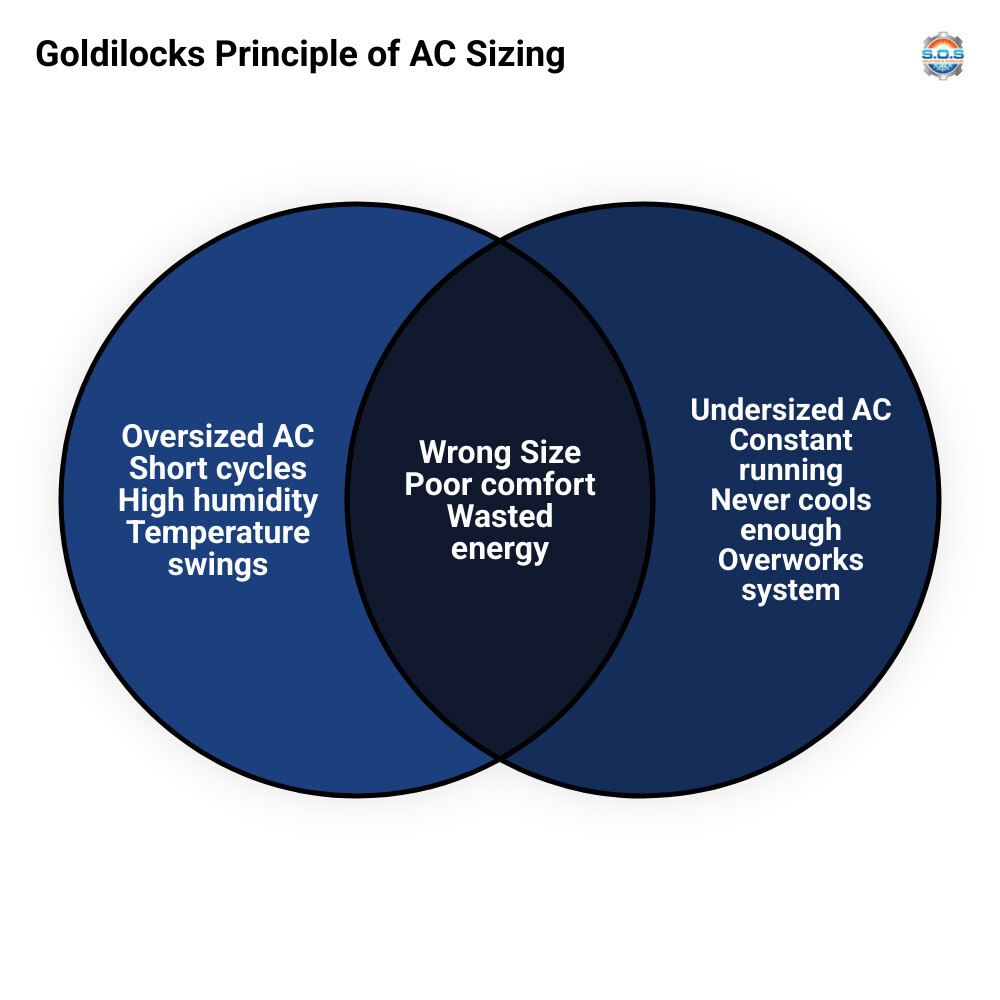
How proper AC sizing affects comfort comes down to one core idea: a system matched to your home's actual cooling needs runs efficiently, removes humidity effectively, and keeps every room at a consistent, comfortable temperature — while a system that's too big or too small does the opposite.
Here's a quick breakdown of what proper sizing means for your comfort:
| Sizing Scenario | What Happens | Comfort Impact |
|---|---|---|
| Properly sized | Runs in balanced cycles | Consistent temps, good humidity control |
| Oversized | Short cycles on and off | Clammy air, uneven cooling, higher bills |
| Undersized | Runs constantly | Never reaches set temp, excess heat and humidity |
Nearly half of all residential AC units are the wrong size — and the overwhelming majority of those are too big, not too small. According to industry estimates from the Air Conditioning Contractors of America (ACCA), between 30 and 50 percent of residential systems are improperly sized. That means millions of homeowners are living with comfort problems that have nothing to do with their thermostat setting, their insulation, or their windows — and everything to do with a system that was never the right fit for their home in the first place.
If you've ever walked into a room that felt stuffy and damp despite the AC running, or noticed some rooms are freezing while others stay warm, you've already felt the effects of improper sizing firsthand. These aren't minor annoyances — they're signs of a system working against you instead of for you.
I'm Bryson Ninow, and through my years in the HVAC industry — including hands-on work helping Salt Lake City homeowners choose and install the right equipment — I've seen how proper AC sizing affects comfort in ways most people never connect back to their unit's size. In the sections below, we'll walk through exactly what sizing means, what goes wrong when it's off, and what professionals look at to get it right.
What Does Proper AC Sizing Really Mean?
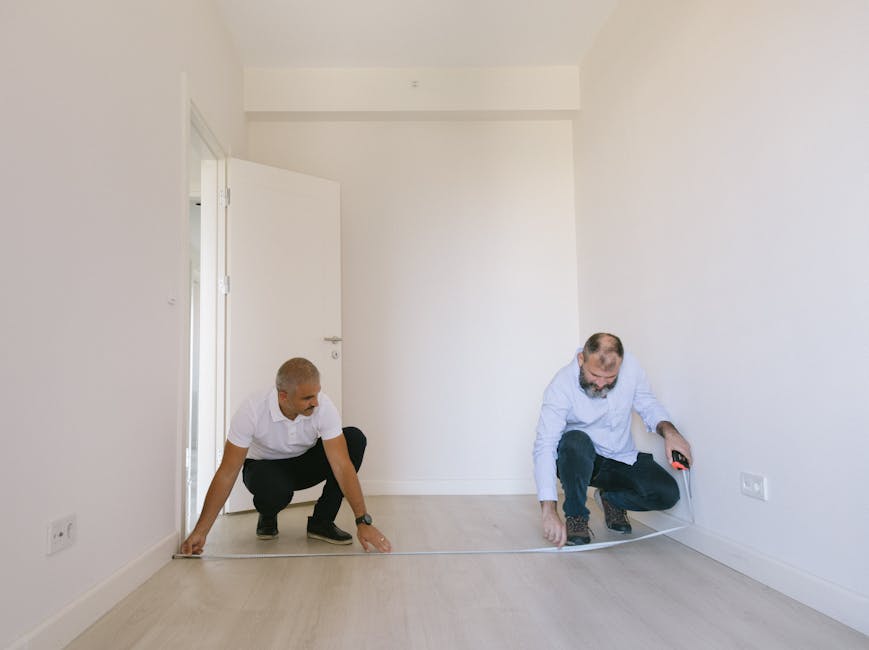
When we talk about AC sizing, we aren't talking about how much space the unit takes up on your side yard or roof. In the HVAC world, "size" refers to cooling capacity. This is the system's ability to remove heat from your home over a specific period.
We measure this capacity in two primary ways: BTUs and Tons.
- BTU (British Thermal Unit): This is the amount of heat required to raise the temperature of one pound of water by one degree Fahrenheit. In cooling, it represents how much heat the AC can pull out of your air.
- Tonnage: One "ton" of air conditioning is equal to 12,000 BTUs per hour. So, a 3-ton unit can remove 36,000 BTUs of heat every hour.
To understand how does air conditioning work: the science behind AC, you have to look at the two types of heat your system manages: sensible heat and latent heat. Sensible heat is what you see on the thermometer—the actual air temperature. Latent heat is the moisture, or humidity, in the air.
Proper sizing ensures the system stays on long enough to tackle both. A professional doesn't just guess based on your home's age; we use a Manual J load calculation. This is a detailed engineering report that accounts for your home’s "envelope"—everything from the direction your windows face to the thickness of your attic insulation. It is the gold standard for ensuring your system isn't just a "best guess" but a precision-engineered solution for your specific address in Salt Lake City.
How Proper AC Sizing Affects Comfort and Humidity Control
One of the biggest secrets in the HVAC industry is that your air conditioner is actually a giant dehumidifier. As it cools the air, moisture condenses on the cold evaporator coils and drains away. On a muggy day, a properly sized system can remove up to 25 gallons of water from your home’s air.
However, this process takes time. If the system is sized correctly, it runs through full, balanced cycles. This allows the air to circulate through the filter and over the cooling coils long enough to strip out the moisture. When sizing is wrong, that cycle is disrupted.
| Feature | Properly Sized System | Improperly Sized System |
|---|---|---|
| Cycle Length | Long, steady cycles | Too short (Oversized) or Never-ending (Undersized) |
| Humidity | Stays between 30% and 50% | Feels "clammy" or "sticky" |
| Temp. Balance | Even across all rooms | Hot and cold spots |
| Noise | Quiet, predictable operation | Frequent loud startups or constant hum |
When the sizing is right, you avoid the "clammy air" syndrome where the house is 72 degrees but feels like a swamp. Proper sizing also ensures better airflow balance. If you are struggling with solutions for uneven home cooling, the issue might not be your vents—it might be that your AC isn't running long enough to push conditioned air to the furthest corners of the house. This is a primary reason why your AC has poor cooling distribution; if the unit shuts off too soon, the upstairs bedrooms never get the cool air they need.
The Hidden Dangers of an Oversized Air Conditioner
The "bigger is better" myth is the most expensive mistake a homeowner can make. When an AC is too large for a home, it engages in short cycling. Because the unit is so powerful, it blasts the house with cold air and hits the thermostat’s target temperature in just a few minutes.
This sounds like a good thing, but it’s a disaster for your equipment. The most grueling part of an AC unit's life is the startup. Frequent startups cause massive component strain, specifically on the compressor and the blower motor. This leads to more frequent calls for troubleshooting AC relay switch problems and forces you to detect the need for AC maintenance much sooner than expected.
Furthermore, because the unit shuts off before it can remove humidity, your home becomes a breeding ground for mold. High humidity levels compromise your indoor air quality and can lead to that "old basement" smell in a modern suburban home.
Why an oversized unit fails the how proper ac sizing affects comfort test
If you want to know how proper AC sizing affects comfort, look at the "yo-yo" effect of an oversized unit. You get a sudden blast of freezing air, followed by a long period of stillness where the humidity starts to climb back up. You feel "sticky" even though the thermometer says it's cool. This moisture retention makes the indoor environment feel oppressive rather than refreshing.
Why an Undersized System Struggles in the Salt Lake Heat
On the flip side, an undersized system is like trying to cool a warehouse with a desk fan. It will run continuously during a Utah July, but the temperature will never actually drop to your desired setpoint.
Continuous operation leads to accelerated wear. Parts that were designed to last 15 years might fail in 7 because they never got a break. If your system is constantly running and you're looking for what to do when your AC stops cooling, it might be that the evaporator coils have actually frozen over because the system never cycled off to let them defrost.
For residents in Cottonwood Heights or Murray, an undersized unit often leads to a frantic search for an AC repair Cottonwood Heights UT guide. The system simply can't keep up with the heat gain coming through your roof and windows.
How proper ac sizing affects comfort during Utah summer peaks
Utah summers are unique. We deal with high "design conditions"—the peak temperatures that happen during our hottest weeks. If your system isn't sized to handle the specific heat gain of your home (factoring in your insulation levels and sun exposure), it will fail right when you need it most. An undersized unit will leave you sitting in a 78-degree house at 10:00 PM, wondering why the AC has been running since noon.
Key Factors Professionals Use for Accurate Sizing
At S.O.S. Heating & Cooling, we don't just look at your square footage and pick a box off the shelf. To ensure how proper AC sizing affects comfort in your home, we evaluate several critical factors:
- Square Footage & Volume: We look at the floor area and the ceiling height. High vaulted ceilings in a Sandy living room require more cooling than a standard 8-foot ceiling.
- Window Orientation: Windows facing west catch the brutal afternoon sun, significantly increasing the cooling load.
- Insulation & Air Leakage: How well does your home hold onto the cold? We check the "envelope" of the building.
- Occupancy: Every person in your home generates about 400 BTUs of heat per hour. A family of six needs more cooling than a couple.
- Ductwork Integrity: Even the perfect AC will fail if the ducts are leaking 30% of the air into the crawlspace.
If you’re planning a new system, our AC installation Draper UT complete guide highlights the importance of proper AC installation. For homes with tricky layouts or additions, we often recommend ductless AC for zoned cooling, which allows you to size the cooling perfectly for individual rooms rather than relying on one giant central unit.
Frequently Asked Questions about AC Sizing
Can I just use my home's square footage to pick an AC size?
The "rule of thumb" (usually 1 ton per 500-600 square feet) is dangerously inaccurate. Two identical-looking homes in Salt Lake City can have completely different cooling needs. One might have brand-new triple-pane windows and R-60 attic insulation, while the other has original 1970s windows and thin insulation. Using square footage alone is how most systems end up oversized. regular AC maintenance is essential, but it can't fix a system that was fundamentally sized wrong from day one.
What is a Manual J load calculation?
Think of a Manual J calculation as a "prescription" for your home's cooling. It is the industry-standard protocol developed by the ACCA. It uses engineering formulas to calculate exactly how many BTUs your home loses and gains. This ensures that when we install your unit, it is sized with mathematical certainty to handle the local climate and your specific building materials. It's the difference between "guessing" and "knowing." This is usually the first step when we determine it's time to schedule an AC tune-up or replacement.
How do I know if my current AC is the wrong size?
There are a few "smoking guns" that point to a sizing issue:
- The system turns on and off every 5-10 minutes (Oversized).
- The indoor air feels "heavy" or damp even when it's cool (Oversized).
- The unit never turns off on a 90-degree day (Undersized).
- Your utility bills are significantly higher than your neighbors' with similar homes.
- Some rooms are consistently 5 degrees warmer than others.
If you notice these signs, check out our ductless AC maintenance Utah guide or give us a call to see if a zoned approach might solve the problem.
Conclusion
At S.O.S. Heating & Cooling, we’ve spent years serving our neighbors from Bountiful to South Jordan. We know that a new air conditioner is a major investment, and the "size" of that investment shouldn't just be measured by the sticker price—it should be measured by the comfort and efficiency it provides for the next 15 to 20 years.
Proper sizing ensures system longevity, slashes your monthly utility bills, and creates an indoor climate that actually feels like a sanctuary. Whether you are interested in the benefits of zone-controlled cooling systems or need a traditional central air replacement, we are here to help.
Don't settle for "close enough." Ensure your home is perfectly balanced for the Utah heat. Schedule your professional Salt Lake City air conditioning consultation today and let our experts perform a precision load calculation for your home. We provide 24/7 emergency service and flexible financing to make sure you stay cool without the stress.
Explore Our Latest Insights and Updates in Plumbing Services
How to Stack Rocky Mountain Power and Federal Rebates for HVAC Upgrades in Utah

A Practical Guide to Drain Cleaning Frequency in the Wasatch Front

The Ins and Outs of How Hard Utah Water Causes Mineral Buildup in Toilet and Drain Lines