
How to Stack Rocky Mountain Power and Federal Rebates for HVAC Upgrades in Utah


.avif)

Understanding Rocky Mountain Power Wattsmart Rebates
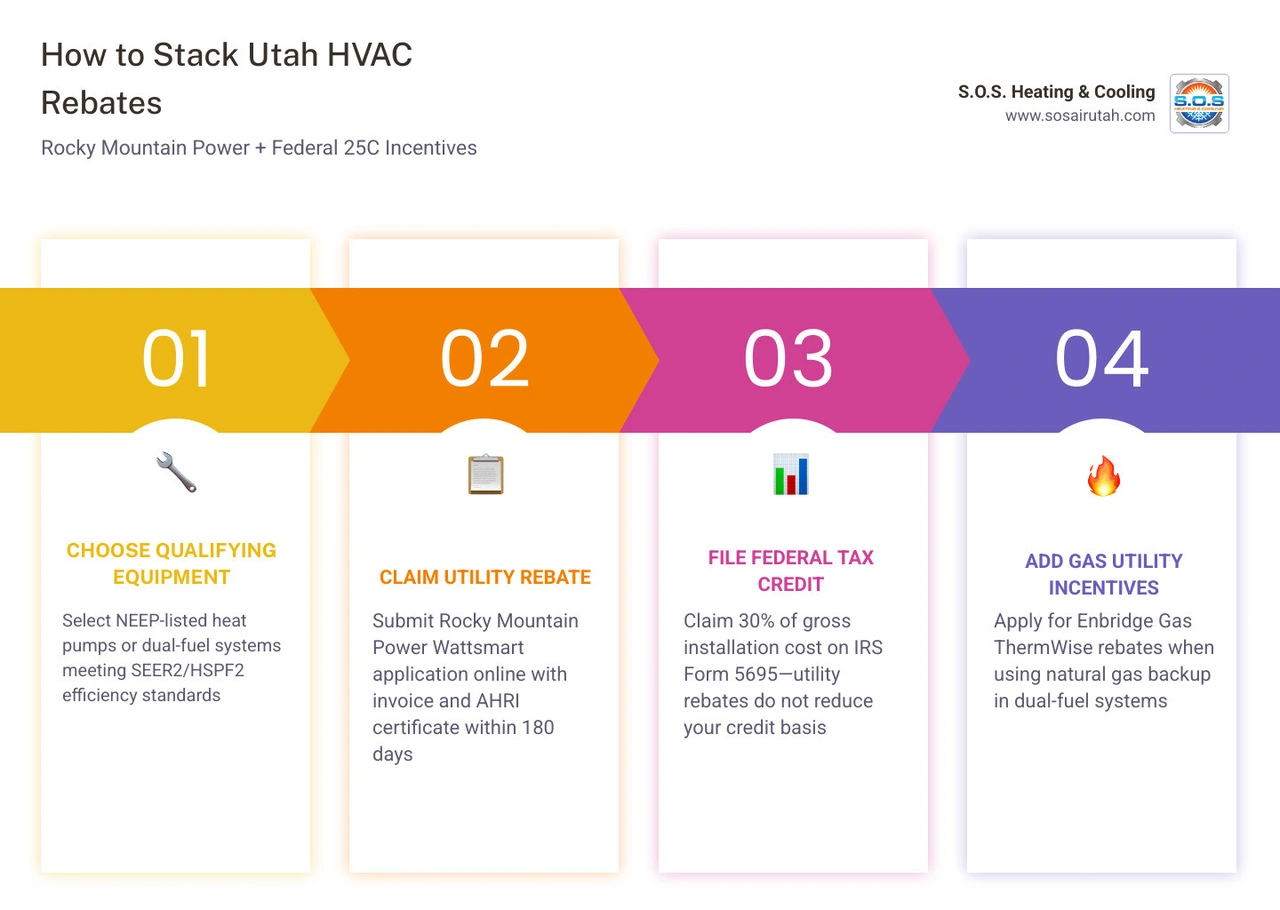
Learning how to stack Rocky Mountain Power and federal rebates for HVAC upgrades in Utah is one of the smartest moves a homeowner can make before replacing a heating or cooling system. Here is a quick summary of how it works:
- Install qualifying equipment — Choose a heat pump or dual-fuel system that meets Rocky Mountain Power Wattsmart efficiency standards (and appears on the NEEP Qualified Products List for the top rebate tier).
- Claim your Rocky Mountain Power Wattsmart rebate — Submit your application online within 180 days of installation using your invoice, AHRI certificate, and related documentation.
- Stack with the federal Section 25C tax credit — Claim 30% of your gross installation cost (up to the annual cap) on IRS Form 5695 when you file your federal taxes. The IRS uses your full project cost — utility rebates do not reduce the amount you can claim.
- Add Enbridge Gas ThermWise rebates if applicable — If your home uses natural gas backup (dual-fuel system), you may qualify for an additional rebate from Enbridge Gas on top of both of the above.
- Check income eligibility for HEAR/HOMES — Utah's federally funded Home Electrification and Appliance Rebates program is expected to launch through the Utah Governor's Office of Energy Development. Income-qualifying households may stack these on top of utility rebates for even greater savings.
The result? A combination of incentives that can meaningfully reduce the net cost of a high-efficiency heat pump installation — without leaving money on the table.
If you are a Salt Lake City area homeowner facing an unexpected HVAC breakdown or planning a system upgrade, the timing has never been more important. Most homeowners only know about one rebate program. But in Utah, Rocky Mountain Power's Wattsmart program, the federal Section 25C energy efficiency tax credit, and Enbridge Gas ThermWise incentives can all be applied to the same project — and when stacked correctly, they can cover a substantial share of your total installation cost. This guide walks you through exactly how to do it, step by step, so you don't leave a single dollar on the table.
I'm Bryson Ninow, a NATE-certified HVAC professional with hands-on experience helping Utah homeowners navigate how to stack Rocky Mountain Power and federal rebates for HVAC upgrades in Utah to make high-efficiency equipment genuinely affordable. I've guided countless families through this exact process, and in this guide I'll share everything I've learned so you can do the same.

Rocky Mountain Power offers some of the most robust utility incentives in the country through its Wattsmart Homes program. For homeowners along the Wasatch Front, these rebates are designed to offset the initial cost of transitioning to high-efficiency electric or hybrid heating and cooling systems.
When upgrading your HVAC system, the largest rebates are reserved for electric heat pumps and dual-fuel systems. For instance, cold-climate heat pumps can qualify for a rebate of up to $2,000 per unit. Standard heat pumps can qualify for $1,000, while high-efficiency central air conditioners can bring in a rebate of up to $350. If you decide to go with a dual-fuel system (which pairs an electric heat pump with a high-efficiency gas furnace), the Wattsmart rebates range from $1,700 to $2,000 depending on the system's efficiency tier.
To learn more about how these local utility programs function specifically for our local communities, check out our guide on Rocky Mountain Power Rebates for Wasatch Front Homeowners. For a broader overview of the state's incentive landscape, you can also review Utah Energy Rebates for HVAC Upgrades.
Qualifying Equipment and Efficiency Standards
To secure these rebates, your new HVAC system cannot be just any run-of-the-mill unit. Rocky Mountain Power enforces strict performance standards:
- Cold-Climate Heat Pumps: Must have an efficiency rating of 8.5 HSPF2 / 17 SEER2 or better and must be listed on the Northeast Energy Efficiency Partnerships (NEEP) Qualified Products List.
- Standard Heat Pumps: Must meet a minimum of 7.5 HSPF2 / 15.2 SEER2.
- Central Air Conditioners: Must reach a minimum of 19 SEER2 to qualify for the $350 rebate.
- Dual-Fuel Systems: Must be AHRI-rated and pair a qualifying heat pump (minimum 7.5 HSPF2 / 14.3 SEER2) with a gas furnace of at least 80% to 90% AFUE.
Your contractor must provide an Air-Conditioning, Heating, and Refrigeration Institute (AHRI) Certificate of Product Ratings to prove the matched system meets these exact thresholds.
Specialized Utility Programs
In addition to one-time equipment rebates, Rocky Mountain Power offers ongoing programs that help you save on monthly operating costs:
- Cool Keeper Program: This demand response program pays you a $30 annual bill credit. It allows the utility to briefly cycle your AC compressor during peak summer demand hours. This prevents grid overload and actually protects your compressor from short-cycling.
- Time of Use (TOU) Plans: Homeowners can opt into TOU rates, which charge significantly less for electricity during off-peak hours. In the winter, the off-peak rate drops to 6.31¢/kWh. Rocky Mountain Power even provides a Bill Guarantee for your first year, ensuring you won't pay more than 10% above standard rates while you adjust your usage habits.
- Wattsmart Batteries: If you integrate solar panels and home battery storage, you can earn additional incentives for letting the utility manage your stored energy during peak grid events.
Federal Incentives and the Inflation Reduction Act in 2026
The federal government provides a powerful financial boost through the Energy Efficient Home Improvement Credit, commonly known as the Section 25C tax credit. Reauthorized and expanded under the Inflation Reduction Act, this incentive allows homeowners to deduct up to 30% of the cost of qualifying energy-efficient home upgrades directly from their federal tax liability.
Unlike utility rebates, which are sent as cash checks or direct deposits, the 25C incentive is a non-refundable tax credit. This means it reduces the amount of federal income tax you owe for the year the system was placed in service. For a detailed breakdown of how these federal programs benefit local families, read about the Inflation Reduction Act Benefits for Utah Homeowners. You can also explore the environmental and financial advantages of these systems in our article on Heat Pump Benefits for Utah Homeowners.
Federal Tax Credit Limits and Caps
While the Section 25C credit covers 30% of your installation costs, it is subject to specific annual limits:
- Heat Pumps: Capped at a maximum of $2,000 per year.
- Central Air Conditioners and Gas Furnaces: Capped at $600 per year.
- Electrical Panel Upgrades: If your new heat pump requires an electrical service upgrade (such as upgrading to a 200-amp panel), you can claim 30% of that cost, capped at $600.
- Labor Costs: Crucially, the federal tax credit applies to both the equipment cost and the labor required for installation.
Because these limits reset every calendar year, strategic homeowners sometimes space out their upgrades—installing a heat pump in one tax year and performing electrical or insulation upgrades in another to maximize their tax credits.
Home Energy Rebate Programs (HEAR and HOMES)
Utah was approved for $101 million in federal funding to launch the Home Energy Rebates programs, administered by the Utah Governor's Office of Energy Development. These programs include:
- Home Electrification and Appliance Rebates (HEAR): Point-of-sale discounts for low-to-moderate-income households. Qualifying families (those earning below 80% of the Area Median Income) can receive up to $8,000 for a heat pump installation, covering up to 100% of the project cost.
- HOMES Performance-Based Rebates: Offers rebates between $2,000 and $8,000 based on measured or modeled whole-home energy savings of 20% to 35% or more.
As of mid-2026, these state-administered programs are preparing for full public rollout. Once active, income-qualified households will be able to combine these point-of-sale discounts with existing utility incentives.
How to Stack Rocky Mountain Power and Federal Rebates for HVAC Upgrades in Utah
The real financial magic happens when you stack these local and federal programs together on a single project. The IRS explicitly allows you to claim the Section 25C tax credit on the gross installation cost of your project. This means you do not have to subtract your Rocky Mountain Power or Enbridge Gas utility rebates before calculating your 30% federal tax credit.
| Incentive Program | Qualifying Equipment | Maximum Incentive Amount | Incentive Type |
|---|---|---|---|
| RMP Wattsmart | Cold-Climate Heat Pump (NEEP Listed) | Up to $2,000 | Cash Rebate |
| Federal Section 25C | ENERGY STAR Certified Heat Pump | Up to $2,000 (30% of gross cost) | Federal Tax Credit |
| Enbridge Gas ThermWise | Dual-Fuel Heat Pump / Gas Backup | Up to $1,200 | Cash Rebate |
| RMP Wattsmart | Smart Thermostat | Up to $75 - $100 | Cash Rebate |
To determine if a heat pump is the right starting point for your home's layout, check out our analysis: Is a Heat Pump Right for Your Home. If you are considering a hybrid setup, read our Hybrid Heating System Installation Complete Guide.
Step-by-Step: How to Stack Rocky Mountain Power and Federal Rebates for HVAC Upgrades in Utah
To successfully secure all eligible savings without running into administrative roadblocks, follow this exact sequence:
- Hire a Program-Eligible Contractor: Rocky Mountain Power requires that qualifying heat pumps and dual-fuel systems be installed by a registered Wattsmart Trade Ally.
- Select Certified Equipment: Ensure your contractor provides written proof that the proposed system meets the required SEER2 and HSPF2 ratings. Keep the AHRI certificate on file.
- Complete the Installation: Have your professional HVAC team install the system according to the Utah Technical Specifications Manual.
- Submit Utility Applications: Your contractor will typically submit the Rocky Mountain Power Wattsmart and Enbridge Gas ThermWise applications on your behalf, or provide you with the exact itemized invoice needed to apply online. This must be submitted within 180 days of installation.
- Receive Your Rebate Checks: Once approved, Rocky Mountain Power typically issues rebate checks within 14 business days.
- File IRS Form 5695: When tax season arrives, hand your itemized invoice and manufacturer certification statement to your CPA, or upload them into your tax software to claim your Section 25C credit.
For a deeper dive into the application logistics, read our step-by-step guide on How to Apply for Energy Rebates in Utah.
Common Mistakes When Learning How to Stack Rocky Mountain Power and Federal Rebates for HVAC Upgrades in Utah
Over the years, we have seen homeowners miss out on thousands of dollars due to small, avoidable errors. Here are the most common pitfalls:
- Missing the 180-Day Deadline: Rocky Mountain Power is strict about its 180-day post-installation submission window. If you wait too long to submit your paperwork, you forfeit the rebate entirely.
- Using an Unapproved Contractor: If your installer is not a registered Trade Ally with the utility, your Wattsmart rebate application will be rejected.
- Buying Non-Compliant Equipment: Never assume a unit is highly efficient just because it is new. It must have an official AHRI match number and meet the exact SEER2/HSPF2 requirements.
- Improper System Sizing: Sizing is critical for both comfort and efficiency. An oversized system will short-cycle, while an undersized system will struggle in extreme weather. Learn how this impacts your home in our guide on How Proper AC Sizing Affects Comfort.
Maximizing Savings with Dual-Fuel and Weatherization Upgrades
If you live along the Wasatch Front—from Bountiful and Layton down to Salt Lake City, Sandy, and Draper—you can maximize your savings by coordinating your electric utility upgrades with your natural gas utility. If your home has a natural gas line, installing a dual-fuel heat pump allows you to stack Rocky Mountain Power rebates with Enbridge Gas (formerly Dominion Energy) ThermWise rebates.
Combining these programs can yield between $2,450 and $2,650 in total utility rebates alone. When you add a smart thermostat rebate (up to $100 from Rocky Mountain Power and $75 from ThermWise), the savings continue to climb.
If you live in Davis County, check out our Best Heating Installation Bountiful UT Guide to see how local weather patterns influence equipment choice. To understand why professional installation is non-negotiable for these advanced systems, read about the Professional HVAC Installation Benefits.
The Dual-Fuel Advantage in Utah's Climate
A dual-fuel system pairs an electric heat pump with a gas furnace. In the mild spring and autumn months, the heat pump heats your home with incredible efficiency. When temperatures drop below a designated "changeover temperature" (typically between 30°F and 40°F), the system automatically switches to the natural gas furnace.
This hybrid approach is highly effective during the Wasatch Front's winter inversion season. Because heat pumps do not burn fossil fuels on-site, using them during milder winter days helps reduce local emissions and improves valley air quality.
Home Envelope Improvements
To get the most out of your new HVAC system, you should also look at your home's insulation and windows. Rocky Mountain Power and the federal government both incentivize "envelope" upgrades:
- Windows: Rocky Mountain Power offers a Tier 2 rebate of $3 per square foot for installing high-efficiency windows with a U-factor of 0.22 or lower. The federal government offers a 30% tax credit up to $600 for qualifying window replacements.
- Insulation and Air Sealing: Adding attic insulation to reach R-38 or R-60 standards keeps your conditioned air inside. This allows you to install a smaller, less expensive HVAC system because your home's heating and cooling load is lower.
Frequently Asked Questions about Utah HVAC Rebates
Do utility rebates reduce my federal tax credit?
No. According to IRS guidelines, utility rebates are treated as non-taxable reductions in utility bills rather than taxable income. Therefore, you do not have to subtract your Rocky Mountain Power or Enbridge Gas rebates from your total project cost when calculating your 30% federal Section 25C tax credit. You calculate the tax credit based on the gross invoice amount.
What is the altitude impact on heat pump performance in Utah?
Utah's elevation can affect HVAC performance. At elevations above 5,000 feet (common in areas like Mt. Olympus, Sandy, and Draper), air is less dense, which can reduce a heat pump's heating capacity by about 4% per 1,000 feet of elevation. A professional contractor must perform an altitude-adjusted Manual J load calculation to ensure your system is sized correctly for your specific neighborhood's elevation and winter design temperatures.
Are Utah's state-administered HEAR and HOMES rebates available in 2026?
Yes, the Utah Governor's Office of Energy Development is actively working to roll out the state's $101 million allocation of federal Inflation Reduction Act funds. These programs are designed to offer point-of-sale discounts for low-to-moderate-income families. Because these programs are not retroactive, upgrades completed before the official launch date will not qualify for these specific state-administered rebates, though they still qualify for standard utility rebates and federal tax credits.
Conclusion
Stacking utility rebates and federal tax credits is the single best way to make a high-efficiency HVAC upgrade affordable. By combining Rocky Mountain Power's Wattsmart incentives, Enbridge Gas ThermWise rebates, and the federal 25C tax credit, Wasatch Front homeowners can recover a significant portion of their total project costs.
At S.O.S. Heating & Cooling, we serve homeowners throughout Salt Lake and Davis counties—including Bountiful, Centerville, Cottonwood Heights, Draper, Farmington, Herriman, Holladay, Kaysville, Layton, Millcreek, Mt. Olympus, Murray, Riverton, Salt Lake City, Sandy, South Jordan, South Salt Lake, and Woods Cross. We offer 24/7 emergency repairs, flexible financing, and zero evaluation fees during business hours. Our team will handle the complex AHRI matching and utility paperwork so you don't miss out on a single dollar.
Ready to upgrade your home comfort and slash your utility bills? Claim Your Savings on the S.O.S. Heating & Cooling Rebates Page and schedule your free home energy consultation today!
Explore Our Latest Insights and Updates in Plumbing Services
The Fantastic Four Components That Keep You Cool
Avoid the Summer Meltdown with These Proactive Spring Steps
Should You Fix or Flee Your Old AC Unit?