

How to Verify an HVAC and Plumbing Contractor Is Licensed in Utah


.avif)

Why Knowing How to Verify an HVAC and Plumbing Contractor Is Licensed in Utah Can Save You From a Costly Mistake
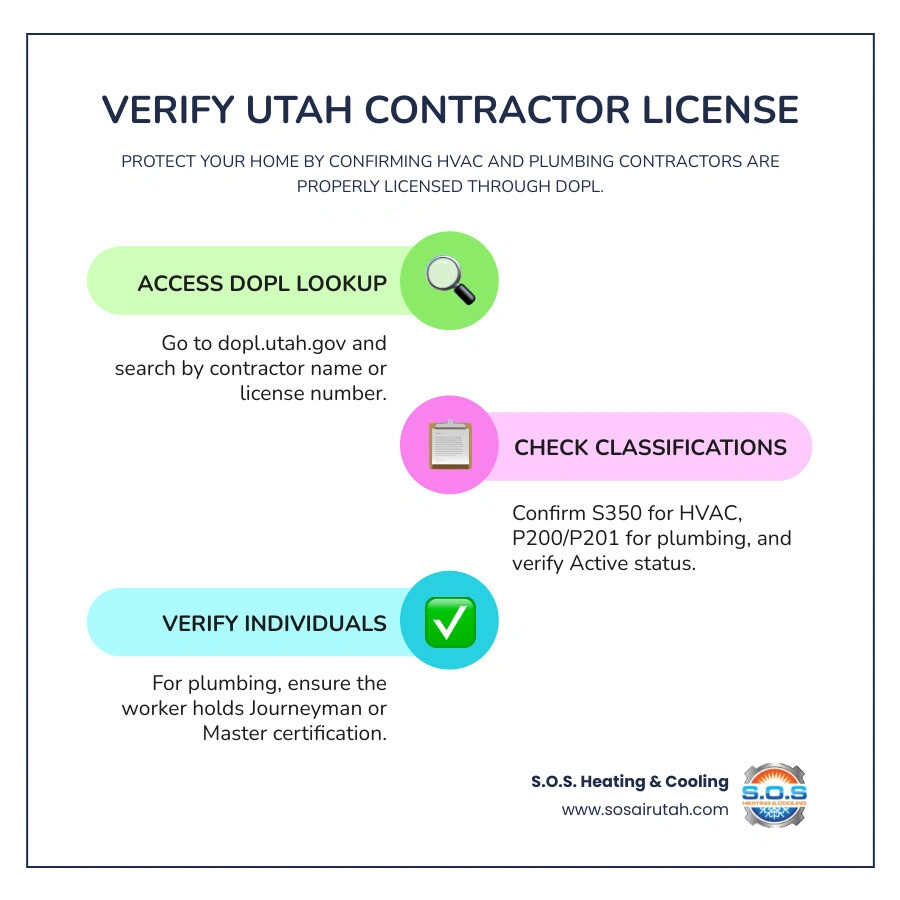
If you need to know how to verify an HVAC and plumbing contractor is licensed in Utah, here is the short answer:
- Go to the Utah Division of Professional Licensing (DOPL) Licensee Lookup at dopl.utah.gov
- Search by the contractor's name or license number
- Select CONTRACTOR from the profession dropdown for HVAC (look for the S350 classification) or PLUMBER for plumbing (look for P200 or P201)
- Confirm the license status shows Active and that the expiration date has not passed
- For plumbing work, also verify the individual performing the work holds a personal Journeyman or Master Plumber certification
That five-minute check can protect you from voided warranties, failed inspections, and contractors who have no accountability under Utah law.
Utah's booming construction industry means there is no shortage of HVAC and plumbing contractors competing for your business. With Utah HVAC employment projected to grow 34% from 2024 to 2034, more contractors are entering the market than ever before. That growth is largely a good thing — but it also means more opportunities for unlicensed or improperly licensed contractors to slip through. In Utah, performing HVAC or plumbing work without a proper license is not just a technicality. Under Utah Code § 58-55-501, unlicensed contracting is a serious offense, and homeowners who unknowingly hire an unlicensed contractor can be left without legal recourse, voided equipment warranties, and work that fails city inspection.
The good news is that Utah makes verification straightforward through a single state agency — the Utah Division of Professional Licensing (DOPL) — and the whole process takes less than two minutes once you know what to look for.
I'm Bryson Ninow, a licensed HVAC professional with DOPL, RMGA, EPA, and NATE certifications, and I've seen what happens when homeowners skip the verification step before hiring a contractor. In this guide, I'll walk you through exactly how to verify an HVAC and plumbing contractor is licensed in Utah so you can hire with confidence and protect your home.
Why You Must Verify Utah HVAC and Plumbing Licenses

When you are inviting a technician into your home to repair a furnace, install a new central air conditioner, or replace a leaking water line, you are trusting them with some of the most complex, high-stakes systems in your house.
Under Utah Code § 58-55-501, performing licensed trade work without an active license is classified as unlicensed contracting, which is a Class A misdemeanor. The state takes this incredibly seriously because of the safety hazards involved. Poorly installed gas lines can leak, improperly vented furnaces can fill a home with carbon monoxide, and faulty plumbing can lead to thousands of dollars in water damage or mold growth.
When you hire a licensed professional, you are protected by several critical guardrails:
- The Utah Residential Recovery Fund: If a licensed contractor performs substandard work or fails to complete a project, residential property owners may have access to the state's Residential Recovery Fund (which historically features a per-claim cap of around $35,000) to help resolve financial damages. If you hire an unlicensed contractor, you lose all access to this safety net.
- Equipment Manufacturer Warranties: Major heating, cooling, and plumbing manufacturers require professional installation for their warranties to remain valid. If an unlicensed individual installs your new HVAC system or water heater, the manufacturer will almost certainly void your warranty, leaving you responsible for any part failures.
- Building Permits and Inspections: Cities like Salt Lake City, Sandy, Draper, and Layton require permits for major mechanical and plumbing installations. Only licensed contractors can pull these permits. Unlicensed work will fail to get municipal approval, which can complicate your home insurance policies and stall future home sales.
To make sure you are getting the quality and legal protection you deserve, it is essential to learn How to Choose the Right HVAC Contractor for the Job before signing any contracts or paying deposits.
Understanding Utah Contractor License Classifications
A common trap for homeowners is assuming that because a contractor has a license, they are legally allowed to perform any type of home service. In Utah, contractor licenses are strictly divided into specific classifications. A general contractor licensed to build a deck or remodel a kitchen is not legally permitted to install a central air system or repipe a bathroom unless they also hold the specific specialty classifications.
Here are the primary classifications you need to look for when verifying contractors for HVAC and plumbing work:
| Classification Code | License Type | Scope of Work Allowed |
|---|---|---|
| S350 | HVAC Contractor | Authorized to install, maintain, and repair warm air heating systems, air conditioning, ventilating, and ductwork. |
| P200 | General Plumbing Contractor | Authorized to install, maintain, and repair all plumbing, water supply, and drainage systems in residential and commercial buildings. |
| P201 | Residential Plumbing Contractor | Authorized to install, maintain, and repair plumbing systems specifically in residential structures (one- to four-family dwellings). |
The Dual-Credential Trap
Plumbing and electrical work in Utah have a unique "dual-credential" requirement that often catches homeowners off guard.
While a business must hold a corporate contractor license (such as a P200 or P201) to advertise, bid, and contract for plumbing work, the actual individual physical technician who shows up at your house to perform the work must also hold a personal trade license issued by DOPL. This means the technician must be registered as an Apprentice Plumber, Journeyman Plumber, or Master Plumber.
If a company has a valid corporate S220 (plumbing) or P200 license, but the person sent to your home is an uncertified, unregistered helper working unsupervised, the work is technically being performed illegally. Always verify both the company's business license and the individual technician's credentials.
How to Verify an HVAC and Plumbing Contractor Is Licensed in Utah
The Utah Division of Professional Licensing (DOPL), a division of the Utah Department of Commerce, maintains a centralized, live database of every licensed professional and contracting business in the state. This system is free, publicly accessible, and updated in real-time.
Here is the exact step-by-step process to verify your contractor:
Step 1: Access the DOPL Licensee Lookup System
- Open your web browser and navigate to the official portal: secure.utah.gov/llv/search/index.html (or go to dopl.utah.gov and click on "Licensee Lookup").
- Select your search type. You can search by Name and Profession or directly by License Number if the contractor has provided it to you.
- If searching by name, enter the legal business name or the owner’s name. Some companies use a "Doing Business As" (DBA) name, so it is often easiest to ask the contractor for their official DOPL license number upfront.
- In the "Profession" dropdown menu, narrow your search by selecting CONTRACTOR or PLUMBER.
Step 2: Cross-Reference the Specific License Classifications
Once you locate the contractor's record in the search results, click on their license number to view the full details. Pay close attention to the following fields:
- License Status: This must say Active. If it says Expired, Suspended, Revoked, or Surrendered, they cannot legally perform your work. If it says Active on Probation, the contractor is licensed but is currently under state monitoring due to past violations.
- Classifications: Scroll down to see the specific classifications. For heating and cooling, look for S350 - HVAC Contractor. For plumbing, look for P200 - General Plumbing or P201 - Residential Plumbing.
- Expiration Date: Ensure the license is current. Utah contractor licenses operate on a fixed two-year cycle and expire on odd-numbered years.
Step 3: Avoid the Dual-Credential Trap for Plumbers
If you are having plumbing work done, perform a second quick search on the same DOPL portal:
- Ask the technician who arrives at your home for their name and plumbing card.
- Search their name under the PLUMBER profession category.
- Verify they hold an active license as a Journeyman Plumber, Master Plumber, or are registered as an Apprentice Plumber working under the direct, on-site supervision of a licensed journeyman.
What to Check Beyond the DOPL License Lookup
While an active DOPL license is a non-negotiable starting point, a license alone does not guarantee a safe, worry-free installation. Before any contractor begins work on your home, you must verify three additional items: insurance, bonding, and local compliance.
Taking these extra steps ensures you are choosing a company built on a foundation of safety and accountability. We highly recommend reading about the Benefits of Choosing a Local HVAC and Plumbing Company Built on Integrity to understand why local reputation and business ethics matter just as much as a state license.
How to Verify an HVAC and Plumbing Contractor Is Licensed in Utah and Insured
Every licensed contractor in Utah is legally required to carry general liability insurance. This insurance protects your property if a technician accidentally damages your home (for example, if a pipe bursts and floods your basement or a spark causes a fire).
- Ask for a COI: Request a Certificate of Insurance (COI) directly from the contractor. A reputable company will gladly have their insurance agency email a copy of this certificate directly to you.
- Check the Limits: Ensure they carry at least the state-mandated minimum of $100,000 per incident and $300,000 in total general liability coverage.
- Verify Workers' Compensation: If the contractor has employees, they must also carry workers' compensation insurance. If an uninsured worker is injured on your property, you could potentially be held liable for their medical expenses.
How to Verify an HVAC and Plumbing Contractor Is Licensed in Utah and EPA Certified
If your HVAC project involves air conditioning, heat pumps, or any system that uses chemical refrigerants, the technicians must hold an EPA Section 608 Certification.
- Federal Requirement: This is a federal mandate managed by the Environmental Protection Agency, not DOPL. It ensures that technicians know how to safely handle, reclaim, and dispose of ozone-depleting refrigerants.
- Ask to See the Card: Do not hesitate to ask your technician to show their EPA certification card. Handling refrigerants without this certification is illegal and can damage your air conditioning equipment.
Frequently Asked Questions About Utah Contractor Licensing
What are the penalties for unlicensed HVAC or plumbing work in Utah?
Performing HVAC or plumbing work without a license in Utah is a Class A misdemeanor under the Construction Trades Licensing Act. DOPL takes a hard line on unlicensed activity to protect public safety. First-time offenders face an administrative penalty of $1,000. A second offense carries a $2,000 fine, and subsequent offenses can incur penalties of up to $2,000 per day for every day the unlicensed work continues. Furthermore, unlicensed contractors have no legal right to file a mechanic's lien against your property if a payment dispute arises.
How often do Utah HVAC and plumbing contractor licenses expire?
Utah contractor licenses are issued on a two-year cycle and expire on November 30th of every odd-numbered year (for example, November 30, 2025, and November 30, 2027). To renew their license, contractors must pay a renewal fee of $128 and complete six hours of approved continuing education (CE) during each two-year cycle. For HVAC contractors, this CE must include at least one hour focused on the energy code and three hours of HVAC-specific technical training to stay current on modern, energy-efficient building standards.
Does Utah recognize out-of-state HVAC or plumbing licenses?
Utah does not have direct, automatic reciprocity agreements with other states for contractor licenses. However, DOPL does offer "licensure by endorsement." If an out-of-state contractor can prove they hold an active license in good standing from a state with similar licensing standards, and they have met equivalent experience and testing requirements, DOPL may waive certain exams or pre-licensure courses. Out-of-state contractors must still apply for and receive an official Utah license before bidding on or performing any work in Utah.
Conclusion
Protecting your home starts with choosing a contractor who respects the law, values safety, and maintains the proper state credentials. By taking just two minutes to verify an HVAC or plumbing contractor's license on the Utah DOPL database, you protect your family from safety hazards, keep your equipment warranties intact, and ensure you have access to state consumer protection funds.
At S.O.S. Heating & Cooling, we believe in complete transparency and honest service. We serve homeowners across the Salt Lake Valley and surrounding areas, including Bountiful, Centerville, Cottonwood Heights, Draper, Farmington, Herriman, Holladay, Kaysville, Layton, Millcreek, Mt. Olympus, Murray, Riverton, Salt Lake City, Sandy, South Jordan, South Salt Lake, and Woods Cross.
Our business is built on providing fair, reliable service without cutting corners. You can learn more about our founding principles by reading How Bryson Ninow Built SOS on Fair and Honest Service. If you want peace of mind for all your home's major systems, we invite you to explore What the Distress to Rest Partner Program Means for Your Home.
If you are experiencing issues with your heating or cooling system and want a fully licensed, insured, and trusted professional to take a look, contact us today to schedule your heater repair in Salt Lake City.
Explore Our Latest Insights and Updates in Plumbing Services
How to Fix AC Leaking Water Inside Your Utah Home
The Ultimate Guide to Mini Split vs Window Unit Cooling
HVAC Upgrades 101: Filter Inversion Pollutants in Salt Lake City Homes